
An increase in income results in an outward shift of an indifference curve.
Network externalities refer to the situation where the usefulness of a product increases
with the number of consumers who use it.
A market failure arises when an entire sector of the economy (for example, the airline
industry) collapses because of some unforeseen event.
An increase in the quantity of a product supplied is caused by an increase in the price of
the product.

If economies of scale are significant, the typical firm will not reach the minimum point
on its long-run average cost curve until it has produced a large fraction of industry
sales.
Most economists believe that only a small gap between the wages of white males and
the wages of other groups is due to education. Most of the gap is explained by
discrimination.
The power of the General Agreement on Tariffs and Trade (GATT) to settle trade
disputes is what sets it apart from the World Trade Organization (WTO).

A perfectly competitive firm’s marginal revenue curve is downward sloping.
Once a country has a comparative advantage in producing a product, it cannot lose that
advantage.
If the market for a product is narrowly defined, then there are likely to be many
substitutes for the product and the demand for the product is relatively elastic.
From 1970 to 2006, the poverty rate in East Asia rose slightly but the level of poverty in
sub-Saharan Africa fell dramatically.

Most pharmaceutical firms selling prescription drugs continue to earn economic profits
long after the patents on the prescription drugs expire because they have established a
strong foothold in the market.
Changes in the health of the average person are an important indicator of changes in the
standard of living.
In a perfectly competitive market, in the long run, arbitrage profits will be bid away.

Each person goes about her daily business seeking to maximize her own self interests.
In doing so, she contributes to the welfare of society at large. This is the idea underlying
Adam Smith’s “invisible hand.”
The endowment effect is the tendency of people to be unwilling to sell a good they
already own even if they are offered a price greater than they would be willing to pay to
buy the good if they did not already own it.
The role of the World Bank is to provide financing for national economic development
efforts.
If a firm experiences positive technological change, it is able to produce more output
using the same inputs.

The median voter theorem states that the outcome of a majority vote is likely to
represent the preferences of the voter who is in the political middle.
Examining the conditions that could lead to unemployment in an economy is an
example of microeconomics topic.
Consumers in a monopolistically competitive market do not receive any consumer
surplus because the price paid for the product exceeds the marginal cost of production.

The overall mortality rate in the United States has remained fairly constant for the past
30 years.
A Giffen good could be either a normal good or an inferior good.
A key insight of the public choice model is that public policymakers are likely to pursue
the public’s interest, even if their self-interests conflict with the public interest.
If average total cost is falling marginal cost must also be falling.

The demand curve for an inferior good can never be downward-sloping.
If production displays constant returns to scale, then all economies of scale have been
exhausted.
In the long run the relevant cost is total cost.

A perfectly competitive firm in a constant-cost industry produces 1,000 units of a good
at a total cost of $50,000. If the prevailing market price is $48, the number of firms and
the industry’s output will decrease in the long run.
Each price-quantity combination on a consumer’s demand curve shows the
utility-maximizing quantity at the given price.
A monopolistically competitive firm should lower its price if its marginal revenue
exceeds its marginal cost.
Consider a manufacturing operation that uses specialized machinery and labor to
produce its output. In this case, the input that is not fixed in the short run is labor.

If the income elasticity for canned food is 0.8, then canned food is an inferior good.
Each year, the U.S. exports about 50 percent of its wheat crop.
A quasi-public good is similar to a public good in that one person’s consumption of the
quasi-public good does not reduce the amount available for everyone else.

When firms exit a perfectly competitive industry, the market supply curve shifts to the
left.
In a competitive market equilibrium
A) total consumer surplus equals total producer surplus.
B) marginal benefit and marginal cost are maximized.
C) consumers and producers benefit equally.
D) the marginal benefit equals the marginal cost of the last unit sold.
For a monopolistically competitive firm, marginal revenue
A) equals the price.
B) is greater than the price.
C) is less than the price.
D) and price are unrelated.
If a corporate bond with face value of $1,000 has an interest rate of eight percent paid
once a year for a term of 30 years, what is the size of the coupon payment?
A) $1,000
B) $300
C) $80
D) $8
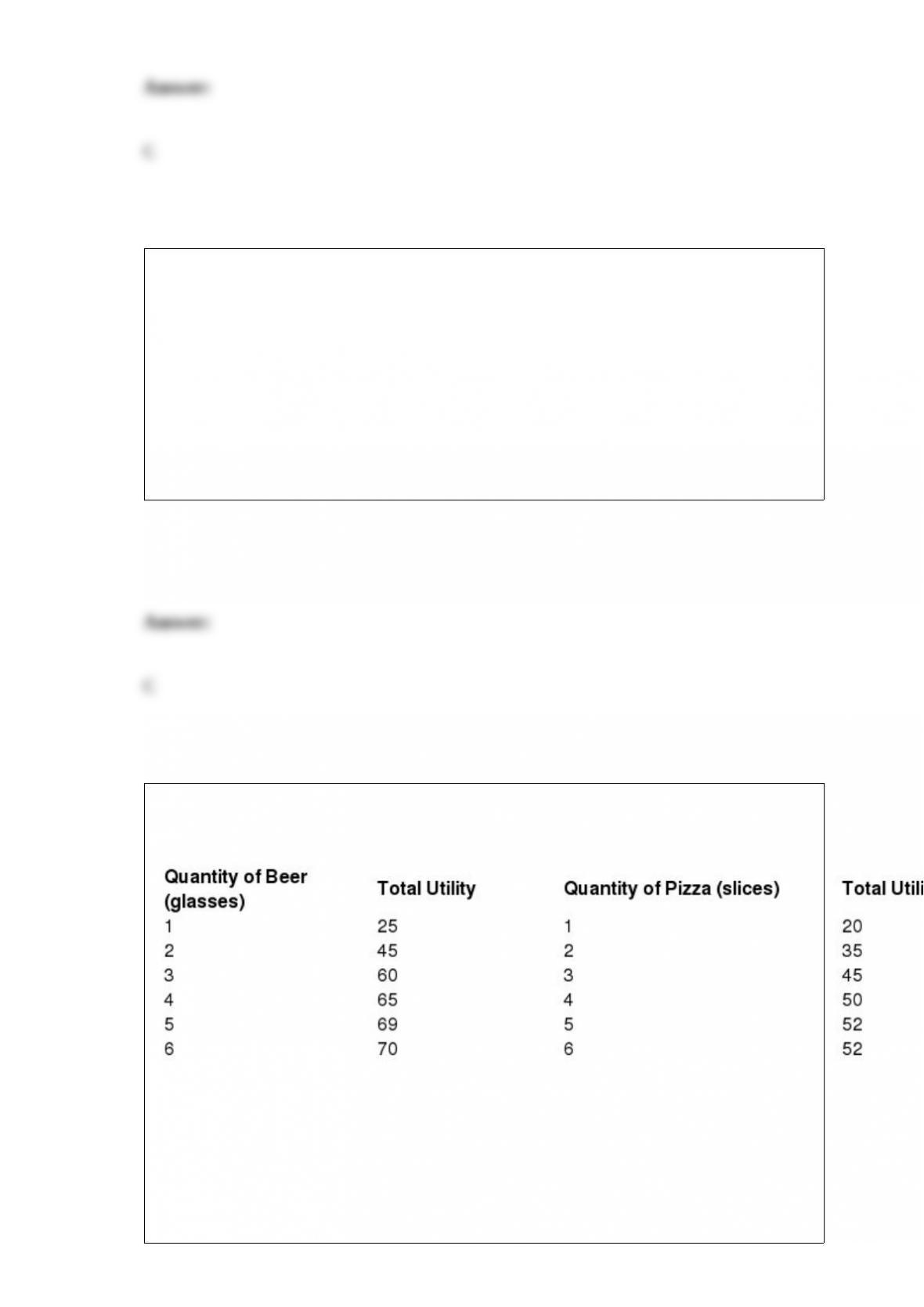
Table 10-7
Table 10-7 shows Antonio’s utility from beer and pizza.
Refer to Table 10-7. Suppose Antonio has $10 to spend and the price of beer = $2 per
glass and the price of pizza = $2 per slice. How many of each good will he consume
when he maximizes his utility?
A) 2 glasses of beer, 1 slice of pizza

B) 2 glasses of beer, 3 slices of pizza
C) 3 glasses of beer, 2 slices of pizza
D) 4 glasses of beer, 5 slices of pizza
Which of the following is a normative economic statement?
A) Rising global demand for coal has led to increases in the price of coal.
B) With rising mortgage rates and rising unemployment rates, the number of unsold
homes has increased.
C) The state of Texas is considering increasing funds for light-rail development to
promote the use of public transportation.
D) Pharmaceutical manufacturers should not be allowed to patent their products so
prescription drugs would be more affordable.
When deciding on which new products to develop, a firm must devote people, time, and
money to designing a new product. Because any firm has only limited resources, it
A) should wait until its competitors develop a similar product before deciding on
devoting resources to its own product development.
B) is not able to develop more than one new product at a time.

C) must be certain that the product it chooses to develop will be successful or it will not
be able to stay in business.
D) faces a trade-off, because resources used to develop one product will not be
available to develop another product.
A common belief among political analysts is that someone running for his or her party’s
nomination for president of the United States must choose a different strategy once the
nomination is secured. To be nominated, the candidate must appeal to voters from one
party – Democrat or Republican – but in a general election a party’s nominee must
appeal to voters from both parties as well as independent voters. Which of the following
offers the best explanation for this change in strategy?
A) the Arrow impossibility theorem
B) the voting paradox
C) the median voter theorem
D) rent seeking
Table 4-6
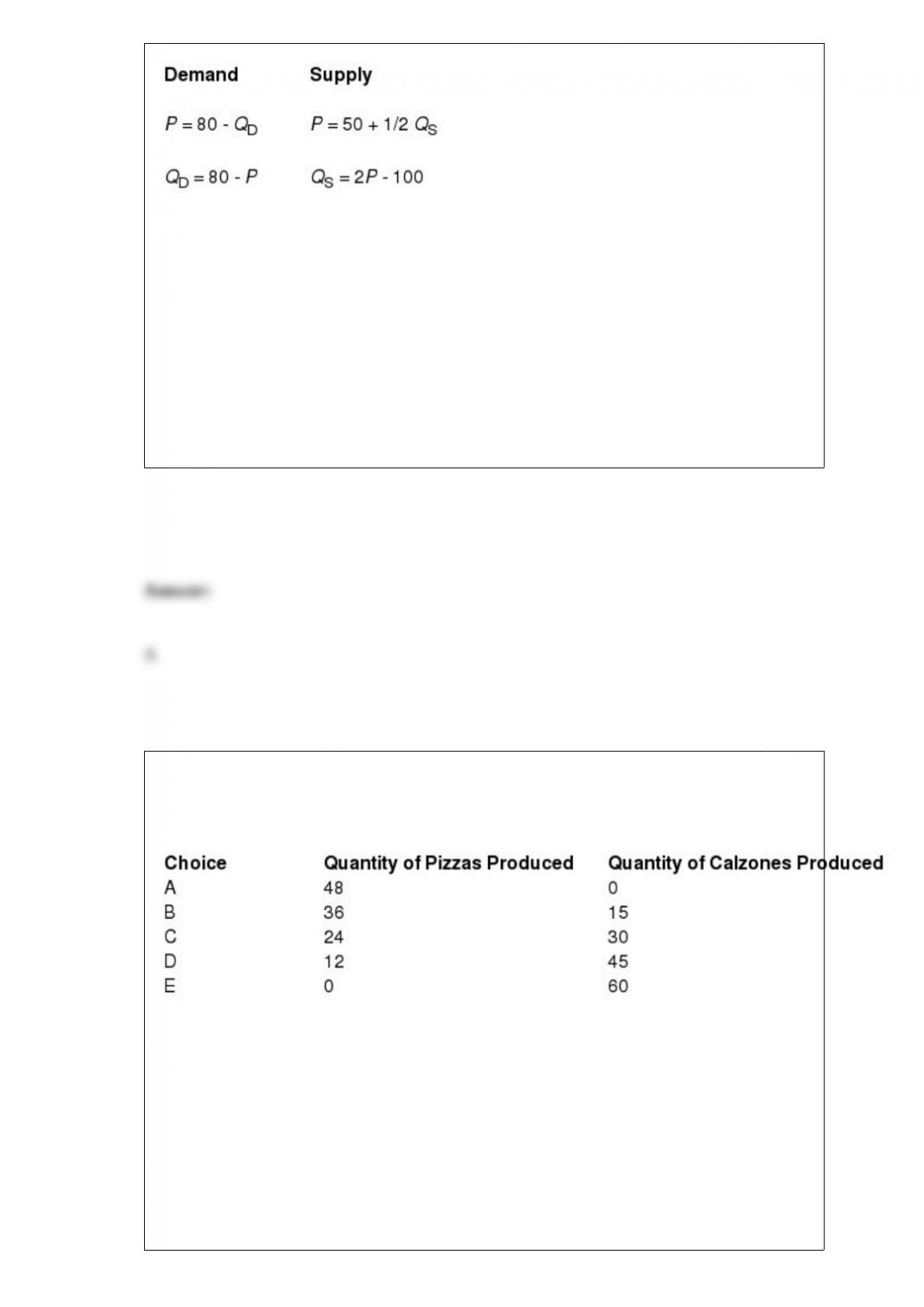
Refer to Table 4-6. The equations above describe the demand and supply for Chef
Ernie’s Sushi-on-a-Stick. The equilibrium price and quantity for Chef Ernie’s sushi are
$60 and 20 thousand units. What is the value of economic surplus in this market?
A) $300 thousand
B) $600 thousand
C) $1,200 thousand
D) $1,600 thousand
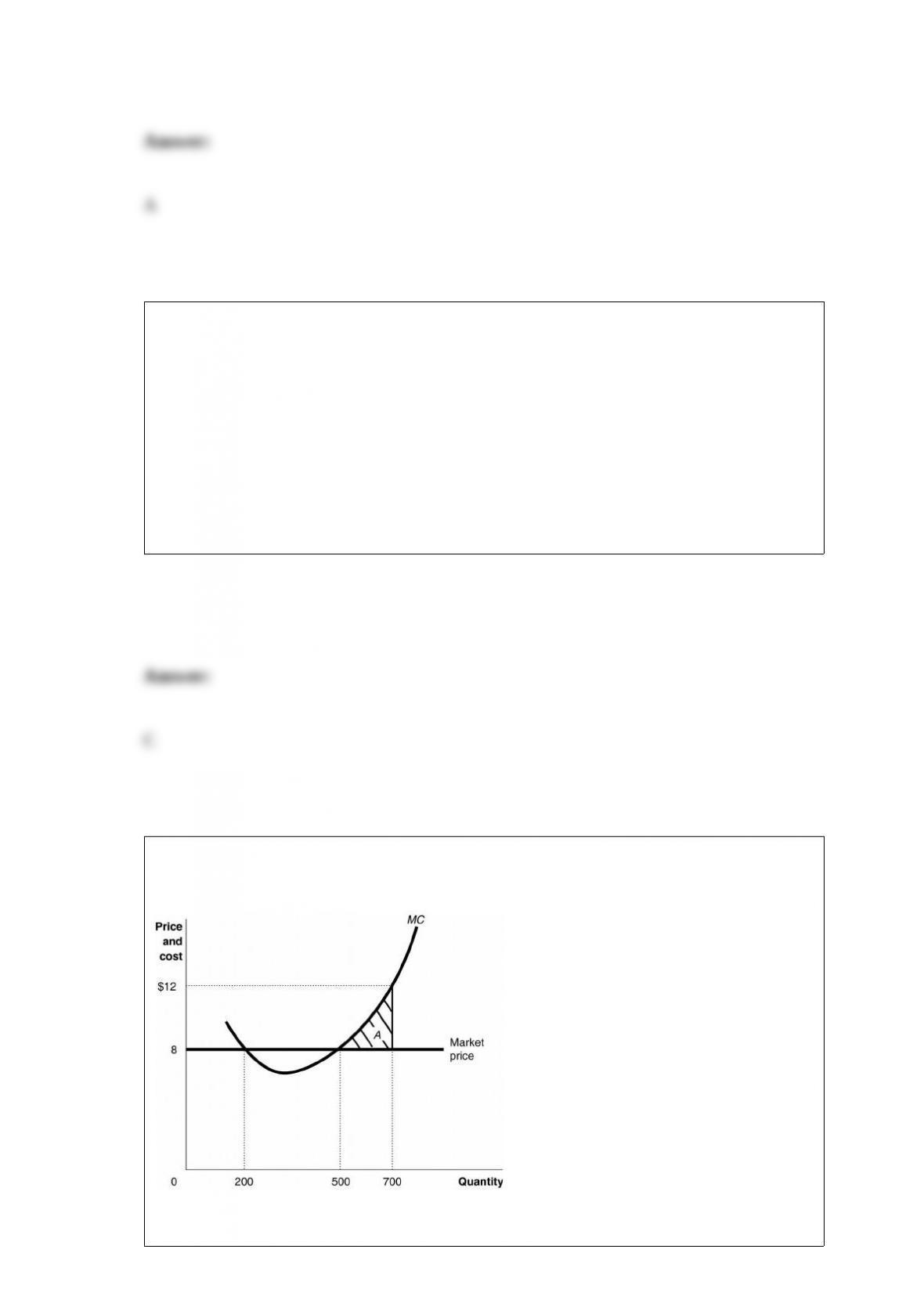
Table 2-1
Production choices for Tomaso’s Trattoria
Refer to Table 2-1. Assume Tomaso’s Trattoria only produces pizzas and calzones. A
combination of 24 pizzas and 30 calzones would appear
A) along Tomaso’s production possibilities frontier.
B) inside Tomaso’s production possibilities frontier.
C) outside Tomaso’s production possibilities frontier.
D) at the horizontal intercept of Tomaso’s production possibilities frontier.
In order to derive an individual’s demand curve for salmon, we would observe what
happens to the utility-maximizing bundle when we change
A) income and hold everything else constant.
B) tastes and preferences and hold everything else constant.
C) the price of the product and hold everything else constant.
D) the price of a close substitute and hold everything else constant.
Figure 12-1
Refer to Figure 12-1. If the firm is producing 700 units
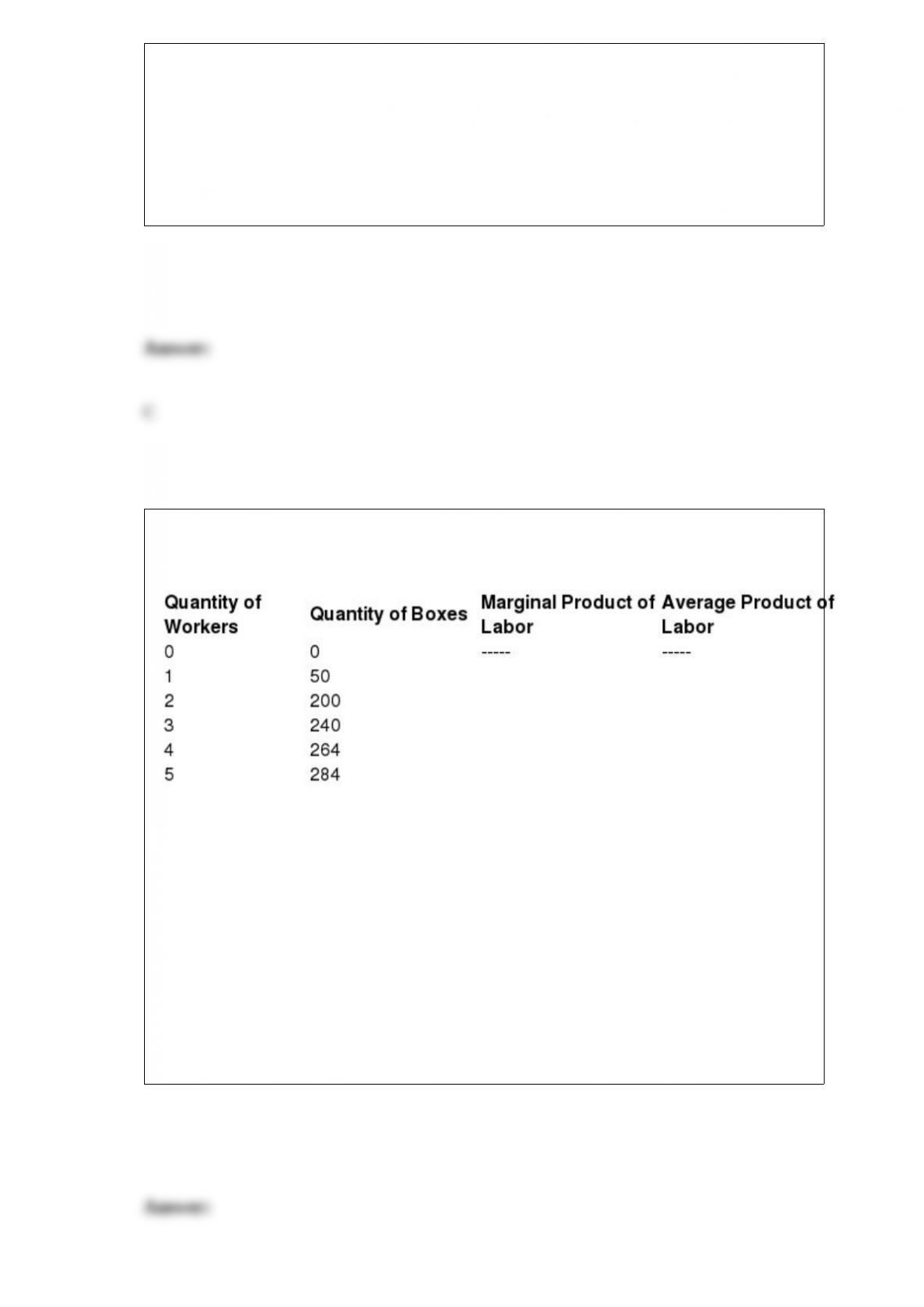
A) it is making a profit.
B) it is making a loss.
C) it should cut back its output to maximize profit.
D) it should increase its output to maximize profit.
Table 11-3
Refer to Table 11-3. The table above refers to the relationship between the quantity of
workers employed and the number of cardboard boxes produced per day by Manny’s
House of Boxes. The capital used to produce the boxes is fixed. The average product of
labor will equal 60 boxes when Manny hires
A) the second worker.
B) the third worker.
C) the fourth worker.
D) the fifth worker.

The term tax incidence refers to
A) the degree of progression of a tax.
B) the actual division of the burden of a tax between buyers and sellers in a market.
C) the amount of revenue government collects from a tax imposed on a good or service.
D) whether the burden of a tax rests more heavily on those with higher incomes or
those with lower incomes.
If, for a given percentage increase in price, quantity supplied increases by a
proportionately larger percentage, then supply is
A) unit-elastic.
B) perfectly elastic.
C) relatively inelastic.
D) elastic.

Long-run equilibrium under monopolistic competition is similar to that under perfect
competition in that
A) firms produce at the minimum point of their average cost curves.
B) price equals marginal cost.
C) firms earn normal profits.
D) price equals marginal revenue.
A tariff is
A) a limit placed on the quantity of goods that can be imported into a country.
B) a tax imposed by a government on goods imported into a country.
C) a subsidy granted to importers of a vital input.
D) a health and safety restriction imposed on an imported product.
Consider an industry that is made up of nine firms each with a market share (percent of
sales) as follows:
a. Firm A: 30%
b. Firm B: 20%

c. Firms C, D and E: 10% each
d. Firms F, G, H and J: 5% each
What is the value of the Herfindahl-Hirschman Index and how is the industry
categorized?
A) 1700; moderately concentrated
B) 1425; moderately concentrated
C) 1600; moderately concentrated
D) 2600; highly concentrated
Governments can increase the consumption of a product that creates positive
externalities by
A) subsidizing the production of the product so that the supply is increased and market
price is reduced.
B) taxing the production and consumption of the product.
C) convincing everyone to consume the good.
D) assigning property rights to the producers of the product.
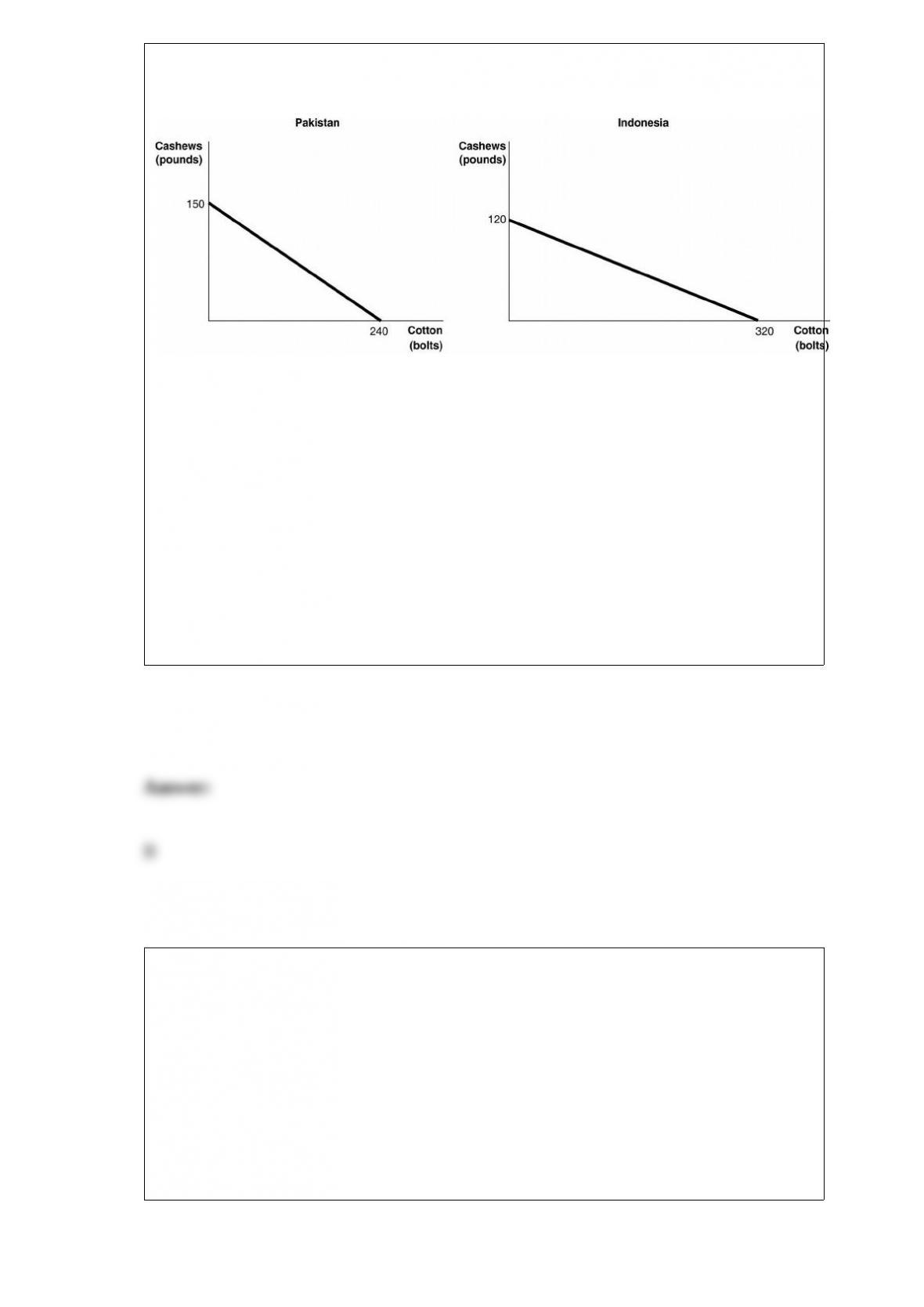
Figure 2-9
Figure 2-9 shows the production possibilities frontiers for Pakistan and Indonesia. Each
country produces two goods, cotton and cashews.
Refer to Figure 2-9. What is the opportunity cost of producing 1 bolt of cotton in
Pakistan?
A) 3/8 of a pound of cashews
B) 5/8 of a pound of cashews
C) 1 3/5 pounds of cashews
D) 150 pounds of cashews
What is a network externality?
A) It refers to having a network of suppliers and buyers for a good or service.
B) It refers to lobbying to form a public enterprise.
C) It refers to a situation in which a product’s usefulness increases with the number of
people using it.
D) It refers to a product that requires connection to a network for it to be useful.

As a result of the tariff on Chinese tires, U.S. consumers are estimated to have spent
________ on imported tires and ________ on U.S.-produced tires.
A) more; more
B) more; less
C) less; more
D) less; less
A game in which pursuing dominant strategies results in noncooperation that leaves all
parties worse off is a
A) prisoner’s dilemma.
B) cooperative equilibrium.
C) first-price auction.
D) zero-sum game.

Which of the following is a common mistake made by consumers?
A) taking into account the implicit costs of an activity
B) ignoring sunk costs
C) being overly optimistic about their future behavior
D) being overly pessimistic about their future behavior
a. What is the difference between a horizontal merger and a vertical merger?
b. Give an example of each type of merger.
c. Could a horizontal merger be welfare improving?

Figure 11-1
Refer to Figure 11-1. Diminishing marginal productivity sets in after
A) the 2nd worker is hired.
B) the 3rd worker is hired.
C) the 4th worker is hired.
D) the 5th worker is hired.
An increase in the supply of capital, which is a complement to labor, will lead to
A) a decrease in the quantity of labor demanded.
B) an increase in the demand for labor.
C) a decrease in the demand for labor.
D) an increase in the quantity of labor demanded.

If a demand curve shifts to the right, then
A) demand has increased.
B) quantity demanded has increased.
C) demand has decreased.
D) quantity demanded has decreased.
Economists Robert Jensen and Nolan Miller reasoned that to be a Giffen good, with an
income effect larger than its substitution effect, a good must be ________ and make up
a ________ portion of a consumer’s budget.
A) a normal good; very small
B) an inferior good; very small
C) a normal good; very large
D) an inferior good; very large

Automobile insurance companies have a problem with people who buy insurance and
then drive recklessly or take less care to avoid losses after being insured. In other
words, the automobile insurance market is subject to
A) asymmetric information.
B) market signaling.
C) moral hazard.
D) adverse selection.
Which of the following statements is true about optimal two-part tariff and perfect price
discrimination for a given demand curve?
A) The total revenue received under the two pricing schedules is the same.
B) The total revenue received under an optimal two-part tariff exceeds that received
under perfect price discrimination.
C) The total revenue received under an optimal two-part tariff is less than that received
under perfect price discrimination.
D) The total revenue received under an optimal two-part tariff could be greater than,
less than or equal to that received under perfect price discrimination, depending on the
fixed-fee portion of the two-part tariff.
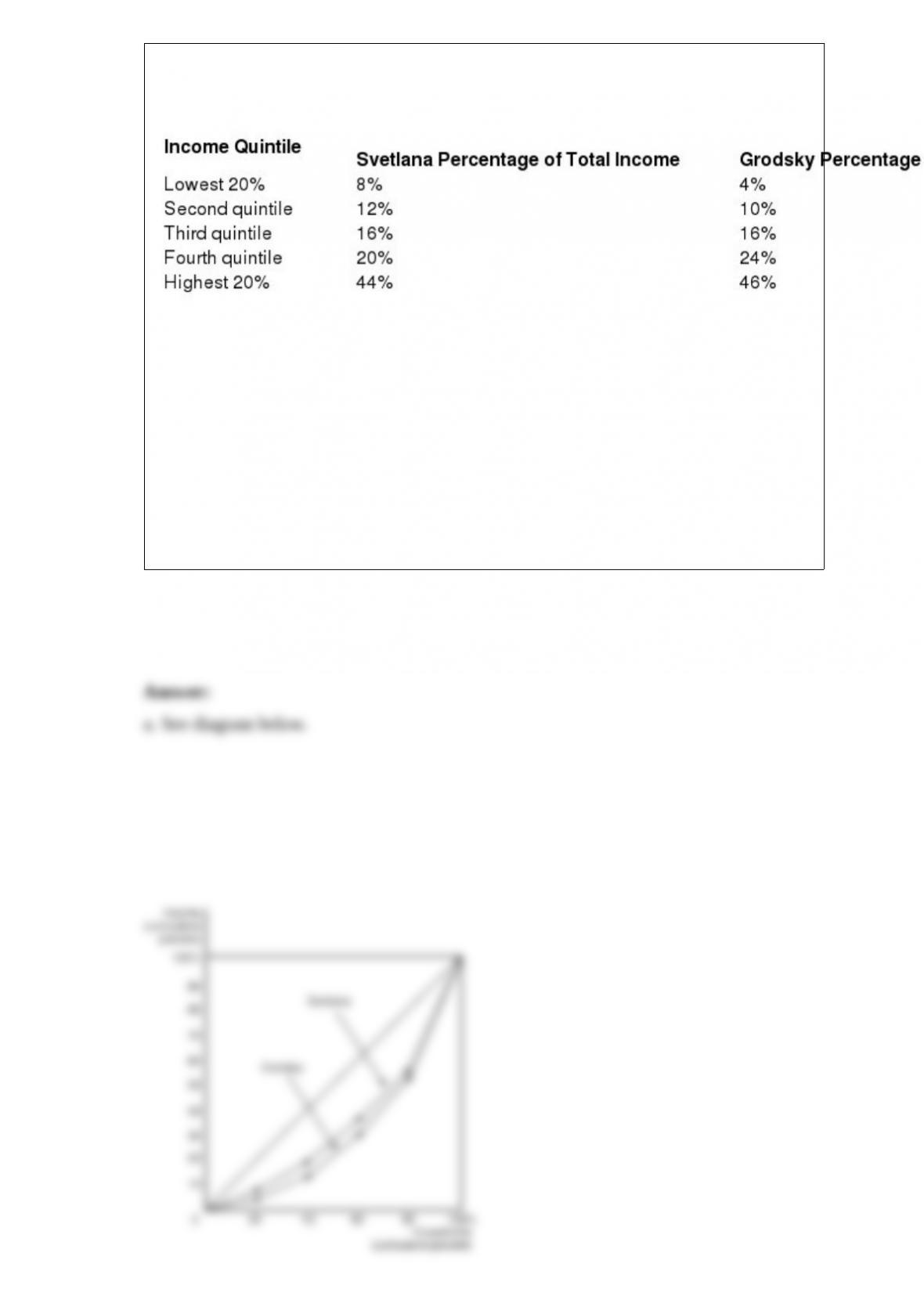
Table 18-11
Table 18-11 shows income distribution data for two countries. Use this data to answer
the following questions.
Refer to Table 18-11.
a. Draw a Lorenz curve for each country.
b. Which country has the more equal distribution of income?
c. Based on the Lorenz curve for the two countries, can you determine which country
has the more progressive tax system? Explain your answer.

An isoquant shows
A) the combinations of two goods that yield the same total satisfaction.
B) the combinations of two inputs that yield the same total product.
C) the combinations of two inputs that cost the same total quantity of money.
D) the combination of two goods that cost the same amount of money.
Cross-price elasticity of demand is calculated as the
A) percentage change in quantity demanded divided by percentage change in price of a
good.
B) percentage change in quantity demanded of one good divided by percentage change
in price of a different good.
C) percentage change in quantity sold divided by percentage change in buyers’ incomes.
D) percentage change in quantity supplied divided by percentage change in price of a
good.

The opportunity cost of taking a semester-long economics class is
A) the cost of tuition and fees only.
B) the value of the time spent in the classroom.
C) zero because there is no admission charged if you are enrolled in the course.
D) equal to the highest value of an alternative use of the time and money spent on the
class.
E) the knowledge and enjoyment you receive from attending the class.
What is an isocost line? What is the slope of an isocost line?
How does a network externality serve as a barrier to entry? Is this barrier
surmountable? Explain.
The following table contains the actual prices charged by four Web sites for a Blu-ray
disc of the movie The Twilight Saga: Breaking Dawn – Part 2 in October 2013.
Explain whether the information in this table contradicts the law of one price.
What is the difference between explicit collusion and implicit collusion?
State the law of diminishing marginal returns.
What is the difference between positive economic analysis and normative economic
analysis? Give one example each of a positive and normative economic issue or
question or statement.
Globalization’s impact on jobs and wages is an important topic for debate. Discuss the
major points for globalization in the jobs and wages debate, and describe how the
actions of large multinational corporations affect the issues in the jobs and wages
debate.
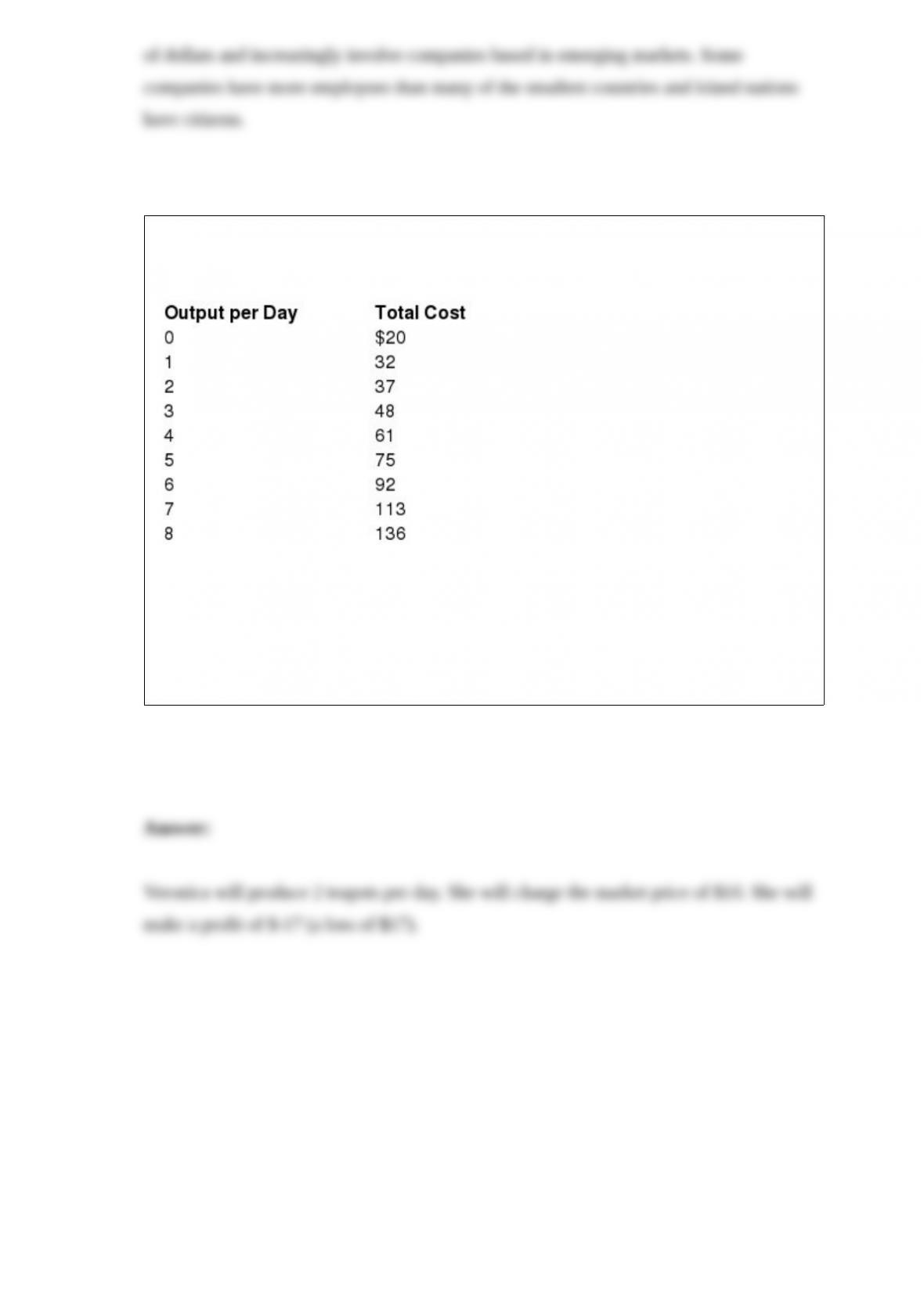
Suppose Veronica sells teapots in the perfectly competitive teapot market. Her output
per day and her costs are as follows:
Suppose the current equilibrium price in the teapot market is $10. To maximize profit,
how many teapots will Veronica produce, what price will she charge, and how much
profit (or loss) will she make? Draw a graph to illustrate your answer. Your graph
should include Veronica’s demand, ATC, AVC, MC, and MR curves, the price she is
charging, the quantity she is producing, and the area representing her profit (or loss).
Identify the World Trade Organization’s (WTO) three main goals and explain how the
WTO differs from the General Agreement on Tariffs and Trade (GATT).
In 2012, which type of tax raised the most revenue for the U.S. federal government?
Which type of tax raised the most revenue for state and local governments?

Explain the economic assumption that “people are rational.”
Suppose that Hawaii legalizes casino gambling. By imposing a tax on casino revenues,
the state government is able to eliminate the state income tax on wages. What is likely
to be the effect on the labor supply curve in Hawaii?
Is it possible for a firm to have an absolute advantage in producing something without
having a comparative advantage? Why or why not?
State the law of diminishing returns. How do diminishing returns differ from
diseconomies of scale? Be sure to define diseconomies of scale in your answer.