
Increases in population shift the market supply curve for labor to the right.
Answer:
Transfer payments are subtracted from national income to get to personal income.
Answer:
The GDP deflator is a measure of the price level which is calculated as nominal GDP
divided by real GDP and multiplied by 100.
Answer:
Both first-degree price discrimination and optimal two-part tariff pricing maximize
economic surplus.
Answer:
An increase in imports increases aggregate demand.
Answer:
Economic efficiency is a market outcome in which the marginal benefit of consumers is
equal to the marginal cost of production and the sum of consumer surplus and producer
surplus is maximized.
Answer:
Holding all other factors constant, income earned from capital is more unequally
distributed than income earned from labor.
Answer:
A U-shaped long-run average cost curve implies that a firm experiences economies of
scale at low levels of production and diseconomies of scale at high levels of production.
Answer:

As the number of firms in a market increases, the supply curve will shift to the left and
the equilibrium price will rise.
Answer:
Which of the following statements is true?
A) If transfer payments such as Social Security payments to the retired and disabled
were excluded from official statistics used to estimate the percentage of people with
incomes below the poverty line, the amount of poverty in the United States would be
much greater.
B) Because the federal income tax system is progressive, measuring poverty using
after-tax incomes results in a higher poverty rate than if poverty is measured using
before-tax incomes .
C) If non-cash benefits such as food stamps and rent subsidies were added to the
incomes of low-income families, poverty would be eliminated.
D) In the United States, income remaining after federal taxes are paid is more equally
distributed than income before taxes.
Answer:
The aggregate demand curve will shift to the left ________ the initial decrease in
government purchases.
A) by less than
B) by more than

C) by the same amount as
D) sometimes by more than and other times by less than
Answer:
The late Hugo Chavez, Venezuela’s former president, proposed that the independence of
the Venezuelan central bank be eliminated. Given the research on the relationship
between central bank independence and inflation, we should expect this event to cause
inflation to ________ and the real exchange rate to ________ between the two counties.
(Assume the nominal exchange does not change, and that the United States is the
domestic country).
A) rise in Venezuela relative to the United States; fall
B) fall in Venezuela relative to the United States; fall
C) rise in Venezuela relative to the United States; rise
D) fall in Venezuela relative to the United States; rise
Answer:
Purchases of which of the following goods would be dramatically reduced during a
recession?
A) tomatoes
B) ink pens
C) gasoline
D) refrigerators
Answer:
All of the following are considered among the four most important determinants in
explaining exchange rate fluctuations in the long run except
A) tariffs and quotas.
B) preferences for domestic and foreign goods.
C) interest rates.
D) relative rates of productivity growth across countries.
Answer:
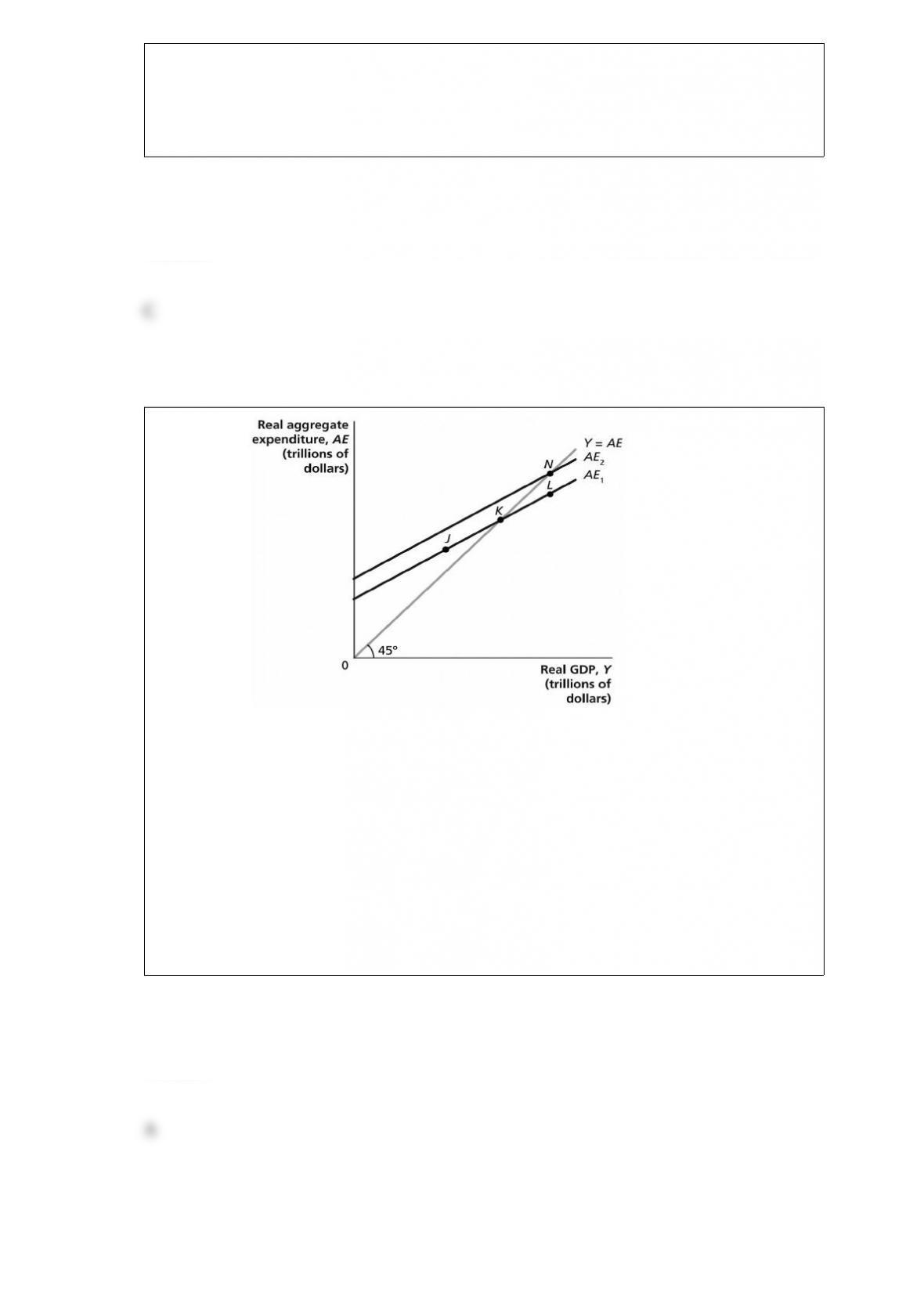
Table 2-1
Production choices for Tomaso’s Trattoria
Assume Tomaso’s Trattoria only produces pizzas and calzones. Tomaso faces ________
opportunity costs in the production of pizzas and calzones.
A) increasing
B) decreasing
C) constant
D) negative
Answer:
Figure 12-2
If the U.S. economy is currently at point K, which of the following could cause it to
move to point N?
A) The price level in the United States falls relative to the price level in other countries.
B) Congress abolishes investment tax incentives.
C) The interest rate rises.
D) Household wealth declines.
Answer:

Suppose a bank has $100 million in checking account deposits with no excess reserves
and the required reserve ratio is 10 percent. If the Federal Reserve raises the required
reserve ratio to 15 percent, then the bank will now have excess reserves of
A) $0.
B) -$5 million.
C) $5 million.
D) $15 million.
Answer:
The largest and fastest-growing category of federal government expenditures is
A) grants to state and local governments.
B) interest on the national debt.
C) national park spending.
D) transfer payments.
Answer:
The following appeared in a Florida newspaper a week after a hurricane hit the state.
“Floridians are relieved that the storm produced no fatalities but homeowners face
weeks, if not months, of rebuilding. Matters are made worse by the soaring prices of
plywood and other building materials that always follow in a hurricane’s path.
Complaints of profiteering and price gouging have not deterred firms from raising their
prices by over 100 percent.” Which of the following offers the best explanation for the
price increases referred to in the article?

A) The hurricane reduced the number of suppliers of building materials.
B) The hurricane created an artificial shortage of building materials.
C) The hurricane caused an increase in the demand for building materials.
D) There was a reduction in supply as firms shipped plywood and other materials to
locations not affected by the storm.
Answer:
Consider two oligopolistic industries selling the same product in different locations. In
the first industry, firms always match price changes by any other firm in the industry. In
the second industry, firms always ignore price changes by any other firm. which of the
following statements is true about these two industries, holding everything else
constant?
A) Market prices are likely to be higher in the first industry in which firms always
match price changes by rival firms than in the second where firms ignore their rivals’
price changes.
B) Market prices are likely to be lower in the first industry where firms always match
price changes by rival firms than in the second where firms ignore their rivals’ price
changes.
C) Market prices are likely to be the same in both markets because they are both
oligopolistic markets.
D) No conclusions can be drawn about the pricing behavior under these very different
firm behaviors.
Answer:
An organization of employees that has the legal right to bargain with employers about
wages and working conditions is called a
A) closed shop.
B) guild.
C) labor union.
D) monopsony.
Answer:
Figure 15-12 Figure 15-12 shows
the cost and demand curves for a monopolist.
Assume the firm maximizes its profits. What is the amount of consumer surplus?
A) $21
B) $124
C) $186
D) $332
Answer:
What is an oligopoly? Give two examples of oligopolistic industries in the United
States.
Answer:
If the government is most interested in minimizing excess burden of an excise tax,
should it impose the tax on goods that are elastic or on goods that are inelastic?
Answer:
If the government is most interested in minimizing excess burden of an excise tax,
should it impose the tax on goods that are elastic or on goods that are inelastic?
Answer:
What is an externality? Explain how someone receiving a meningitis vaccination is an
example of an externality in the market for health care.
Answer:
Describe how inflation can be costly even if it is anticipated.
Answer: