
Suppose the price of capital and labor remain constant but that the average educational
level of workers has increased and therefore, productivity of labor increases. This
would lead a firm
A) to adopt a more capital-intensive production technology.
B) to adopt a more labor-intensive technology.
C) to keep its output and production technology unchanged, but to use fewer units of
labor.
D) to use only labor to produce the product.
When consumers pay only a fraction of the true cost of medical services, their demand
increases. The marginal cost of producing these extra services
A) is greater than the marginal benefit consumers receive from them.
B) is less than the marginal benefit consumers receive from them.
C) is equal to the marginal benefit consumers receive from them.
D) is zero due to the insurance payments.
The short-run Phillips curve is ________ than the long-run Phillips curve.
A) flatter
B) steeper
C) less stable
D) Both B and C are correct.
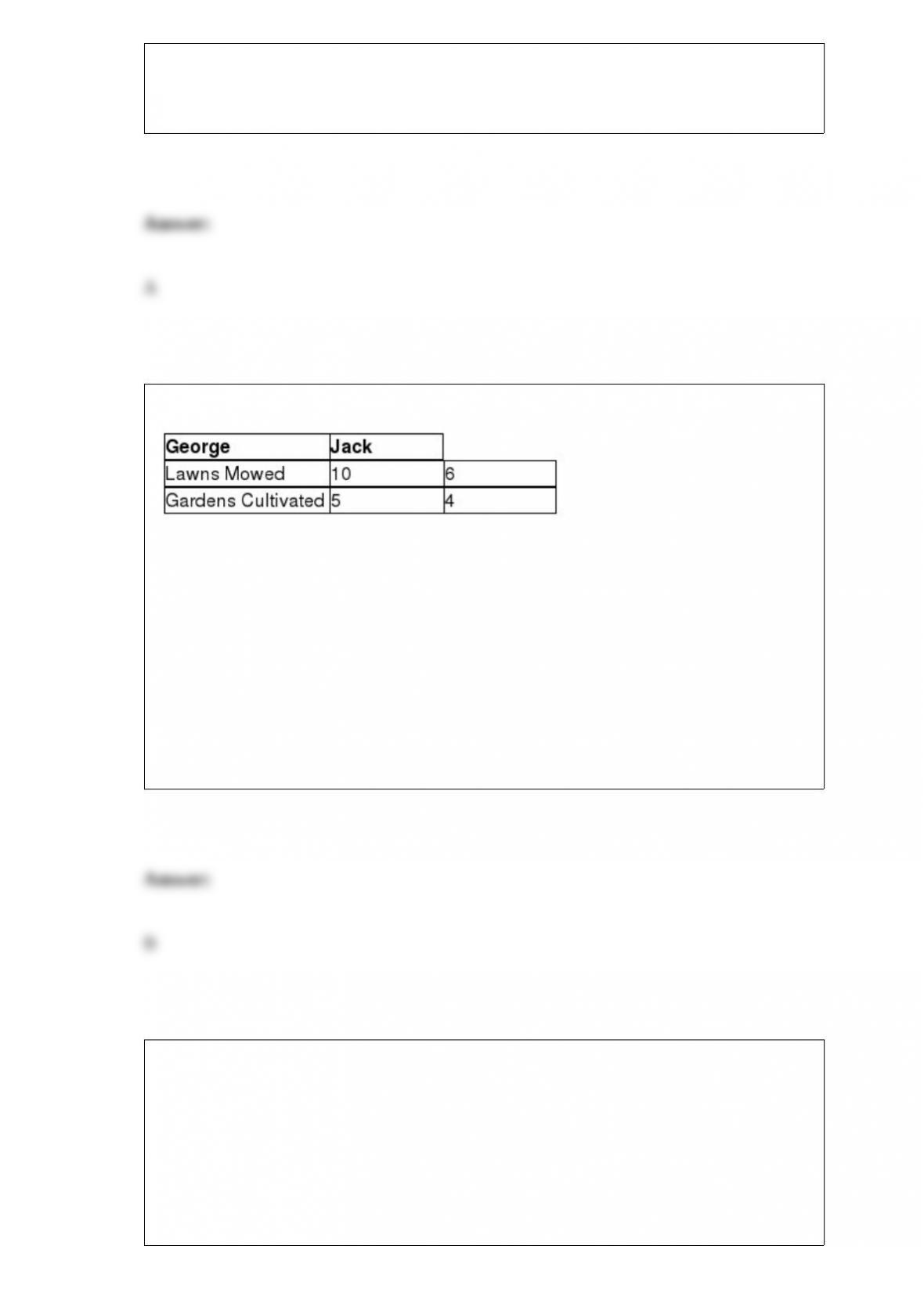
Table 2-15
Table 2-15 shows the output per day of two gardeners, George and Jack. They can
either devote their time to mowing lawns or cultivating gardens. Which of the following
statements istrue?
A) Jack has an absolute advantage in both tasks.
B) George has an absolute advantage in both tasks.
C) Jack has an absolute advantage in lawn mowing and George in garden cultivating.
D) Jack has an absolute advantage in garden cultivating and George in lawn mowing.
The Coffee Nook, a small cafe near campus, sells cappuccinos for $2.50 and Russian
tea cakes for $1.00 each. What is the opportunity cost of buying a cappuccino?
A) 2 1/2 Russian tea cakes
B) 2/5 of a Russian tea cake
C) $2.50
D) $1.00
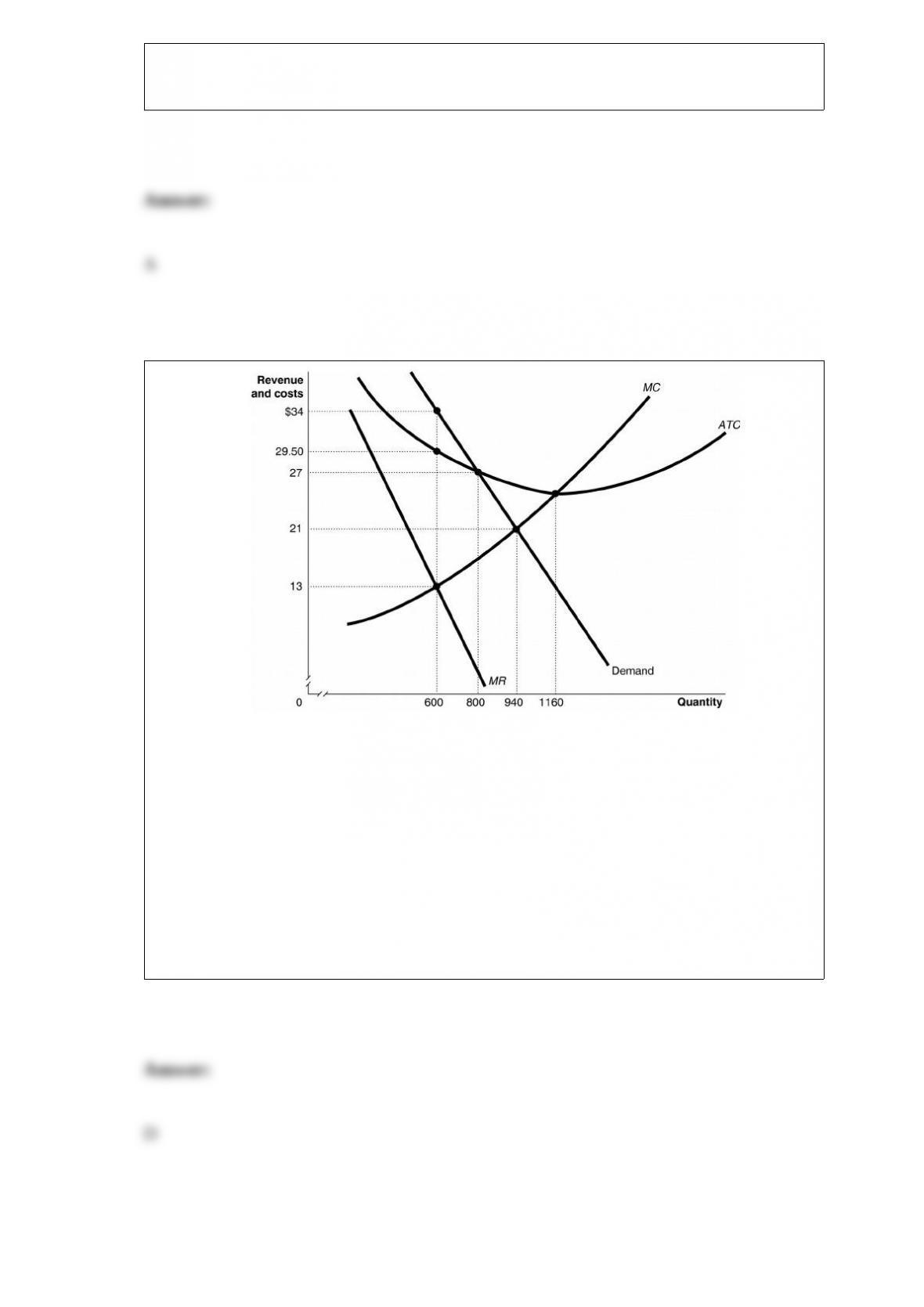
Figure 15-4 Figure
15-4 shows the demand and cost curves for a monopolist.
What is the price charged for the profit-maximizing output level?
A) $13
B) $21
C) $27
D) $34

Before its IPO, Facebook was an example of a private firm. As a private firm, Facebook
was
A) not subject to government regulations and taxation.
B) run by stockholders and a board of directors.
C) run by its founder, Mark Zuckerberg.
D) not legally allowed to raise funds through venture capital firms.
Organizing a successful firm in a market economy has become ________ over the last
century.
A) legally impossible
B) politically impossible
C) less difficult
D) more difficult
A government tax rebate of $1,000 would ________ your disposable income by
________.
A) increase; less than $1,000
B) increase; $1,000
C) decrease; less than $1,000

D) decrease; $1,000
If the quantity of soccer balls demanded is represented by the equation QD = 80 – 2P
then the corresponding price of soccer balls is represented by the equation
A) P = 1.6QD + 80.
B) P = 80 – QD.
C) P = 40 – 0.5QD.
D) P = QD + 160.
The Gini coefficient for the United States in 1980 was 0.403. In 2011, the coefficient
was equal to 0.477. This means that
A) per capita income in the United States rose from 1980 to 2011.
B) there was a decrease in the amount of government transfer payments from 1980 to
2011.
C) cuts in federal income tax rates in the early 1980s and 2001 helped to reduce income
inequality.
D) income inequality increased from 1980 to 2011.

Which of the following is likely to occur as the result of the law of diminishing
marginal utility?
A) Petra’s utility from her second apple was less than her satisfaction from her first
orange.
B) Hudson enjoyed his second slice of pizza more than his first.
C) Sabine’s utility from her first granola bar is greater than Rachel’s utility from her
second granola bar.
D) Wesley enjoyed his second bottle of iced tea less than his first bottle, other things
constant.
Fiscal policy actions that are intended to have long-run effects on real GDP attempt to
increase ________ through changing ________.
A) aggregate demand; government spending
B) aggregate supply; taxes
C) aggregate demand; taxes
D) aggregate supply; government spending

Table 17-6
The Hair Cuttery, a new hair salon, is ready to start hiring. The table above shows the
relationship between the number of hairdressers the firm hires and the quantity of
haircuts it produces.
a. Suppose the price of haircuts is $8. Complete the table by filling in the values for
marginal product and marginal revenue product.
b. The Hair Cuttery is an input price-taker. Suppose the wage paid to hairdressers is $40
per day. What is the profit-maximizing number of hairdressers?
c. Suppose the wage rate rises to $60 per day.
(i) What happens to the firm’s demand curve for hairdressers?
(ii) What happens to the profit-maximizing quantity of hairdressers?
d. Suppose the wage rate is $40 per day and the price of haircuts is now $10.
(i) What happens to the firm’s demand curve for hairdressers?
(ii) What happens to the profit-maximizing quantity of hairdressers?
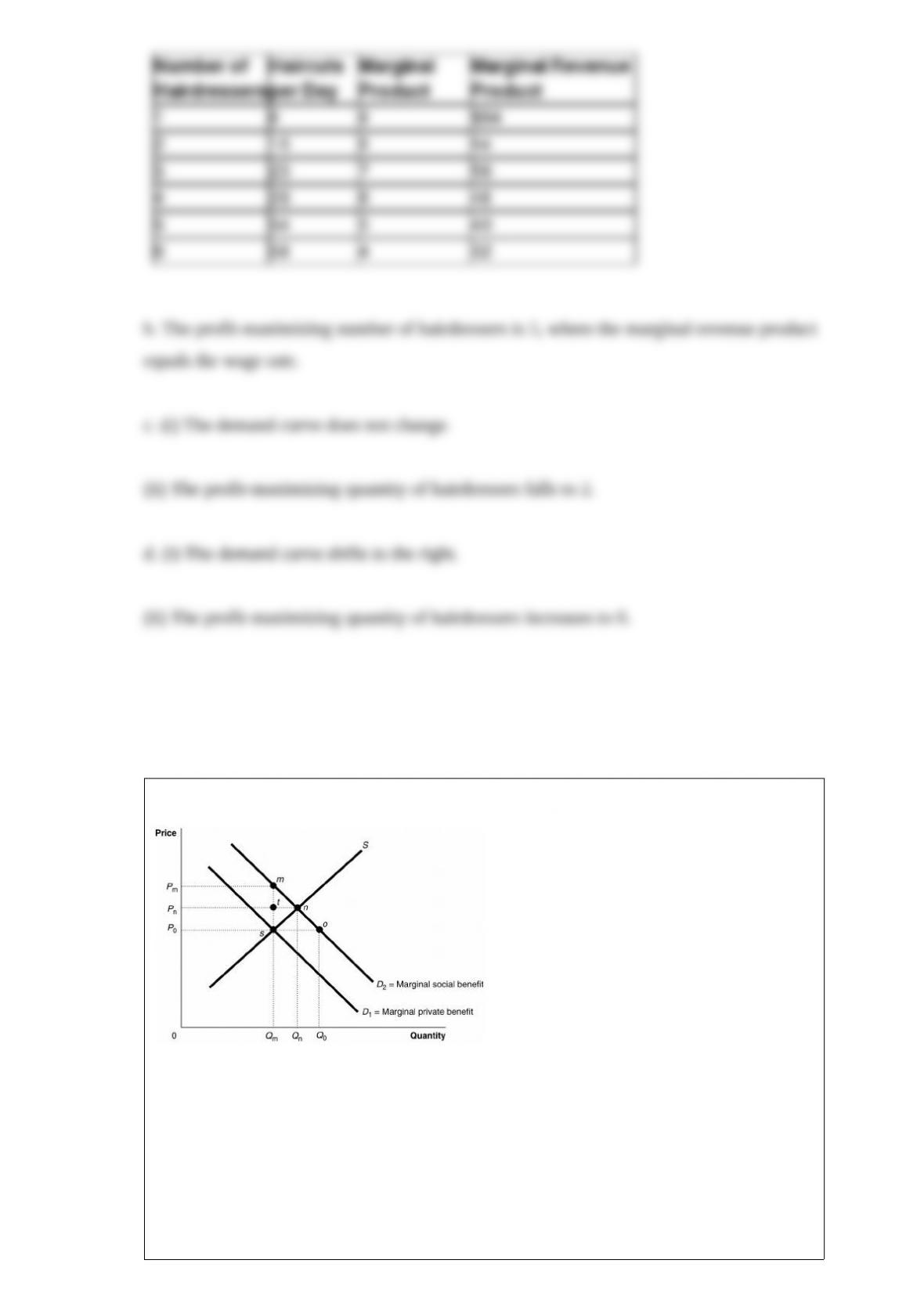
Figure 5-3
In the absence of any government intervention, the private market
A) under produces by Qo– Qm units.
B) over produces by Qo– Qm units.
C) over produces by Q– Qm units.
D) under produces by Q– Qm units.
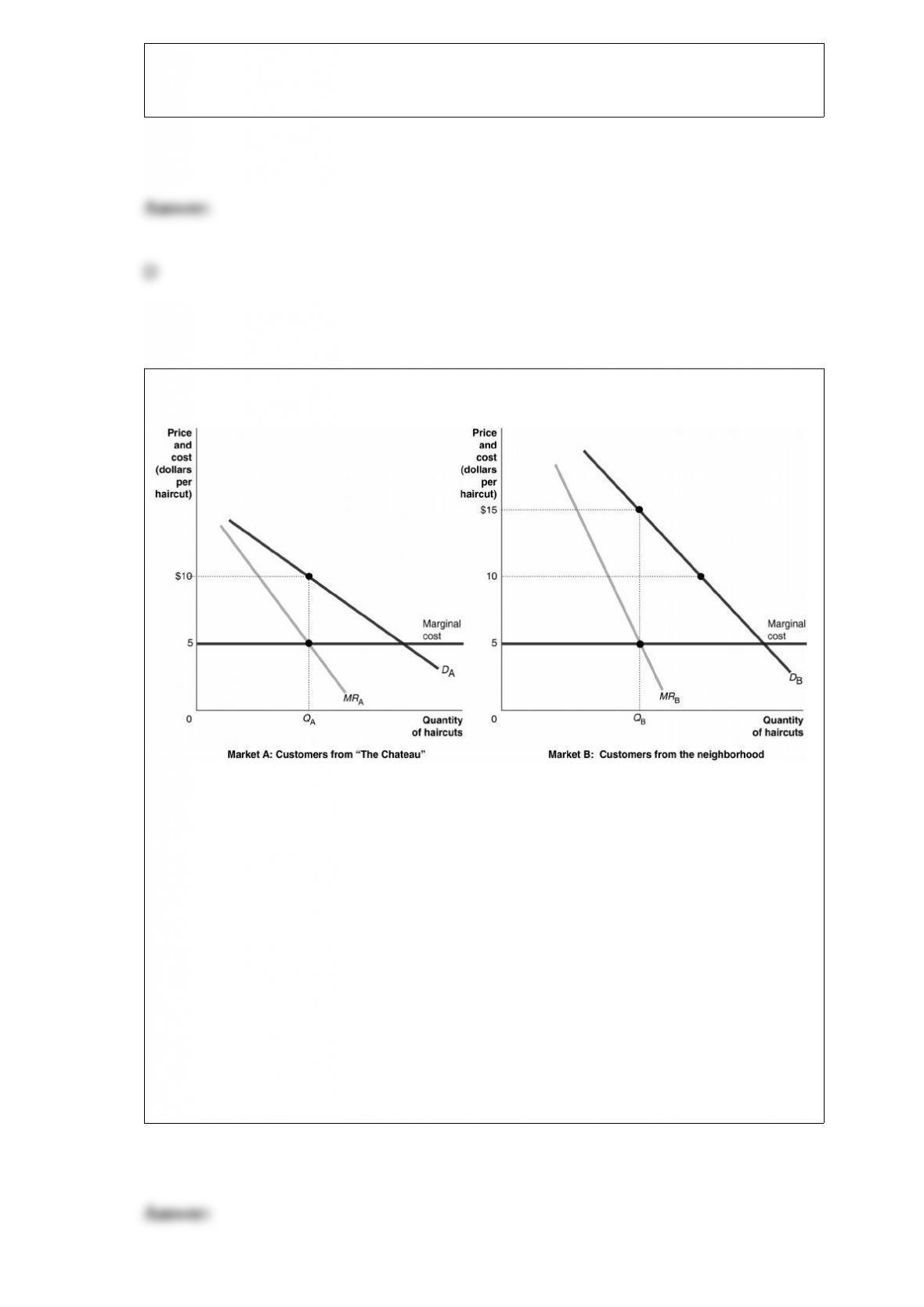
Figure 16-3
Chantal owns a hairdressing salon which caters to two main groups of customers:
residents of “The Chateau,” a retirement community, and other residents in the
neighborhood. Figure 16-3 shows the demand curves for the residents of the retirement
community, labeled Market A, and other residents in the neighborhood, labeled Market
B. The demand curves are not identical.
What prices are charged in the two markets?
A) price in market A = price in market B = $15
B) price in market A = $10; price in market B = $15
C) price in market A = price in market B = $5
D) price in market A = price in market B = $10
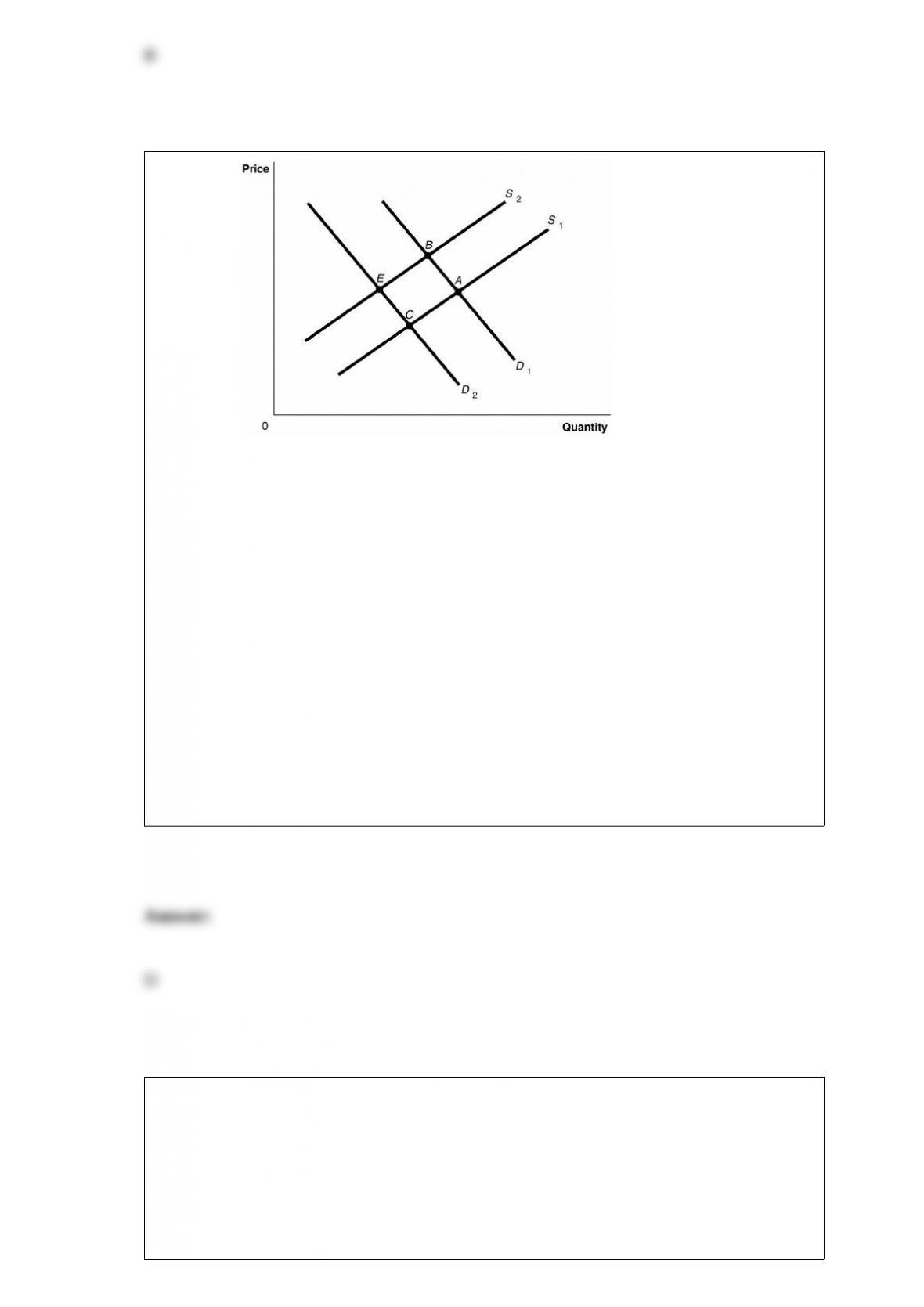
Figure 3-8
The graph in this figure illustrates an initial competitive equilibrium in the market for
apples at the intersection of D2 and S2 (point E). Which of the following changes would
cause the equilibrium to change to point A?
A) A positive change in the technology used to produce apples and decrease in the price
of oranges, a substitute for apples.
B) An increase in the wages of apple workers and a decrease in the price of oranges, a
substitute for apples.
C) An increase in the number of apple producers and a decrease in the number of apple
trees as a result of disease.
D) A decrease in the wages of apple workers and an increase in the price of oranges, a
substitute for apples.
Better health allows people to work harder, which raises a country’s total income. This
indicates that in effect, better health
A) is a primary cause of price increases.
B) reduces the incentive to work.
C) shifts out a country’s production possibilities frontier.
D) increases consumer surplus.
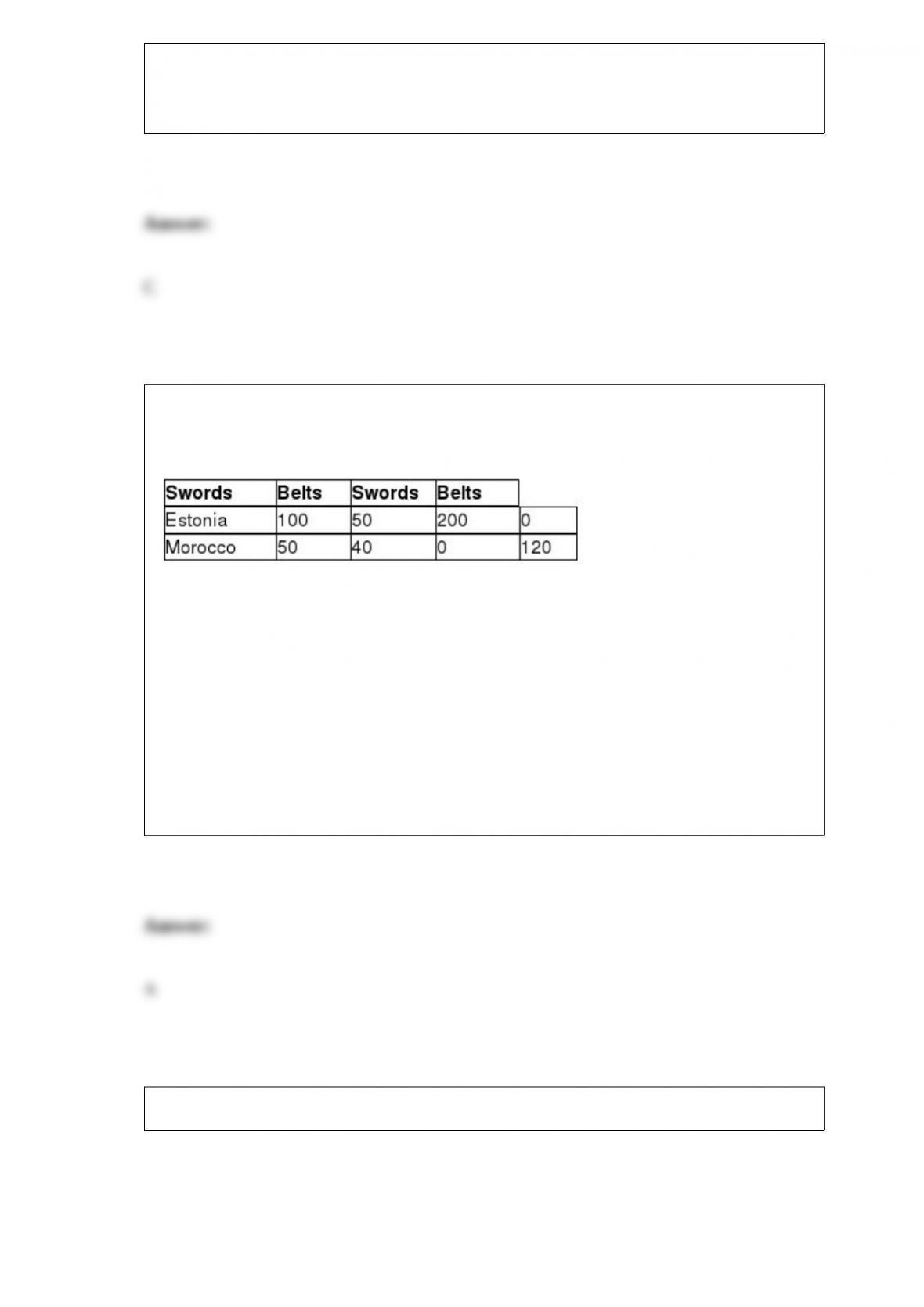
Table 7-6 Production and
Consumption Production
Without Trade With Trade
Estonia and Morocco can produce both swords and belts. Table 7-6 shows the
production and consumption quantities without trade, and the production numbers with
trade. With trade, what is the total gain in sword production?
A) 50
B) 100
C) 200
D) 350
Figure 15-5
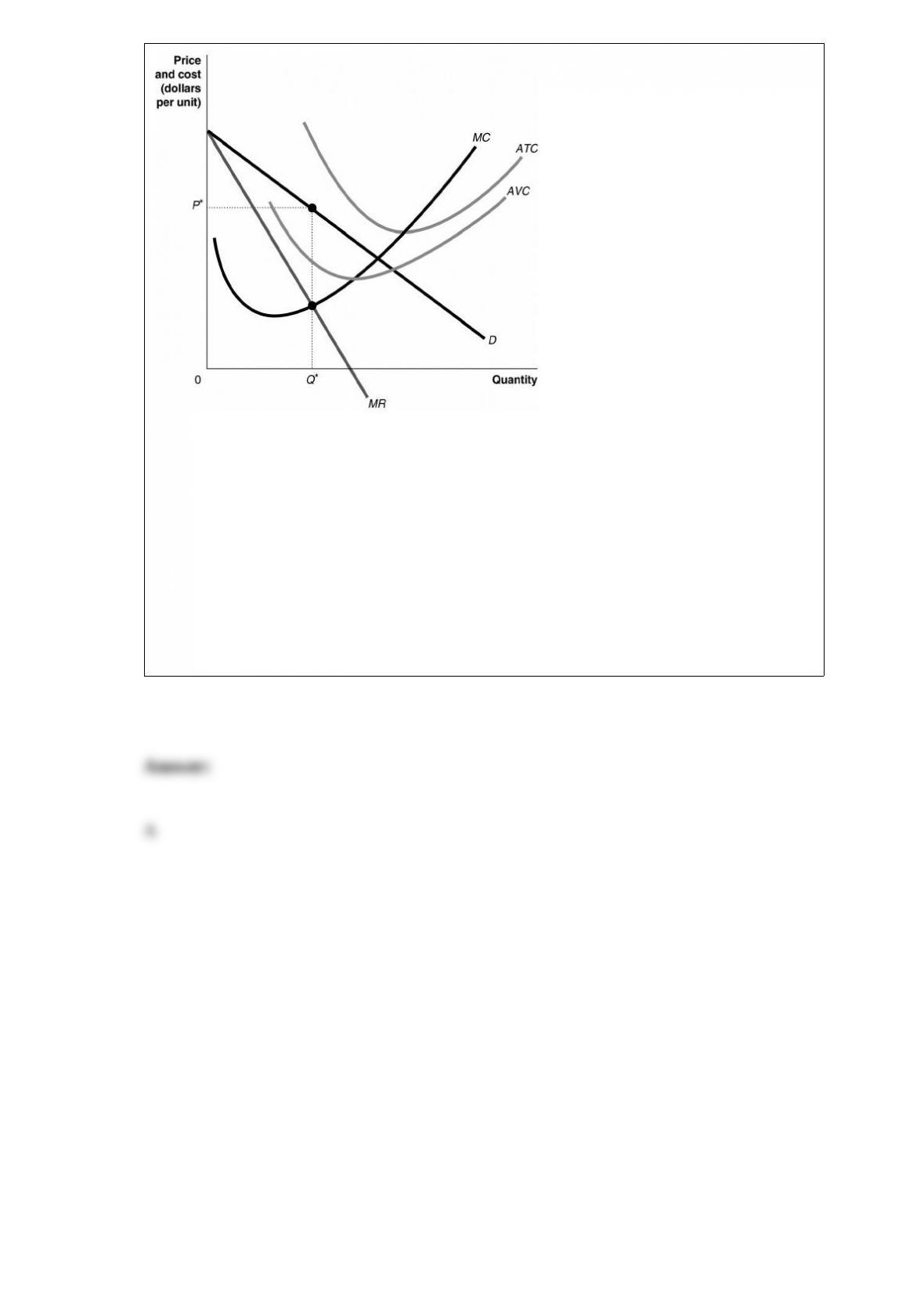
If the monopolist charges price P* for output Q*, in order to maximize profit or
minimize loss in the short run, it should
A) continue to produce because price is greater than average variable cost.
B) shut down because price is greater than marginal cost.
C) shut down because price is less than average total cost.
D) continue to produce because a monopolist always earns a profit.