1) John is an athlete. He has $120 to spend and wants to buy either a heart rate monitor
or new running shoes. Both the heart rate monitor and running shoes cost $120, so he
can only buy one. This illustrates the principle that
a.trade can make everyone better off.
b.people face trade-offs.
c.rational people think at the margin.
d.people respond to incentives.
2) When a profit-maximizing firm‘s fixed costs are considered sunk in the short run,
then the firm
a.can set price above marginal cost.
b.must set price below average total cost.
c.will never show losses.
d.can safely ignore fixed costs when deciding how much output to produce.
3) If demand is price inelastic, then when price rises, total revenue
a.will fall.
b.will rise.
c.will remain unchanged.
d.may rise, fall, or remain unchanged. More information is need to determine the
change in total revenue with certainty.
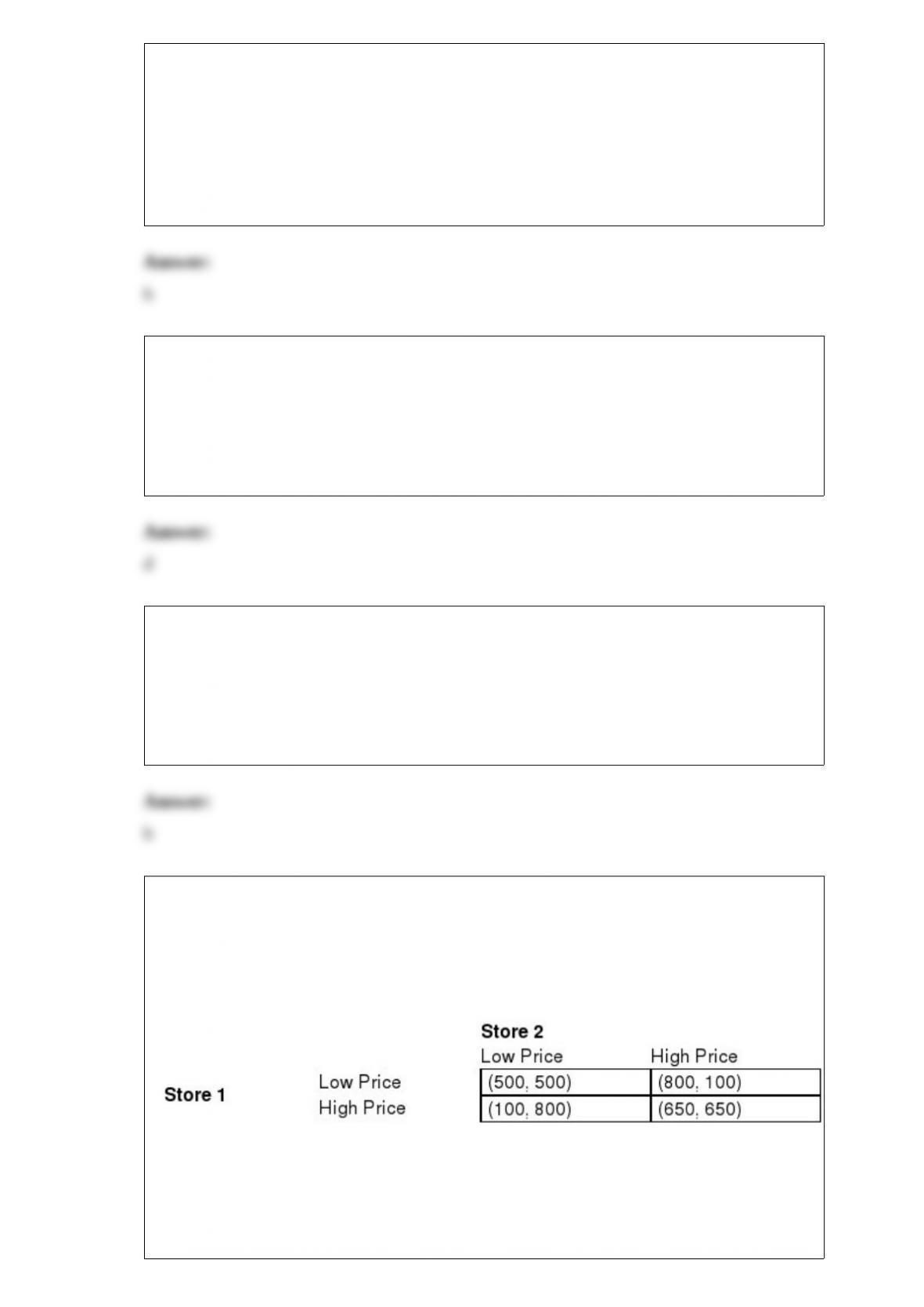
4) Table 17-19
Consider a small town that has two grocery stores from which residents can choose to
buy a loaf of bread. The store owners each must make a decision to set a high bread
price or a low bread price. The payoff table, showing profit per week, is provided
below. The profit in each cell is shown as (Store 1, Store 2).
Refer to Table 17-19. What is grocery store 2’s dominant strategy?
a.Grocery store 2 does not have a dominant strategy.
b.Grocery store 2 should always set a low price.
c.Grocery store 2 should always set a high price.
d.Grocery store 2 should set a low price when grocery store 1 sets a low price, and
grocery store 2 should set a high price when grocery store 1 sets a high price.
5) Which of the following is the most accurate statement?
a.Protection is necessary in order for young industries to grow up and be successful.
b.Protection is not necessary for an industry to grow.
c.Protection is necessary because if young industries are not protected, they may suffer
losses.
d.Protection may not always be necessary for infant industries, but it has proven to be
useful in most cases.
6) When firms are able to increase the amount of physical capital available to workers,
the
a.marginal product of labor will decrease.
b.value of the marginal product of labor will decrease.
c.value of the marginal product of labor will increase.
d.final product price will increase.
7) The production possibilities frontier is used to illustrate some basic economic ideas,
including
a.scarcity.
b.opportunity cost.
c.economic growth.
d.All of the above are correct.
8) Table 12-23
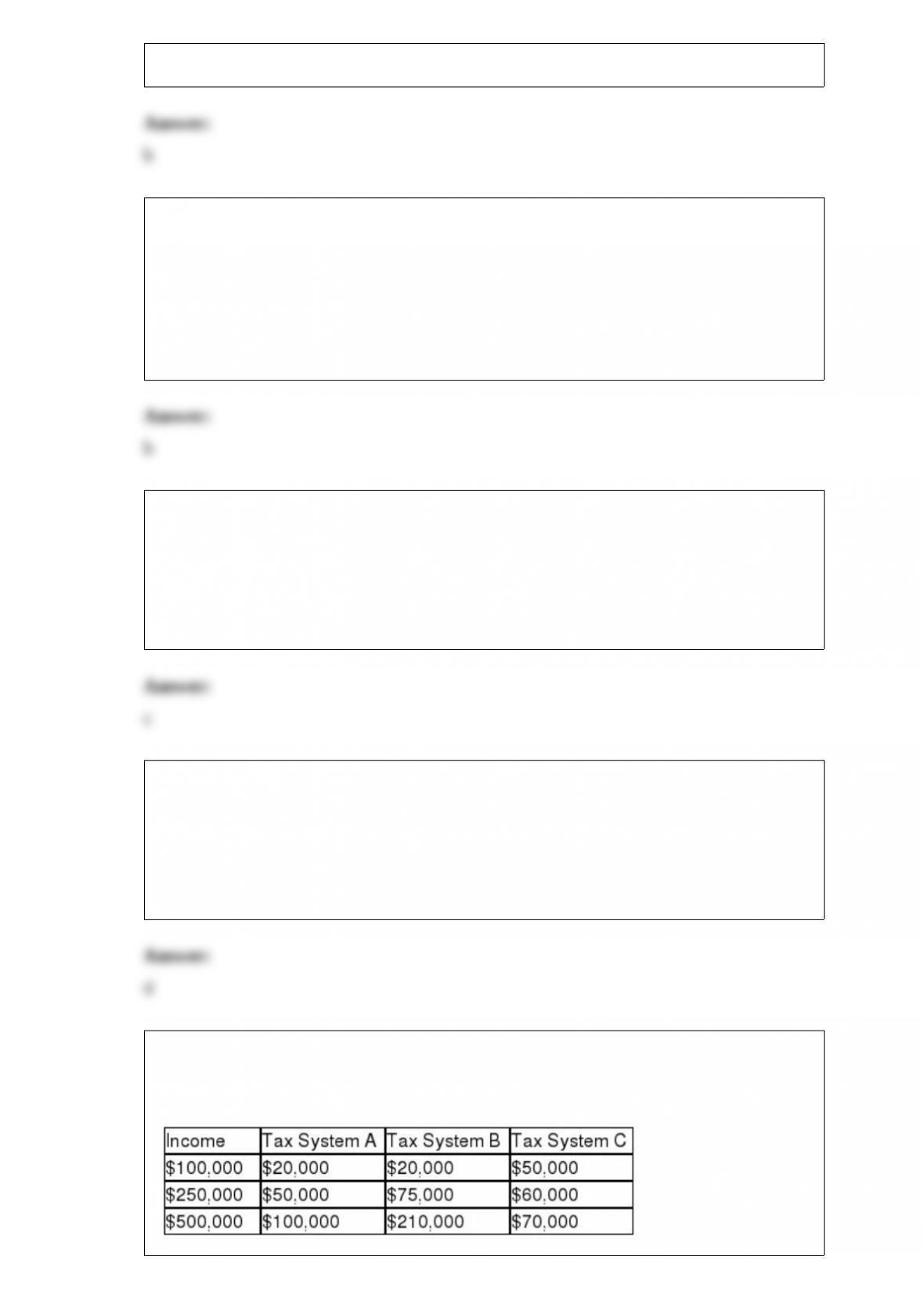
The dollar amounts in the last three columns are the taxes owed under the three
different tax systems.
Which of the three tax systems is regressive?
a.Tax System A
b.Tax System B
c.Tax System C
d.None of the systems are regressive.
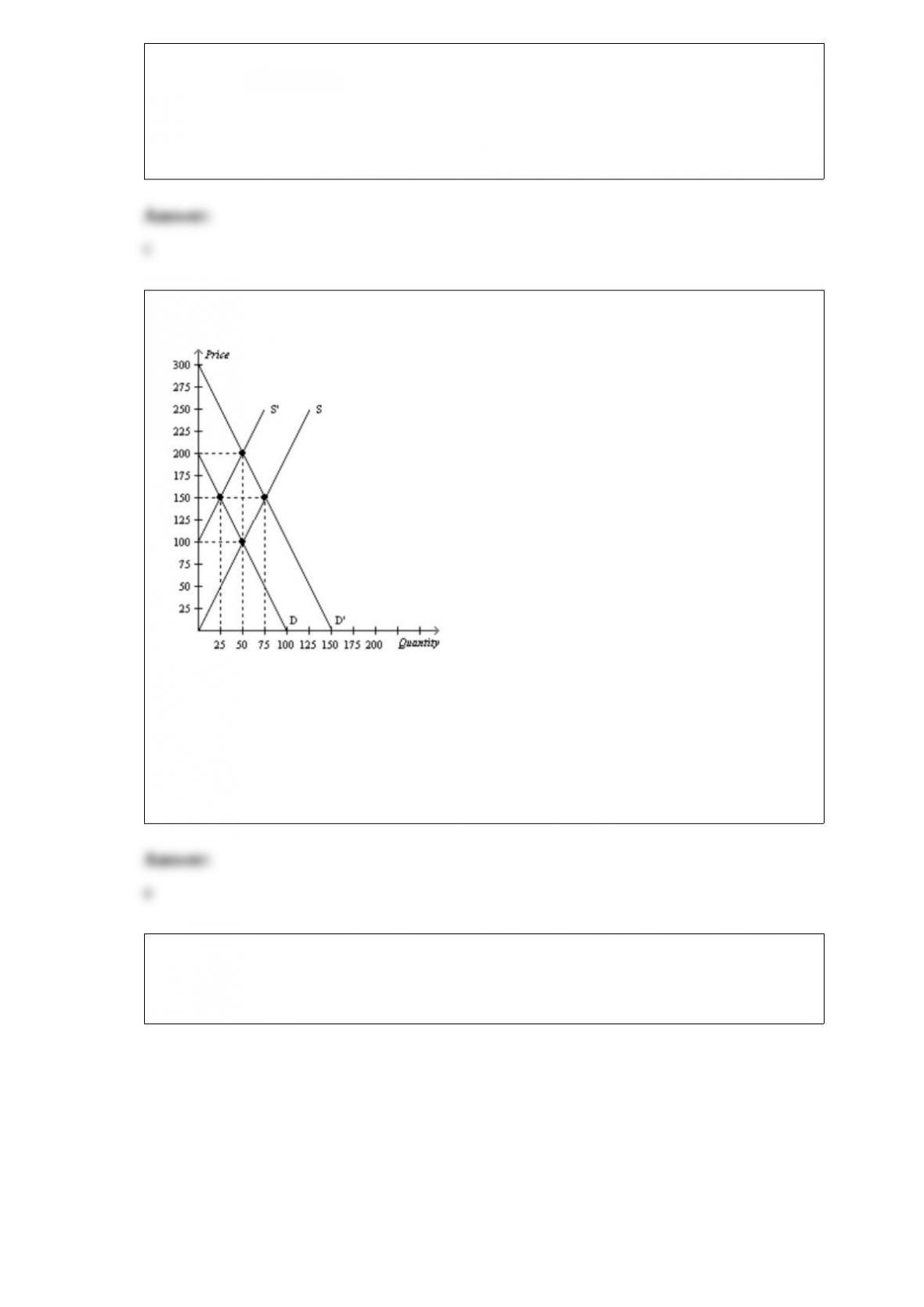
9) Figure 7-11
If the supply curve is S’, the demand curve is D, and the equilibrium price is $150, what
is the producer surplus?
a. $625
b. $1,250
c. $2,500
d. $5,000
10) Figure 18-1
On the graph, L represents the quantity of labor and Q represents the quantity of output
per week.
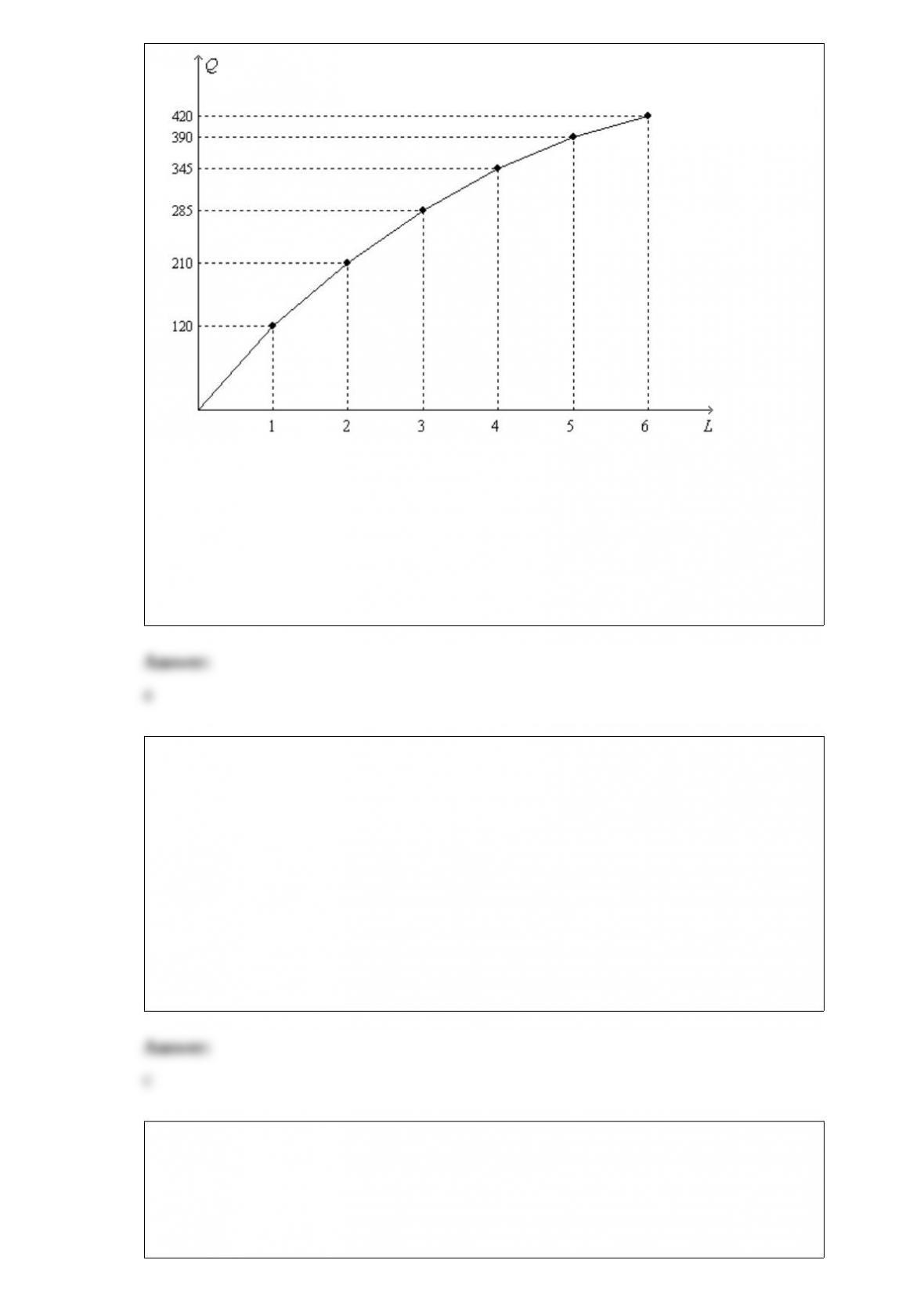
Refer to Figure 18-1. Suppose the firm sells its output for $15 per unit, and it pays
each of its workers $750 per week. When output increases from 210 units to 285 units,
the
a.marginal cost is $10 per unit of output.
b.marginal revenue is $5 per unit of output.
c.value of the marginal product of labor is $4,275
d.firm’s profit decreases.
11) Chile is an importer of computer chips, taking the world price of $12 per chip as
given. Suppose Chile imposes a $7 tariff on chips. Which of the following outcomes is
possible?
a.The price of chips in Chile increases to $19; the quantity of Chilean-produced chips
decreases; and the quantity of chips imported by Chile decreases.
b.The price of chips in Chile increases to $16; the quantity of Chilean-produced chips
increases; and the quantity of chips imported by Chile decreases.
c.The price of chips in Chile increases to $19; the quantity of Chilean-produced chips
increases; and the quantity of chips imported by Chile decreases.
d.The price of chips in Chile increases to $16; the quantity of Chilean-produced chips
increases; and the quantity of chips imported by Chile does not change.
12) The largest source of income for the federal government is
a.individual income taxes.
b.corporate taxes.
c.tariffs.
d.’sin” taxes on alcohol and cigarettes.
13) All externalities
a.cause markets to fail to allocate resources efficiently.
b.cause equilibrium prices to be too high.
c.benefit producers at the expense of consumers.
d.cause equilibrium prices to be too low.
14) Private contracts between parties with mutual interests
a.will reduce the well-being of society.
b.will lead to market outcomes in which the public interest is sacrificed for personal
gain.
c.can solve some inefficiencies associated with positive externalities.
d.will create negative externalities.
15) In the Tragedy of the Commons parable, if the medieval townspeople had foreseen
the tragedy, then they could have dealt with the problem in much the same way that
modern society deals with
a.fire protection.
b.poverty.
c.pollution.
d.national defense.
16) Table 17-10
The table shows the demand schedule for a particular product.
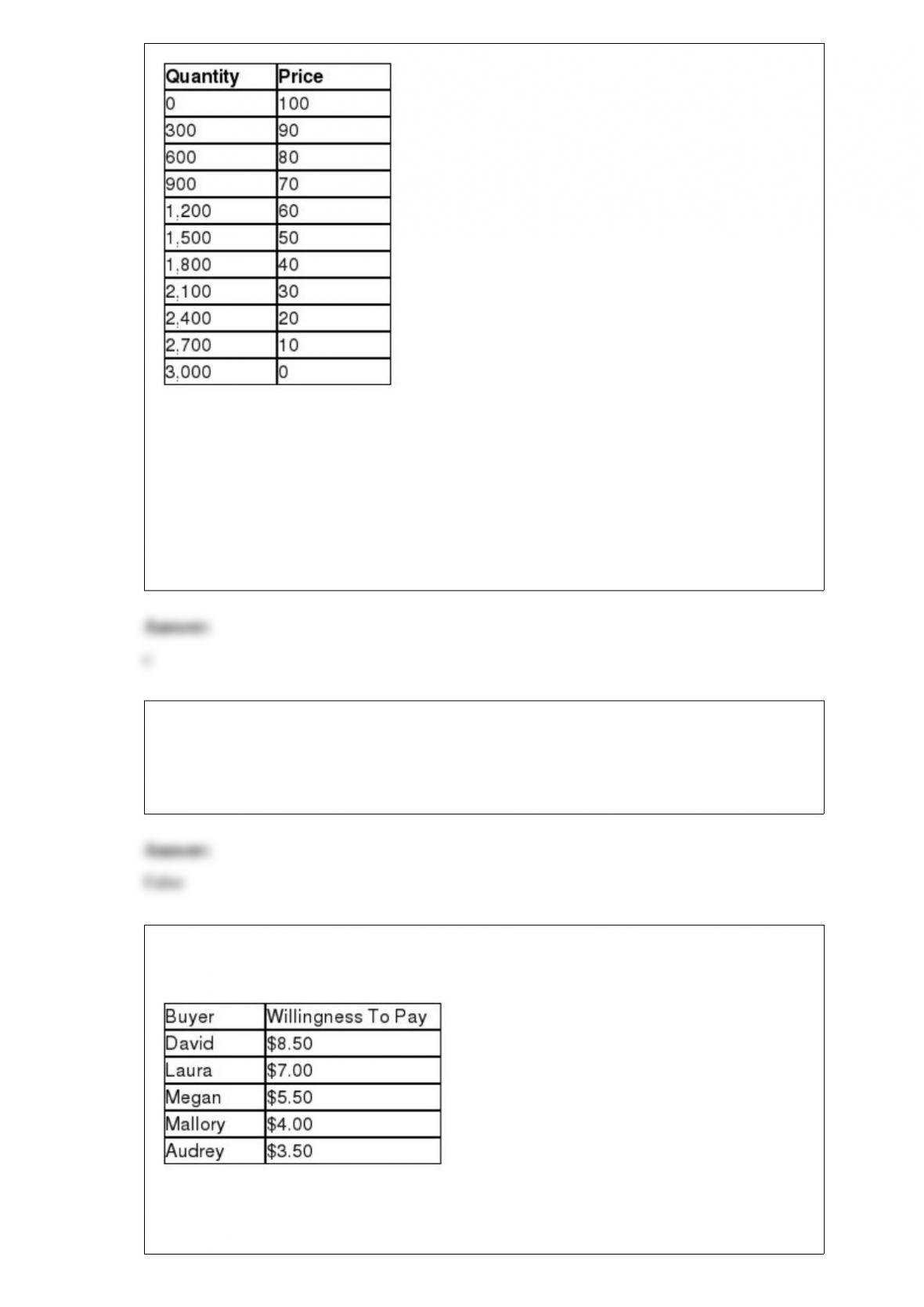
Refer to Table 17-10. Suppose the market for this product is served by two firms who
have formed a cartel and are colluding to set the price and quantity in this market. If the
marginal cost to produce this product is constant at $40 per unit and there is no fixed
cost, then what will the combined profit of the cartel be?
a. $15,000
b. $24,000
c. $27,000
d. $63,000
17) The superstar phenomenon explains why professional athletes earn more than
amateur athletes.
a.True
b.False
18) Table 7-2
This table refers to five possible buyers’ willingness to pay for a case of Vanilla Coke.
If the market price is $3.80,
a.David’s consumer surplus is $4.70 and total consumer surplus for the five individuals
is $9.50.

b.Megan’s consumer surplus is $1.70 and total consumer surplus for the five individuals
is $9.80.
c.David, Laura, and Megan will be the only buyers of Vanilla Coke.
d.the demand curve for Vanilla Coke, taking the five individuals into account, is
horizontal.