
Wage and price controls and incomes policies are
a. techniques used to increase aggregate demand without increasing aggregate supply.
b. methods used by government to try to reduce inflation without increasing
unemployment.
c. examples of discretionary monetary policies.
d. currently in effect in the U.S. economy.
e. key elements of President Roosevelt’s New Deal.
The dollar value of business sales minus the cost of intermediate products purchased
from other firms equals the
a. depreciation.
b. personal income.
c. direct and indirect tax liabilities.
d. value added.
e. profit.
Social Security benefits are funded by taxes levied on

a. sales.
b. wages.
c. property income.
d. wealth.
e. all forms of income.
The sensitivity of GDP to changes in intended investment increases as the
a. marginal propensity to save declines.
b. multiplier declines.
c. slope of the consumption function declines.
d. change in equilibrium declines.
e. spending chain declines.
The following questions are based on the following diagram illustrating the results of a
study of food expenditures and income for a group of families:
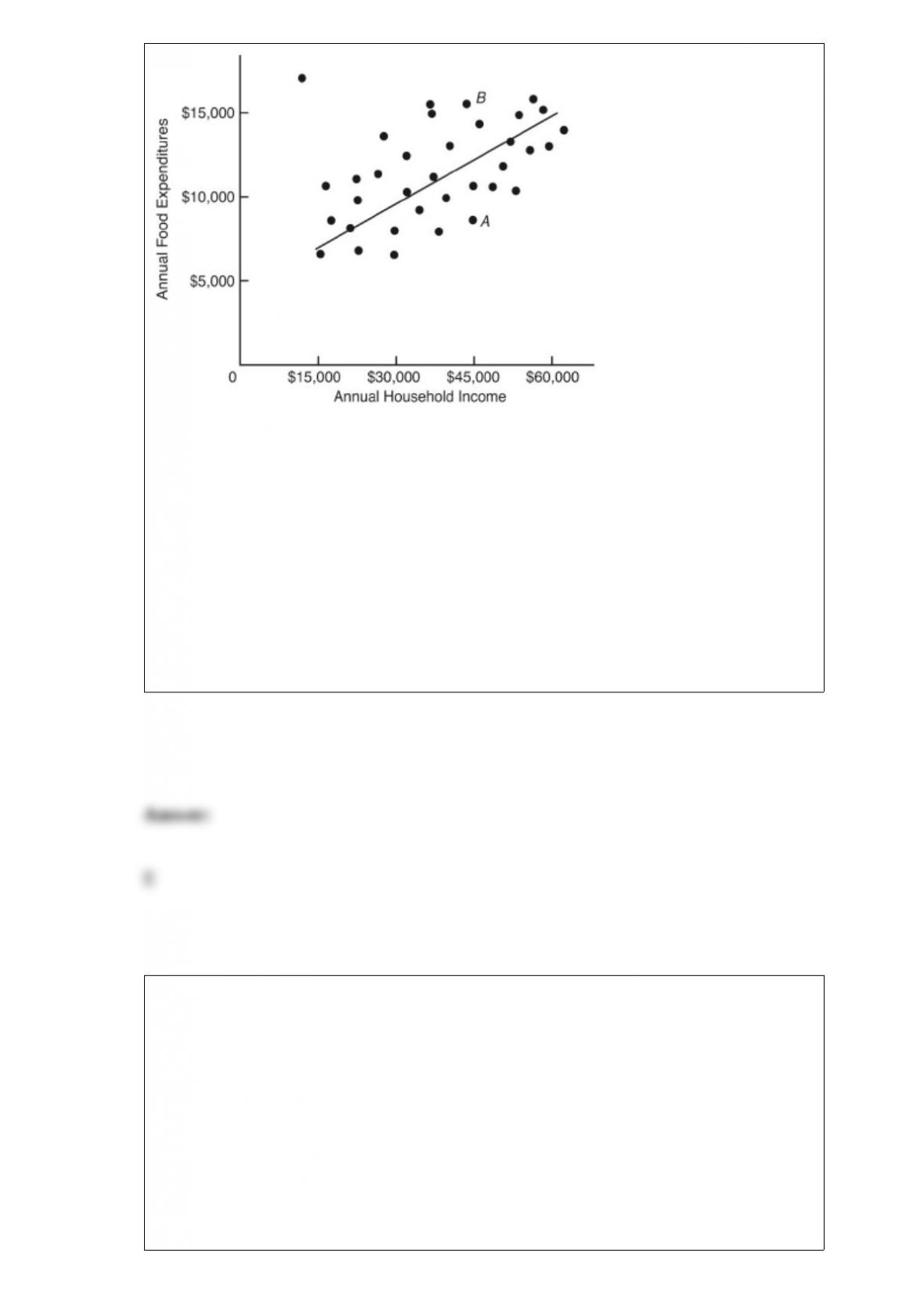
Family B
a. spends less than family A on food.
b. has a higher income than family A.
c. spends more than its income on food.
d. spends about the same amount on food as the average family.
e. spends a higher percentage of its income on food than family A.
Defining poverty in terms of a certain percentage of the population with the lowest
incomes means that
a. as income rises the number of poor people will remain the same.
b. income distribution will never become more equal.
c. unless income distribution is perfectly equal, poverty will never be eliminated.
d. the number of people who are poor will fall as population rises.

e. the poverty level will automatically decline as per capita income increases.
The nonaccelerating inflation rate of unemployment is another name for the ________
rate of unemployment.
a. cyclical
b. Keynesian
c. natural
d. actual
e. sedentary
The Celler-Kefauver Anti-Merger Act
a. established the Antitrust Division of the Justice Department.
b. extended the antitrust laws to cover mergers of not-for-profit organizations.
c. made market conduct the basic test for allowing a merger to take place.
d. disallowed the purchase of a competitor’s assets if the outcome would substantially
lessen competition.
e. was ruled unconstitutional by the Supreme Court.

In 2009 the federal government was the source of ________ percent of all R&D funds.
a. less than 10
b. between 10 and 20
c. between 20 and 30
d. between 30 and 40
e. over 40
Investment in a project will take place if the
a. marginal propensity to save exceeds the marginal propensity to consume.
b. expected rate of return exceeds the interest rate.
c. interest rate exceeds the marginal propensity to save.
d. net investment in the economy exceeds gross investment.
e. multiplier exceeds the expected rate of return.

Fiscal policy that promotes, either directly or indirectly, the reduction of private and
public spending would be appropriate when the economy is
a. experiencing a high rate of inflation.
b. experiencing a high rate of unemployment.
c. entering a recession.
d. exporting more than it imports.
e. experiencing rapidly falling price levels.
When the Fed sells government securities on the open market
a. bank reserves decline.
b. the Fed is following an easy money policy.
c. government bond prices rise.
d. bank reserves and interest rates both rise.
e. interest rates fall.

A basic problem with public regulation is that
a. regulatory agencies exist at the state but not the federal level of government and
therefore lack power.
b. it is difficult to decide what constitutes a fair rate of return.
c. it inevitably expands so that ultimately all production is nationalized.
d. regulatory commissions set only minimum prices that regulated firms can charge,
thus promoting excessive entry of new firms into regulated markets.
e. regulation requires that modestly staffed government agencies make the day-to-day
operating decisions of regulated firms.
The following questions are based on the following graph, which shows the relationship
between price levels and unemployment:
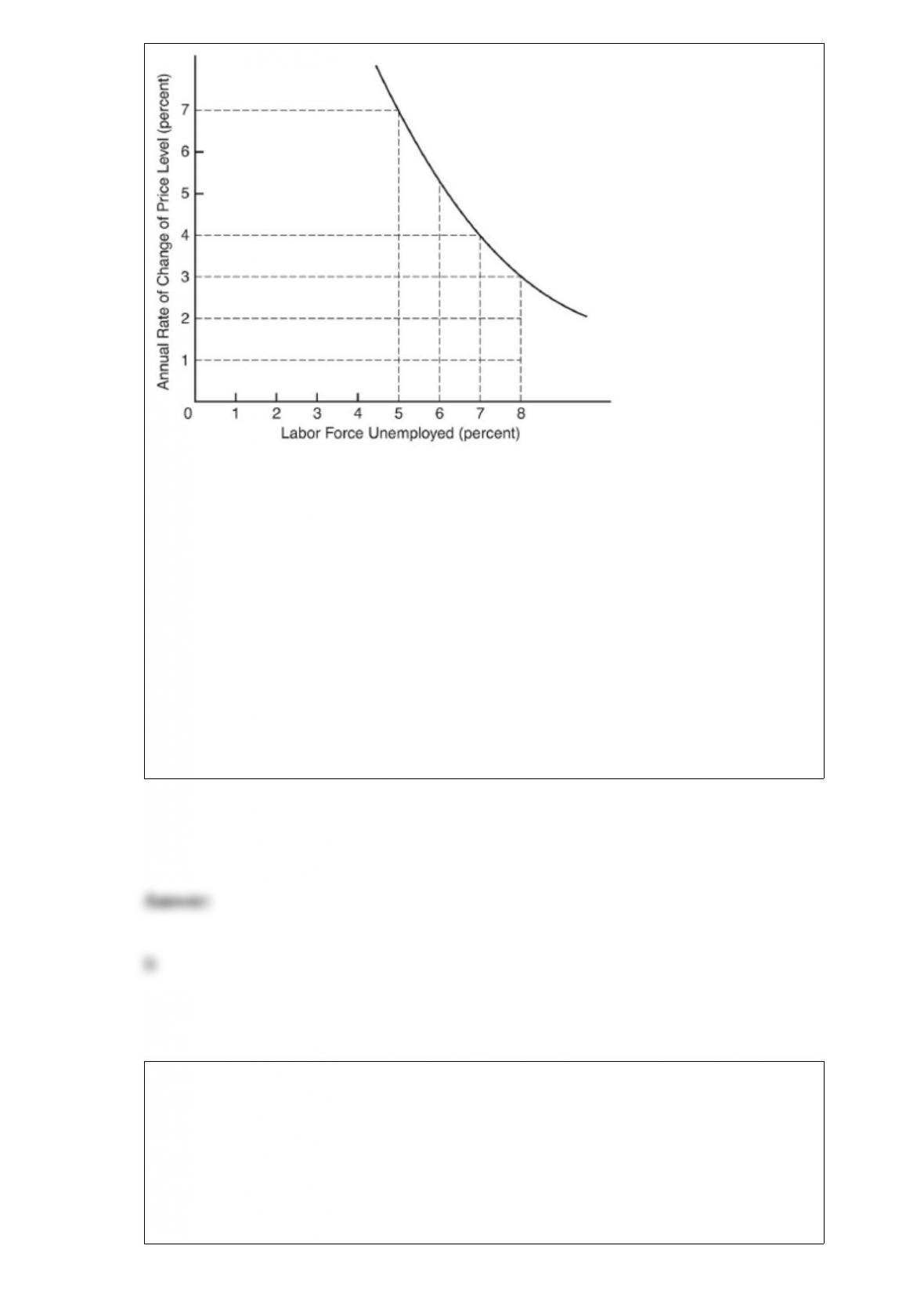
If the economy operates with 8 percent unemployment, the significance of the curve is
that it implies that any economic policy that drives unemployment down to 5 percent
does so at the cost of
a. adding about 3 percentage points to the rate of inflation.
b. adding about 4 percentage points to the rate of inflation.
c. adding about 5 percentage points to the rate of inflation.
d. adding about 7 percentage points to the rate of inflation.
e. increasing the rate of inflation by more than 7 percentage points.
In the market diagram, excess supply is best represented by triangle
a. ABC.
b. CDB.
c. AED.

d. DEC.
e. BEC.
One minus the marginal propensity to consume equals
a. the average propensity to consume.
b. the multiplier.
c. the marginal propensity to save.
d. the expected rate of return.
e. disposable income.
The following questions are based on the following information for a society:
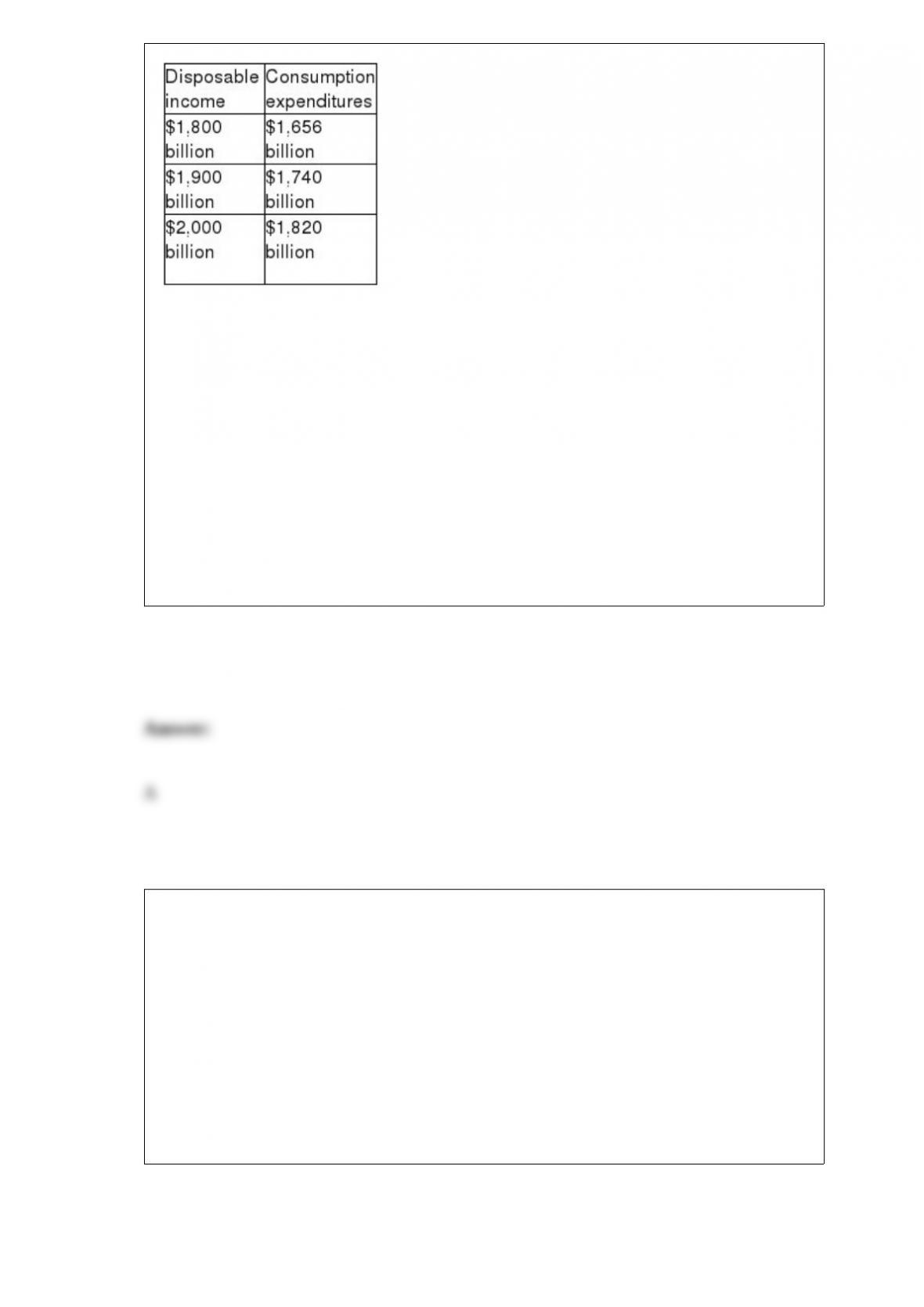
If disposable income increases from $1,900 to $2,000 billion, the marginal propensity
to consume is
a. 0.8.
b. 0.84.
c. 0.92.
d. 1.0.
e. 1.08.
According to government statistics, the number of business firms in the United States is
a. under 5 million.
b. between 5 and 10 million.
c. between 10 and 15 million.
d. between 15 and 20 million.
e. over 20 million.

Which of the following is the best example of land?
a. mineral deposits
b. human efforts
c. buildings and equipment that contribute to production
d. accounts receivable
e. goods and services purchased by households for their enjoyment
The commercial introduction of new products and processes for the first time is called
a. research and development.
b. capitalization.
c. patent pending.
d. innovation.
e. derived demand.

The simplest way for government to intervene to remedy a country’s pollution problem
is through the use of
a. effluent fees.
b. direct regulation.
c. pollution taxes.
d. tax credits for pollution control equipment.
e. certificates or licenses to pollute.
Generally, in the field of technology, the United States has been
a. a world leader for much of its history.
b. a step behind most European nations, even in recent years.
c. ahead of Europe but far behind Japan.
d. a leader in science but not in manufacturing.
e. a user rather than a creator of new technologies.

The additional amount a family spends on consumption from an additional dollar of
disposable income is called the
a. saving function.
b. marginal propensity to save.
c. multiplier.
d. marginal propensity to consume.
e. average propensity to consume.
With which of the following statements would John Kenneth Galbraith probably agree?
a. All people should have equal income.
b. Economic and political freedoms are likely to be lost if we rely too heavily on the
government to solve economic problems.
c. The nation suffers because too little is spent on government services such as
transportation, education, and urban renewal.
d. There is every reason to be skeptical about government’s ability to solve our social
and economic problems.
e. Government tends to be slow, inefficient, and cumbersome.

A subsistence standard of living coupled with periods of starvation was the prospect for
humanity according to the views of
a. Adam Smith.
b. David Ricardo.
c. Joseph Schumpeter.
d. Karl Marx.
e. Thomas Malthus.
If disposable income is held constant, aggregate consumption expenditure will increase
in all but which of the following cases?
a. The public’s wealth holdings increase.
b. The rate of interest increases.
c. The public anticipates price increases in the future.
d. The public currently has an abnormally low stock of durable goods.
e. The population increases.
The following questions are based on the following graph:
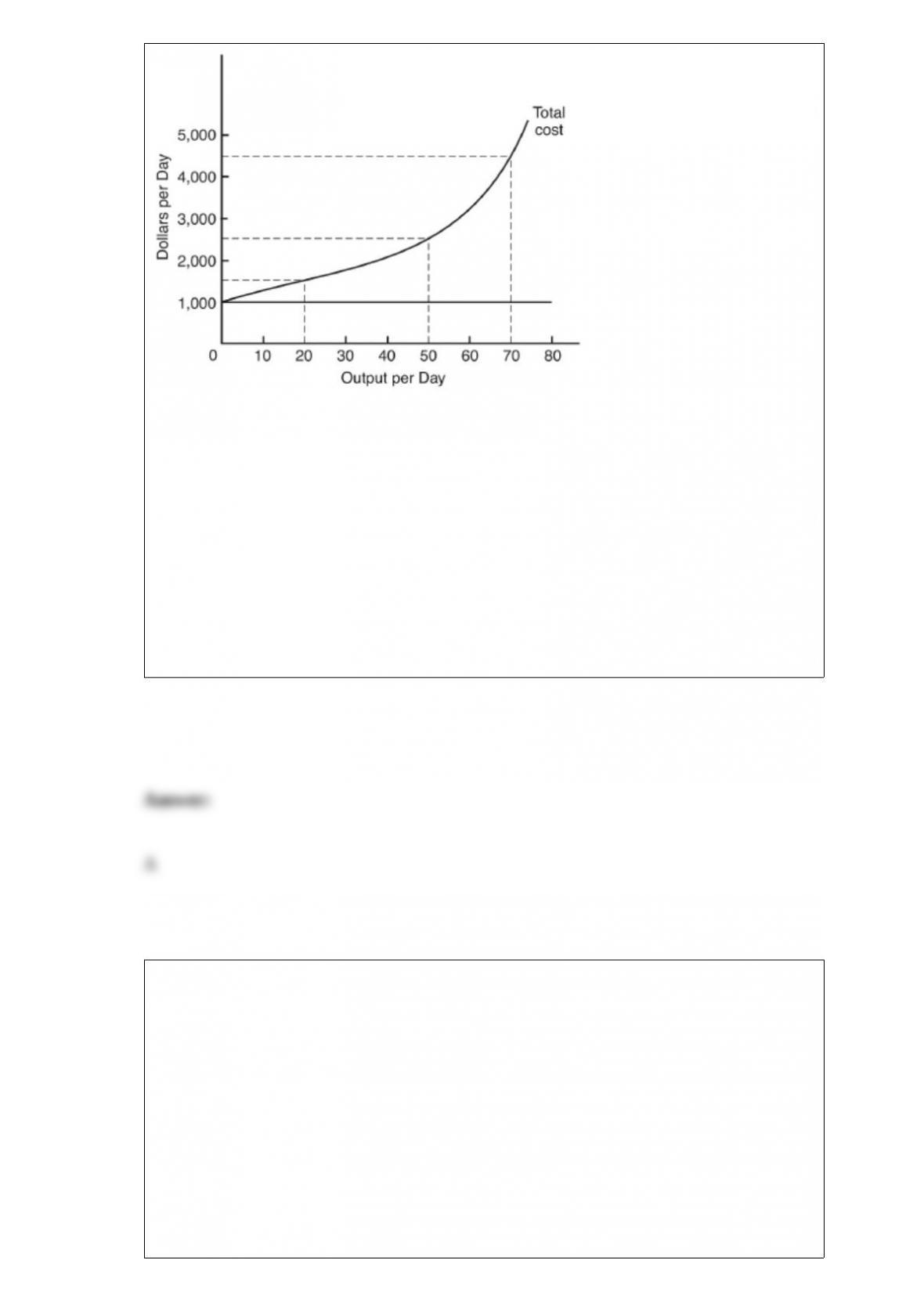
At 50 units of output per day, total fixed cost is
a. $1,000.
b. $1,500.
c. $2,500.
d. $3,500.
e. $4,500.
In the late 1930s, with the ALCOA case, the courts changed their former interpretation
of antitrust laws to
a. reflect the rule of reason.
b. allow all but overt monopoly pricing behavior by a firm.
c. focus primarily on a firm’s share of the market rather than its market conduct.
d. find that only those firms that behaved collusively were violating the antitrust laws.
e. reiterate that mere size was not an offense.

Under a system of fixed exchange rates, a balance-of-payments deficit or surplus is
measured by
a. determining if the total amount of foreign currency bought equals the total amount
sold.
b. calculating the changes in the exchange rate.
c. the rate of increase or decrease in domestic price levels.
d. the rate of appreciation or depreciation of a currency.
e. calculating the central bank’s purchases or sales of currency.
The following questions are based on the following perfectly competitive firm’s demand
curve for labor:
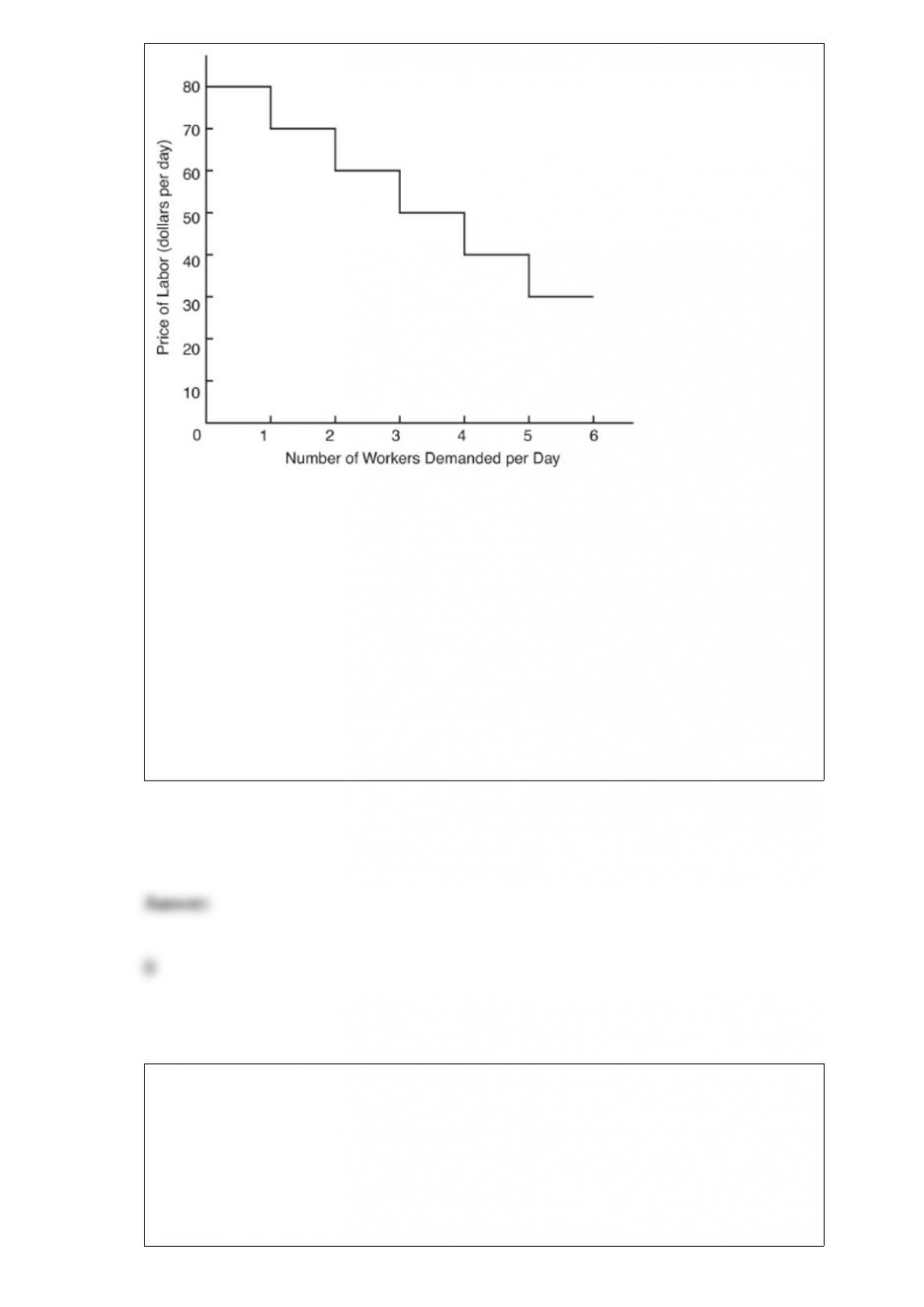
If this is a profit-maximizing firm and it currently employs five workers, the value of
the marginal product of the fifth worker is
a. $5.
b. $40.
c. $50.
d. $200.
e. not determinable from the information given.
A rising marginal cost curve below the average variable cost curve means
a. average variable costs are falling.
b. average fixed costs are rising.
c. average total costs are rising.
d. total variable cost is falling.
e. total fixed cost is rising.
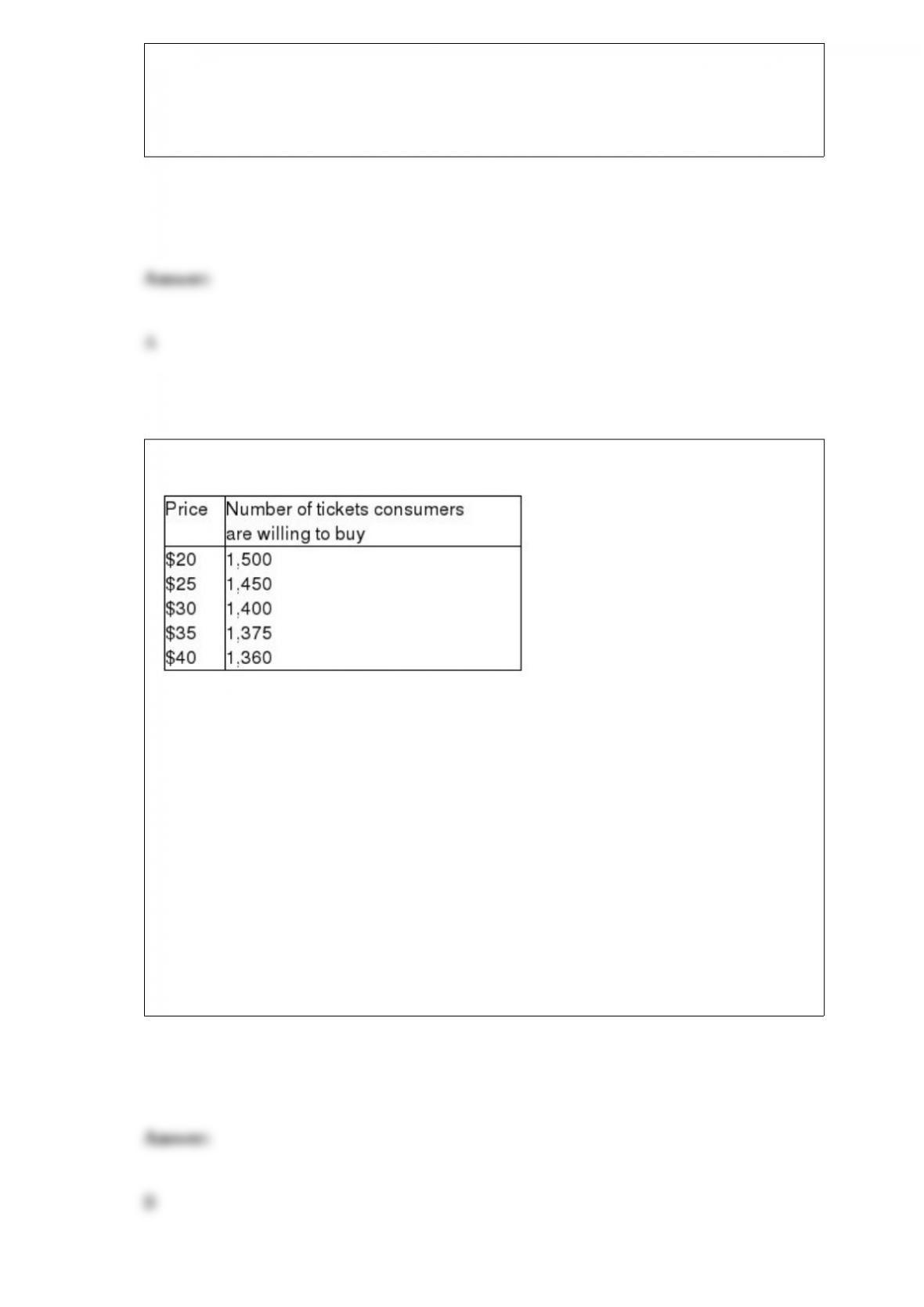
The following questions are based on the following table:
This table shows the number of theater tickets the public is willing to buy for a
particular show at various prices. If we plotted the points in this table, the result would
be a ________ curve.
a. growth
b. demand
c. cost
d. supply
e. production possibilities