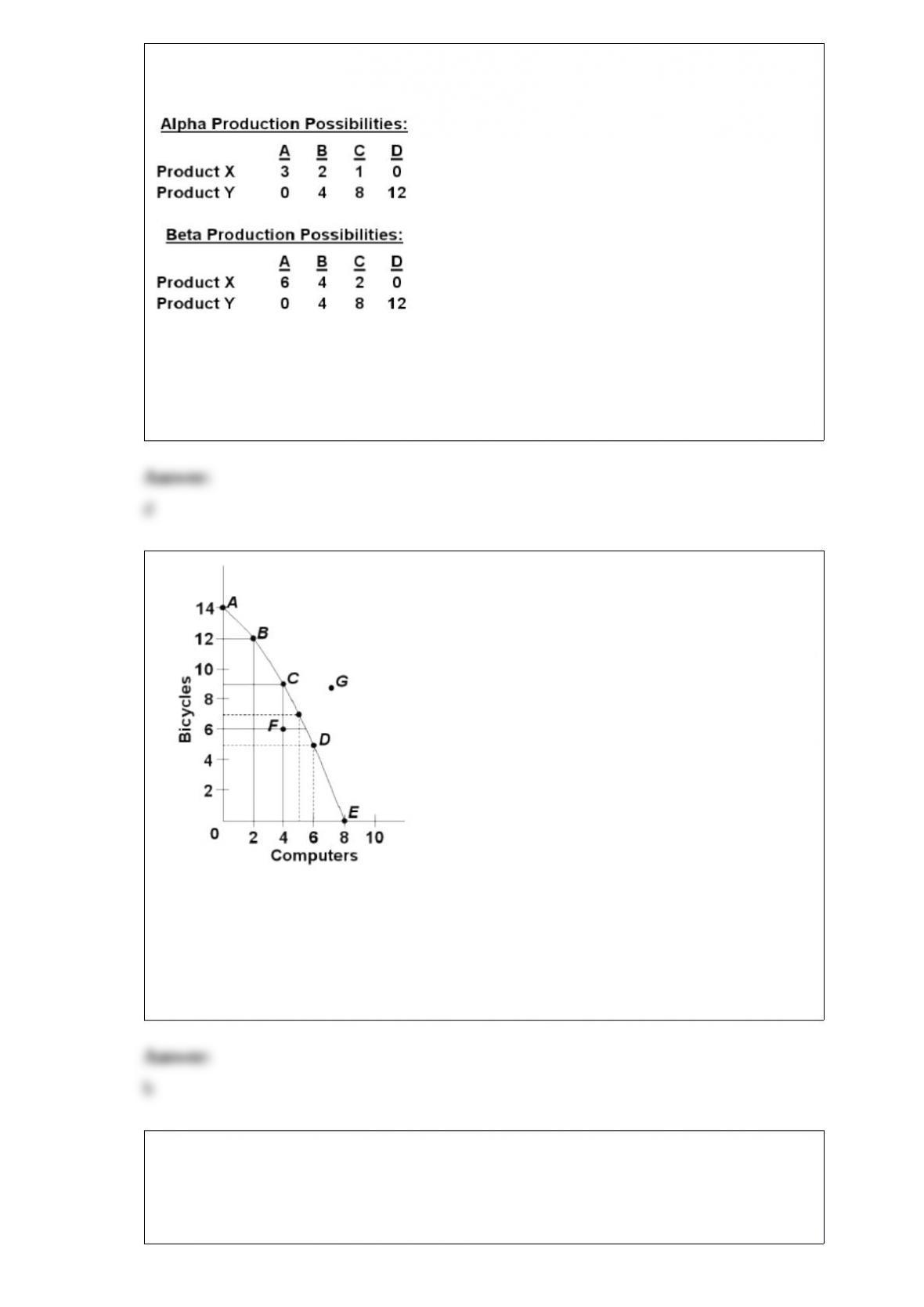
1) the following production possibilities tables for countries alpha and beta:
refer to the above tables. according to the concept of comparative advantage:
a.alpha should specialize in x; beta in y
b.beta should produce some x and some y
c.alpha should produce some x and some y
d.beta should specialize in x; alpha in y
2)
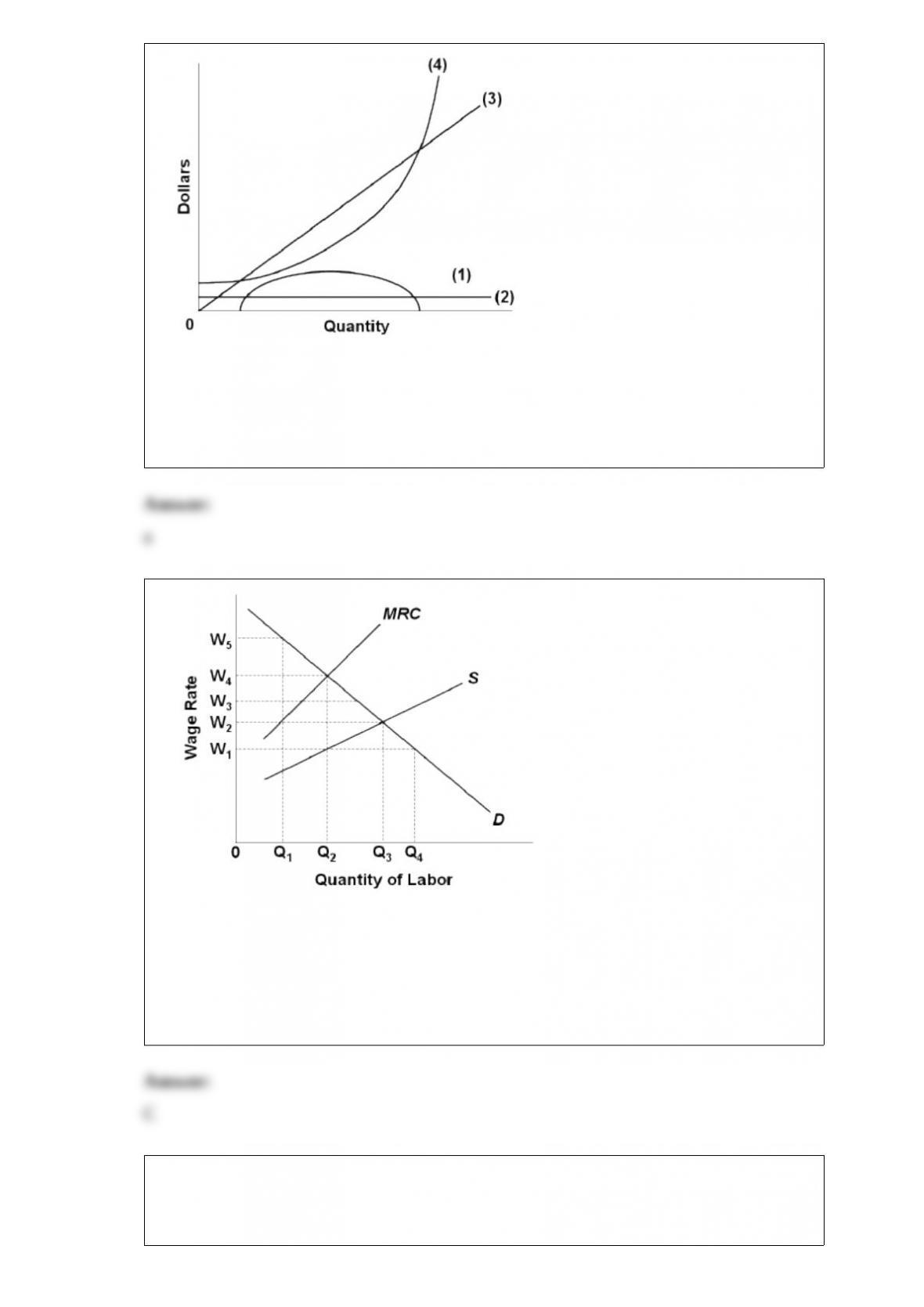
refer to the above diagram. if society is currently producing the combination of bicycles
and computers shown by point d, the production of 2 more units of bicycles:
a.cannot be achieved because resources are fully employed.
b.will cost 1 unit of computers.
c.will cost 2 units of computers.
d.will cause some resources to become unemployed.
3) mr. chan has an income of $20 that he is spending on donuts and cheese in such
amounts that he derives 25 utils of satisfaction from the donuts and 25 utils of
satisfaction from the cheese. on the basis of this information we:
a.cannot say whether or not chan is buying donuts and cheese in equilibrium amounts.

b.can say that chan should buy more cheese and fewer donuts.
c.can say that chan should buy more donuts and less cheese.
d.can say that chan is buying the utility-maximizing amounts of donuts and cheese.
4) which of the following is a limitation of the simple circular flow model?
a.product markets are ignored.
b.resource markets are ignored.
c.the determination of product and resource prices is not explained.
d.households are included, but not businesses.
5) economies of scale are indicated by:
a.the rising segment of the average variable cost curve.
b.the declining segment of the long-run average total cost curve.
c.the difference between total revenue and total cost.
d.a rising marginal cost curve.
6) the term productive efficiency refers to:
a.any short-run equilibrium position of a competitive firm.
b.the production of the product-mix most desired by consumers.
c.the production of a good at the lowest average total cost.
d.fulfilling the condition p = mc.
7) (Consider This) In part as a result of the U.S. government’s ethanol program,
between 2005 and 2007 the inflation-adjusted price of a bushel of corn:
A.rose 50 percent.
B.rose 200 percent.
C.fell 20 percent.
D.collapsed to only 5 percent of its pre-2005 level.
8)
curve (4) in the above diagram is a purely competitive firm’s:
a.total cost curve.
b.total revenue curve.
c.marginal revenue curve.
d.total profit curve.
9)
Refer to the above diagram. An industrial union could maximize employment by
negotiating a wage rate of:
A.W4.
B.W3.
C.W2.
D.W1.
10) in economics, the pleasure, happiness, or satisfaction received from a product is
called:
a.marginal cost.

b.rational outcome.
c.status fulfillment.
d.utility.
11) The effect of imposing a lump-sum tax is to:
A.reduce the absolute levels of consumption and saving at each level of GDP and to
reduce the size of the multiplier.
B.reduce the absolute levels of consumption and saving at each level of GDP, but to not
change the size of the multiplier.
C.reduce the absolute levels of consumption and saving at each level of GDP and to
increase the size of the multiplier.
D.increase the absolute levels of consumption and saving at each level of GDP and to
increase the size of the multiplier.