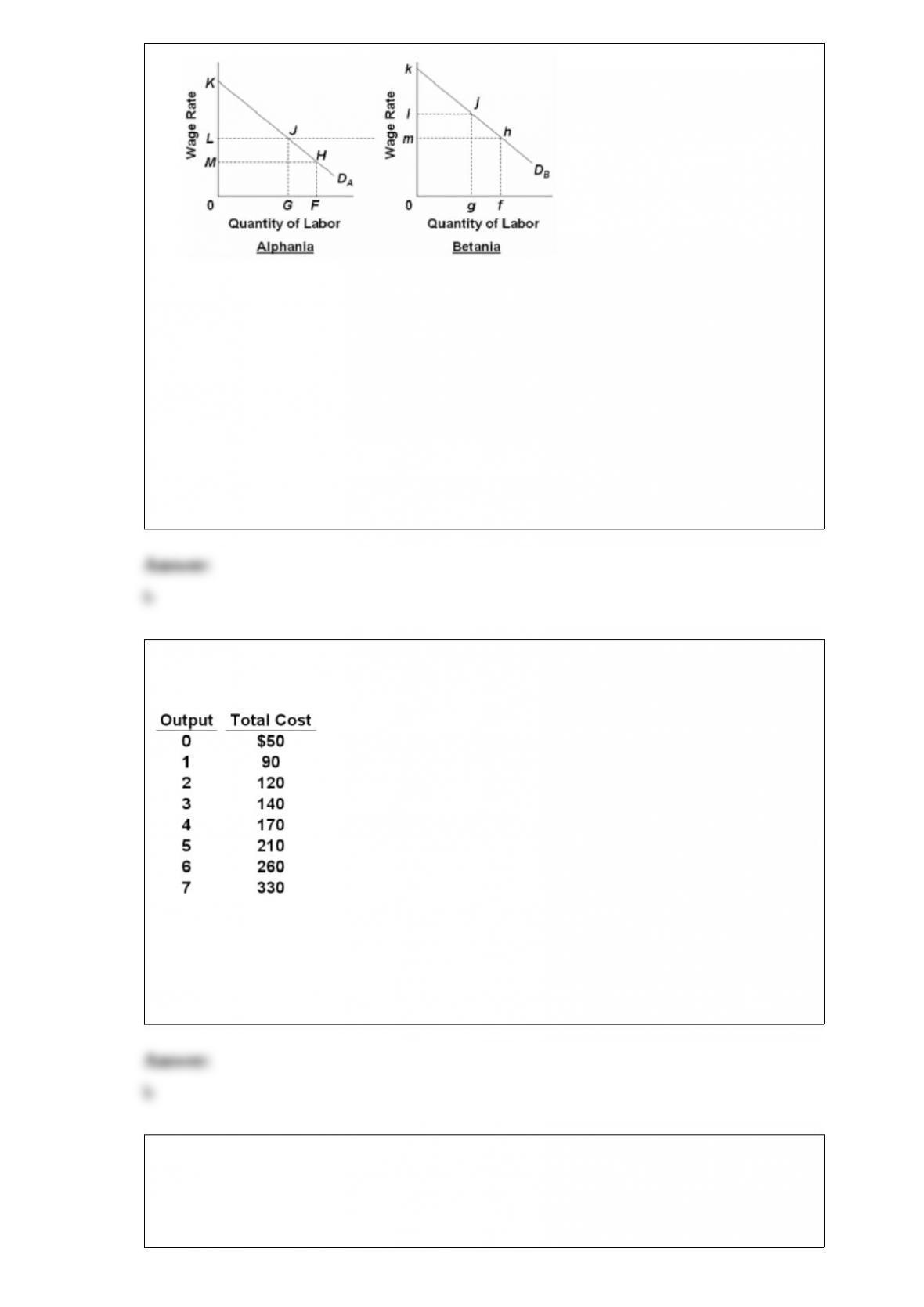
1)
assumptions: (1) the demand for labor in alphania and betania are as shown by da and
db, respectively; (2) alphania’s native labor force is f and that of betania is g; (3) wage l
in alphania is equal to wage m in betania; and (4) full employment exists in both
countries.
refer to the above diagram and assumptions. if migration is costless and unimpeded,
business income will:
a.decrease in betania, but increase in alphania.
b.increase in betania, but decrease in alphania.
c.decrease in both alphania and betania.
d.increase in both alphania and betania.
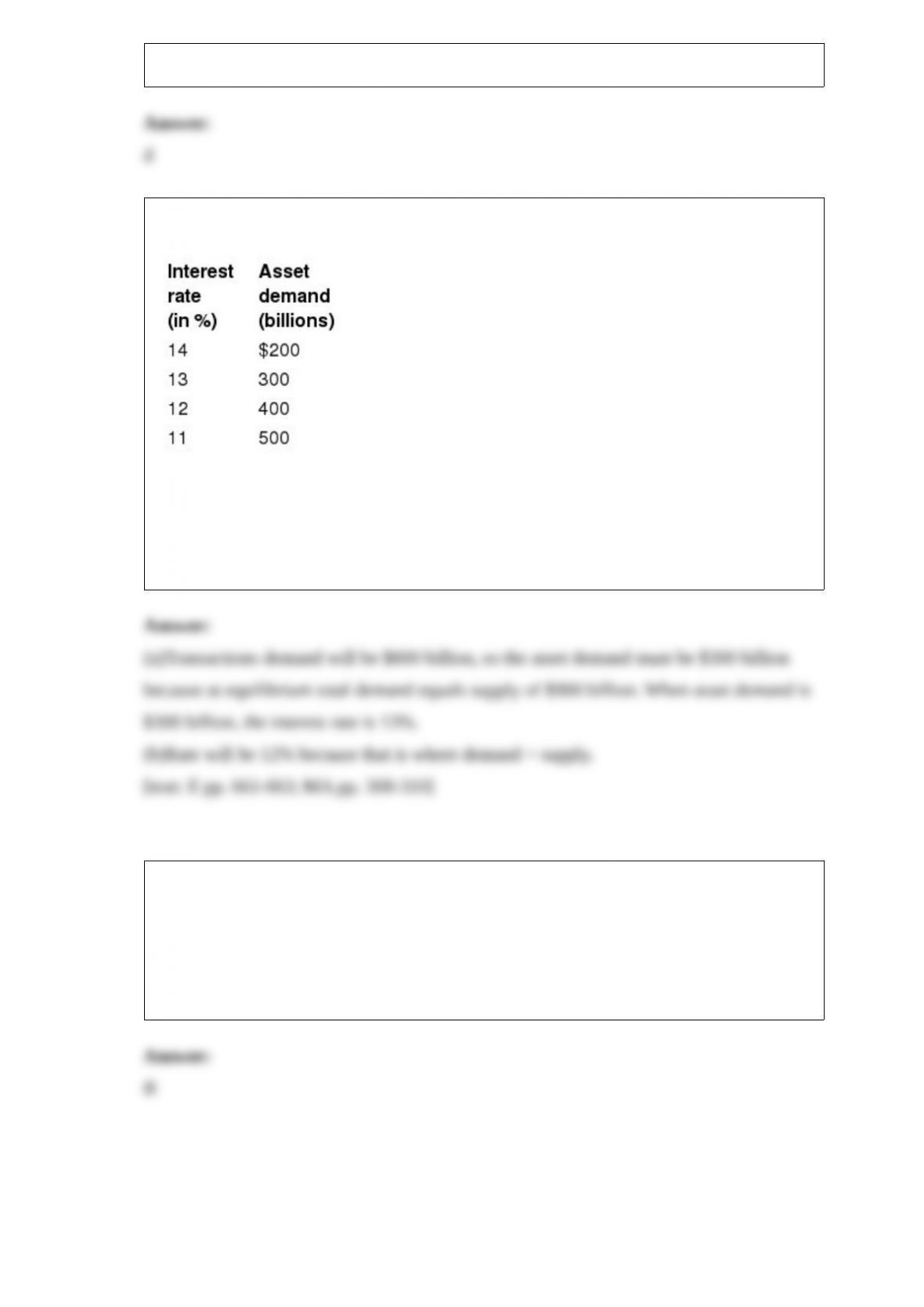
2) the following cost data for a purely competitive seller:
refer to the above data. if product price is $25, the firm will:
a.shut down and incur a $90 loss.
b.shut down and incur a $50 loss.
c.produce 3 units and incur a $65 loss.
d.produce 4 units and realize a $10 economic profit.
3) (last word) declines in stock prices measured by the dow jones average:
a.are a major cause of recessions.
b.usually reduce saving and increase consumption spending.
c.usually increase investment and reduce net exports.
d.sometimes precede recessions; sometimes do not.
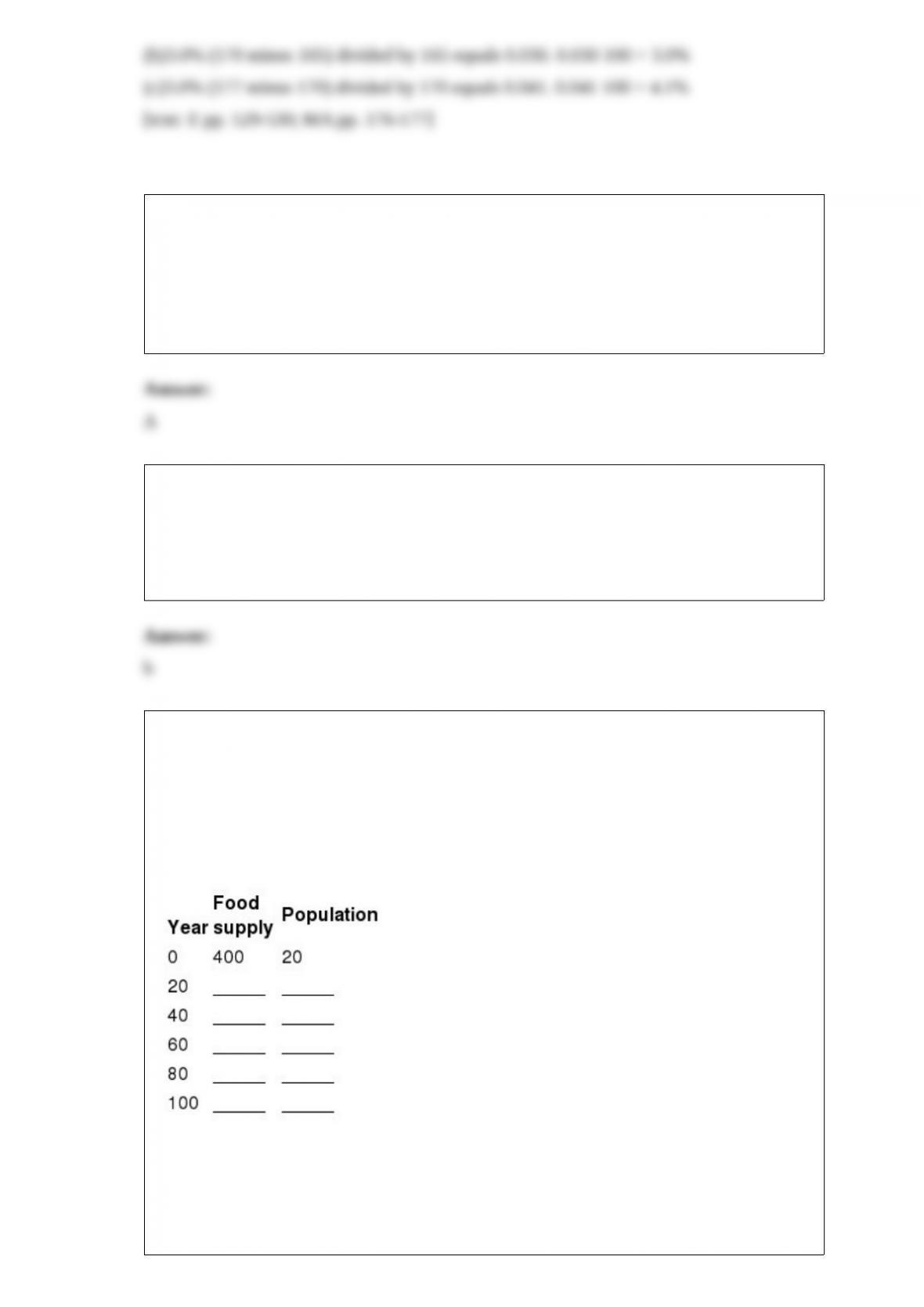
4) Use the table below to answer the questions:
(a)If the transactions demand for money equals 10% of nominal GDP, the nominal GDP
is $6000 billion, and the supply of money is $900 billion, what is the equilibrium
interest rate?
(b)If nominal GDP remains constant, and the money supply is increased from $900 to
$1000 billion, what will the equilibrium rate of interest be?
5) (Last Word) In 2005, the countries with the highest scores on the Environmental
Performance Index were:
A.U.S. and Tanzania.
B.Sweden and New Zealand.
C.Russia and Canada.
D.Brazil and Australia.

6)
refer to the above diagram. flow (2) represents:
a.wage, rent, interest, and profit income.
b.land, labor, capital, and entrepreneurial ability.
c.goods and services.
d.consumer expenditures.
7) According to the equation of exchange, changes in the money supply can affect:
A.only the velocity of money.
B.both the price level and real output.
C.only real output and employment.
D.only the price level.
8) Refer to the above diagrams. Assuming a constant price level, an increase in
aggregate expenditures from AE1 to AE2 would:
A.move the economy from A to C along AD1.
B.move the economy from C to A along AD1.
C.increase aggregate demand from AD1 to AD2.
D.decrease aggregate demand from AD2 to AD1.
9) Answer the next four questions based on the following data using year 1 as the base
year. All dollars are in billions. Calculate to one decimal place.
(a)What was the percentage rise in prices between years 1 and 2?
(b)What was the percentage rise in prices between years 2 and 3?
(c)What was the percentage rise in prices between years 3 and 4?
10) If a good that generates positive externalities were produced and priced to take into
account these spillover benefits, then its:
A.price and output would increase.
B.output would increase but price would remain constant.
C.price would increase and output would decrease.
D.price would increase but output would remain constant.
11) transfer payments are included in:
a.ni.
b.pi.
c.gdp.
d.ndp.
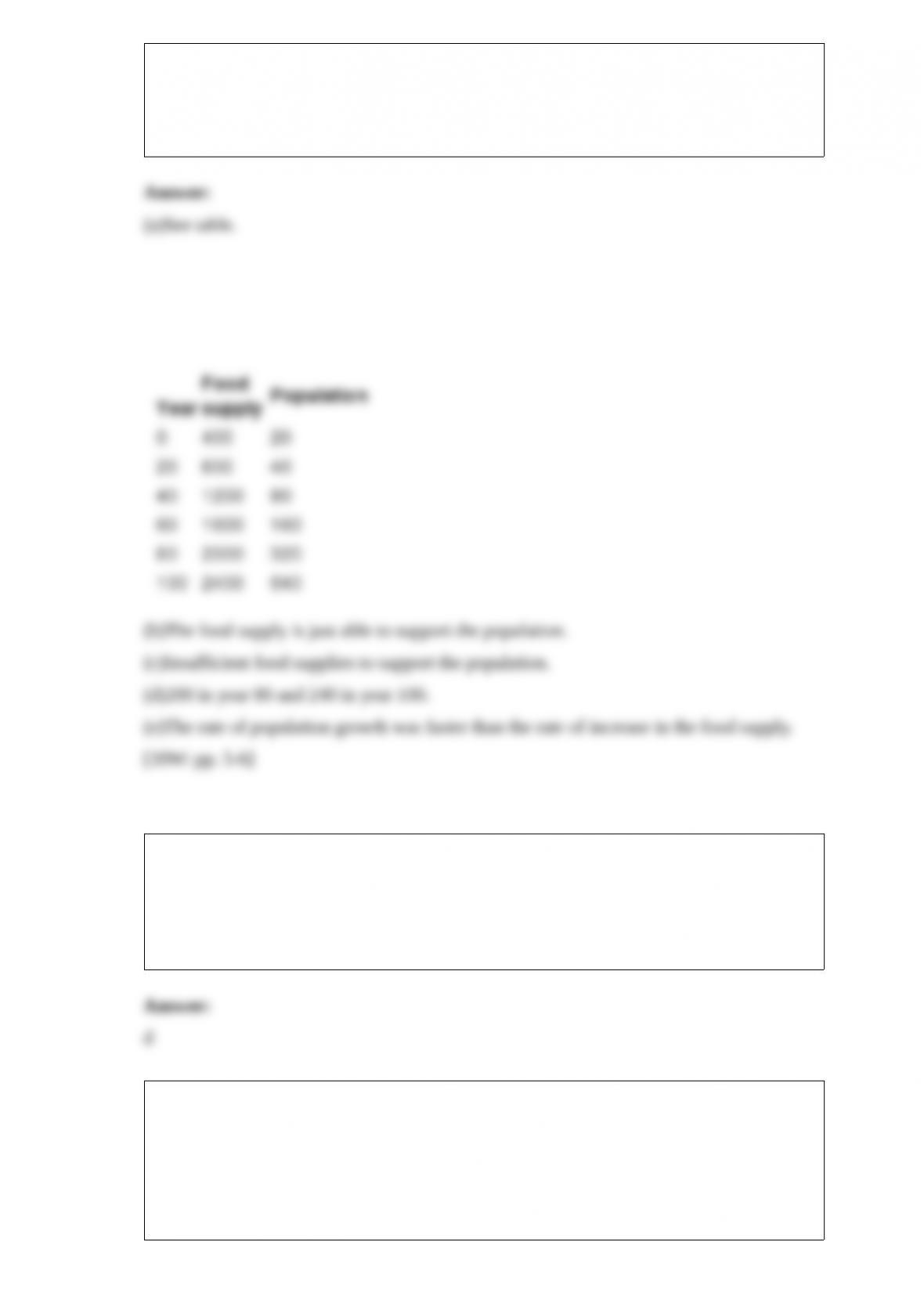
12) Suppose that it takes a minimum of 10 units of food to keep a person alive for a
year, that the population can double every 20 years, and that the food supply can
increase every 20 years by an amount equal to what it was in the beginning (year 0).
(a)Assume that both the population and the food supply grow at these rates. Complete
the following table by computing the size of the population and the food supply in years
20 through 100.
(b)What happens to the relationship between the food supply and the population in the
60th year?
(c)What would actually prevent the population from growing at this rate following the
60th year?
(d)Assuming that the actual population growth in the years following the 60th does not
outrun the food supply, what would be the size of the population in year 80 and year
100?
(e)Explain why the standard of living failed to increase in the years following the 60th
even though the food supply increased by 75% between years 60 and 100.
13) average fixed cost:
a.equals marginal cost when average total cost is at its minimum.
b.may be found for any output by adding average variable cost and average total cost.
c.graphs as a u-shaped curve.
d.declines continually as output increases.
14) United States exports of goods and services (on a national income account basis)
are about:
A.20 percent of U.S. GDP.
B.4 percent of U.S. GDP.
C.28 percent of U.S. GDP.
D.12 percent of U.S. GDP.

15) The Federal Deposit Insurance Corporation (FDIC) insures deposits up to $100,000
in:
A.mutual fund companies and pension fund companies.
B.thrifts and insurance companies.
C.commercial banks and thrifts.
D.securities firms and insurance companies.