1) Suppose that a firm introduces a highly profitable new product. If this new product
offers less marginal utility per unit to consumers than existing substitute products, then
the:
A.laws of economics have been violated.
B.new product must have increasing, not diminishing, marginal utility.
C.existing products were being produced at a loss.
D.new product has a lower price than the existing substitute products.
2) Entrepreneurs:
A.work exclusively in government and university R&D laboratories.
B.often form small companies called start-ups.
C.are less likely to exist in service industries than in manufacturing industries.
D.are engaged mainly in basic scientific research.
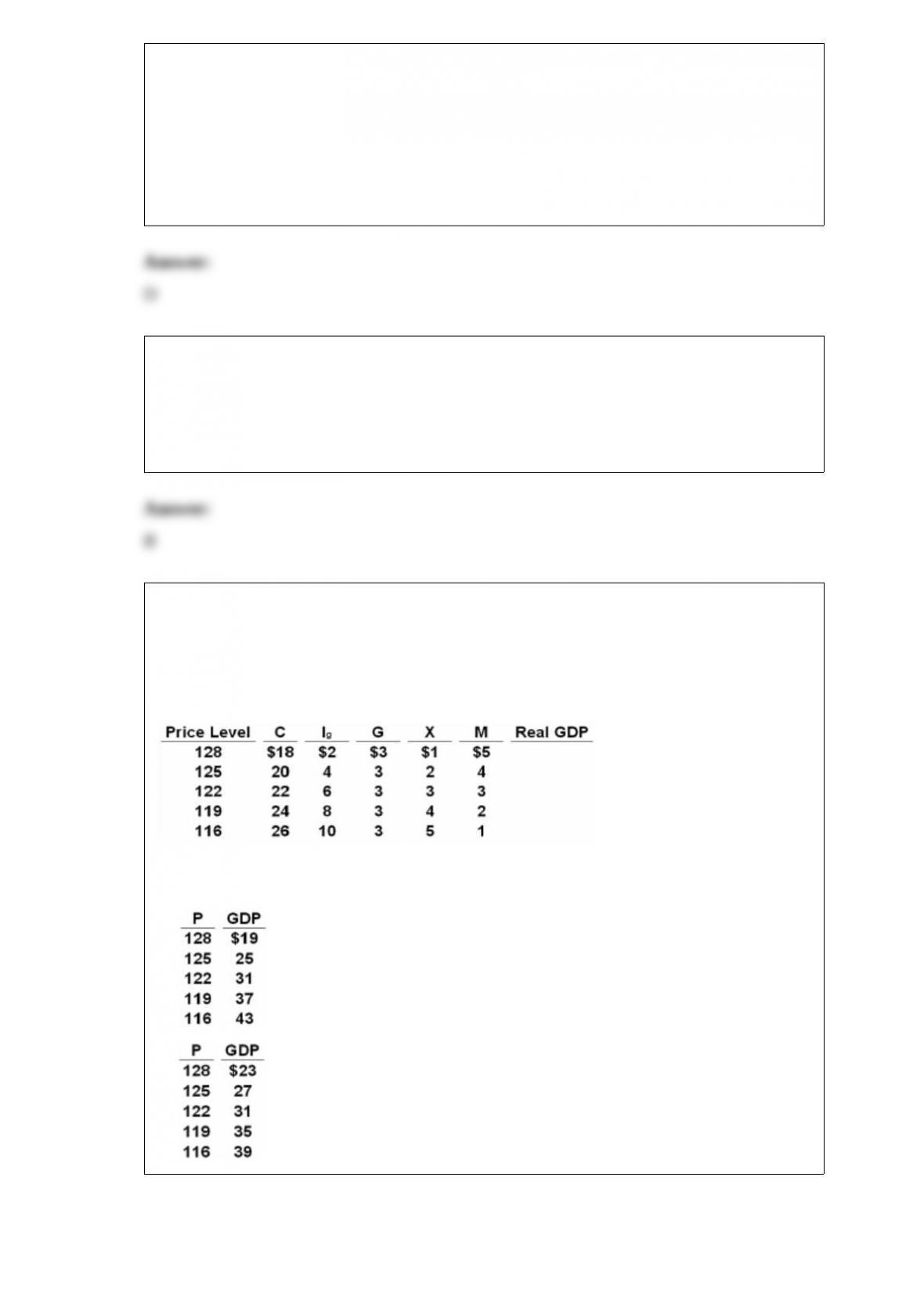
3) Answer the next question(s) on the basis of the following table for a particular
country in which C is consumption expenditures, Ig is gross investment expenditures, G
is government expenditures, X is exports, and M is imports. All figures are in billions of
dollars. Each question is independent of the other questions.
Refer to the above table. Which of the following schedules constitutes aggregate
demand in this country?
A.
B.

C.
D.
4) which of the following is the smallest dollar amount in the united states?
a.disposable income
b.personal income
c.gross domestic product
d.national income
5) If a firm is hiring variable resources D and F in imperfectly competitive input
markets, it will maximize profits by employing D and F in such quantifies that:
A.MRPD/MRCD = MRPF/MRCF = 1.
B.MRPD/MRCD = MRPF/MRCF.
C.MRPD/PD = MRPF/PF = 1.
D.MRPD/PD = MRPF/PF.
6) If the supply of a product is perfectly elastic and demand is downsloping, an excise
tax of $2 per unit will increase price by:
A.more than $2.
B.less than $2.
C.$2 and increase equilibrium output.
D.$2 and reduce equilibrium output.
7) The following table shows the marginal benefit that a particular public project will
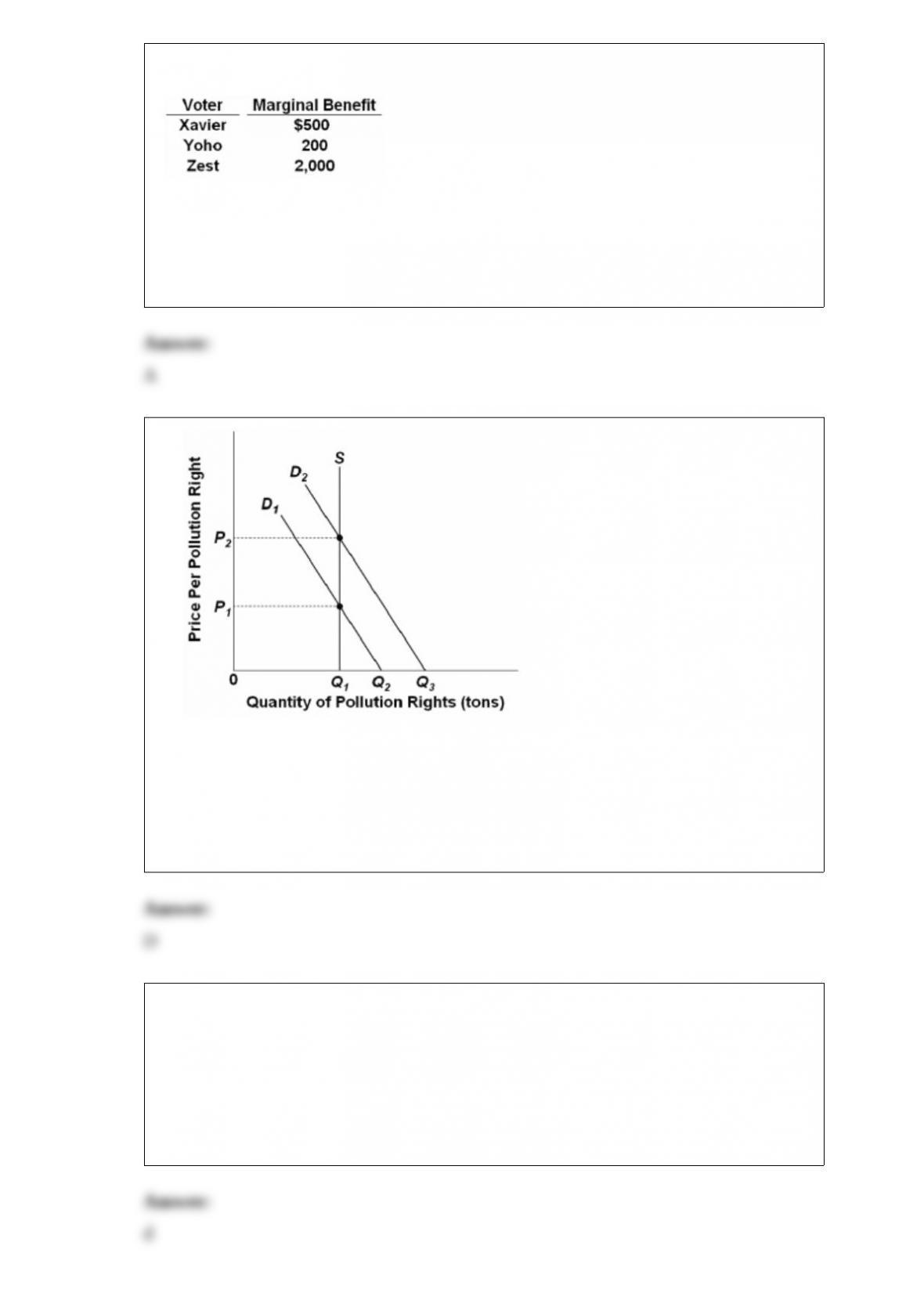
provide to each of the three members of a community. No vote trading is allowed.
If the tax cost of this proposed project is $600 per person, a majority vote will:
A.defeat this project and resources will be underallocated to it.
B.defeat this project and resources will be allocated efficiently.
C.pass this project and resources will be overallocated to it.
D.defeat this project and resources will be overallocated to it.
8)
Refer to the above diagram of a market for pollution rights. The increase in the price of
pollution rights from P1 to P2will:
A.reduce the quantity of pollution rights.
B.increase the quantity of pollution rights.
C.increase the incentive for environmental groups to buy pollution rights.
D.increase the opportunity cost of polluting.
9) the concept of net domestic investment refers to:
a.the amount of machinery and equipment used up in producing the gdp in a specific
year.
b.the difference between the market value and book value of outstanding capital stock.
c.gross domestic investment less net exports.
d.total investment less the amount of investment goods used up in producing the year’s
output.

10)
Refer to the above table. An interest rate of 2 percent is not sustainable because:
A.the demand for bonds in the bond market will fall and the interest rate will fall.
B.the demand for bonds in the bond market will rise and the interest rate will fall.
C.the supply of bonds in the bond market will decline and the interest rate will rise.
D.the supply of bonds in the bond market will rise and the interest rate will rise.
11) Under an international gold standard:
A.exchange rates would fluctuate inversely with the domestic interest rates of the
participating countries.
B.each nation must agree to depreciate its currency in direct proportion to the growth of
its real GDP.
C.gold would flow into a nation experiencing a balance of payments surplus.
D.exchange rates would fluctuate directly with the domestic price levels of the various
trading countries.
12) determine, other things equal, the effects of a given change in a determinant of
demand or supply for product x upon (1) the demand (d) for, or supply (s) of, x, (2) the
equilibrium price (p) of x and (3) the equilibrium quantity (q) of x.
refer to the above. an increase in the prices of resources used to produce x will:
a.increase s, increase p, and increase q.
b.increase d, increase p, and increase q.
c.decrease s, decrease p, and decrease q.
d.decrease s, increase p, and decrease q.
13) graphically, consumer surplus is measured as the triangle:
a.under the demand curve and below the actual price.
b.under the demand curve and above the actual price.
c.above the supply curve and above the actual price.
d.above the supply curve and below the actual price.
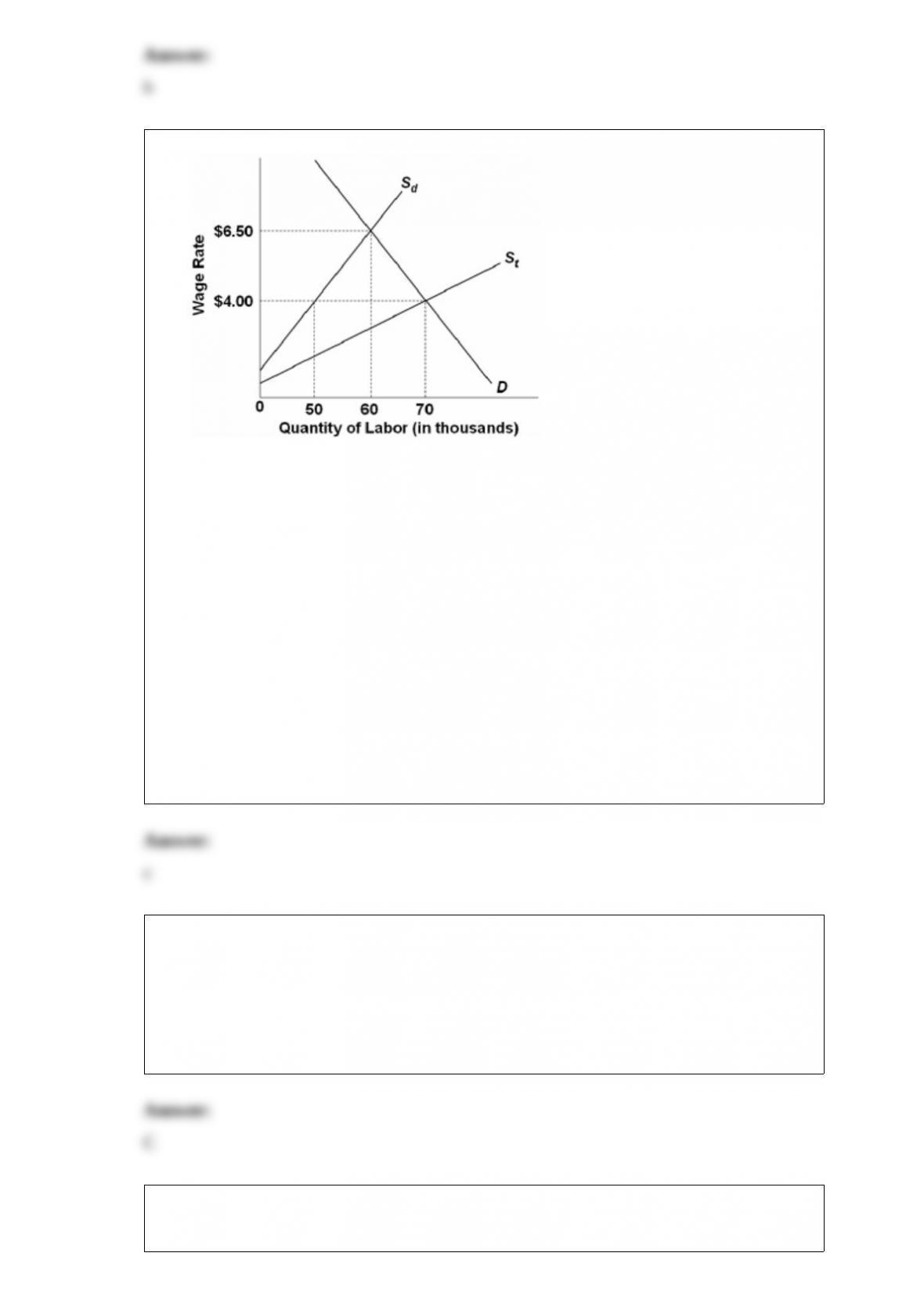
14)
assumptions: 1) employers in this market are willing and able to ignore minimum wage
laws; 2) sd represents the supply of domestically-born (and legal immigrant) workers;
3) st represents the total supply of workers in this labor market (sd plus illegal
immigrants); and 4) unless otherwise stated, illegal immigration is not effectively
blocked by the government.
refer to the above figure. it suggests that:
a.illegal immigrant workers are in this market because these are jobs that domestic-born
workers are unwilling to do.
b.employment of domestic-born workers could be increased by 20,000 if illegal
immigration were blocked.
c.the presence of illegal immigrants in this labor market reduces wages, making these
jobs less attractive to domestic-born workers.
d.firms hiring from this labor market would be forced to shut down if illegal
immigration were blocked.
15) Overnight loans from one bank to another for reserve purposes entail an interest
rate called the:
A.prime rate.
B.discount rate.
C.Federal funds rate.
D.treasury bill rate.
16) (Consider This) Credits cards are:
A.the fastest growing component of the M1 money supply.
B.near-monies that are part of the M2 money supply but not the M1 money supply.
C.not money, officially defined.
D. also known as time deposits.
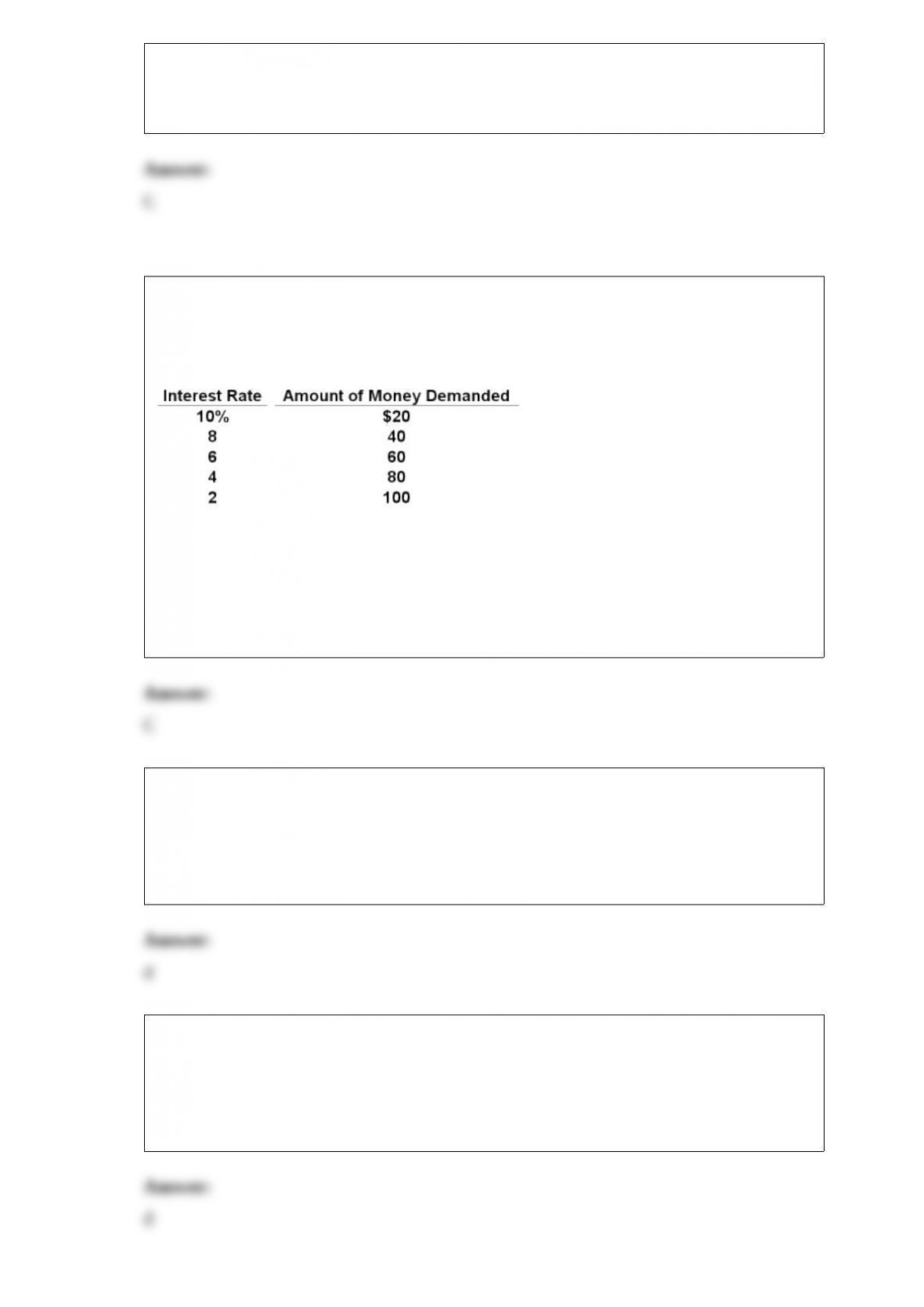
17) The following information. For transactions, households and businesses want to
hold an amount of money equal to one half of nominal GDP. The table shows the
amounts of money they want to hold as an asset at various interest rates.
Refer to the above information. If nominal GDP is $300 and the supply of money is
$230, the equilibrium interest rate will be:
A.8 percent.
B.6 percent.
C.4 percent.
D.2 percent.
18) real income is found by:
a.dividing nominal income by 70.
b.multiplying nominal income by 1.03.
c.dividing the price index (in hundredths) by nominal income.
d.dividing nominal income by the price index (in hundredths).
19) a firm’s supply curve is upsloping because:
a.the expansion of production necessitates the use of qualitatively inferior inputs.
b.mass production economies are associated with larger levels of output.
c.consumers envision a positive relationship between price and quality.
d.beyond some point the production costs of additional units of output will rise.

20) If country A can produce both goods X and Y more efficiently, that is, with smaller
absolute amounts of resources, than can country B:
A.mutually advantageous specialization and trade between A and B may still be
possible.
B.we can conclude that A is an industrially advanced economy and B is a developing
economy.
C.it will necessarily be advantageous for B to import both X and Y from A
D.then there is no possible basis for mutually advantageous specialization and trade
between A and B