
If the inflation rate falls and nominal interest rates are unchanged,
A) inflation will fall.
B) inflation will continue at the same rate.
C) real interest rates rise.
D) real interest rates are unaffected.
E) real interest rates fall.
A firm’s demand curve is given by P = 500 – 2Q. The firm’s current price is $300 and
the firm sells 100 units of output per week.
a. Calculate the firm’s marginal revenue at the current price and quantity using the
expression for marginal revenue that utilizes the price elasticity of demand.
b. Assuming that the firm’s marginal cost is zero, is the firm maximizing profit?

Consider the information below:
For Group A the cost of attaining an educational level y is

CA(y) = $6,000y
and for Group B the cost of attaining that level is
CB (y) = $10,000y.
Employees will be offered $50,000 if they have y < y*, where y* is an education
threshold determined by the employer. They will be offered $130,000 if they have y >
y*.
The highest level of y* that can be set and still have the high-productivity people
choose to meet it is
A) 16.
B) 13 1/3.
C) 13.
D) 8.
E) 0.
At point D, demand is:
A) completely inelastic.
B) inelastic, but not completely inelastic.
C) unit elastic.
D) elastic, but not infinitely elastic.
E) infinitely elastic.
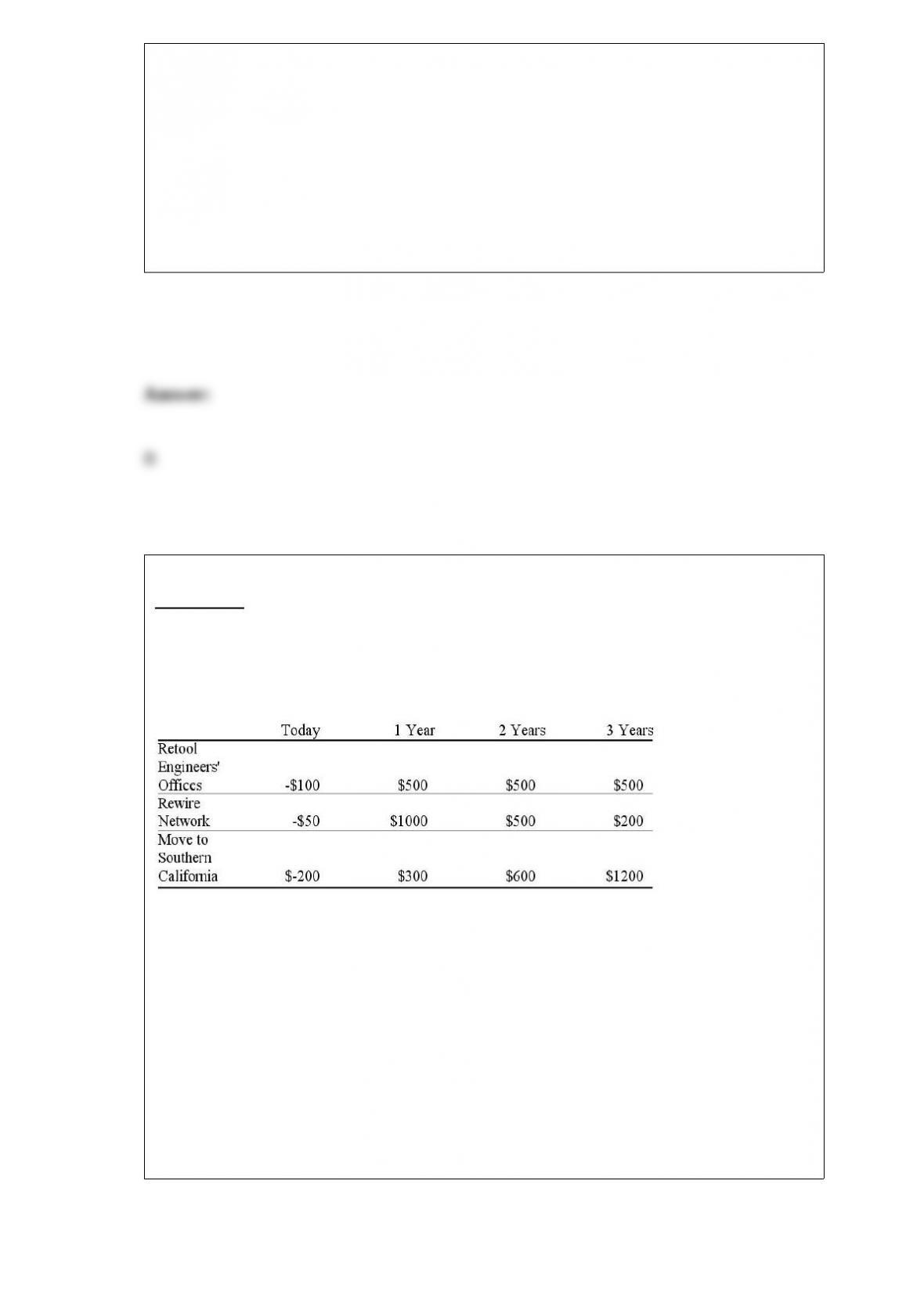
Scenario 2:
Consider the payment streams listed below that are available from different capital
projects for Furry Software. The firm must choose to implement just one out of the
three possible projects.
If the interest rate were 2%, Furry Software should
A) retool the offices.
B) rewire the network.
C) move to Southern California.
D) be indifferent between retooling and rewiring.
E) be indifferent between rewiring and moving.

A simple linear demand function may be stated as Q = a – bP + cI where Q is quantity
demanded, P is the product price, and I is consumer income. To compute an appropriate
value for b, we can use observed values for Q and P and then set -b(P/Q) equal to the:
A) income elasticity of demand.
B) cross-price elasticity of demand.
C) price elasticity of demand.
D) price elasticity of supply.
Scenario 5.3:
Wanting to invest in the computer games industry, you select Whizbo, Yowzo and
Zowiebo as the three best firms. Over the past 10 years, the three firms have had good
years and bad years. The following table shows their performance:
Refer to Scenario 5.3. Based on the 10 years’ past performance, rank the companies’
expected revenue, highest to lowest:
A) Whizbo, Yowzo, Zowiebo

B) Whizbo, Zowiebo, Yowzo
C) Zowiebo, Yowzo, Whizbo
D) Zowiebo, Whizbo, Yowzo
E) Zowiebo, with Whizbo and Yowzo tied for second
Bindy, an 18-year-old high school graduate, and Luciana, a 40-year-old college
graduate, just purchased identical hot new sports cars. Acme Insurance charges a higher
rate to insure Bindy than Luciana. This practice is an example of:
A) collusion.
B) price discrimination.
C) two-part tariff.
D) bundling.
E) none of the above
A perpetual payment of $10,000, offered for sale at $125,000, is being offered at an
effective yield of
A) 8%.

B) 2%
C) 5%.
D) 80%.
E) 92%.
Scenario 14.1:
You are the manager of a firm producing green chalk. The marginal product of labor is:
MPL = 24L-1/2
Suppose that the firm is a competitor in the green chalk market. The price of green
chalk is $1 per unit. Further suppose that the firm is a competitor in the labor market.
The wage rate is $12.00 per hour.
Given the information in Scenario 14.1, how much labor will be hired to maximize
profit?
A) 1/16
B) 1/2
C) 1
D) 4

To optimally deter crime, law enforcement authorities should:
A) set higher fines for crimes that have a lower probability of being caught.
B) set the fine equal to the expected benefit, even if it is difficult to catch the offenders.
C) ignore the probabilities of catching offenders and attempt to prevent crime at all
costs.
D) set very high fines regardless of the probability that an offender is caught.
Use the following statements to answer this question:
I. Based on the principal-agent framework in economics, we know that the lack of
incentive compatibility may arise in private firms but not in public agencies or
government bureaus.
II. The key problem in principal-agent situations is the principal’s fundamental inability
to oversee or supervise the agent.
A) I and II are true.
B) I is true and II is false.
C) II is true and I is false.
D) I and II are false.

The effect of the September 11 attacks on the World Trade Center on the market for
office space in downtown Manhattan was that both the equilibrium price and the
equilibrium quantity fell. What is the most likely explanation for this?
A) Supply and demand both shifted left, and the magnitude of the demand shift was
greater.
B) Supply and demand both shifted left, and the magnitude of the supply shift was
greater.
C) Supply shifted left, demand shifted right, and the magnitude of the demand shift was
greater.
D) Supply shifted left, demand shifted right, and the magnitude of the supply shift was
greater.
Which of the following goods has a low, but positive, income elasticity of demand?
A) furniture.
B) new cars.
C) health insurance.
D) all of the above
E) none of the above
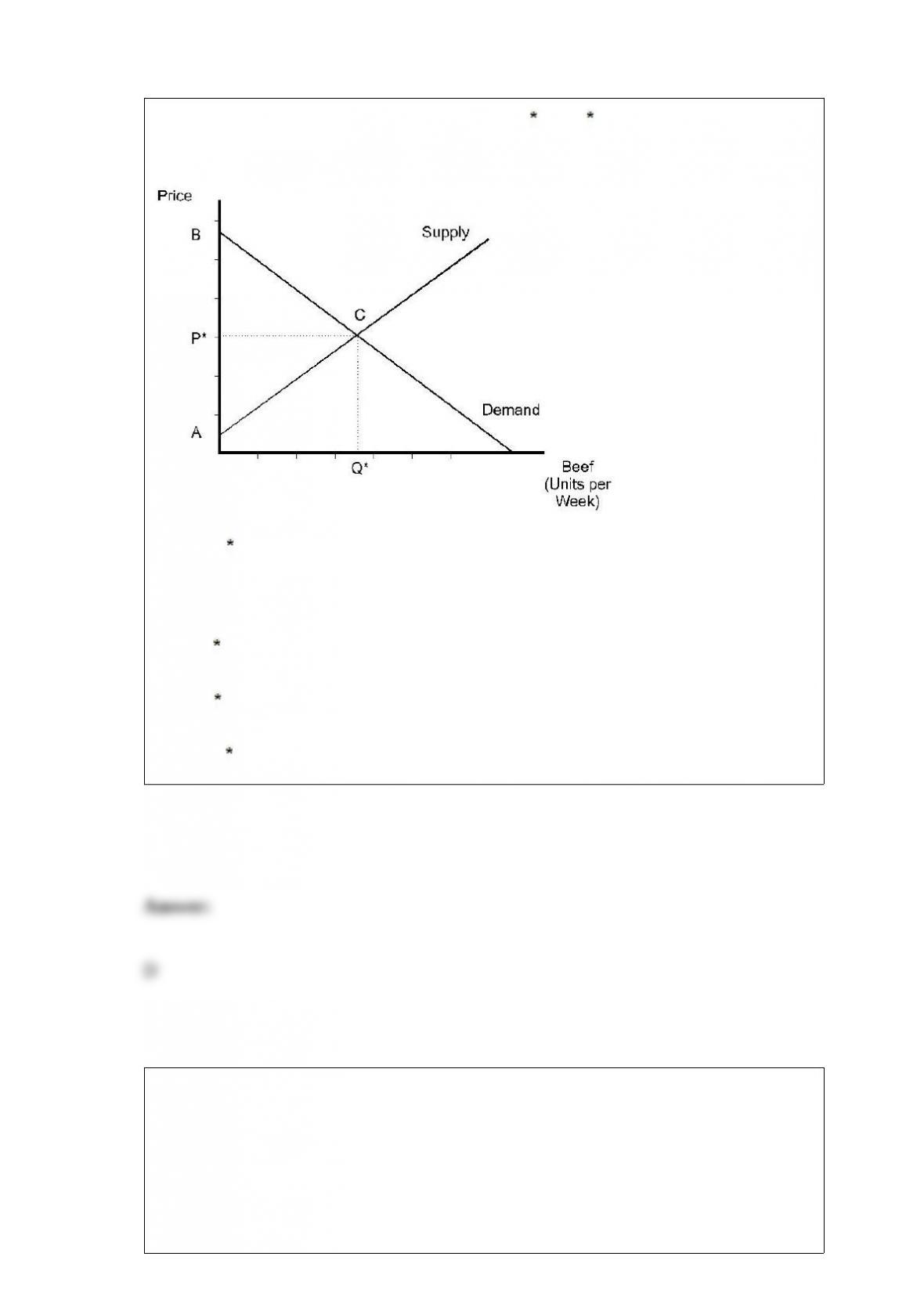
The price of beef and quantity of beef traded are P and Q , respectively. Given this
information, consumer surplus is the area:
A) 0BCQ
B) ABC
C) ACP
D) CBP
E) 0ACQ
Imagine a primitive society in which there are two goods: food and shelter. The utility
functions for two representative members of the society, Jane and Paul, are given below.
Jane’s utility function:
UJ = 25F0.5S0.5
Paul’s utility function:
UP = 50F0.75S0.25
where F = units of food, and S = units of shelter.
a. Determine the marginal rate of substitution for each individual.
b. The current prices of food and shelter are $12 and $6, respectively. Determine the
proportions in which Jane and Paul should consume food and clothing to achieve an
exchange equilibrium.

BioMed Pharmaceutical has held a patent on an important heart medication called
Heartex, but the patent will expire in the coming year. After the patent expires, other
firms can legally sell the same medication as a generic drug product. What will happens
to the demand for Heartex and to the Lerner index for this product as the generic drugs
enter the market?
A) Demand becomes less elastic, Lerner index increases
B) Demand becomes less elastic, Lerner index declines
C) Demand becomes more elastic, Lerner index increases
D) Demand becomes more elastic, Lerner index declines
The two leading U.S. manufacturers of high performance radial tires must set their
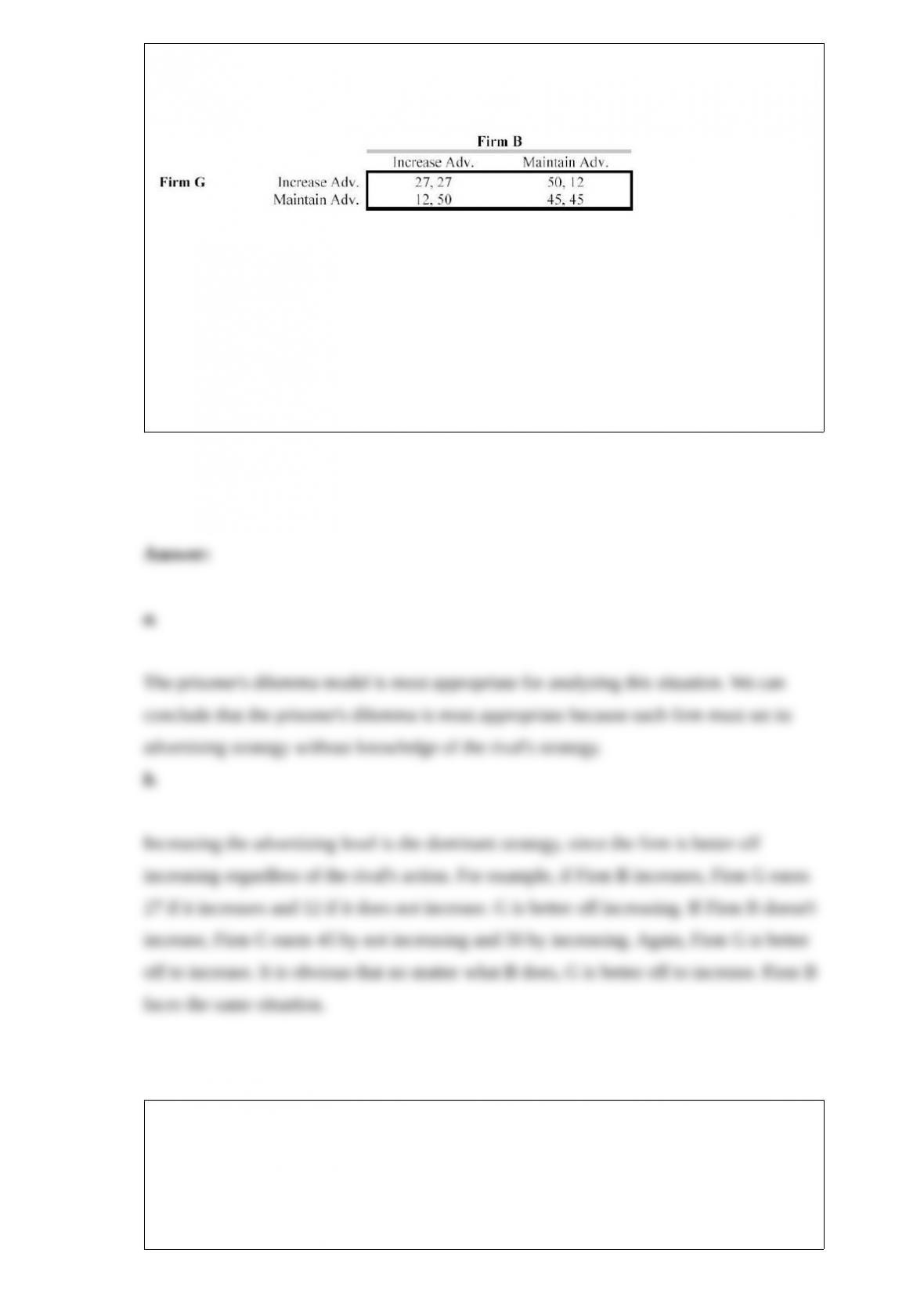
advertising strategies for the coming year. Each firm has two strategies available:
maintain current advertising or increase advertising by 15%. The strategies available to
the two firms, G and B, are presented in the payoff matrix below.
The entries in the individual cells are profits measured in millions of dollars. Firm G’s
outcome is listed before the comma, and Firm B’s outcome is listed after the comma.
a. Which oligopoly model is best suited for analyzing this decision? Why? (Remember
it is illegal to collude in the United States.)
b. Carefully explain the strategy that should be used by each firm. Support your choice
by including numbers.
Let P be the output price for a particular good. Why is the value P*MPL greater than
MRPL for a monopolist?
A) The monopolist is not as technically efficient as firms operating under perfect
competition.
B) The monopolist hires less labor, so MPL is higher under a monopoly than under
perfect competition.
C) The monopolist sets a price that is higher than MR.
D) A and C are correct.
E) B and C are correct.
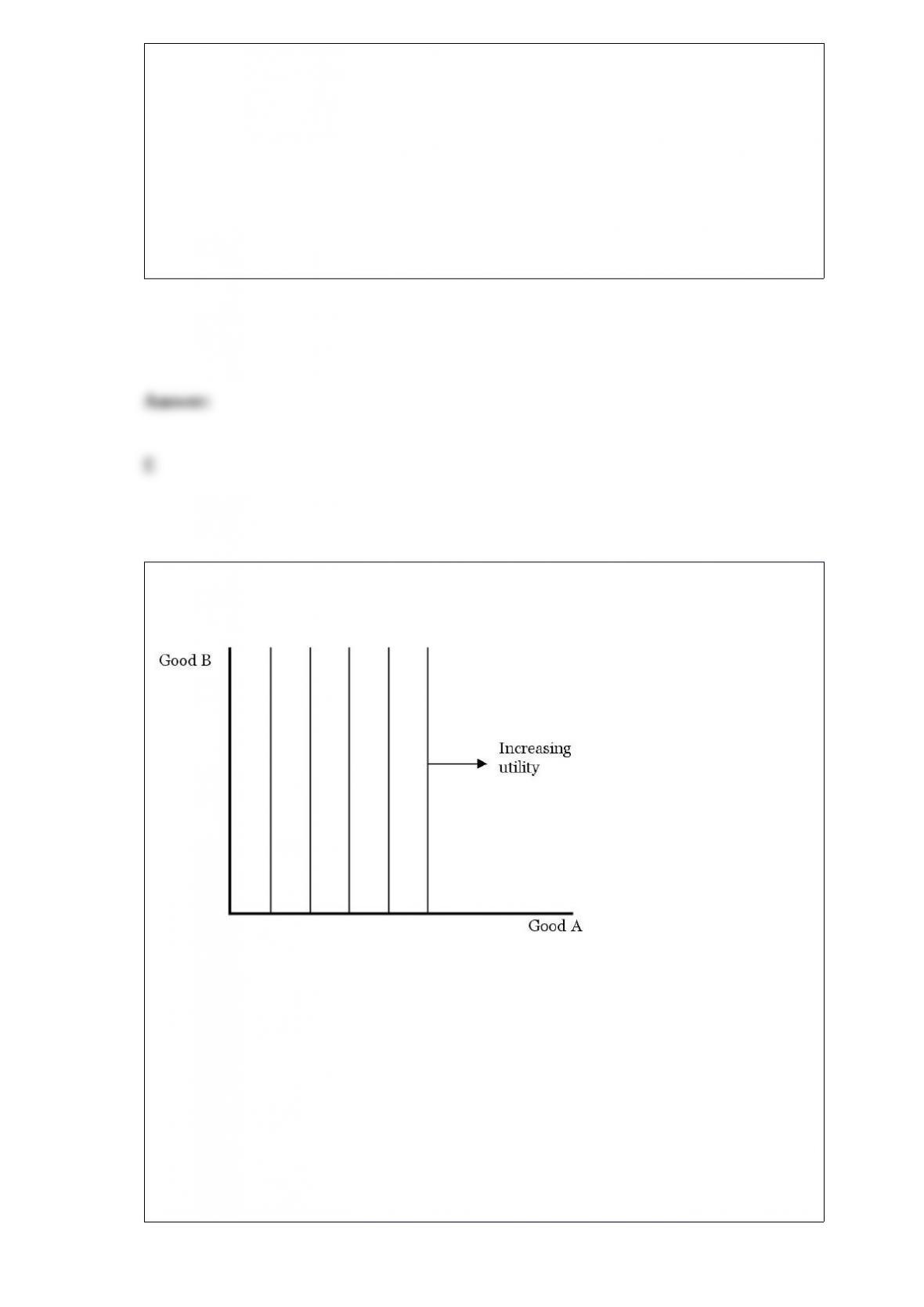
Figure 3.3
Refer to the indifference curve in Figure 3.3. Which of the following is true about the
MRS?
A) It is negative.
B) It is positive.
C) It is equal to zero.
D) It is undefined.

The world demand for power transmission wire is made up of both domestic and
foreign demands. Thus, the total demand is the sum of the two sub-demands, which are
given as:
Domestic demand: Pd = 5 – 0.005Qd
Foreign demand: Pf = 3 – 0.00075Qf,
where Pd and Pf are in dollars per pound, and Qd and Qf are in pounds per day.
a. Determine the world demand for power transmission wire.
b. Determine the prices at which domestic and foreign buyers would enter the market.
c. Determine the domestic and foreign quantities at P = $2.50 per pound. Check to see if
the sum of Qd and Qf equals Q.
d. Determine total rate of purchases at P = $4.00 per pound.
At the profit-maximizing level of output, marginal profit
A) is also maximized.

B) is zero.
C) is positive.
D) is increasing.
E) may be positive, negative or zero.
Scenario 4.2:
Suppose that the demand for artichokes (Qa) is given as:
Qa = 200 – 4PUse the information in Scenario 4.2. At what price, if any, is the demand
for artichokes completely elastic?
A) 50
B) 30
C) 10
D) 0
E) none of the above
Other things equal, expected income can be used as a direct measure of well-being

A) always.
B) no matter what a person’s preference to risk.
C) if and only if individuals are not risk-loving.
D) if and only if individuals are risk averse.
E) if and only if individuals are risk neutral.
What is the shape of the marginal revenue curve derived from a linear downward
sloping demand curve?
A) Horizontal
B) Vertical
C) U-shaped
D) Downward sloping, with a constant slope
Scenario 17.5
Consider the following information:

Income to the firm from workers who sell door-to-door
Bad Luck Good Luck
Low Effort (e = 0) $5,000 $7,000
High Effort (e = 1) $7,000 $13,000
Cost of effort: c = $2500e
Probabilities: Bad luck = .75; Good luck = .25
The owners can’t know whether the workers are exerting high or low effort if income is
A) $5000.
B) $7000.
C) above $7000.
D) $13,000.
E) above $13,000.
Suppose that the prices of good A and good B were to suddenly double. If good A is
plotted along the horizontal axis,
A) the budget line will become steeper.
B) the budget line will become flatter.
C) the slope of the budget line will not change.
D) the slope of the budget line will change, but in an indeterminate way.

Which of the following statements correctly characterizes the problem with comparing
production outcomes that are stocks and flows?
A) Labor usage is always a flow, which makes it difficult to compare with stock inputs
like capital.
B) Most capital inputs are stocks, but the returns on these investments (profits) occur as
a flow.
C) Most capital inputs are flows, but economists treat these expenditures as stocks by
using the opportunity or economic costs associated with these inputs.
D) Business returns or profits may be equivalently viewed as stocks or flows, which
makes it difficult to compare the returns with the input expenditures.
Alvin’s preferences for good X and good Y are shown in the diagram below.
Figure 3.2

Refer to Figure 3.2. At any consumption bundle with the quantity of good X exceeding
the quantity of good Y (that is, a bundle located below the 45 degree line, like point A),
Alvin’s marginal rate of substitution of good X for good Y is
A) diminishing.
B) positive.
C) constant and positive.
D) zero.
If the actual price were below the equilibrium price in the market for bread, a:
A) surplus would develop that cannot be eliminated over time.
B) shortage would develop, which market forces would eliminate over time.
C) surplus would develop, which market forces would eliminate over time.
D) shortage would develop, which market forces would tend to exacerbate.
Scenario 1:
Irrespective of the amount of cheese doodles and pretzels that Sam consumes, his
marginal rate of substitution of cheese doodles for pretzels is 2. Also, irrespective of the

amount of cheese doodles and pretzels that Sally consumes, her marginal rate of
substitution of cheese doodles for pretzels is 3.
Suppose instead that Sam is initially allocated 3 cheese doodles and 3 pretzels, whereas
Sally is initially allocated 6 cheese doodles and 10 pretzels. Which of the following
statements is TRUE?
A) This allocation is Pareto optimal.
B) This allocation is not Pareto optimal as Sally and Sam have unequal amounts of each
good.
C) The allocation is not Pareto optimal as Sally would be willing to exchange two
pretzels for one cheese doodle and be better off, without making Sam worse off.
D) The allocation is not Pareto optimal as Sam would willing exchange one pretzel for
two cheese doodles and be better off, without making Sally worse off.