
The Hatfields and the McCoys both earn $50,000 per year in real terms in the labor
market, and both families are able to earn a 5% real interest rate on their savings. In the
year 2010, both families began to save. The Hatfields saved 8% of their income each
year; the McCoys saved 10%. In 2010, the Hatfields consumed ______ more than the
McCoys; in 2011, the Hatfields consumed ______ than the McCoys.
A. $1,000; about $960 less
B. $2,000; about $960 more
C. $1,000; about $960 more
D. $2,000; about $960 less
The real exchange rate is the:
A. price of the average domestic good or service relative to the price of the average
foreign good or service, when prices are expressed in terms of a common currency.
B. quantity of foreign currency assets held by a government for the purpose of
purchasing the domestic currency in the foreign exchange market.
C. rate at which two currencies can be traded for each other.
D. nominal exchange rate adjusted for domestic inflation.

There is $5,000,000 of currency in Econland, all held by banks as reserves. The public
does not hold any currency. If the banks’ desired reserve/deposit ratio is 0.25, then the
money supply equals:
A. $5,000,000
B. $6,250,000
C. $10,000,000
D. $20,000,000
Refer to the figure below. Player A can infer that Player B will:
A. choose Left.
B. choose Right.
C. choose Left when A chooses Up and choose Right when A chooses Down.
D. Player A cannot infer anything about what Player B will do given this matrix.
Additional economic growth should be pursued when:

A. new technologies are discovered.
B. scarcity exists.
C. the marginal costs of growth exceed the marginal benefits.
D. the marginal costs of growth are less than the marginal benefits.
The Fed cannot achieve a negative real interest rate if the inflation rate is zero or
negative because:
A. the nominal interest rate cannot fall below zero.
B. inflation doves will not permit a negative real interest rate.
C. zero or negative values of inflation can not be accurately measured.
D. inflationary expectations are not anchored when the inflation rate is zero.
Labor income includes:
A. wages, salaries, and earnings of the self-employed.
B. payments to owners of factories, machines, and buildings.
C. interest, dividends, and rent.
D. profits, royalties, and rent.

You expect a share of EconNews.Com to sell for $65 a year from now. If you are
willing to pay $61.06 for one share of the stock today, you expect a dividend payment
of $4, and the rate of return on safe assets is 5%, how much is your risk premium?
A. 1.5%
B. 6.5%
C. 8.0%
D. 13.0%
The table below shows the relationship between the number of times you get your car
washed each month and your total monthly benefit from car washes. Each car wash
costs $15.
What is the marginal cost of the 5th car wash each month?
A. $15
B. $14
C. $12
D. $4
Which of the following is the most likely to be a fixed factor of production at a pizza
restaurant?
A. The number of waiters.
B. The size of the seating area.
C. The amount of pizza dough.
D. The amount of electricity.
The tendency for inflation to change relatively slowly from year to year in industrial
countries is called:
A. the inflation gap
B. inflation expectations.
C. inflation inertia.
D. potential inflation.
Which of the following firms is most likely to be a pure monopolist?
A. A clothing retailer with the best location in a mall
B. A grocery store in a large city
C. The most popular hot dog vendor on a city street corner
D. The only gas station in a small, isolated town
Pat earns $25,000 per year (after taxes), and Pat’s spouse, Chris, earns $35,000 (after
taxes). They have two pre-school-aged children. Childcare for their children costs
$12,000 per year. Given that Chris doesn’t want to stay home with the kids, regardless
of what Pat does, Pat should stay home with the kids if, and only if, the value of Pat
spending more time with the kids is greater than:
A. $37,000 per year.
B. $25,000 per year.
C. $13,000 per year.
D. $12,000 per year.

Which of the following is NOT true of a perfectly competitive firm?
A. It faces a perfectly elastic demand curve.
B. It is unable to influence the price of the good it sells.
C. It seeks to maximize revenue.
D. It sells only a small fraction of the total quantity exchanged in the market.
In the short-run Keynesian model where the marginal propensity to consume is 0.5, to
offset an expansionary gap resulting from a $1 billion increase in autonomous
consumption, government purchases must be:
A. increased by $1 billion.
B. decreased by $1 billion.
C. decreased by $0.5 billion.
D. decreased by $2 billion.
The major suppliers of U.S. dollars to the foreign exchange market are:
A. foreigners wishing to purchase U.S. goods or assets.
B. the Federal Reserve.
C. U.S. households or firms wishing to purchase U.S. goods or assets.
D. U.S. households or firms wishing to purchase foreign goods or assets.
Suppose a monopolist faces the demand curve shown below.
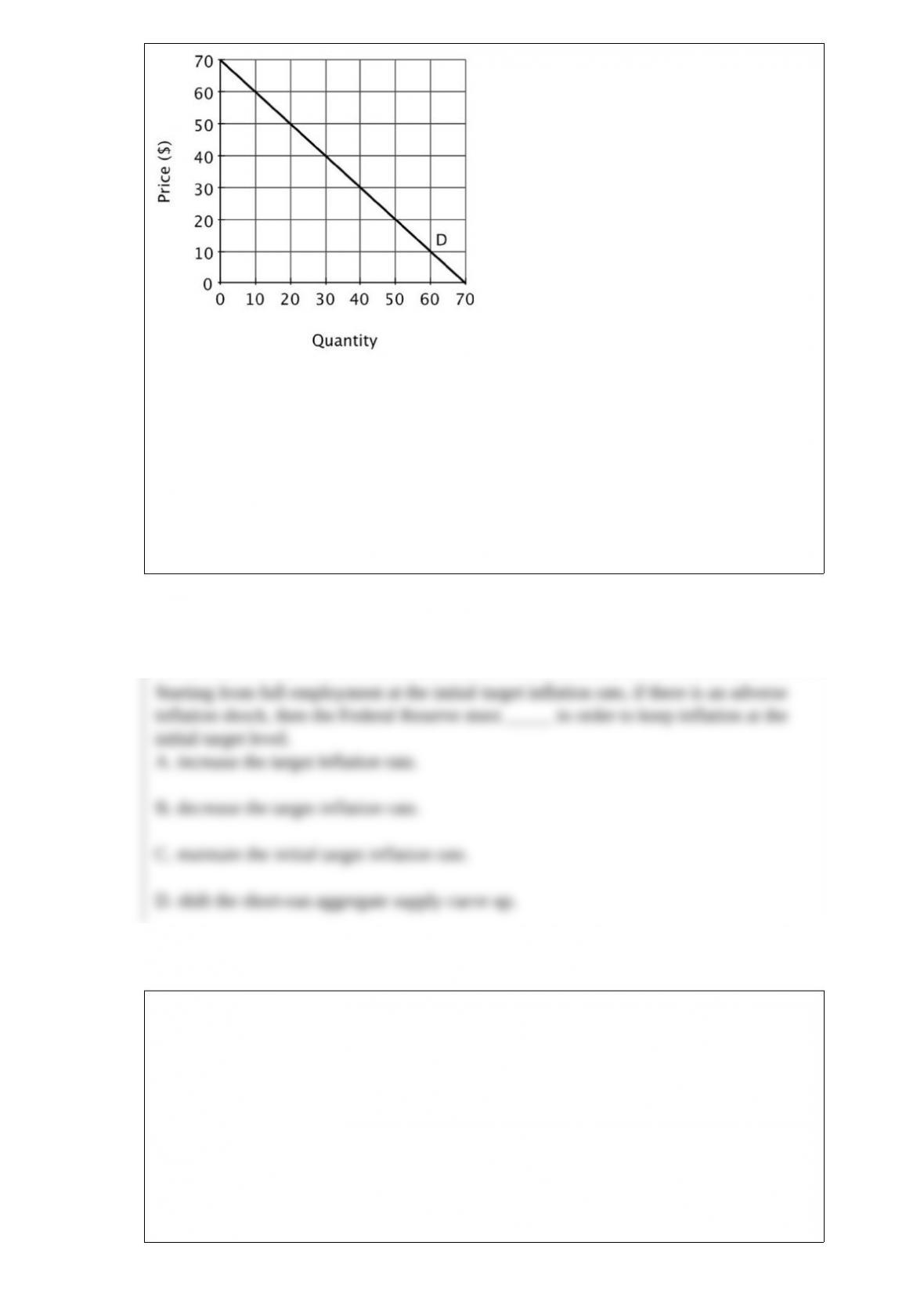
The marginal revenue of the 35th unit of output is:
A. $20.
B. $10.
C. $0.
D. $-5.
Starting from full employment at the initial target inflation rate, if there is an adverse
inflation shock, then the Federal Reserve must _____ in order to keep inflation at the
initial target level.
A. increase the target inflation rate.
B. decrease the target inflation rate.
C. maintain the initial target inflation rate.
D. shift the short-run aggregate supply curve up.
One factor that contributed to the growth in the share of population employed in the
United States between 1960 and 2010 was increased:
A. labor union participation.
B. female labor force participation.
C. male labor force participation.
D. minimum wages.
If commercial banks are maintaining a 4 percent reserve/deposit ratio and the Fed raises
the required reserve ratio to 6 percent, then banks will ______ their loans based on
current deposits, and the money supply will _____.
A. increase; increase
B. increase; decrease
C. decrease; increase
D. decrease; decrease
Which of the following statements is true?
A. Absolute advantage implies comparative advantage.
B. Comparative advantage does not require absolute advantage.
C. Absolute advantage requires comparative advantage.
D. Comparative advantage requires absolute advantage.
If potential output for an economy equals $8 billion, and actual output equals $7 billion,
then this economy has a(n):
A. budget deficit.
B. trade deficit.
C. expansionary gap.
D. recessionary gap.
Defenders of limits on economic growth are concerned that continued economic growth
will eventually:
A. raise interest rates.
B. reduce the rate of technological progress.
C. exhaust natural resources.
D. make plant and equipment obsolete.
Tracy and Amy are playing a game in which Tracy has the first move at X in the
decision tree shown below. Once Tracy has chosen either the top or bottom branch at X,
Amy, who can see what Tracy has chosen, must choose the top or bottom branch at Y or
Z. Both players know the payoffs at the end of each branch.
The equilibrium to the game results in ______ for Amy and Tracy relative to what they
could get if they could solve their ______.
A. lower payoffs; prisoner’s dilemma
B. higher payoffs; commitment problem
C. lower payoffs; credible threat
D. lower payoffs; commitment problem
Lane and Riley are the only two residents in a neighborhood, and they share the same
driveway. They would like to have the driveway paved. The value of the paved
driveway is $1,500 to Lane and $900 to Riley. Regardless of who pays for the paving
both people will benefit from it.
If the cost of paving the driveway is $2,000 and Lane proposes that they each pay 50
percent of this cost, then Riley ______ agree to Lane’s proposal because ______.
A. will; repaving the driveway would increase total economic surplus
B. will not; repaving the driveway would lower total economic surplus
C. will; if they split the cost, then Riley’s economic surplus would increase
D. will not; if they split the cost, then Riley’s economic surplus would decrease
On January 1, 2008, Anna invested $5,000 at 5% interest for one year. The CPI on
January 1, 2009 stood at 1.60. On January 1, 2009, the CPI was 1.68. The real rate of
interest earned by Anna was ______ percent.
A. -5
B. 0
C. 5
D. 8
Many beaches have a lifeguard on duty during the summer but not during the winter.
The most likely explanation for this is that:
A. the marginal cost of having a lifeguard on duty varies over the year and tends to be
lower during the summer.
B. the marginal benefit of having a lifeguard on duty is higher during the summer when
more people are at the beach.
C. people understand that if you go swimming at the beach during the winter, you do so
at your own risk.
D. there is no danger of drowning at the beach during the winter.
Which of the following events would increase the unemployment rate, if nothing else
changed?
A. Unemployed workers leave the labor force.
B. Employed workers leave the labor force.
C. Workers from outside the labor force become employed.
D. Unemployed workers become employed.

The CPI equals 1.00 in year one and 1.15 in year two. If the nominal wage is $15 in
year one and a contract calls for the wage to be indexed to the CPI, what will be the
nominal wage in year two?
A. $15.00
B. $16.15
C. $17.25
D. $22.50
Suppose a firm uses workers and office space to produce output. The firm is locked into
a year-long lease on its office space, but it can easily vary the number of
employee-hours it uses each day. The table below describes the relationship between
the number of employee-hours the firm uses each day and the firm’s daily output. Each
unit of output sells for $2, the hourly wage rate is $14, and the rent on the office space
is $50 per day.
This firm’s fixed cost each day is:
A. $66
B. $64
C. $50
D. $14

Average variable cost is defined as:
A. Total cost divided by total output
B. Total cost divided by number of workers
C. Variable cost divided by total output
D. Variable cost divided by price