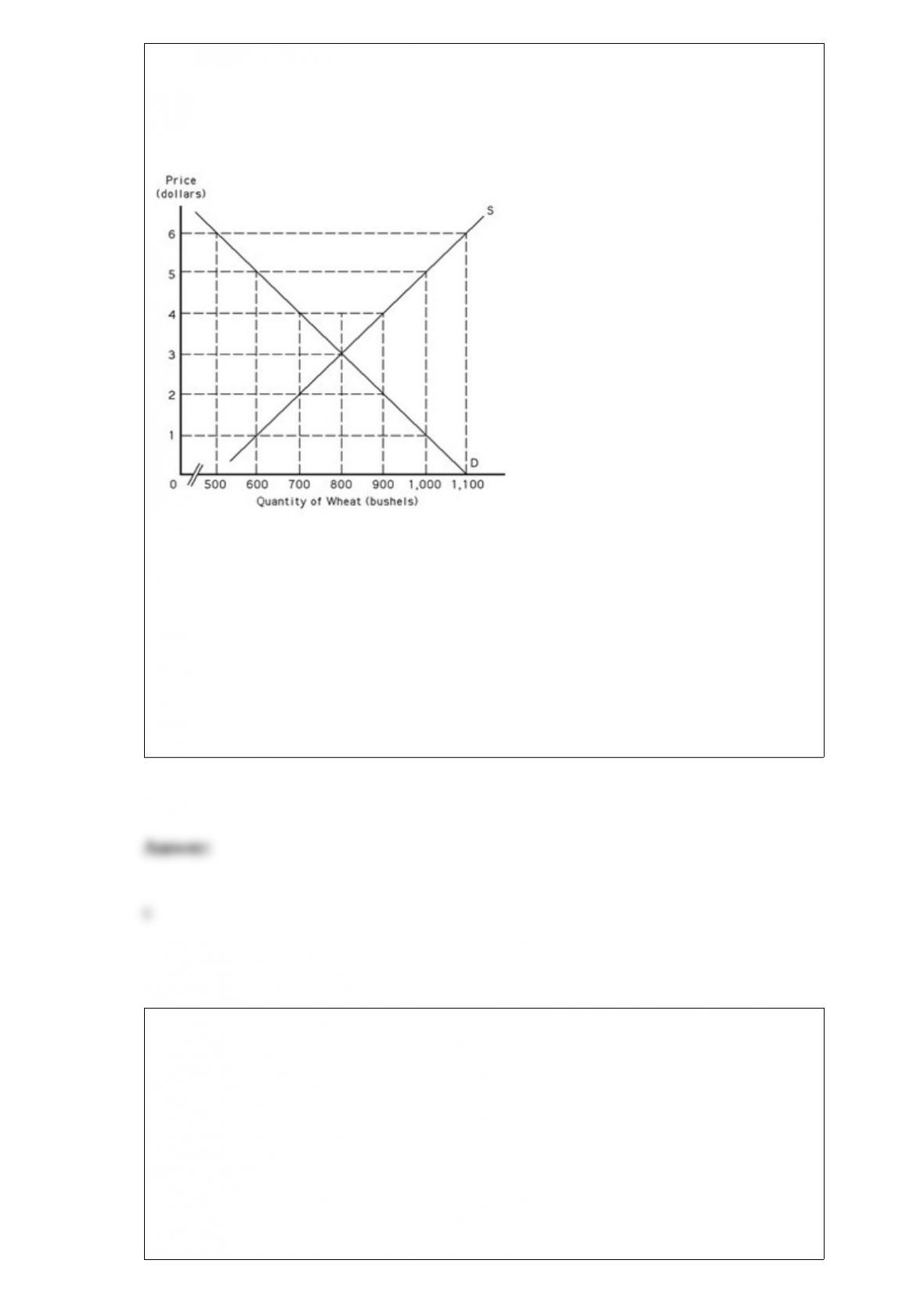
Refer to Exhibit 39-4. The government feels that the present level of farmers’ total
revenues is insufficient to support a reasonable standard of living and wants to raise it
to exactly $3,000. This can be achieved by
Exhibit 39-4
a. restricting supply so that price increases to $4.
b. a price support of $5.
c. restricting supply so that price increases to $5.
d. any of the above
e. none of the above
In country A the income shares (in percent) received by the lowest fifth of income
groups to the highest fifth of income groups is, respectively, 10, 15, 20, 25, and 30. In
country B the income shares (in percent) received by the lowest fifth of income groups
to the highest fifth of income groups is, respectively, 5, 12, 20, 25 and 38. It follows
that the
a. income distribution is more equal in country B than A.
b. income distribution is less unequal in country B than A.

c. Lorenz curve in country B is nearly the same as the line of perfect income equality in
country A, but not in country B.
d. income distribution is less equal in country B than A.
e. a and b
A natural monopoly exists when
a. a monopolist produces a product, the main component of which is a natural resource.
b. economies of scale are so large that only one firm can survive and achieve low unit
costs.
c. a firm is the exclusive owner of a key resource necessary to produce the firm’s
product.
d. there are no close substitutes for a firm’s product.
Which of the following statement is falsebased on information presented in the
textbook?
a. There is evidence of a shortage in the market for kidneys (for transplants).
b. The waiting list for transplanted kidneys is used as a non-price rationing device.
c. There is a price ceiling in the market for transplanted kidneys at a price of $0.

d. In the market for transplanted kidneys the legal price is the same as the equilibrium
price.
e. It is currently unlawful to buy or sell kidneys at any positive price.
If there is an increase in the expected inflation rate, then,
a. the supply and demand for loanable funds will decrease.
b. the supply and demand for loanable funds will increase.
c. the supply of loanable funds will decrease, and the demand for loanable funds will
increase.
d. the supply of loanable funds will increase, and the demand for loanable funds will
decrease.
Refer to Situation 37-2.If Dan’s MB/MC ratio for producing is currently greater than his
MB/MC ratio for stealing, then he will
Situation 37-2Dan and Ann live in the same community and both can participate in two
activities, producing and stealing.
a. steal more and produce less.
b. steal less and produce less.

c. produce more and steal more.
d. produce more and steal less.
Which of the following is an example of a service?
a. medical care
b. dental care
c. a psychology lecture
d. a television set
e. a, b and c
Country 1 produces two goods, A and B. Country 2 produces the same two goods.
Currently, country 1 produces 100A and 200B and country 2 produces 300A and 700B.
Which of the following statements is true?
a. If country 1 is on its production possibilities frontier, then country 2 must be on its
PPF, too.
b. The PPF for country 1 is necessarily closer to the origin (or further to the left) than
the PPF for country 2.
c. If country 1 is productive inefficient, then so is country 2.
d. Country 2 is operating on its PPF, but country 1 is clearly not operating on its PPF.

e. none of the above
The type of proposed merger that generally concerns the federal government the most is
a horizontal merger.
a. True
b. False
If market demand is inelastic and supply is subject to severe shifts from season to
season, it follows that
a. price changes are likely to be small.
b. price changes are likely to be large.
c. total revenue is likely to be constant over time.
d. total revenue is likely to be highly volatile.
e. b and d
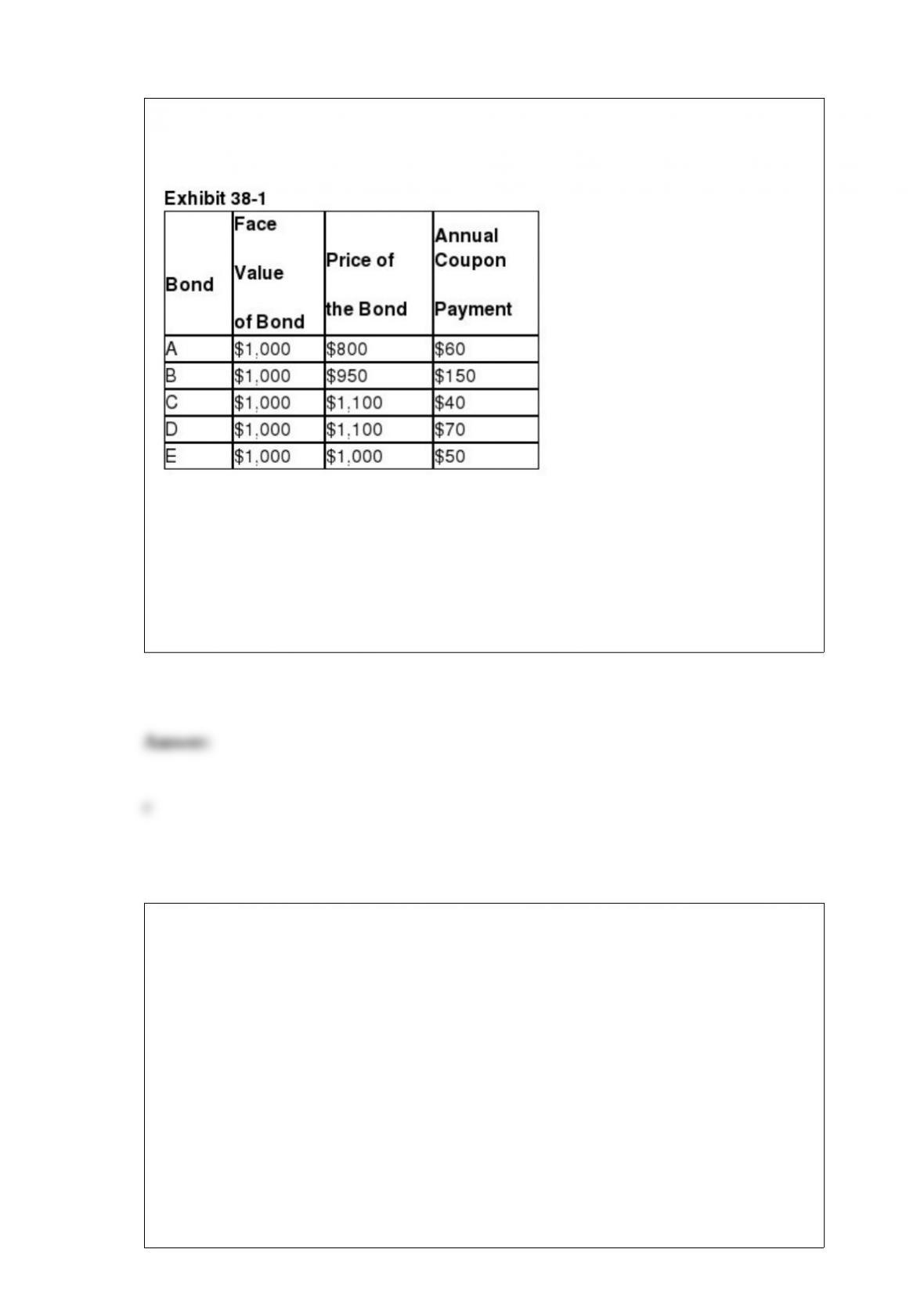
Refer to Exhibit 38-1. The yield on bond C is approximately
a. 11.0 percent.
b. 4.8 percent.
c. 3.6 percent.
d. 100 percent.
Which of the following is not a prediction of the theory on baseball caps and cheating?
a. More people will wear baseball caps on test days than on lecture days.
b. More people will wear baseball caps for multiple choice tests than for essay tests.
c. More people will wear baseball caps when students sit close to each other in class
and are taking a test than when students sit far apart from each other and are taking a
test.
d. Baseball caps are more likely to be worn on backwards (than frontwards) on test days
than on lecture days.
e. none of the above

Good X is a normal good. If the average income of those who buy good X rises, the
_____________ curve for good X will shift ____________ resulting in a(n)
_____________ in the equilibrium price of X and a(n) ____________ in the
equilibrium quantity of X.
a. supply; rightward; decrease; increase.
b. demand; leftward; decrease; decrease
c. demand; rightward; increase; increase
d. supply; leftward; increase; decrease
e. supply; leftward; increase; increase
What is the Dow Jones Industrial Average (DJIA)?Give a description of why the DJIA
was first created, how it is computed, and how it has evolved over time.

Which of the following statements is false?
a. A call option will sell for a fraction of the cost of the stock.
b. A futures contract can be written for a commodity (such as wheat), or for a currency.
c. A futures contract gives the owner the right, but not the obligation, to buy or sell a
commodity at a specified price on a given future date.
d. The specified price at which an option gives the owner the right to buy a stock at is
called the stick price.
One consequence of a negative externality is that
a. social costs are greater than private costs.
b. private costs are greater than social costs.
c. the marginal private cost curve slopes upward.
d. the market output is less than the socially optimal output.
e. a and c

Which of the following best describes an interpersonal utility comparison?
a. Jones likes computers produced by Dell Computer Corporation and Smith likes
computers produced by Apple Computer Inc.
b. Smith gets more utility from working on his computer than Jones gets from working
on his computer.
c. Smith got less utility from eating the 30th cookie than eating the 29th cookie, and the
same holds for Jones.
d. Usually, Smith seems a lot happier than Jones.
e. Smith usually eats more in a day than Jones eats in a day.
Logrolling refers to the
a. exchange of political favors by corporations.
b. need for the president to veto an entire bill when only certain parts of the bill are
objectionable.
c. exchange of votes to gain support for legislation.
d. a and b
e. none of the above
List and describe the three different types of transfers discussed in this chapter.Give a
hypothetical example of each to help support your answer.
Describe the three main options available to a corporation when it needs to raise money
so that it can invest in a new product or a new manufacturing technique.
Explain why the price of a good tends to fall when there is a surplus of the good.Give a
hypothetical numerical example to help support your answer.
Explain how scarcity can exist in a relatively rich country such as the United
States.Give examples to help support your answer.
Define price discrimination. What three conditions must exist before a firm can use it
successfully?
What is the difference between the public interest theory of regulation and the public
choice theory of regulation?
Explain what it means to say that “the market” feeds Cleveland.Give an example using
a specific food item to help support your answer.