
A construction laborer might make more than a similarly skilled book store clerk
because the working conditions in the book store are more desirable.
The Justice Department will not allow firms to merge if the result will be higher prices
to consumers.
If the quantity supplied is perfectly inelastic then quantity does not respond to price
changes.
The income elasticity of demand for popcorn is -1.1. Therefore, if income increases, the
demand for popcorn will increase.

Consumers pay the part of a tax associated with a higher price for the product.
Warranties reduce information asymmetry.
Empirical studies show that entry into markets increases both price and quantity of
goods supplied.

If the price elasticity of demand is 3 then this means that a one-percentage increase in
quantity demanded will cause a three-percentage decrease in the price of the good.
The demand for labor is dependent on the demand for the outputs the labor is used to
produce.
Monopolistically competitive firms sell differentiated products.
In a market-based economy, only the government can reduce economic uncertainty.

Deposit insurance creates a moral hazard that depositors have less incentive to monitor
their bank.
Suppose that in a small town 40 used cars are sold each month. Of the 40 cars sold, 30
are lemons and 10 are plums. If consumers expect 50% of the used cars sold to be
lemons, this market is in equilibrium.
A pollution tax lowers the price of the good or service produced by the polluting firm in
a competitive market.

A firm reaches the minimum efficient scale in the short run.
Cognitive processing is particularly important in making consumer decisions that
involve many options.
As the price of a product falls, the demand for the product increases, ceteris paribus.
A profit-maximizing firm will hire labor as long as the marginal revenue product of
labor is less than the wage.

Experience rating systems for pricing insurance discourage firms from spending money
to try to improve their employees’ health.
Markets do not determine the quantity of goods sold, only the price.
A monopolist maximizes profit by producing the output at which marginal revenue
equals marginal cost.
It is less likely for oligopolists to maintain high prices in a repeated game than when the

firms must choose one strategy to follow for the entire lifetime of the firm.
An increase in demand will cause the equilibrium price and quantity to rise, ceteris
paribus.
When a few people share the benefit from a project and a large number of people pay
for the cost, the government is more likely to approve inefficient projects.
A lower price for automobiles would reduce the externalities from automobiles.

A key assumption of most economic analysis is that people act rationally and in their
own self-interest.
Recent work in neuroscience shows that different regions of the brain are involved in
the valuation of the benefits and the costs of possible actions.
The notion of opportunity cost allows the measurement of tradeoffs.
Excess demand in an unregulated market will cause the price of a product to fall.

The Sherman Act outlawed practices that result in the restraint of trade.
A principle is a self-evident truth that most people readily understand and accept.
A duopoly is an industry with two firms in it.

The budget line and the demand curve are both similar in the way that both show the
price of a good that a consumer can buy.
The law of diminishing marginal utility means that total utility must fall as more units
of a good are consumed.
Recall the application about laws against predatory pricing, when a firm prices below a
competitor’s cost always violates the antitrust laws.
Market power is the power to produce at the lowest cost.

Under a monopolistically competitive market structure, firms will continue to enter the
market until the economic profit is eliminated.
If consumer preference for a product increases, this will cause the equilibrium price of
the product to go down, and the equilibrium quantity of the product to go up.
The long-run supply curve is upward sloping in a constant cost industry.

Unrealistic simplifying assumptions should be avoided because they cause the analysis
that is based on the assumption to be incorrect.
Compared to a pollution tax, a policy of uniform abatement with permits is:
A) less efficient.
B) more efficient.
C) exactly as efficient.
D) either more or less efficient depending on the number of firms affected.
According to this Application, prices for nondurable goods have ________ prices for
services.
A) risen less than
B) risen more than
C) risen at the same rate as
D) fallen more than

A contestable market is one where:
A) there are infinitely many firms.
B) entry necessarily occurs.
C) there is the legitimate threat of entry.
D) firms can maintain the monopoly price.
During World War II the percent share of income earned by the top 10 percent of wage
earners in the U.S.:
A) increased.
B) held steady.
C) decreased.
D) tripled.

Toby sells wheat in a perfectly competitive market. The demand curve for Toby’s wheat
is:
A) horizontal.
B) vertical.
C) downward sloping.
D) U-shaped.
The output effect is defined as:
A) the demand for the input whose price has increased will decrease, but the demand
for the other factors will increase.
B) the change in the quantity of labor demanded resulting from a change in the quantity
of output produced.
C) the change in the quantity of labor demanded resulting from an increase in the price
of other inputs.
D) the demand for the factor whose price has increased will increase, but the demand
for the other factors will decrease.
Table 15.3 shows the preferred budget for a new performance center and the number of
voters in a community who prefer that budget. If Dawn proposed $5 million while Terry
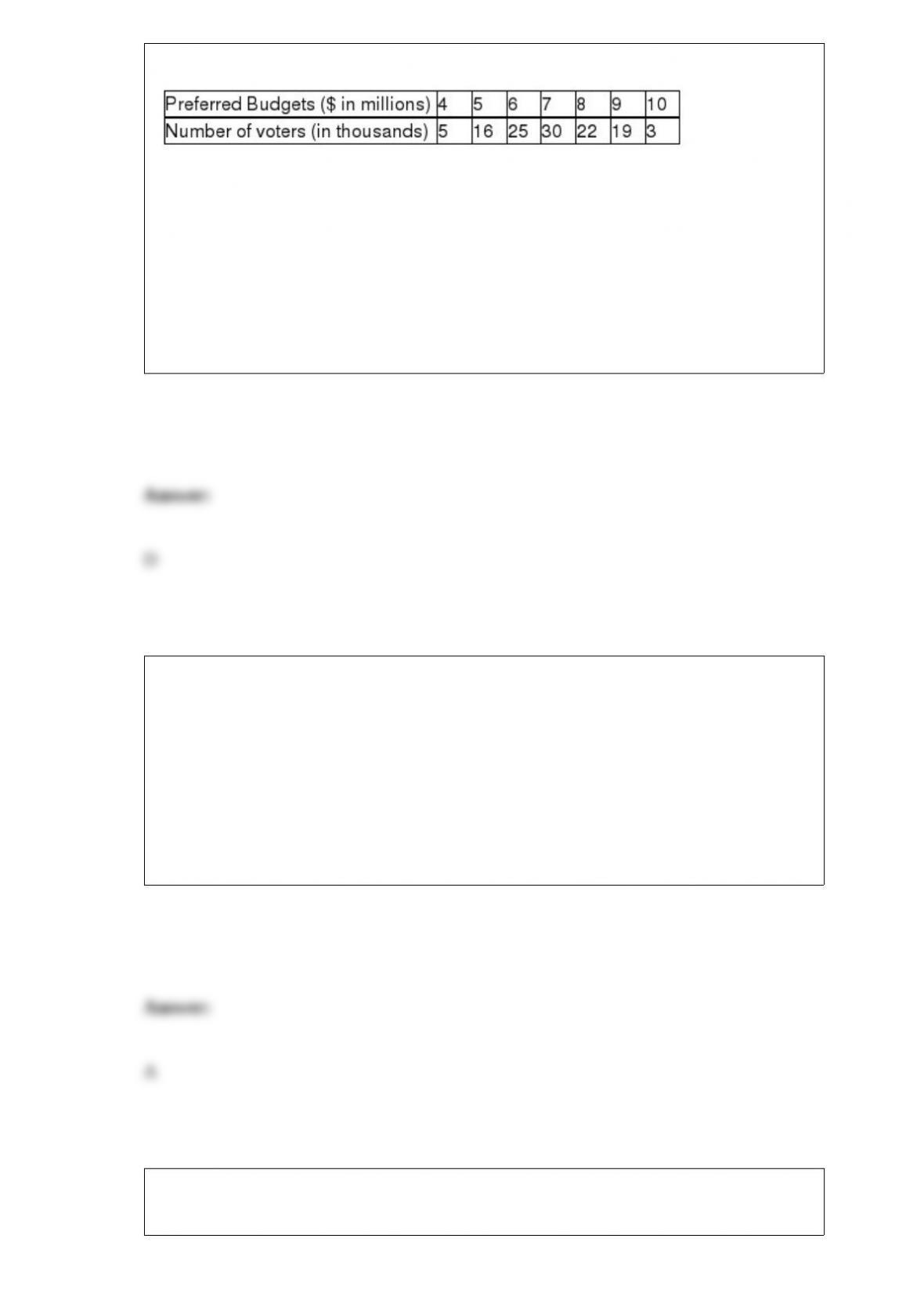
proposed $9 million, whose budget will be selected if everyone votes?
Table 15.3
A) Dawn’s
B) Terry’s
C) It is a tie.
D) The outcome cannot be predicted.
Tradable pollution permits:
A) will be sold by firms that have relatively low abatement costs.
B) reduce the level of pollution to zero.
C) are likely to lead to a higher total level of pollution in an area.
D) cause each firm to reduce the level of pollution it generates by the same amount.
Consider two individuals, Jesse and April, who hand paint kites and snowboards. Table
3.2 shows how much of each good Jesse and April can paint in one hour.
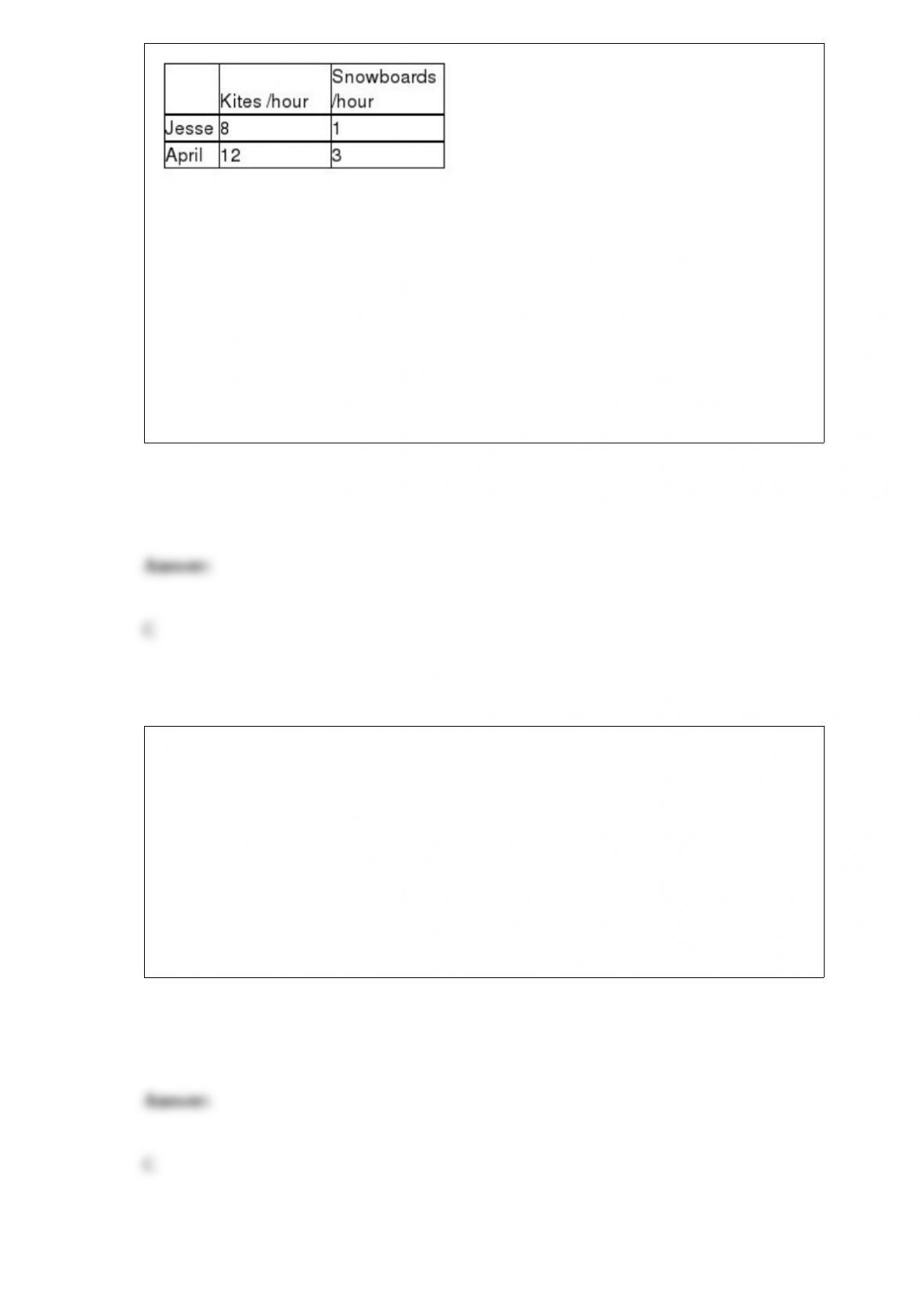
Table 3.2
Which of the following is true?
A) April has an absolute advantage in painting kites but not snowboards.
B) April has an absolute advantage in painting snowboards but not kites.
C) April has an absolute advantage in painting both goods.
D) April does not have an absolute advantage in painting either good.
Suppose you notice that the market for used bikes is dominated by lemons (low-quality
bikes). In such a situation, if you are a buyer of used bikes, you are faced with:
A) a positive externality.
B) perfect information.
C) an adverse selection problem.
D) symmetric information.

A firm that can sell as much as it can produce at the market price is likely operating in:
A) a perfectly competitive market.
B) a monopoly market.
C) a monopolistically competitive market.
D) an oligopoly market.
Maria raised the price of her burritos from $2.00 to $2.40 due to an increase on the
price of cheese, one of the main ingredients. Her total revenue increased from $300 to
$338. We can conclude that the demand for burritos is:
A) unit elastic.
B) inelastic.
C) elastic.
D) horizontal.
If demand is elastic, and the government decides to raise the tax on new cars. Then the
price for cars will increase by a ________ amount and car buyers will bear a ________
share of the tax.
A) large; large

B) large; small
C) small; large
D) small; small
In a market for a homogeneous good, if sellers and buyers can enter or exit a market
freely , the market is most likely:
A) an oligopoly.
B) a monopolistically competitive market.
C) a monopoly.
D) a perfectly competitive market.
Assume the price of textbooks rises from $90 to $110 and the quantity supplied
increases from 750 to 850 per week. Using the initial price method the price elasticity
of supply is:
A) 1.67.
B) .60.
C) 1.5.
D) .12.
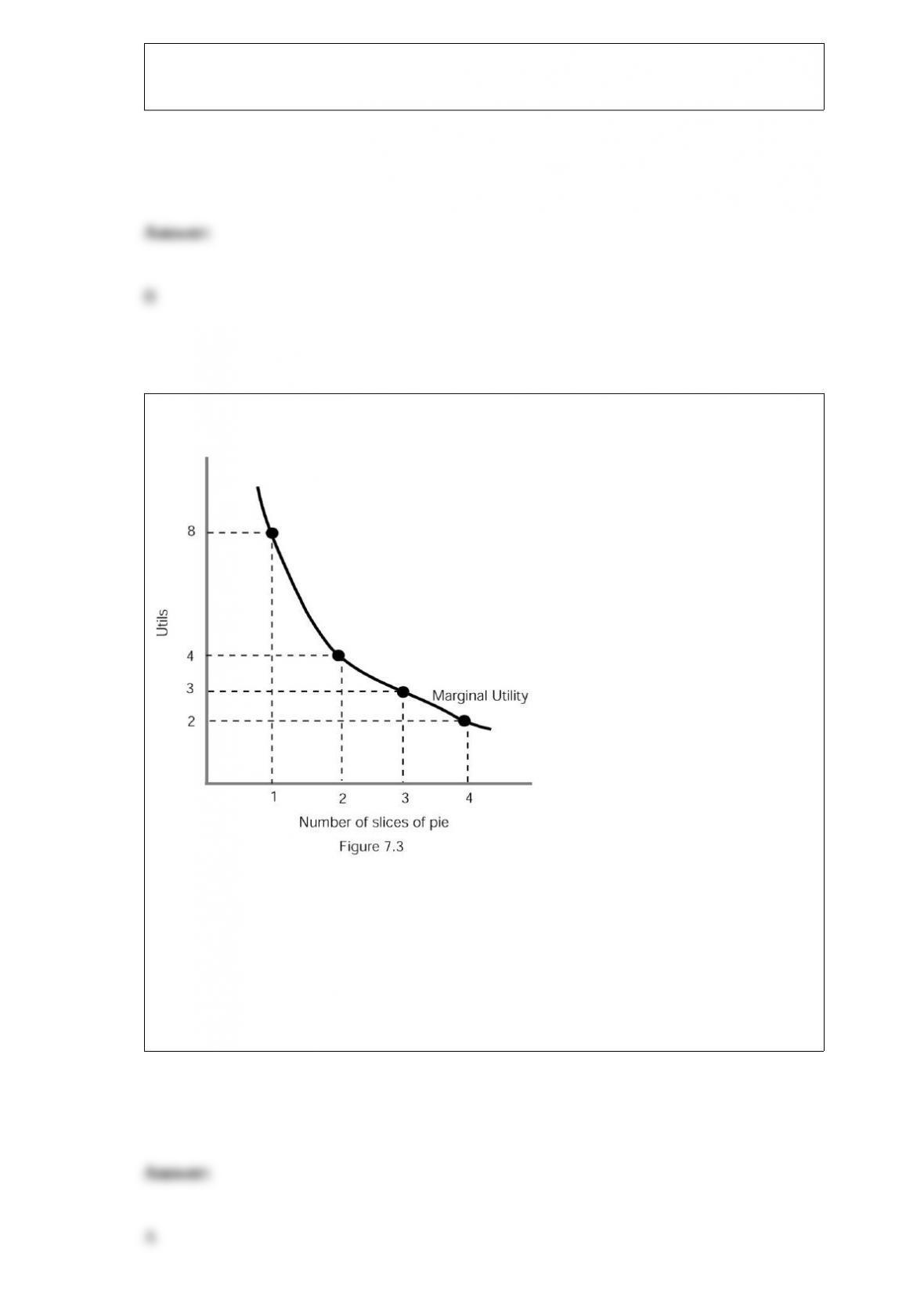
Refer to Figure 7.3. The total utility from consuming 2 slices of pie is:
A) 12.
B) 7.
C) 15.
D) 4.
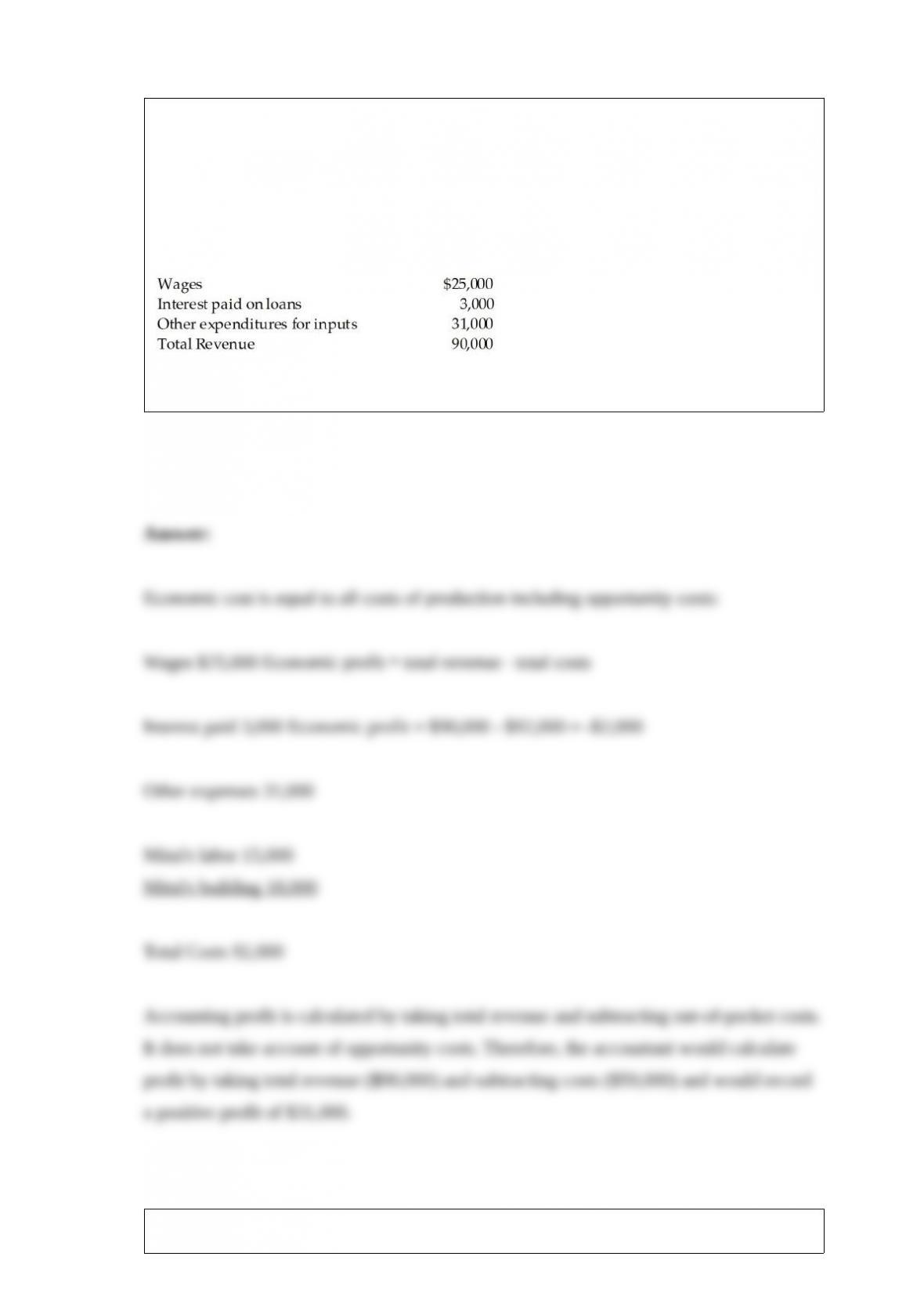
Mitzi’s Pet Salon hires you to determine the company’s status. The data in Table 8.2
provides information on the company’s annual costs and revenues. Mitzi spends at least
40 hours a week at her place of business. If she closed the salon, she could work for her
competitor and earn $15,000 per year. She also owns the building that houses the salon
and could rent it out for $18,000 per year if she closes her business. Calculate the
economic cost and economic profit for Mitzi’s Pet Salon. Would an accountant come to
the same conclusion about the profitability of this firm? Explain.
Table 8.2
In the used car market, the less-informed party is the ________. In the health care

market, the less-informed party is the ________.
A) buyer; seller
B) seller; buyer
C) buyer; government
D) seller; government
Suppose the nation of Arcadia produces only two goods, teapots and surfboards. If
Arcadia produces only teapots, it can make 80 per day. If Arcadia produces only
surfboards, it can make 30 per day. What is the opportunity cost of 1 teapot in Arcadia?
A) 3/8 of a surfboard
B) 8/3 surfboards
C) 30 surfboards
D) 80 surfboards
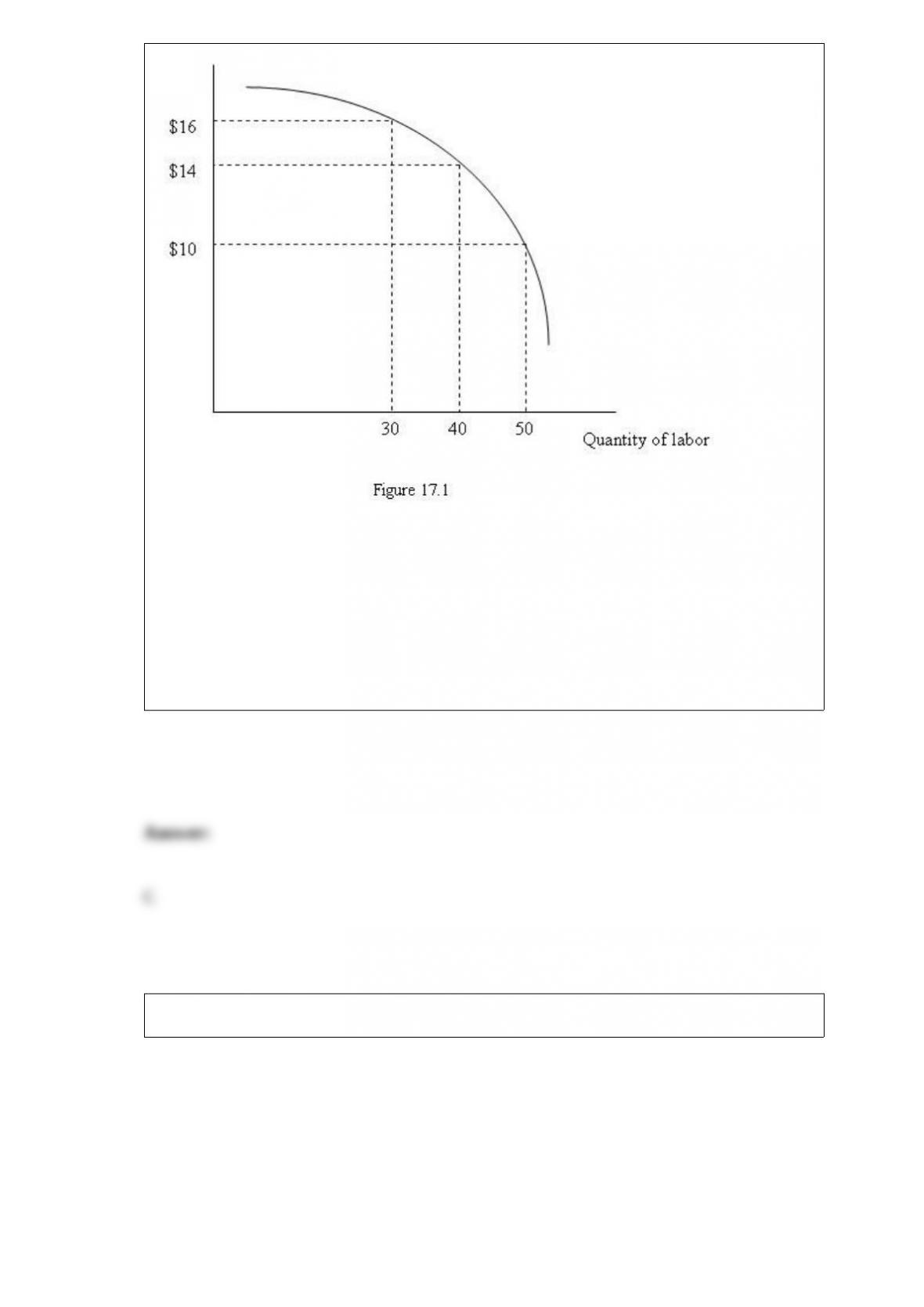
Figure 17.1 depicts a firm’s marginal revenue product curve. If the firm maximizes its
profit and the hourly wage is $12, how many hours of labor will the firm demand?
A) smaller than 30 hours
B) between 30 hours and 40 hours
C) between 40 hours and 50 hours
D) greater than 50 hours
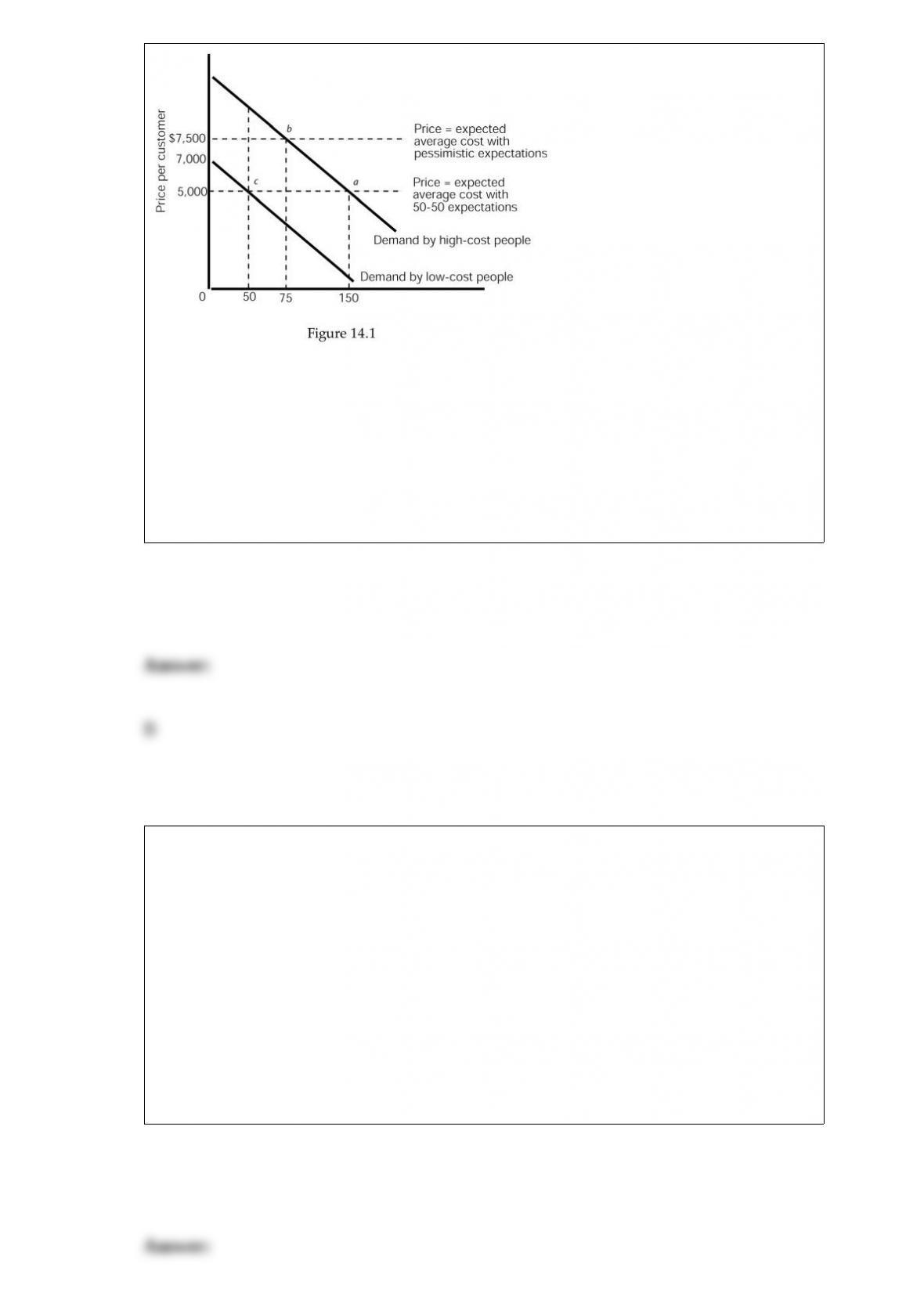
Refer to Figure 14.1. If the price of insurance is $5000, then:
A) 50% of the consumers will be high-cost.
B) 25% of the consumers will be low-cost.
C) 75% of the consumers will be low-cost.
D) 50% of the consumers will be low-cost.
Suppose that your tuition to attend college is $10,000 per year and you spend $4,000
per year on room and board. If you were working full time instead of attending college,
you could earn $20,000 per year. What is your opportunity cost of attending college for
one year?
A) $14,000
B) $24,000
C) $30,000
D) $34,000
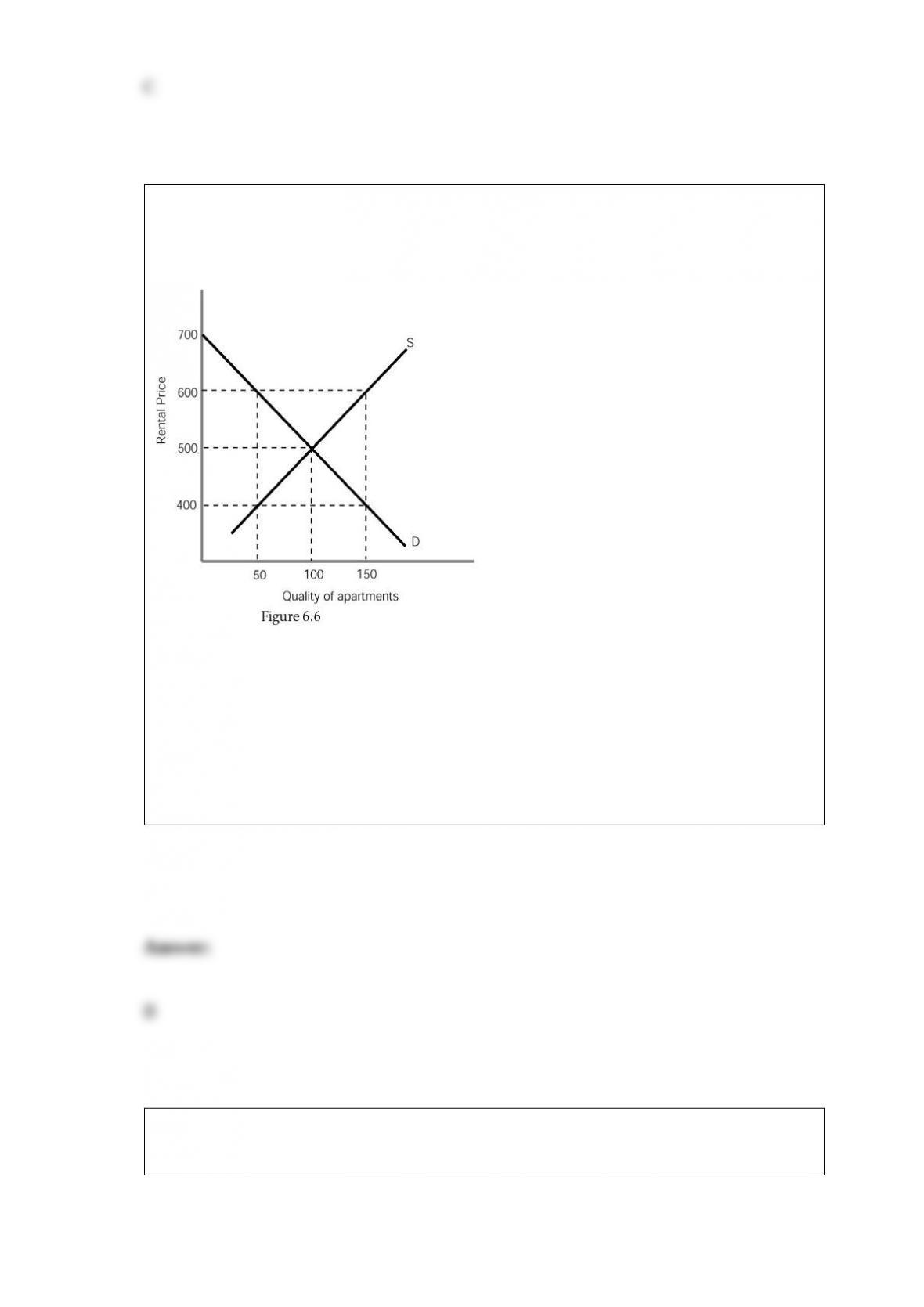
Refer to Figure 6.6. Suppose that landlords could not charge the market equilibrium
price of $500, but instead could charge no more than $400. As a result, the quantity of
apartments rented will fall from 100 to 50. In this case consumer surplus will:
A) decrease.
B) increase.
C) stay the same.
D) It is impossible to say.
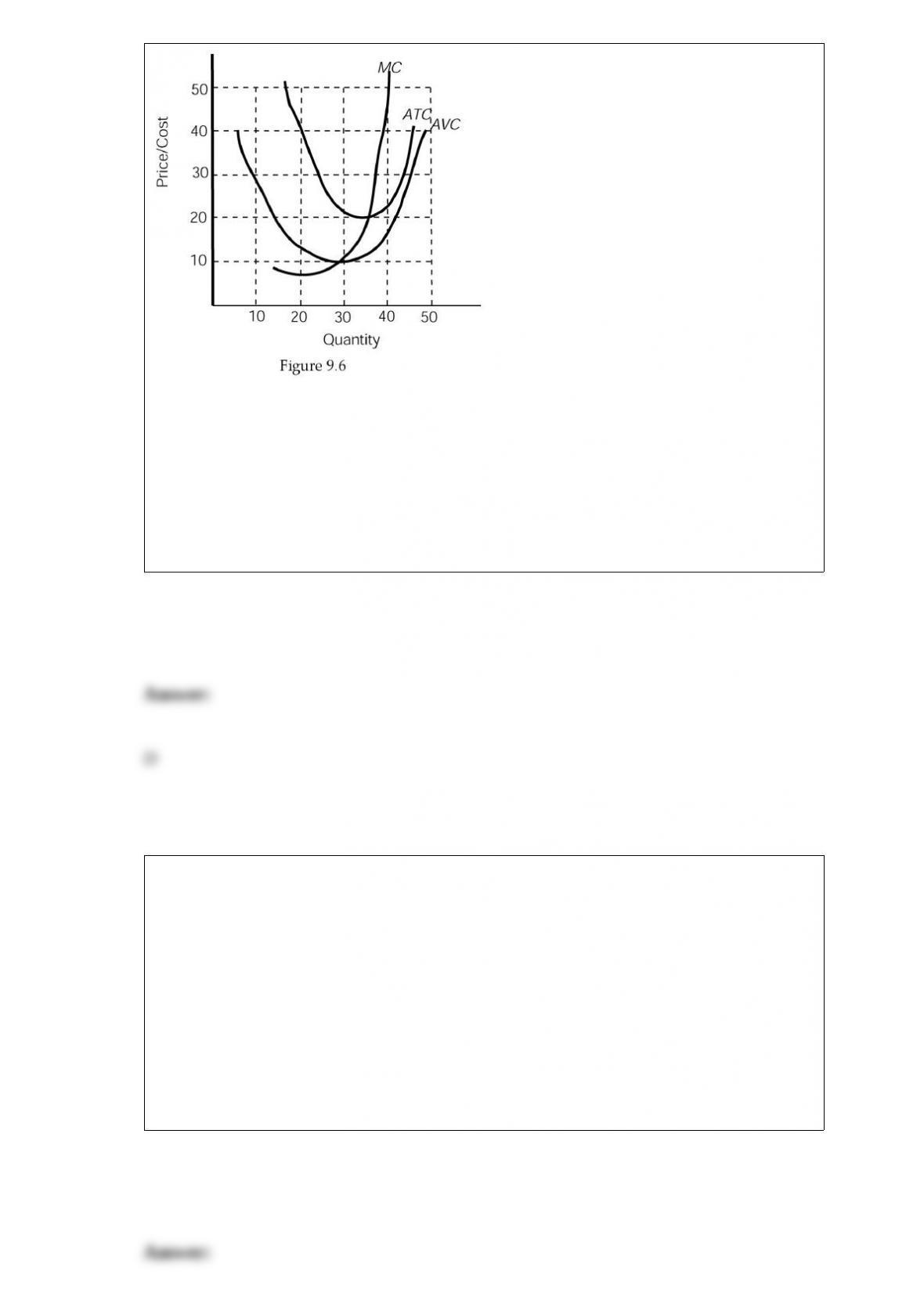
Refer to Figure 9.6. At a market price of $9, this perfectly competitive profit
maximizing firm should produce ________ units.
A) 30
B) 25
C) 20
D) 0
Suppose that in the time it takes for him to bake a cake, Bob can produce sew 5 pairs of
jeans. In the time it takes for Joe to bake a cake, he can produce sew 8 pairs of jeans
day. In this example, who has the absolute advantage in baking a cake?
A) Joe
B) both Bob and Joe
C) Bob
D) There is insufficient information to answer this question.

Governments like to know the price elasticity of demand because it helps them
determine how changes in sales tax rates will affect:
A) tax revenues.
B) government spending.
C) income.
D) profits.
Suppose that consumers expect that the price of a product will increase in the future.
The result is that:
A) the current demand for the product increases.
B) the current demand for the product decreases.
C) the current supply of the product increases.
D) the current supply of the product decreases.

For small quantities of output, average variable cost decreases as output increases due
to:
A) a reduction in the number of workers.
B) diminishing return.
C) labor specialization increases worker productivity.
D) More information is needed to determine.
In Eugene, Oregon, there are several Italian restaurants, each offering slightly different
items prepared in slightly different ways. It is likely that an Italian restaurant in Eugene,
Oregon, operates in a:
A) perfectly competitive market.
B) monopolistically competitive market.
C) monopoly market.
D) oligopoly market.
What is the most likely reason that milk sold in convenience stores is more expensive
than milk sold in grocery stores?
A) Convenience stores sell milk in smaller packages, so the per-gallon packaging costs

are higher.
B) Grocery stores buy in bulk, while convenience stores buy milk in smaller quantities.
C) People who buy milk at convenience stores tend to have less elastic demand for
milk.
D) Convenience store owners are greedier than grocery store owners.
Suppose that an increase in the scale of production at CR Cabinets Inc. leads to no
change in average costs, CR Cabinets Inc. experiences:
A) minimum efficient scale.
B) economies of scale.
C) diseconomies of scale.
D) constant returns to scale.
The price elasticity of demand for a good is relatively elastic if:
A) there are a large number of substitutes.
B) the consumer has more time to make decisions about purchasing the good.
C) the good is less of a necessity.

D) all of the above
Suppose that the Surgeon General releases a study suggesting that orange juice
consumption increases the risk for diabetes. As a result of the study, we could predict
that the demand curve for orange juice will ________ and the equilibrium price will
________.
A) increase; increase
B) increase; decrease
C) decrease; decrease
D) decrease; increase
What is moral hazard?
Comment on the following statement: “Elasticity is constant along a straight-line
demand curve.”
Explain the free-rider problem.
Explain what will happen to the equilibrium price and quantity of hybrid automobiles if
there are technological advancements in the production of hybrid automobiles while at
the same time consumer preference for hybrid automobiles increases.
Comment on the following statement: “When firms are earning positive profits, the
industry supply curve will shift to the right.”
Recall the Application about how having car insurance affects driving behavior to
answer the following
question(s).
Recall the Application. Explain the effect of mandatory car insurance laws on the
number of traffic accidents and fatalities.
Describe the field of economics known as macroeconomics.
Comment on the following statement: “The shape of the long-run average cost curve is
determined by diminishing returns.”
Why is the market equilibrium efficient?

What is marginal revenue?
Describe some of the ways in which firms differentiate their products.
Under what circumstances would a monopolist price be as low as the price that would
prevail in a perfectly competitive market?
How do you calculate a percentage change in quantity if given an elasticity of demand
and a percentage change in price?
What is a centrally planned economy?
Explain what will happen to the demand for labor, the equilibrium wage, and the
equilibrium quantity of labor if a technological innovation makes workers more
productive.
Discuss three types of antitrust policy.
What are the externalities associated with education?