
Suppose the economy is experiencing an inflationary gap. Based on available data, the
Fed starts implementing contractionary monetary policy, but this moves the economy
into a recessionary gap. The most probable explanation is that, because of the total lag
in monetary policy, the government did not realize that the economy was already
healing itself, i.e., that the
a. AD curve was shifting rightward.
b. AD curve was shifting leftward.
c. SRAS curve was shifting rightward.
d. SRAS curve was shifting leftward.
A $300 billion increase in government spending increases Real GDP by $1,800
billion.Assuming a constant price level, what does the government spending multiplier
equal?
a. 0.17
b. 120
c. 6
d. 60
e. 0.83
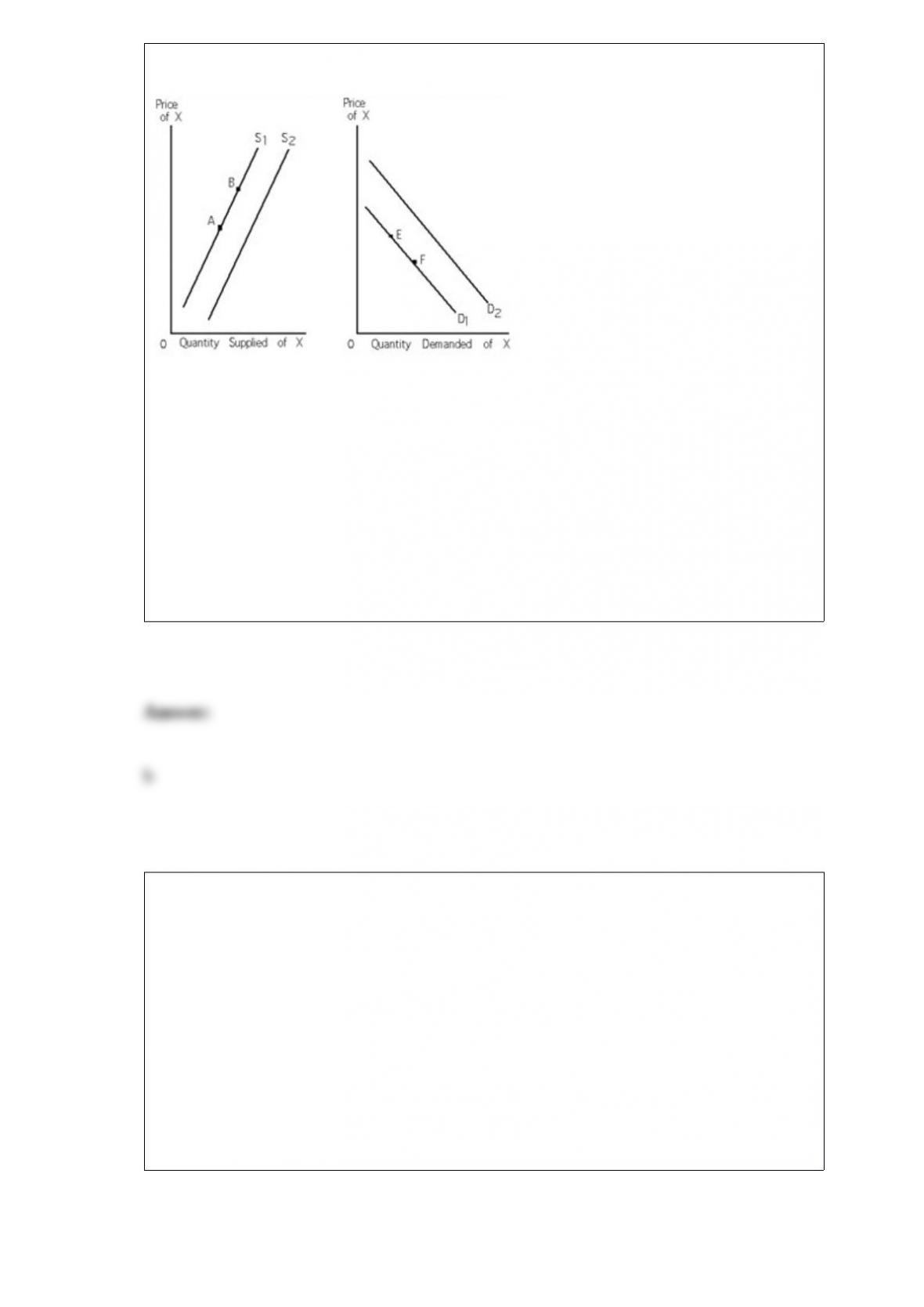
Exhibit 3-9
Consumers view X and Y as substitutes. If the price of Y increases, an economist would
expect a movement in the market for X from
a. F to E.
b. A to B.
c. E to F.
d. B to A.
Nonactivists hold that
a. activist monetary policies are likely to be destabilizing rather than stabilizing.
b. economic fine-tuning is quite feasible.
c. flexibility in wages and prices is sufficient to allow the economy to return at a
reasonable speed to full-employment output.
d. a and c
e. all of the above

The question of how a tax change might impact U.S. economic output is most closely
associated with the study of
a. microeconomics.
b. managerial economics.
c. macroeconomics.
d. consumer economics.
Which of the following statements is true?
a. In the monetarist transmission mechanism, changes in the money market directly
affect aggregate demand.
b. In the monetarist transmission mechanism, there is no need for the money market to
affect the loanable funds market or investment before aggregate demand is affected.
c. In the monetarist transmission mechanism, if individuals are faced with an excess
supply of money, they spend that money on a wide variety of goods—not just bonds or
other assets, as is the case in the Keynesian transmission mechanism.
d. a and b
e. a, b and c

Michael can produce the following combinations of X and Y: 10X and 10Y, 5X and
15Y, and 0X and 20Y. Vernon can produce the following combinations of X and Y:
100X and 20Y, 50X and 30Y, or 0X and 40Y. It follows that
a. Michael has the comparative advantage in producing X and Vernon has the
comparative advantage in producing Y.
b. Michael has the comparative advantage in producing Y and Vernon has the
comparative advantage in producing X.
c. Neither Michael nor Vernon has a comparative advantage in producing X.
d. Neither Michael nor Vernon has a comparative advantage in producing Y.
e. There is not enough information to answer the question.
To an economist, freeway congestion is a sign that the price to drive on the freeway is
a. below its equilibrium level.
b. at its equilibrium level.
c. above its equilibrium level.
d. either a or c
e. none of the above

Suppose that there is a financial crisis, and people choose to spend less.As a result,
velocity drops by 5 percent.According to market monetarists, if the GDP target growth
rate is 3 percent, the Fed would need to increase the money supply by ______________
percent in order to achieve their GDP target.
a. 8
b. 2
c. 4
d. 5
It is often easier to see the ___________ of globalization than it is to see the
_____________.This is because the costs tend to be more ________________, while
the benefits tend to be __________________.
a. costs; benefits; concentrated; widely dispersed.
b. benefits; costs; concentrated; widely dispersed.
c. costs; benefits; widely dispersed; concentrated.
d. benefits; costs; widely dispersed; concentrated.
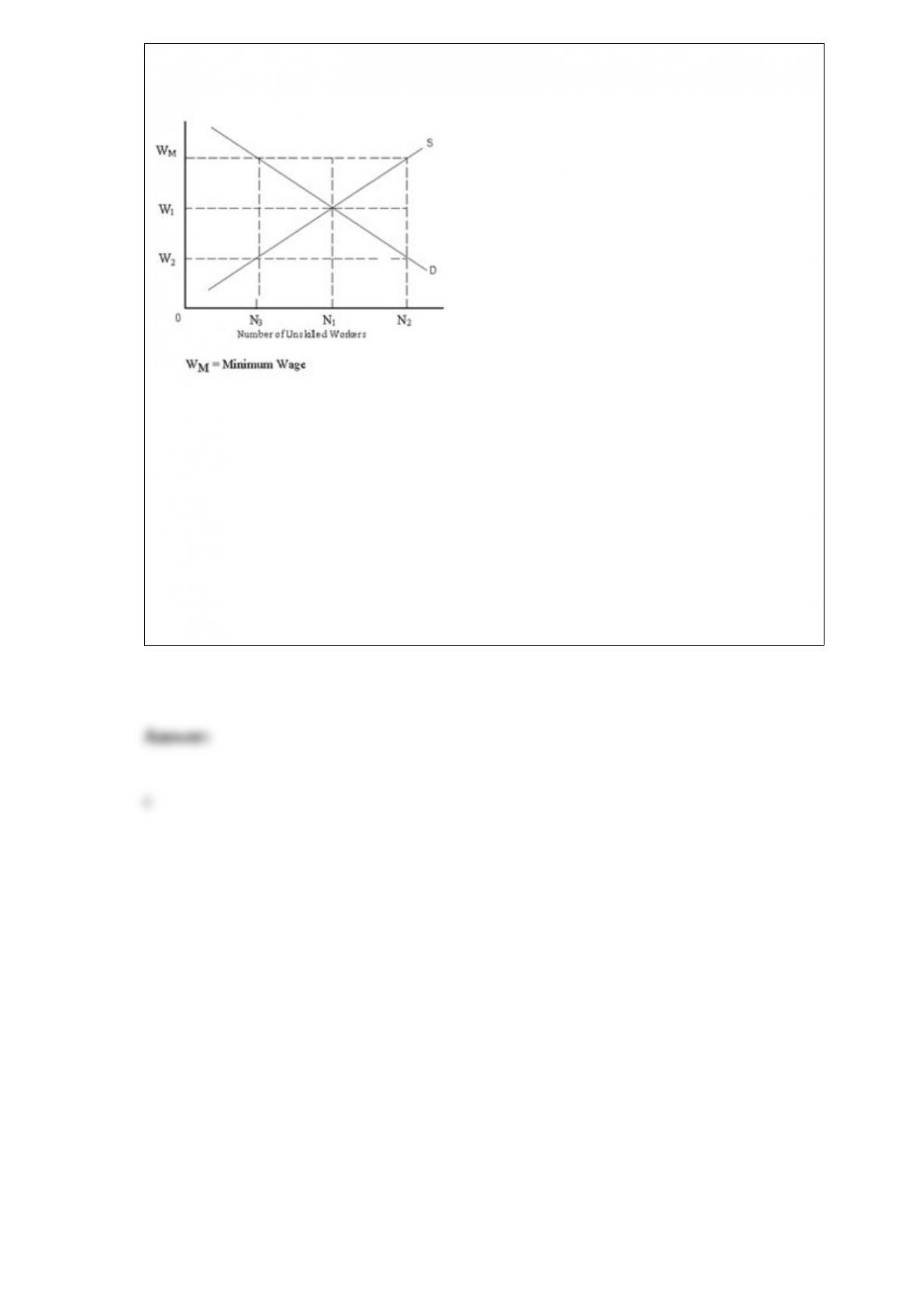
Exhibit 4-7
The number of unskilled workers who want to work at the minimum wage is
a. N3.
b. N1.
c. N2.
d. N2 – N1.