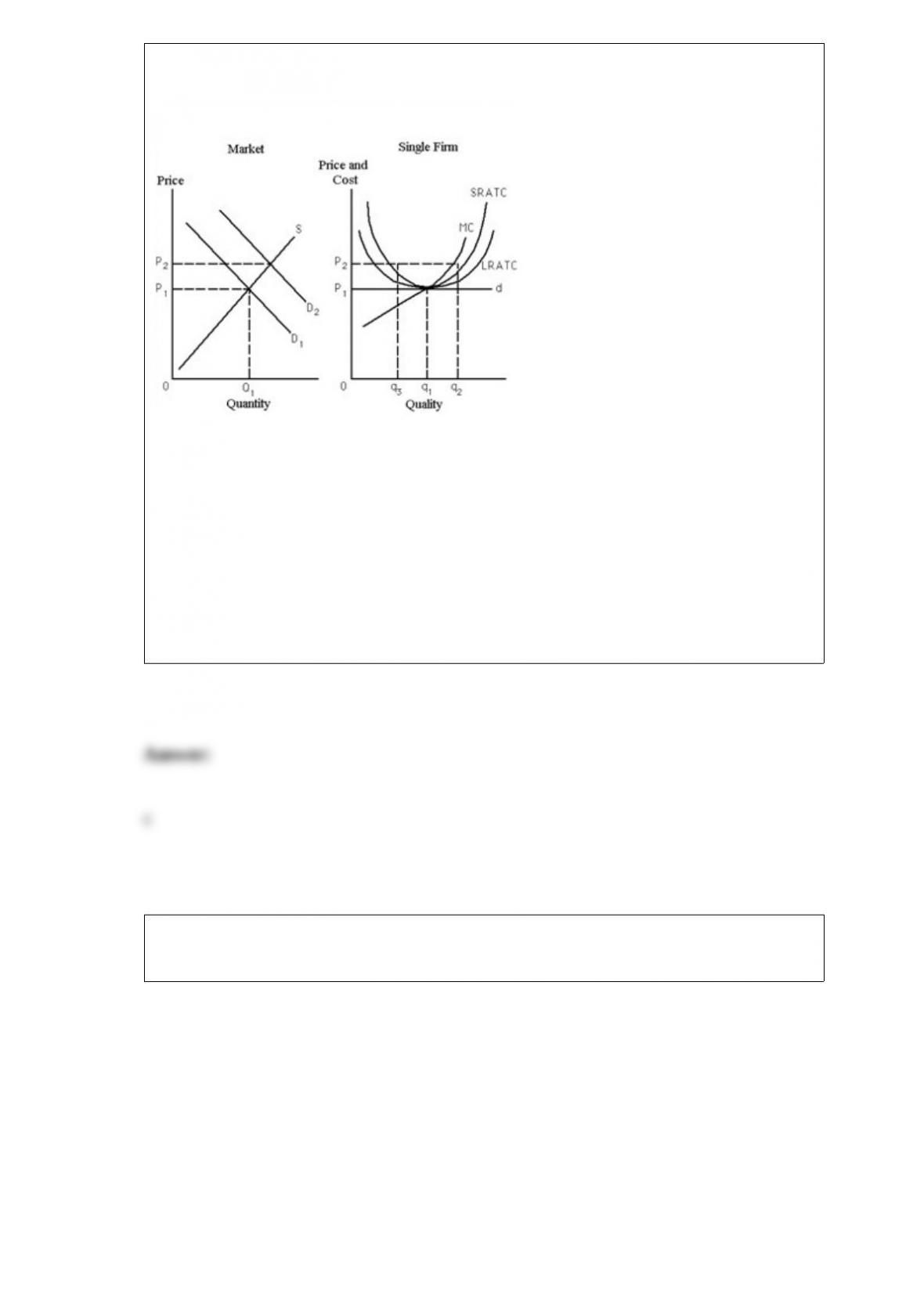
Exhibit 23-9
Following an increase in market
demand from D1 to D2, the firm’s profits in the short run will
a. remain the same at P1 times q1.
b. remain the same at zero.
c. increase by less than (P2 – P1) times q2.
d. increase by (P2 – P1) times q3.
Exhibit 35-5 U.S. $ Equivalent Foreign Currency
per U.S. $
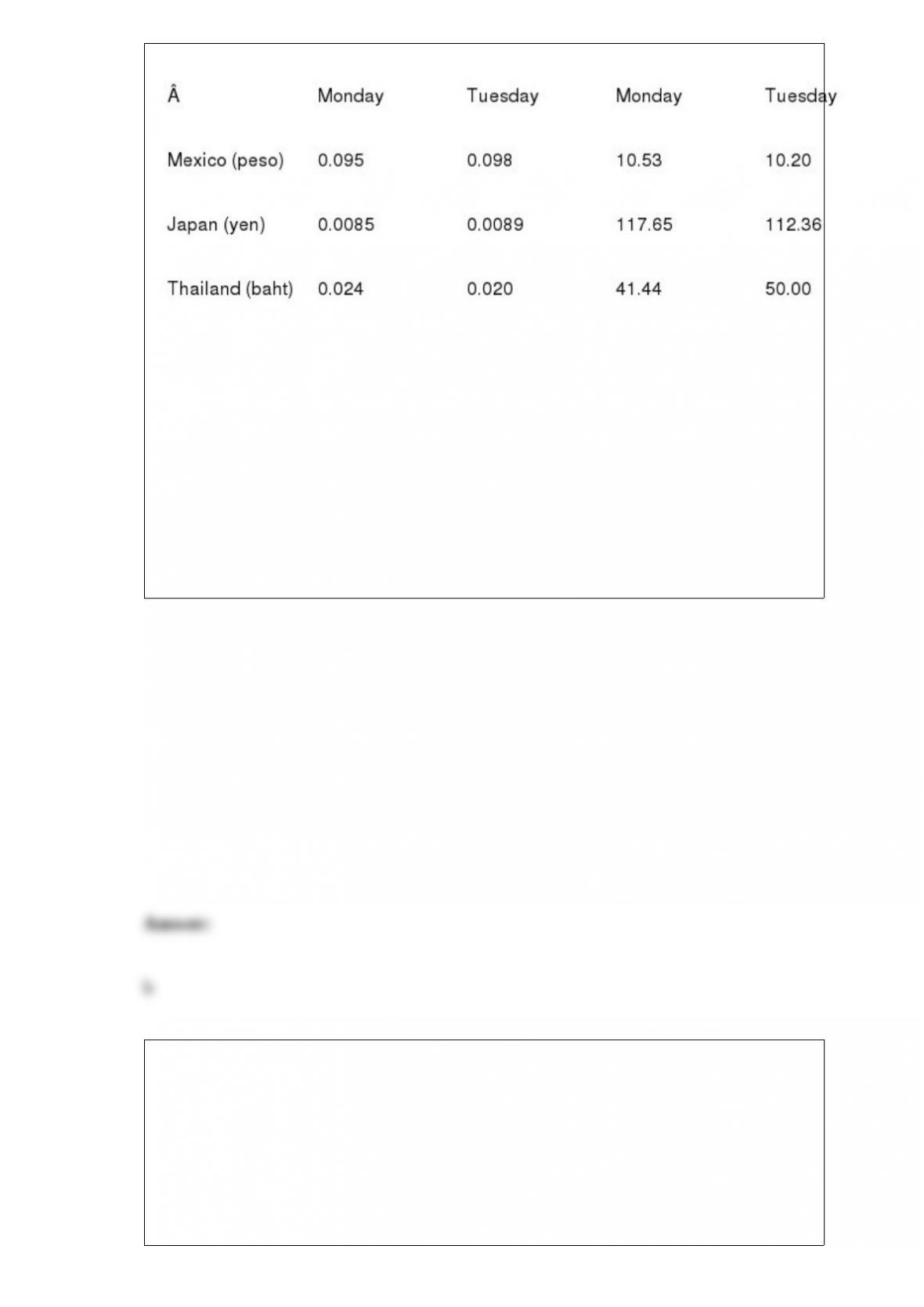
Based on the information provided in this table, between Monday and Tuesday, the U.S.
dollar ____________ against the Japanese yen and the yen _____________ against the
U.S. dollar.
a. appreciated; appreciated
b. depreciated; appreciated
c. appreciated; depreciated
d. depreciated; depreciated
Why might special interest groups be more likely to push for transfers instead of
economic growth?The answer is because it usually takes a much __________________
percentage _______________ in growth to equal what they can get from the transfer.
a. smaller; decrease
b. larger; increase
c. larger; decrease
d. smaller; increase
e. none of the above
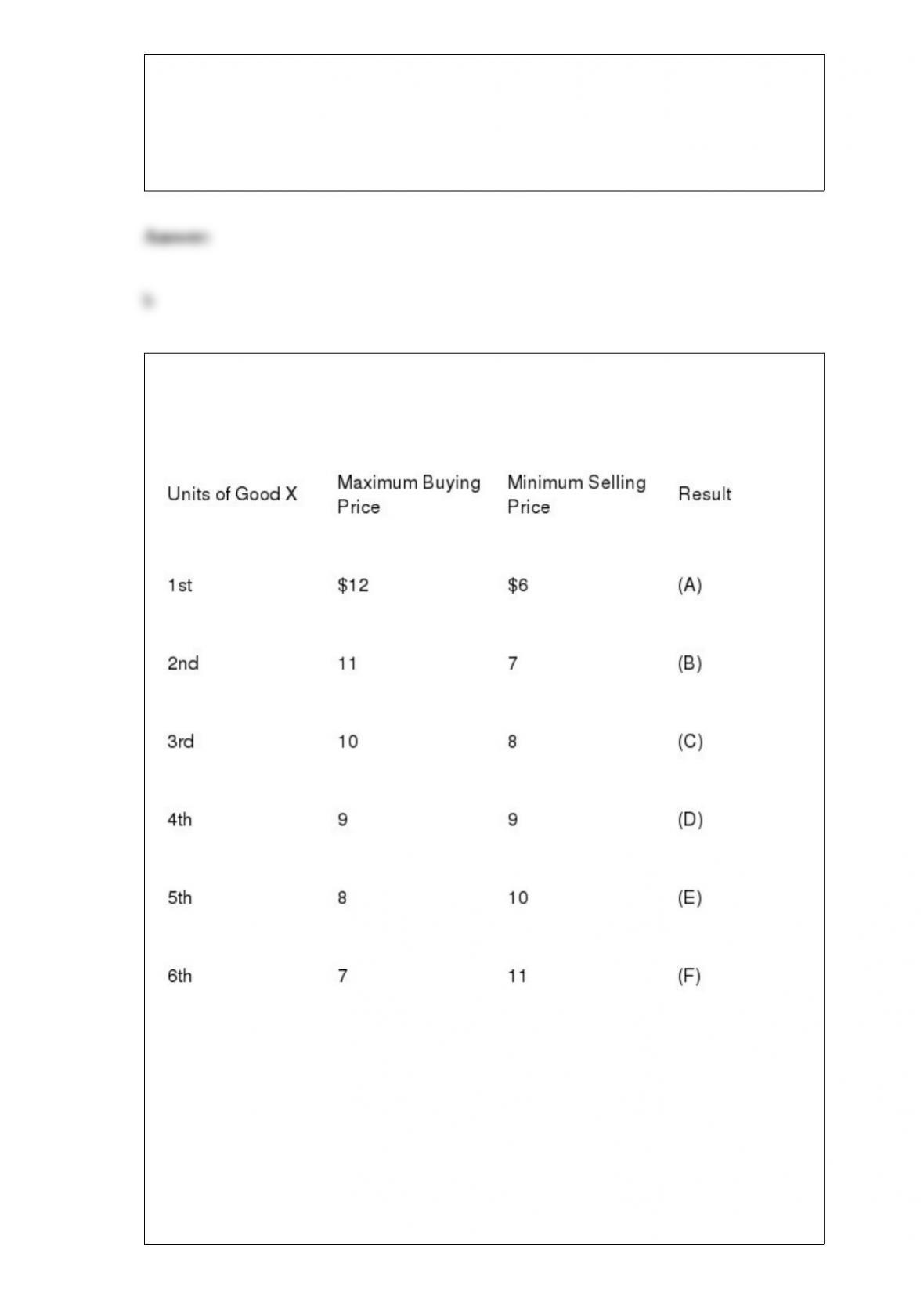
Exhibit 3-11
Fill in blanks (E) and (F) respectively with “Exchange” or “No Exchange” to indicate
whether or not exchange would take place at the given prices.
a. Exchange; Exchange
b. Exchange; No Exchange
c. No Exchange; Exchange

d. No Exchange; No Exchange
Income elasticity of demand for an inferior good is
a. less than 0.
b. greater than 1.
c. equal to 1.
d. equal to 0.
e. none of the above
Which of the following is definitely not a nonexcludable public good?
a. national defense
b. elementary education
c. flood control
d. charitable giving
e. None of the above; all are nonexcludable public goods.
What looks like discrimination in the labor markets is always just a problem of the high
cost of information.
a. True
b. False
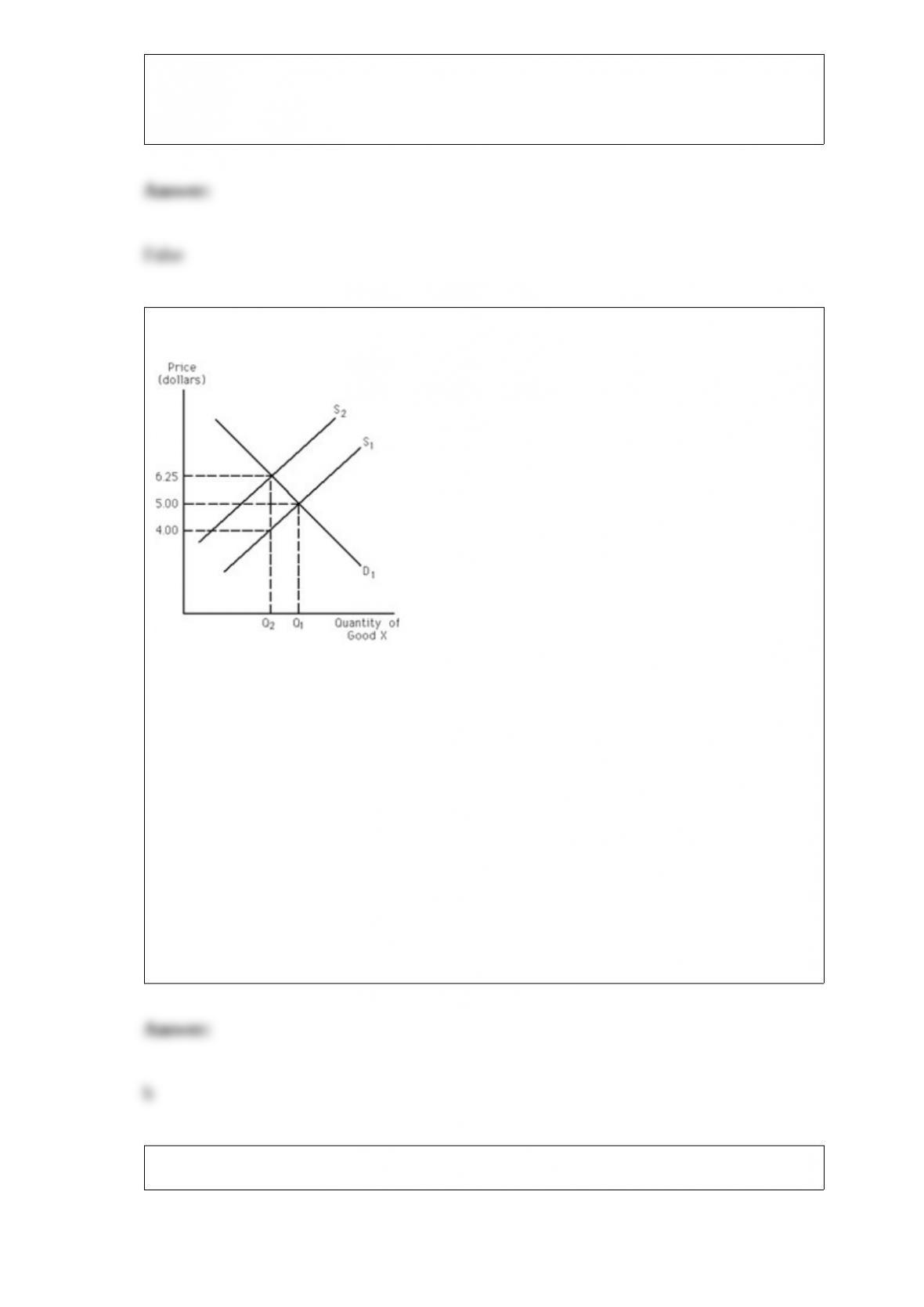
Exhibit 20-2
The market for good X is initially in equilibrium at $5. The government then places a
per-unit tax on good X, as shown by the shift of S1 to S2. Approximately what
percentage of the tax do producers end up paying?
a. 55 percent
b. 45 percent
c. 70 percent
d. 63 percent
e. 25 percent
Exhibit 3-4
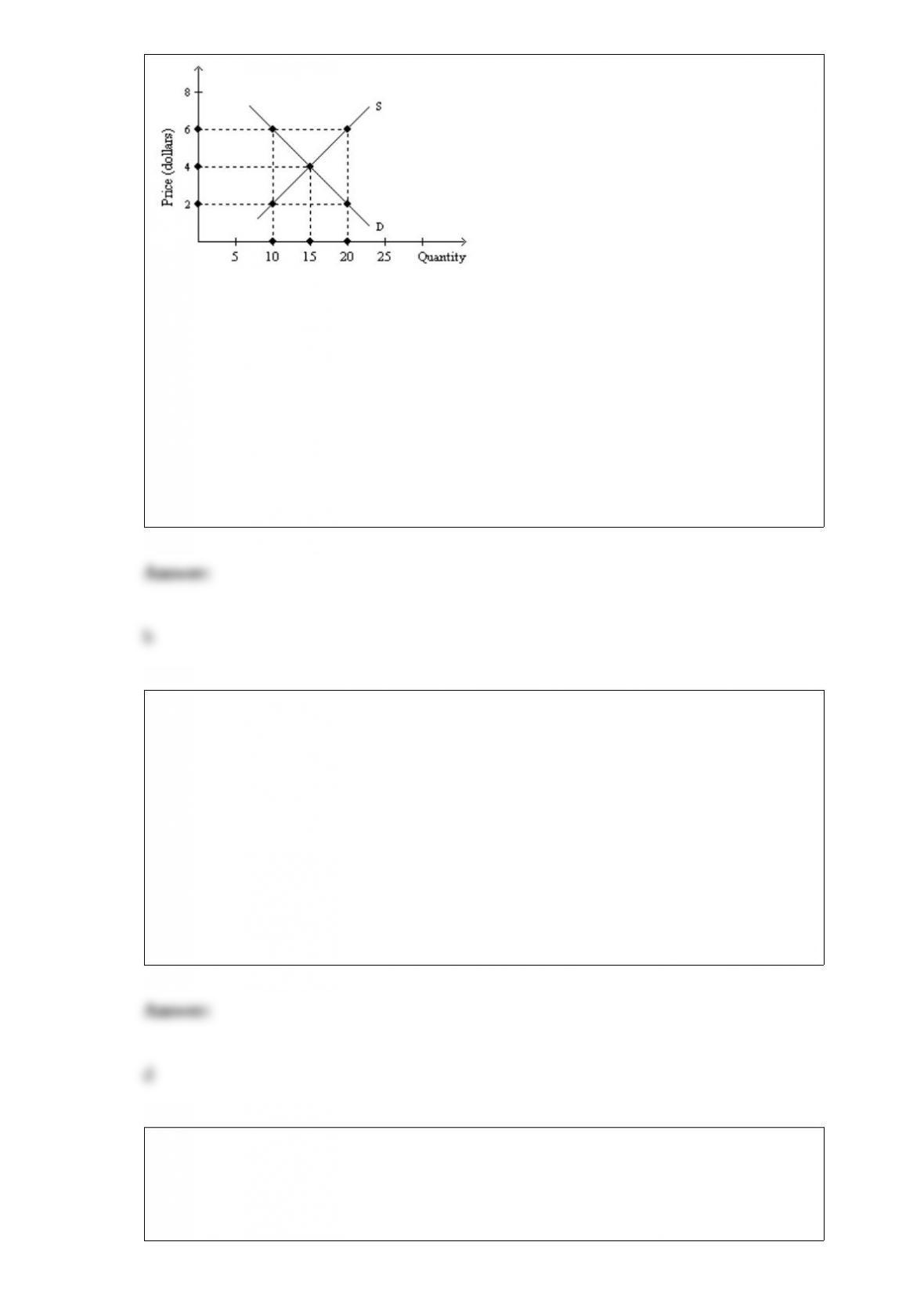
At a price of $6 _______________ units will be exchanged.
a. 5
b. 10
c. 15
d. 20
Suppose that for a given good, demand decreases and supply decreases at the same
time. If demand decreases by a greater amount than supply decreases, then equilibrium
price __________ and equilibrium quantity __________ for that good.
a. rises; rises
b. rises; falls
c. falls; rises
d. falls; falls
A demand schedule is a numerical tabulation of the ___________________ of a good at
different ____________________.
a. quantity supplied; prices
b. quantity demanded; incomes
c. quantity demanded; prices
d. quantity supplied; incomes
In the textbook, economics is defined as the science of
a. money and business.
b. choices.
c. scarcity.
d. price.
e. individuals’ actions.
Exhibit 34-2
The U.S. demand and supply for a good are shown. Under a policy of free trade, the
world price is PW. If there is a policy change such that imports are prohibited, the price

becomes PN. U.S. producers are better off if imports are __________; specifically, their
producers’ surplus changes by area __________.
a. permitted; PWDE
b. permitted; PN BDPW
c. prohibited; BDC
d. prohibited; PNBDPW
Suppose at a price of $4 and at a price of $6, John purchases 40 units of good X. Given
this information, we know that
a. John’s entire demand curve for good X is perfectly elastic.
b. John’s entire demand curve for good X is inelastic.
c. John’s demand for good X is perfectly inelastic between the prices of $4 and $6.
d. John’s demand for good X is perfectly elastic between the prices of $4 and $6.
e. John’s entire demand curve for good X is unit elastic.
Exhibit 2-1
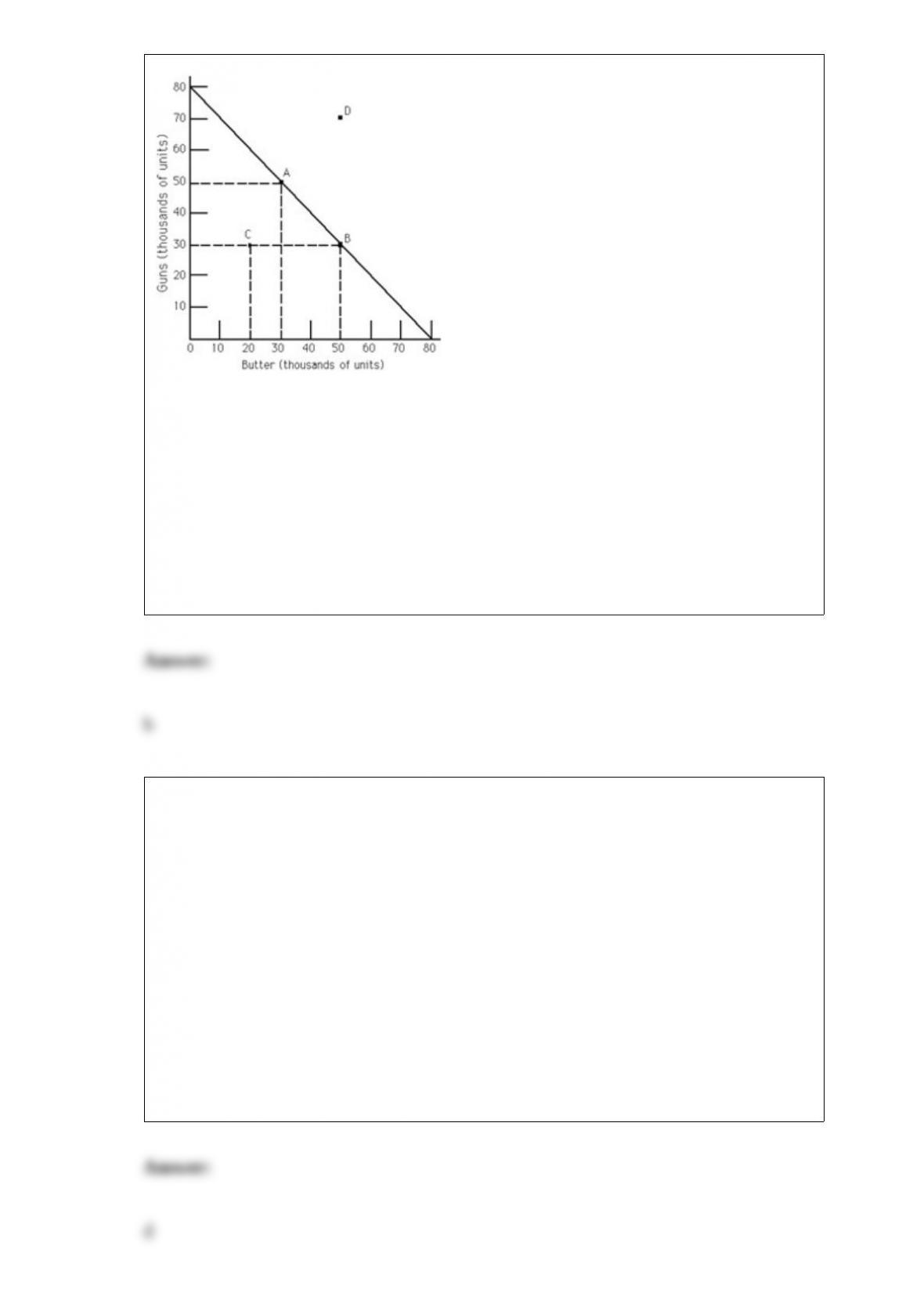
The opportunity cost of moving from point B to A is
a. 10,000 units of butter.
b. 20,000 units of butter.
c. 50,000 units of guns.
d. the maximum amount of butter that can be produced with available resources.
A tariff on avocadoes ______________ the price of avocadoes, _____________
consumers’ surplus for avocado buyers, _______________ producers’ surplus of
avocado growersand __________________ tariff revenue. Because the loss to
_____________ is more than the gain to ___________________, there is a net loss to
society.
a. raises; increases; decreases; generates; producers; consumers and government
b. lowers; increases; decreases; does not generate; producers and government;
consumers
c. raises; increases; decreases; does not generate; producers and government; consumers
d. raises; decreases; increases; generates; consumers; producers and government
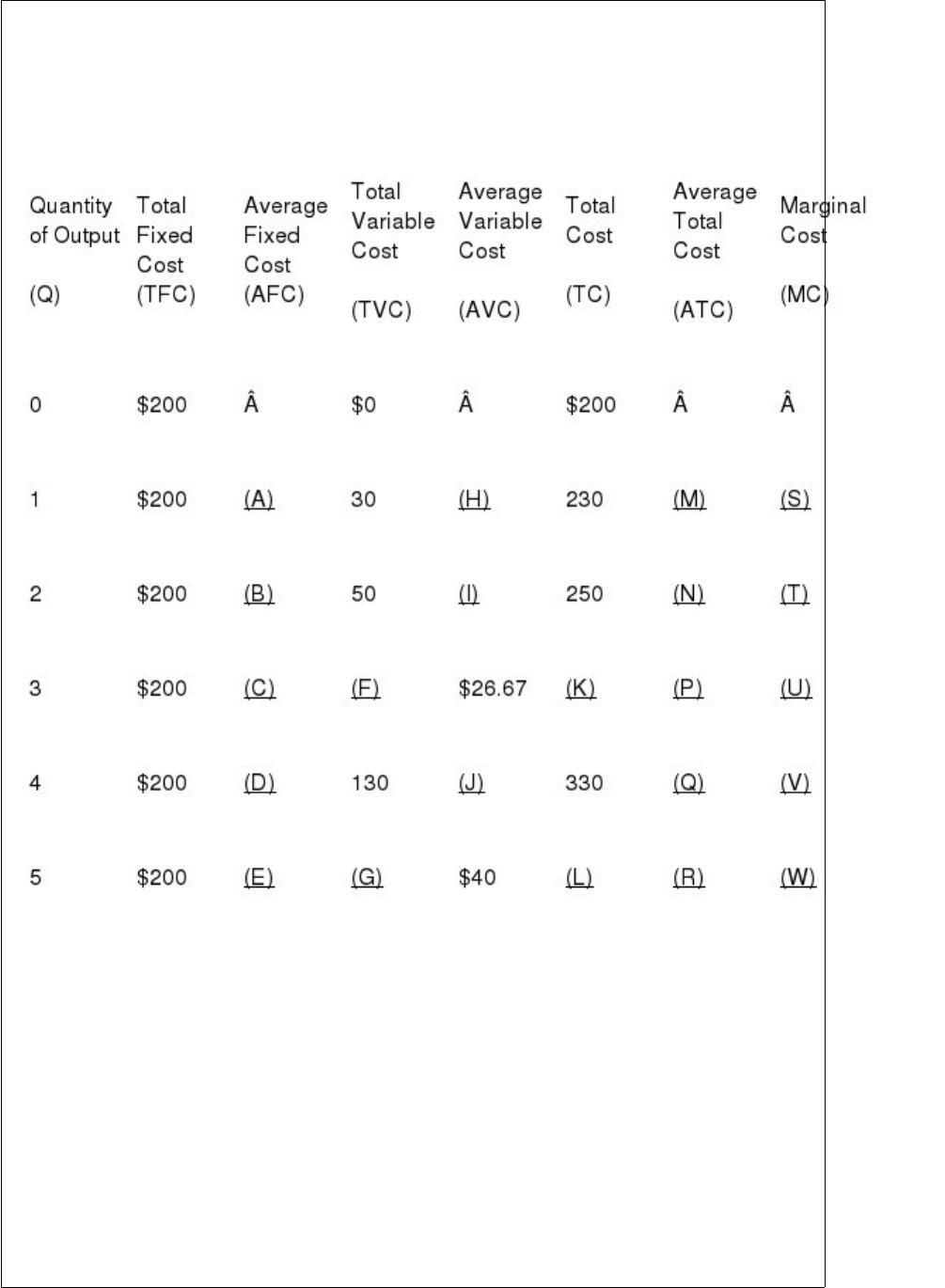
Exhibit 22-13
What dollar amounts go in blanks (E) and (F), respectively?
a. $200; $30
b. $40; $80
c. $200; $15
d. $3; $40
e. There is not enough information to answer this question.

If a monopolist wishes to sell an additional unit of the good, then
a. it must raise its price to signal consumers that its product is now a more important
part of their budget, and they will purchase more.
b. like a competitive firm, it can simply make more output available and not lower
price.
c. it must lower price.
d. it can raise price and not worry that sales will decrease.
e. a and d
A person with a high positive rate of time preference greatly prefers current
consumption over future consumption.
a. True
b. False