
1) Thrifts are known as “banker’s banks” because they lend money to commercial
banks.
2) ndp can be determined by adding taxes on production and imports to gdp.
3) health care costs have risen absolutely but remained constant as a percentage of gross
domestic product.
4) although sleeping in on a work day or school day has an opportunity cost, sleeping
late on the weekend does not.
5) the medicare prescription drug, improvement, and modernization act of 2003
established a system of national health insurance.
6) The average person in the United States generates about 10 pounds of trash per day.
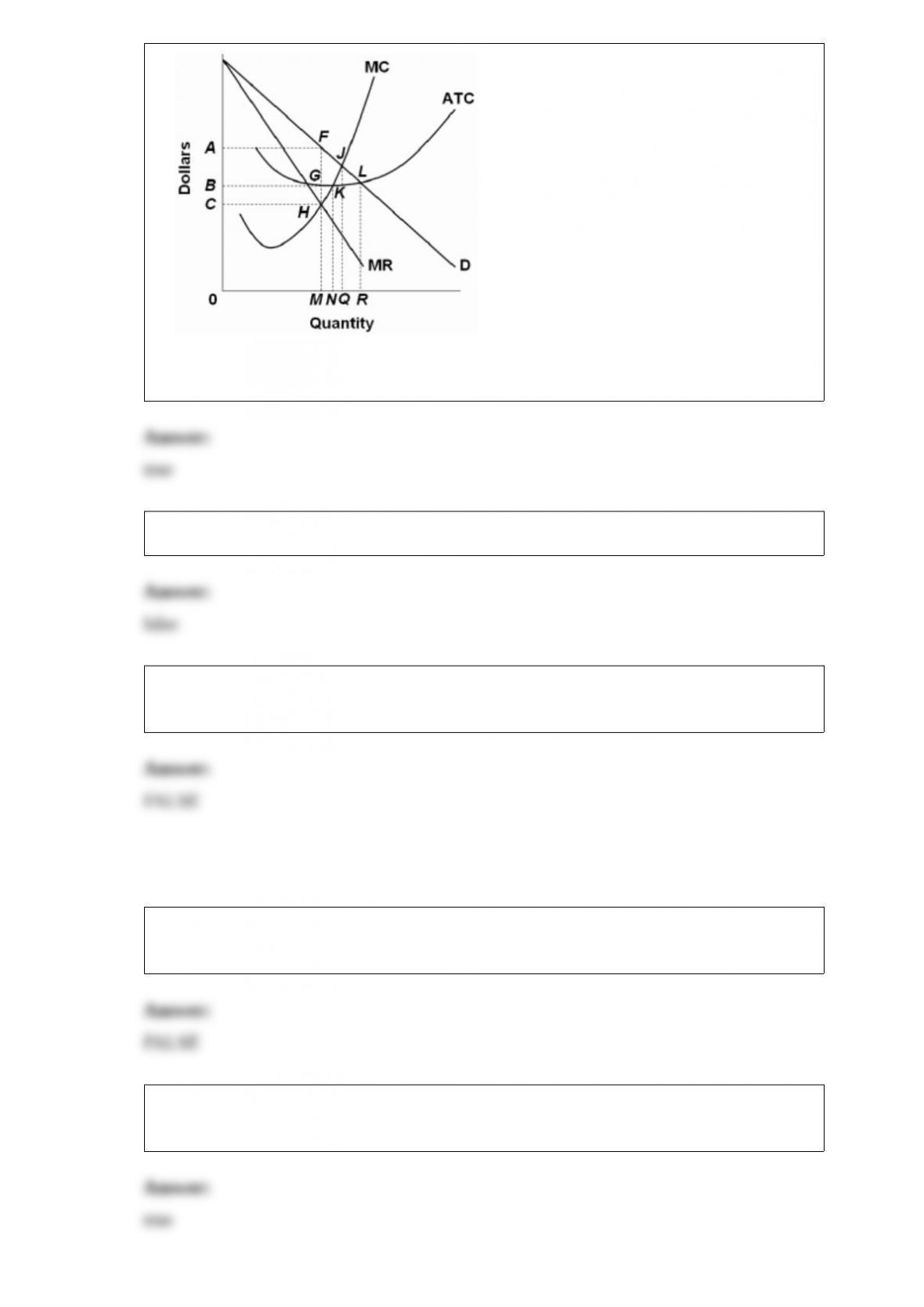
7)
refer to the above diagram for a nondiscriminating monopolist. the profit-maximizing
output for this firm is m.
8) a price floor in a competitive market will result in persistent shortages of a product.
9) The percentage of the United States’ domestic output that is derived from
international trade is higher than that for any other industrially advanced nation.
10) The principal beneficiaries of government agricultural aid have been the very
low-income farmers.
11) some employers have reacted to rising health care costs by hiring more part-time
and temporary workers.
12) the production of durable goods is more stable than the production of nondurables
over the business cycle.
13) the optimal allocation of resources is found:
a.where mb = mc.
b.at every point along a production possibilities curve.
c.where the marginal benefit is at its greatest.
d.where the marginal cost is at its lowest.
14) which of the following best approximates a pure monopoly?
a.the foreign exchange market
b.the kansas city wheat market
c.the diamond market
d.the soft drink market
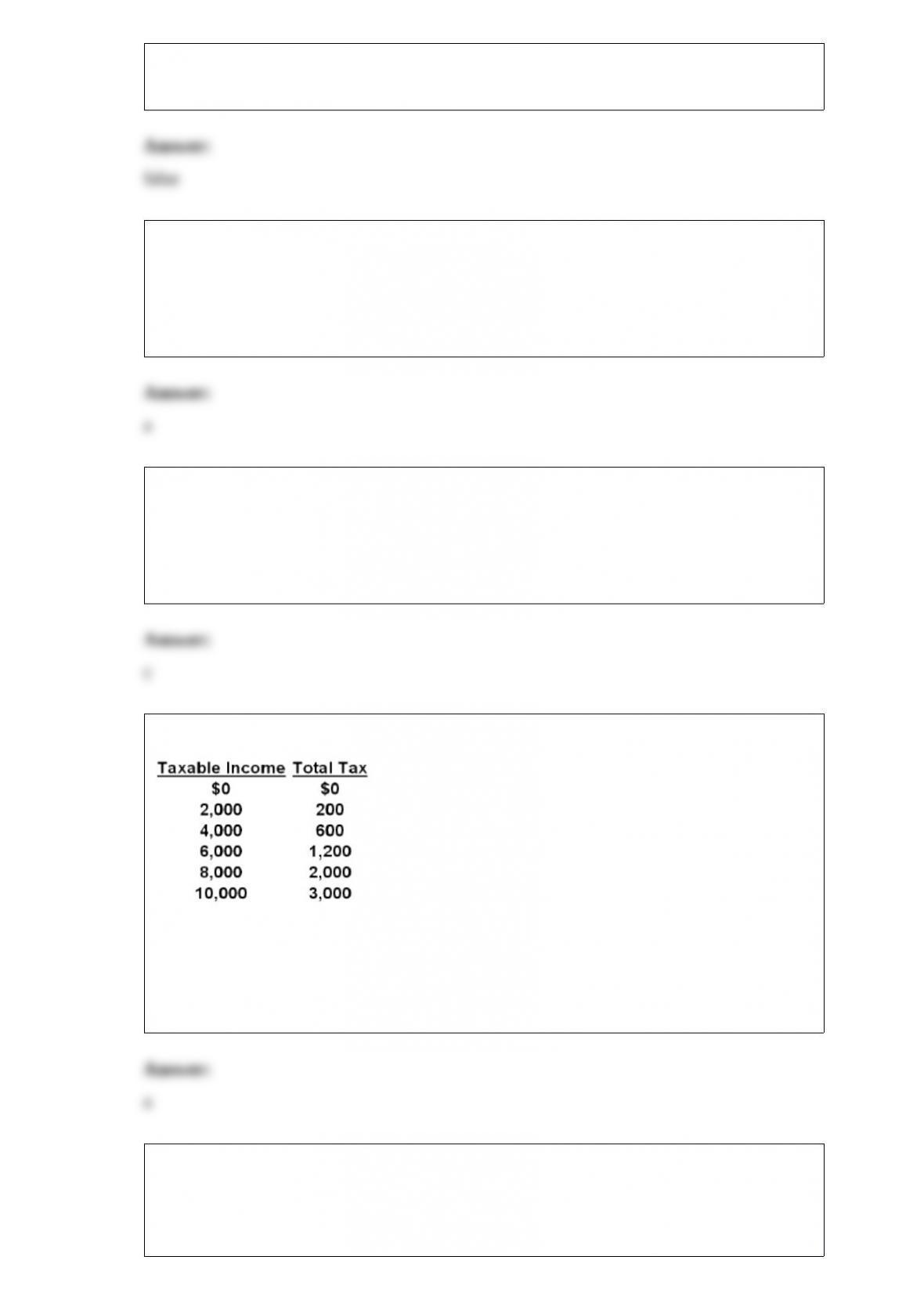
15) the following data represent a personal income tax schedule.
refer to the above table. this tax is such that the after-tax distribution of income will be:
a.more equal than the before-tax distribution.
b.less equal than the before-tax distribution.
c.distributed in precisely the same way as the before-tax distribution.
d.less than the before-tax distribution by the same percentage at each income level.
16) The TANF program is designed to:
A.increase the minimum wage.
B.shift people from welfare to employment.
C.provide medical insurance to poverty level workers.
D.provide income to the blind and disabled.
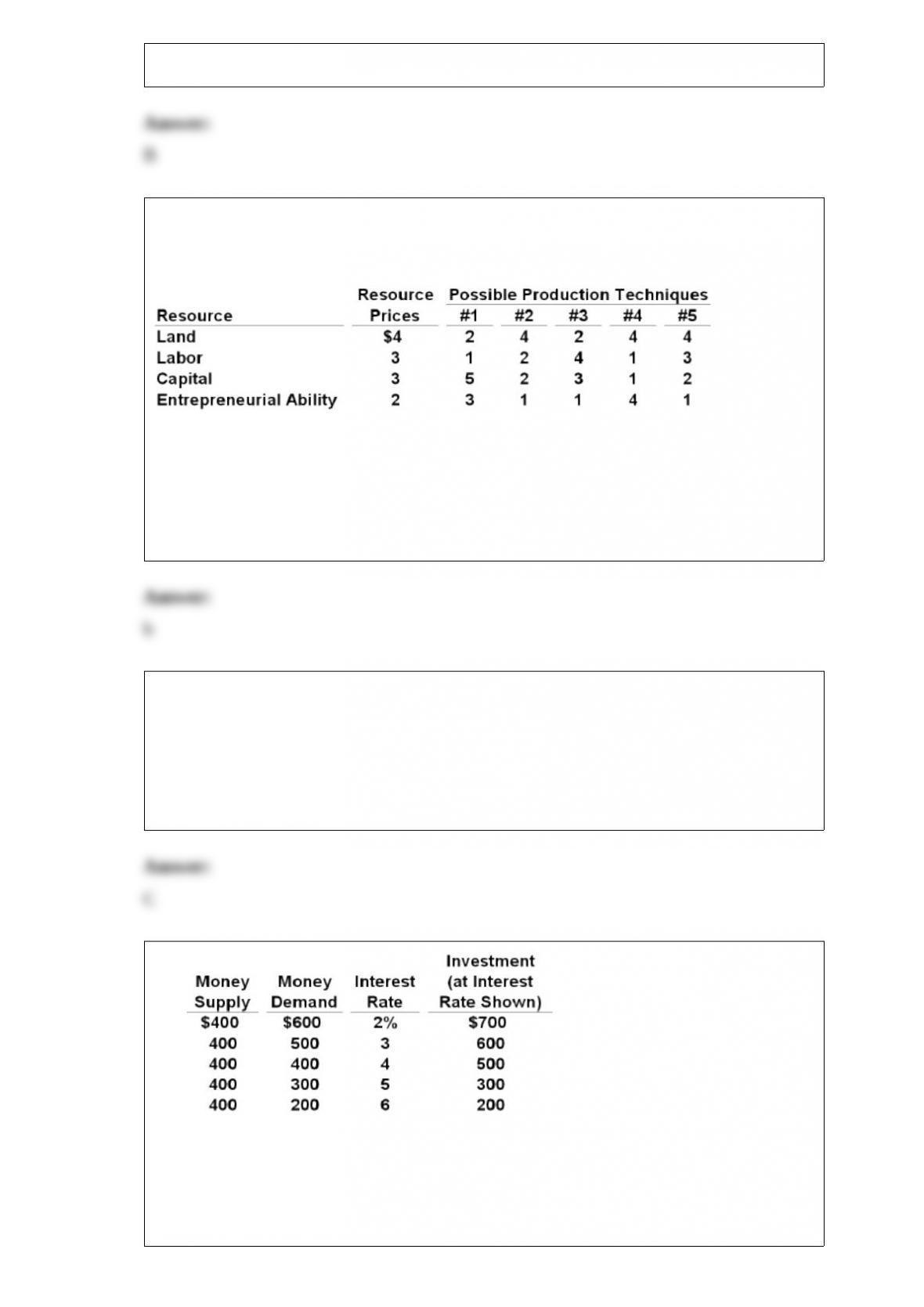
17) answer the next question(s) using the following data which show all available
techniques for producing 20 units of a particular commodity:
refer to the above data. in view of the indicated resource prices, the economically most
efficient production technique(s) is (are) technique(s):
a.#1
b.#2 and #4
c.#3
d.#1 and #3
18) Which of the following has bolstered the case for active monetary policy?
A.budget surpluses
B.increasing globalization of financial markets
C.the success of monetary policy in helping the economy emerge from the 1990-1991
recession and sustain economic growth through the 1990s
D.a decreasing role of banks and thrifts in the financial industry
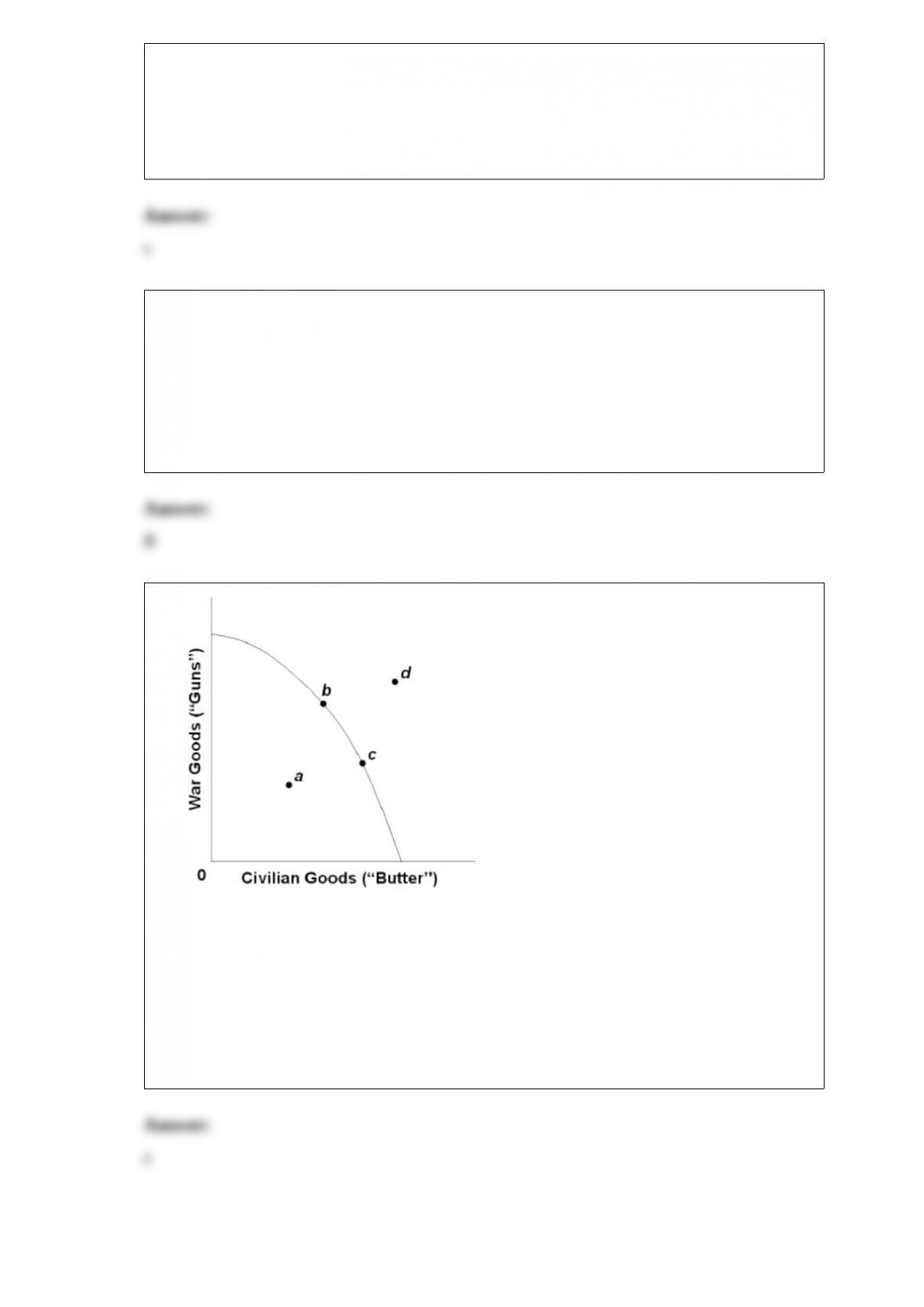
19)
Refer to the above table. An interest rate of 2 percent is not sustainable because:
A.the demand for bonds in the bond market will fall and the interest rate will fall.
B.the demand for bonds in the bond market will rise and the interest rate will fall.
C.the supply of bonds in the bond market will decline and the interest rate will rise.
D.the supply of bonds in the bond market will rise and the interest rate will rise.

20) Suppose the balance on the current account is +$100 billion and the balance on the
capital account is -$1 billion. The balance on the financial account is:
A.+$101 billion.
B.-$100 billion.
C.-$99 billion.
D.+$100 billion.
21) Suppose a firm anticipates that a particular R&D expenditure of $100 million will
result in a new product and thus create a one-time added profit of $108 million a year
later. The firm will:
A.undertake the R&D expenditure if its interest-rate-cost of borrowing is 12 percent.
B.undertake the R&D expenditure if its interest-rate-cost of borrowing is 10 percent.
C.not undertake the R&D expenditure if its interest-rate-cost of borrowing is 9 percent.
D.not undertake the R&D expenditure if its interest-rate-cost of borrowing is 7 percent.
22) The optimal extraction level in the present for a non-renewable resource is:
A.zero.
B.where the market price of the resource equals the extraction cost of the last unit.
C.where the market price of the resource equals the extraction cost of the last unit plus
the user cost of the last unit.
D.where the extraction cost of the last unit equals the user cost of the last unit.
23) we would expect the cross elasticity of demand between dress shirts and ties to be:
a.positive, indicating normal goods.
b.positive, indicating complementary goods.
c.negative, indicating substitute goods.
d.negative, indicating complementary goods.
24) suppose that gamma is an advanced industrial country and omega is a developing
nation. omega will gain the most from having some of its people emigrate to gamma if:
a.omega is currently experiencing full employment.
b.the most skilled workers emigrate.
c.omega currently suffers from high unemployment and the unemployed emigrate.
d.the costs to emigrate to gamma are high.
25) In recent decades:
A.all countries classified as DVCs have had little or no economic growth.
B.some nations classified as DVCs have grown rapidly while others have grown very
slowly or not at all.
C.all countries classified as DVCs have experienced rapid economic growth and rising
living standards.
D.all countries classified as low-income DVCs have had declining per capita GDPs.
26)
refer to the above production possibilities curve. at the onset of the second world war
the united states had large amounts of idle human and property resources. its economic
adjustment from peacetime to wartime can best be described by the movement from
point:
a.c to point b.
b.b to point c.
c.a to point b.
d.c to point d.
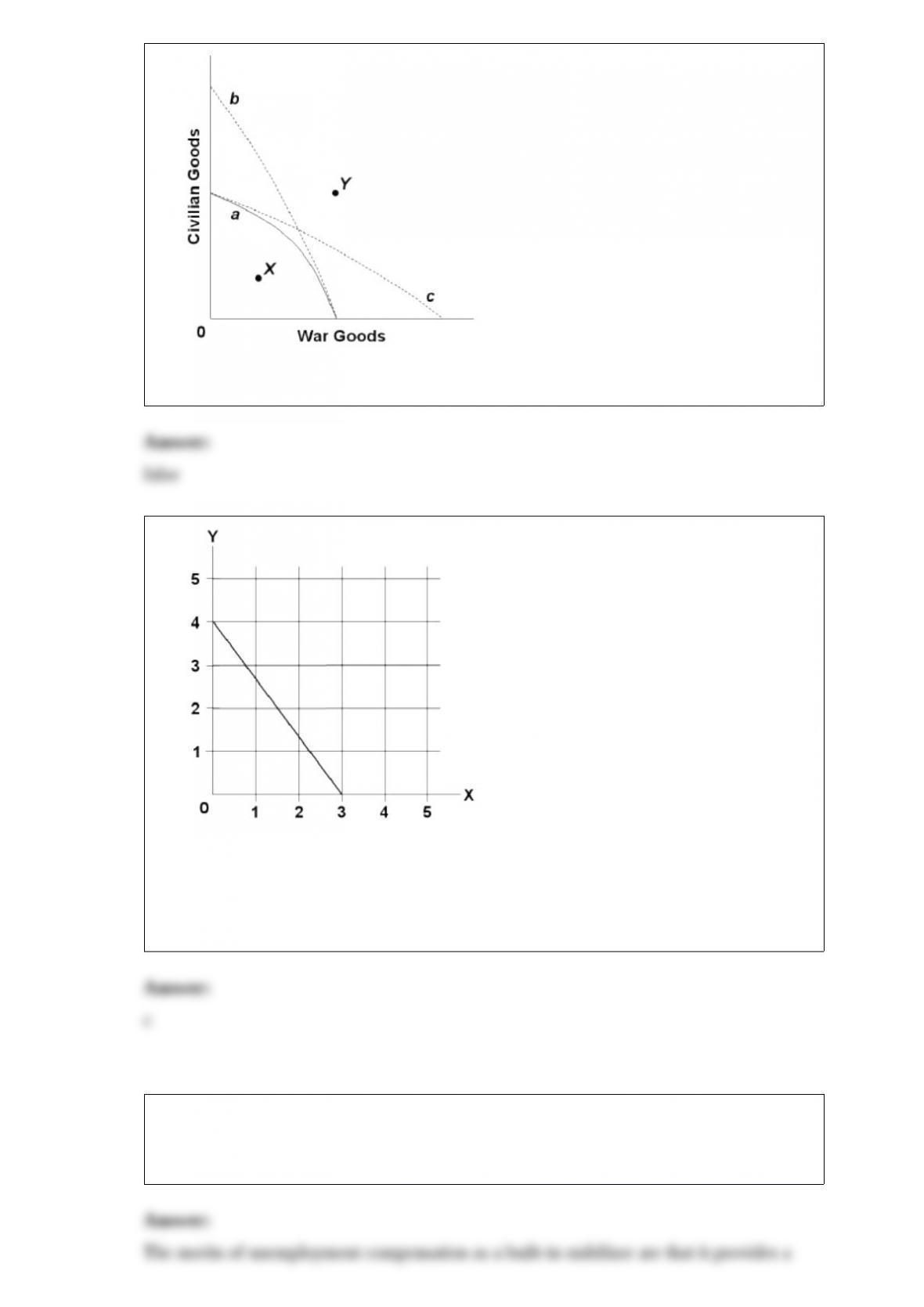
27)
refer to the above diagram. given production possibilities curve (a), the combination of
civilian and war goods indicated by point x is unattainable to this economy.
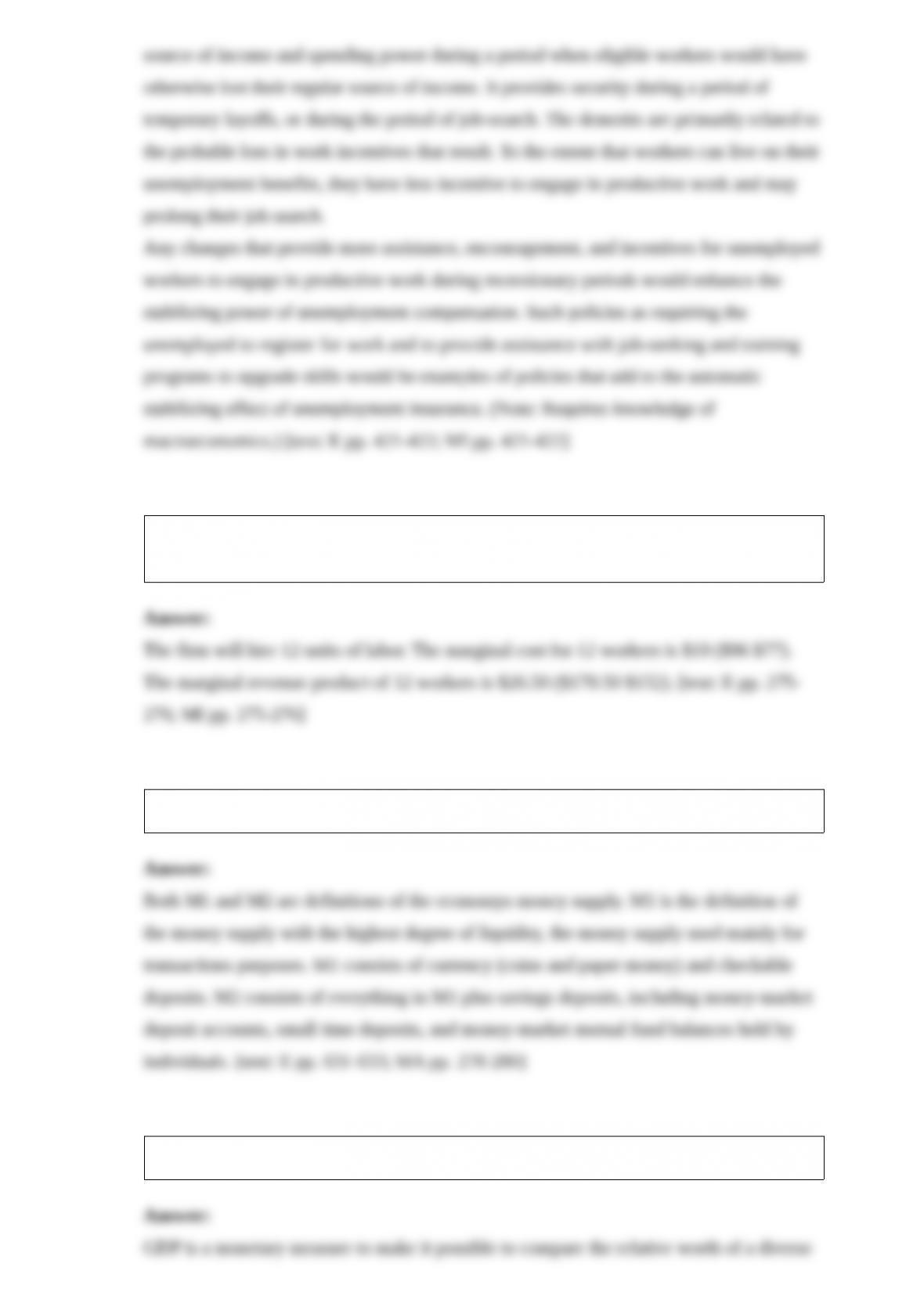
28)
in the above diagram variables x and y are:
a.both dependent variables.
b.directly related.
c.inversely related.
d.unrelated.
29) What are the merits and demerits of unemployment compensation as a built-in
stabilizer? Can you think of any changes in unemployment compensation that might
improve its effectiveness as a stabilizing technique?
30) Use the following data to answer the question.
How many units of labor will this firm hire in maximizing its profits?
31) What is the difference between the M1 and M2 definitions of the money supply?
32) Why is GDP a monetary measure?
33) What is the discount rate and how does changing it affect the money supply?
34) Explain the view of Thomas Malthus on population growth in 1789 and contrast it
with what has happened since that time.
35) What are the human realities of poverty in DVCs?
36) What are some of the reasons for the major backflows that occur in most
international migration patterns?