
Assume a hypothetical case where an industry begins as perfectly competitive and then
becomes a monopoly. Which of the following statements regarding economic surplus in
each market structure is true?
A) Under perfectly competitive conditions, economic surplus in this industry equals
consumer surplus plus producer surplus. Under monopoly conditions, some consumer
surplus is transferred to producer surplus, but economic surplus is the same as it was
under perfectly competitive conditions.
B) Under perfectly competitive conditions, economic surplus in this industry is
maximized. Under monopoly conditions economic surplus is minimized.
C) Under perfectly competitive conditions, economic surplus is equal to consumer
surplus; there is no producer surplus because firms are price-takers. Under monopoly
conditions, economic surplus is equal to producer surplus.
D) Under perfectly competitive conditions, economic surplus is maximized. Under
monopoly conditions economic surplus is less than under perfect competition and there
is a deadweight loss.
If a corporate bond with face value of $5,000 has an interest rate of 4 percent paid once
a year for a term of 30 years, what is the size of the coupon payment?
A) $4
B) $200
C) $1,250
D) $5,000

If, for a given percentage increase in price, quantity supplied increases by a
proportionately larger percentage, then supply is
A) unit-elastic.
B) perfectly elastic.
C) relatively inelastic.
D) elastic.
How are the fundamental economic decisions determined in North Korea?
A) Individuals, firms, and the government interact in a market to make these economic
decisions.
B) These decisions are made by the country’s elders who have had much experience in
answering these questions.
C) The government decides because North Korea is a centrally planned economy.
D) The United Nations decides because North Korea is a developing economy.
The De Beers diamond mining and marketing company of South Africa became one of
the most profitable and longest-lived monopolies in history. Which of the following has
always threatened De Beers’ control of the diamond market?
A) Since few diamonds are ever destroyed, De Beers has constantly faced possible
competition from other firms reselling diamonds.

B) Competition from imitation diamonds: Technology has made it possible to make
fake diamonds look exactly like real diamonds.
C) Competition from other gemstones, including rubies and emeralds, that have become
more popular over time.
D) At different times in the past, some countries have banned the importation of
diamonds from South Africa for political reasons.
Technological advances have resulted in lower prices for digital cameras. What is the
impact of this on the market for traditional (non-digital) cameras?
A) The demand curve for traditional cameras shifts to the right.
B) The supply curve for traditional cameras shifts to the right.
C) The demand curve for traditional cameras shifts to the left.
D) The supply curve for traditional cameras shifts to the left.
An efficiency wage
A) is higher than the market wage and tends to increase productivity.
B) is lower than the market wage and tends to increase productivity.
C) is higher than the market wage and tends to decrease productivity.
D) is lower than the market wage and tends to decrease productivity.
Differences in marginal revenue products are the most important factor in explaining
wage differences. Other factors that explain wage differences include all but one of the
following. Which factor does not help explain differences in wages?
A) cognitive differentials
B) compensating differentials
C) discrimination
D) labor unions
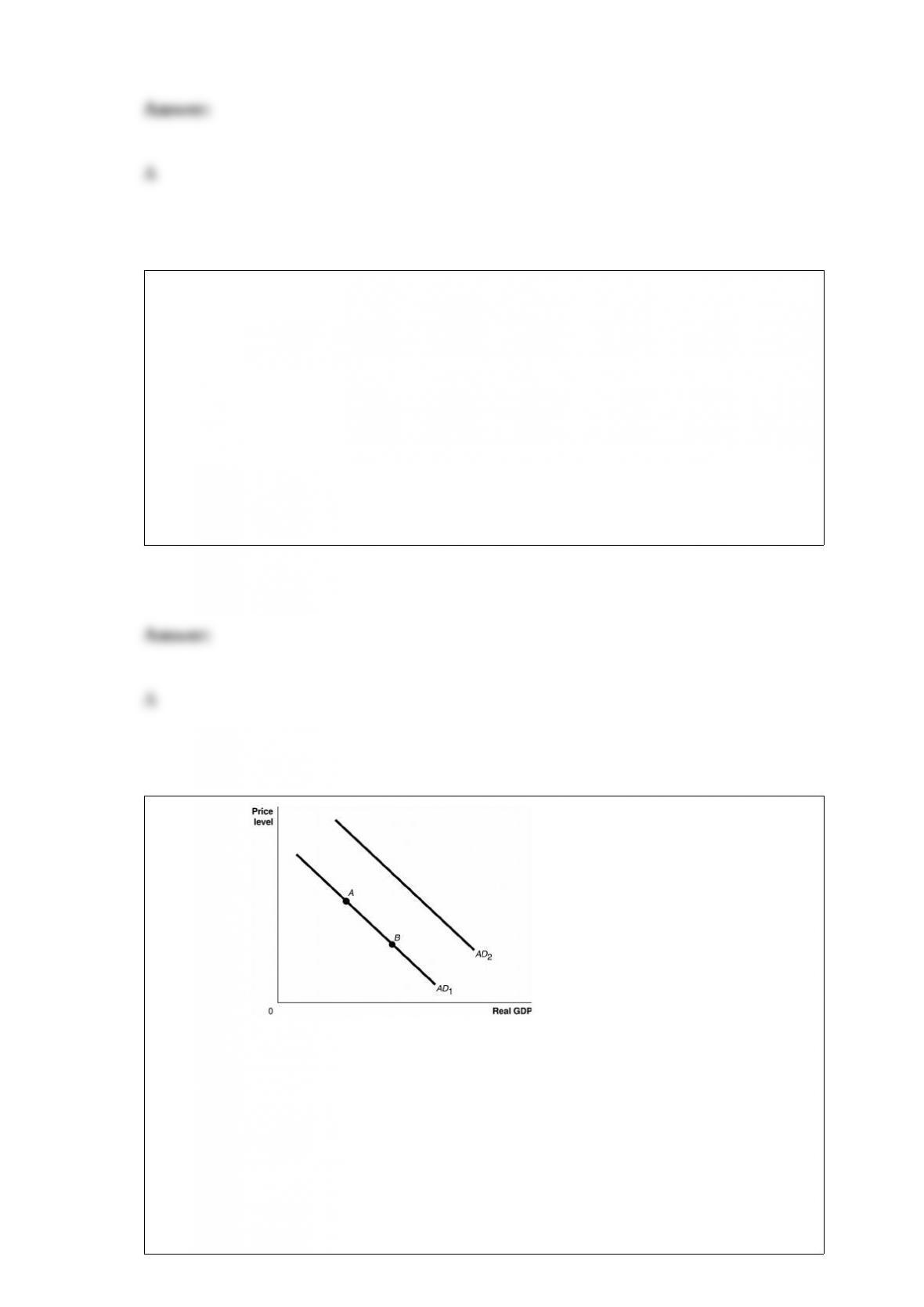
Figure 13-1
Ceteris paribus, a decrease in the growth rate of domestic GDP relative to the growth
rate of foreign GDP would be represented by a movement from
A) AD1 to AD2.
B) AD2 to AD1.
C) point A to point B.

D) point B to point A.
When a financial asset is first sold, the sale takes place in the ________ market, and
subsequent sales take place in the ________ market.
A) stock; bond
B) primary; secondary
C) investment; commercial
D) secure; risk
Under the Soviet system of communism,
A) managerial pay was determined by the extent to which managers could lower the
per-unit costs of production.
B) technological progress was slow because managers had little incentive to develop
new technologies.
C) competitive pressures in the Soviet Union allowed the country’s technological
progress to keep pace with the rest of the world.
D) the per-worker production function in the Soviet Union shifted up more rapidly than
production functions in other countries.

The government purchases multiplier is defined as
A) .
B) .
C) .
D) .
The term “early adopters” refers to
A) firms that are the first to implement a new technology that is used to produce new
goods or services.
B) book clubs that are first to recommend best-selling books to their members.
C) consumers who respond quickly to fads, seasonal changes, etc.
D) consumers who are willing to pay high prices to be among the first to own new
products.
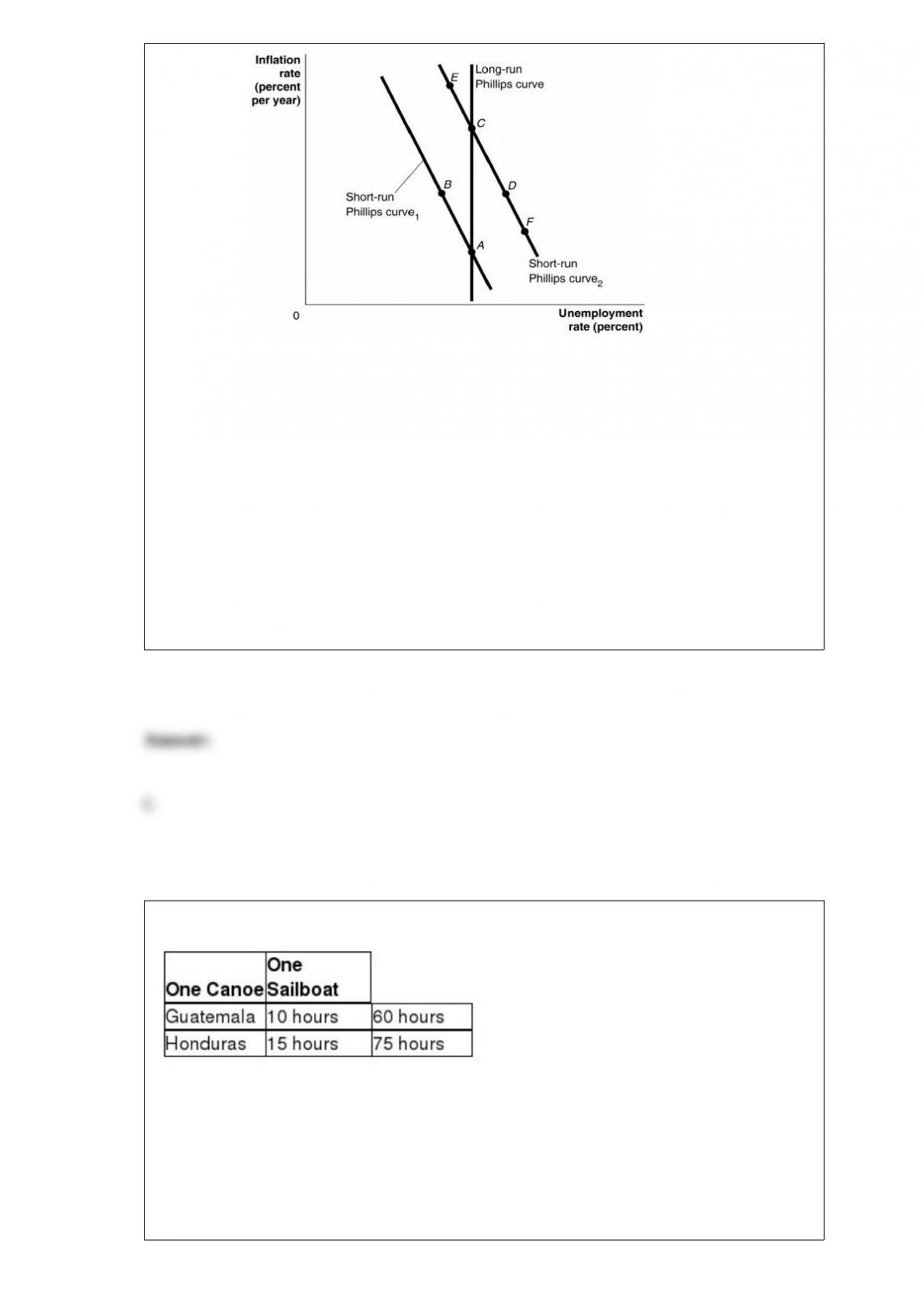
Figure 28-9
Fed Chairman Paul Volcker’s response to high inflation of the late 1970s is depicted in
the figure above as a movement from
A) A to D to C.
B) C to B to A.
C) C to D to A.
D) C to E to B.
E) A to B to C.
Table 2-9
Table 2-9 shows the number of labor hours required to produce a canoe and a sailboat in
Guatemala and Honduras. What is Guatemala’s opportunity cost of producing one
sailboat?
A) 1/6 of a canoe
B) 2/3 of a canoe

C) 3 canoes
D) 6 canoes
Assume a firm is able to use an optimal two-part tariff.
a. Is the outcome economically efficient? Why or why not?
b. What happens to consumer surplus?
c. Does this represent perfect price discrimination? Why or why not?
For a firm in a perfectly competitive market, price is
A) equal to both average revenue and marginal revenue.
B) equal to average revenue but greater than marginal revenue.
C) greater than marginal revenue but less than average revenue.
D) less than both average revenue and marginal revenue.

Absolute poverty measures vary from country to country. For example, in 2013, the
poverty line in the United States for a family of four with two children was an annual
income of $23,550 but economists often use a much lower threshold income of $1 per
day when calculating the rate of poverty in poor countries. How is this absolute poverty
measured?
A) by comparing the percentage of households living below the poverty line to the total
population
B) by comparing a household’s income to the income required to maintain the average
standard of living in a society at a particular time
C) by comparing the amount of goods and services that a household’s income can
purchase to an objective measure of the amount of income needed to sustain a certain
predetermined standard of living
D) by comparing the amount of goods and services that a household’s income can
purchase in one country to the amount of goods and services that a household’s income
can purchase in another country of comparable living standard
Which of the following best describes how banks create money?
A) Banks charge higher interest rates on loans than they pay on deposits.
B) Banks charge fees for providing financial advice.
C) Banks create checking account deposits when making loans from excess reserves.
D) Banks make loans from reserves.

Explain whether you agree or disagree with the following statement: “The reason that
inflation is bad is because it increases the cost of living – the costs of goods and services
we buy – without increasing income in general.”
What is a long-run supply curve? What does a long-run supply curve look like on a
perfectly competitive market graph?
The Bureau of Labor Statistics does not count discouraged workers as unemployed.
Suppose discouraged workers were counted as unemployed. Explain how the
unemployment rate and the labor force participation rate would change.

To understand why someone cannot get a job, it helps to know the three types of
unemployment. List the three types of unemployment and explain what causes each
type. What advice for finding a job would be appropriate for someone in each type of
unemployment?
If you know that a country’s net foreign investment is positive, what does that tell you
about the relationship between the country’s national saving and private investment?
(Assume that the capital account is zero and net transfers are zero.)

What are the three main sets of factors that cause the supply and demand curves in the
foreign exchange market to shift?
Explain whether it is possible for a country to have an absolute advantage in the
production of a product without having a comparative advantage in the production of
that product.
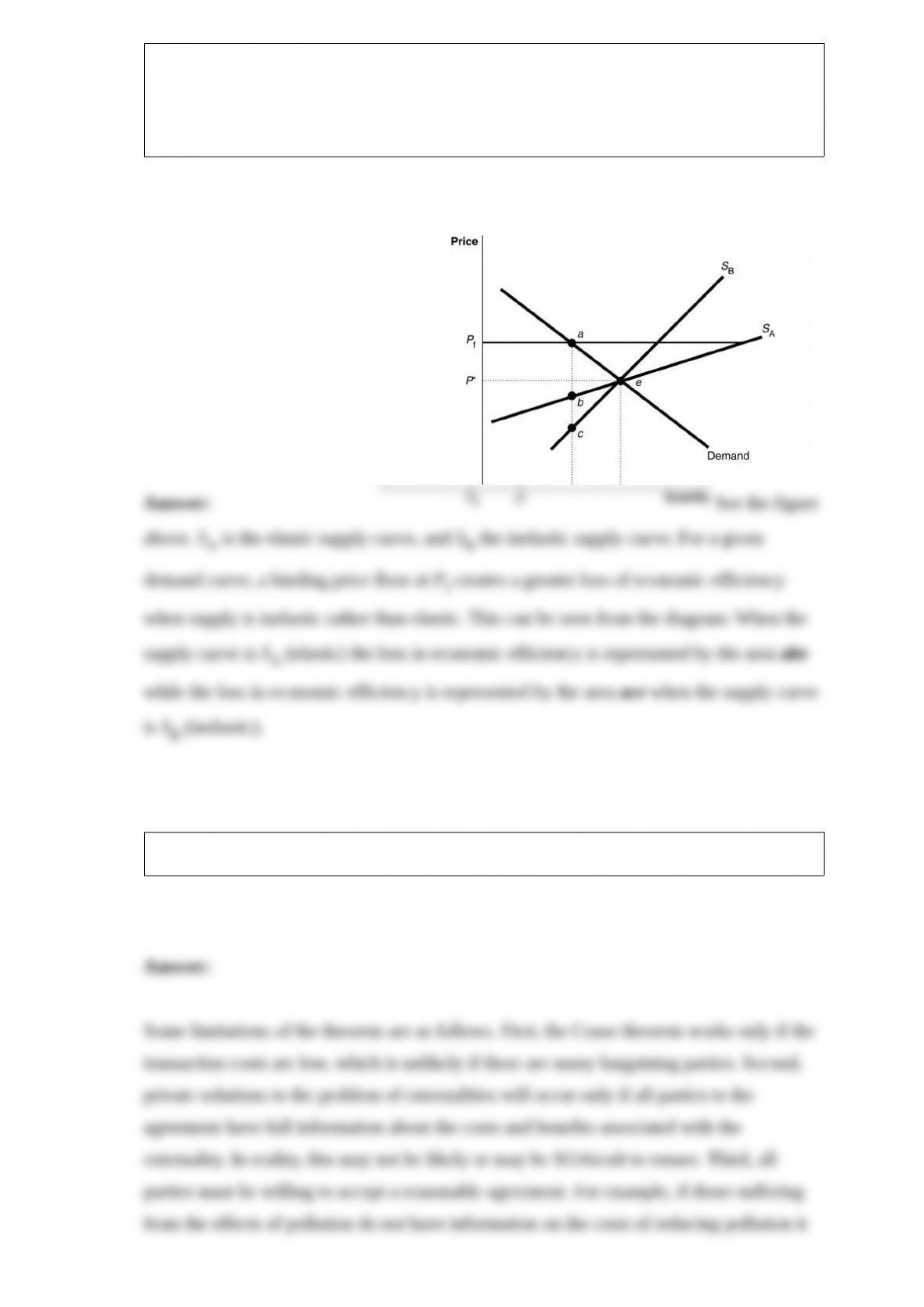
For a given demand curve, will there be a greater loss of economic efficiency from a
binding price floor when supply is elastic or inelastic? Illustrate your answer with a
demand and supply graph. In your graph you must show two supply curves, one elastic
and the other inelastic.
What are some of the limitations of the Coase theorem in practice?

What shape does a production possibilities frontier take if it displays increasing
opportunity costs? What shape does a production possibilities frontier take if it displays
constant opportunity costs? Which shape is most common in production situations?