
The key behavioral assumption of the cartel theory is that oligopolists in an industry
a. try to maximize sales instead of profits.
b. act as if they are perfect competitors.
c. act in a manner consistent with there being only one firm in the industry.
d. try to create a demand for their products by way of advertising.
e. none of the above
Raquel, who earns $900 a week, bought a television set and gained $70 consumers’
surplus. What price did she pay for the good?
a. $40
b. $830
c. $160
d. $5
e. There is not enough information to answer the question.
Suppose that an American-made pair of blue jeans has a price of $80. If the exchange
rate is $0.095 = 1 peso, then a Mexican consumer would have to pay approximately
__________ pesos to purchase the blue jeans, but if the exchange rate is $0.085 = 1
peso, then a Mexican consumer would have to pay _________ pesos to purchase the
blue jeans.

a. 7.6; more
b. 842; more
c. 7.6; fewer
d. 842; fewer
e. 8,444; fewer
Under certain circumstances, a congressional district may be a special interest group.
a. True
b. False
Exhibit 24-1
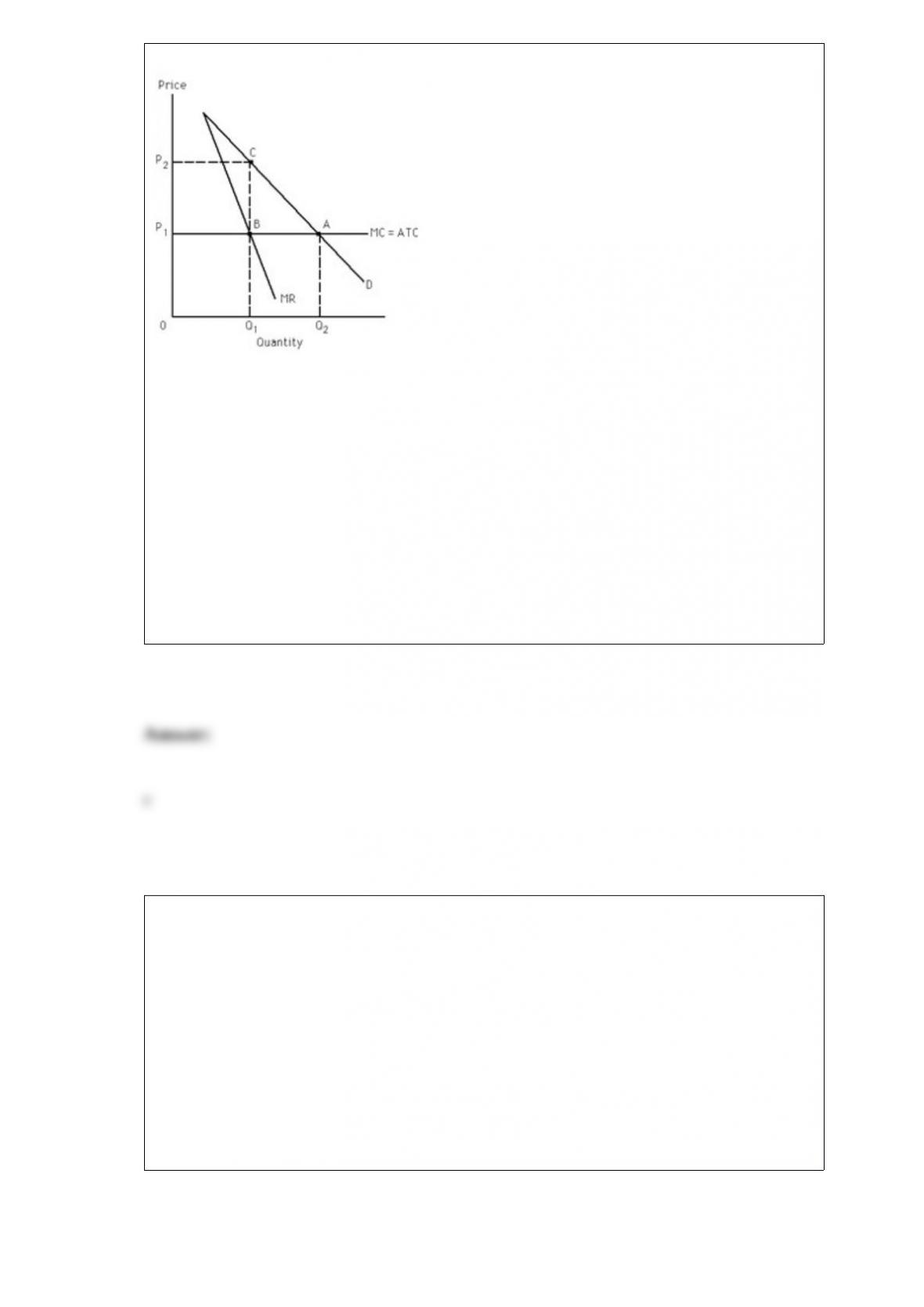
If the product is produced under single-price monopoly, what quantity will be produced
and what price will be charged in order to maximize profit?
a. Q2 units at P1
b. Q1 units at P1
c. Q1 units at P2
d. Q2 units at P2
The long-run average total cost (LRATC) curve shows the
a. lowest average variable cost at which the firm can produce any given level of output.
b. lowest unit cost at which the firm can produce any given level of output.
c. highest average fixed cost at which the firm can produce any given level of output.
d. lowest marginal cost at which the firm can produce any given level of output.
e. none of the above

Jones buys two goods, A and B. Currently, Jones receives marginal utility of 24 utils
from good A and pays a price of $1.50 per unit. Jones receives a marginal utility of 43
utils from good B and pays a price of $1.99 per unit. Jones receives __________ per
dollar from good B as he does from good A.
a. the same marginal utility
b. more marginal utility
c. less marginal utility
d. more consumers’ surplus
e. less consumers’ surplus
Exhibit 22-14
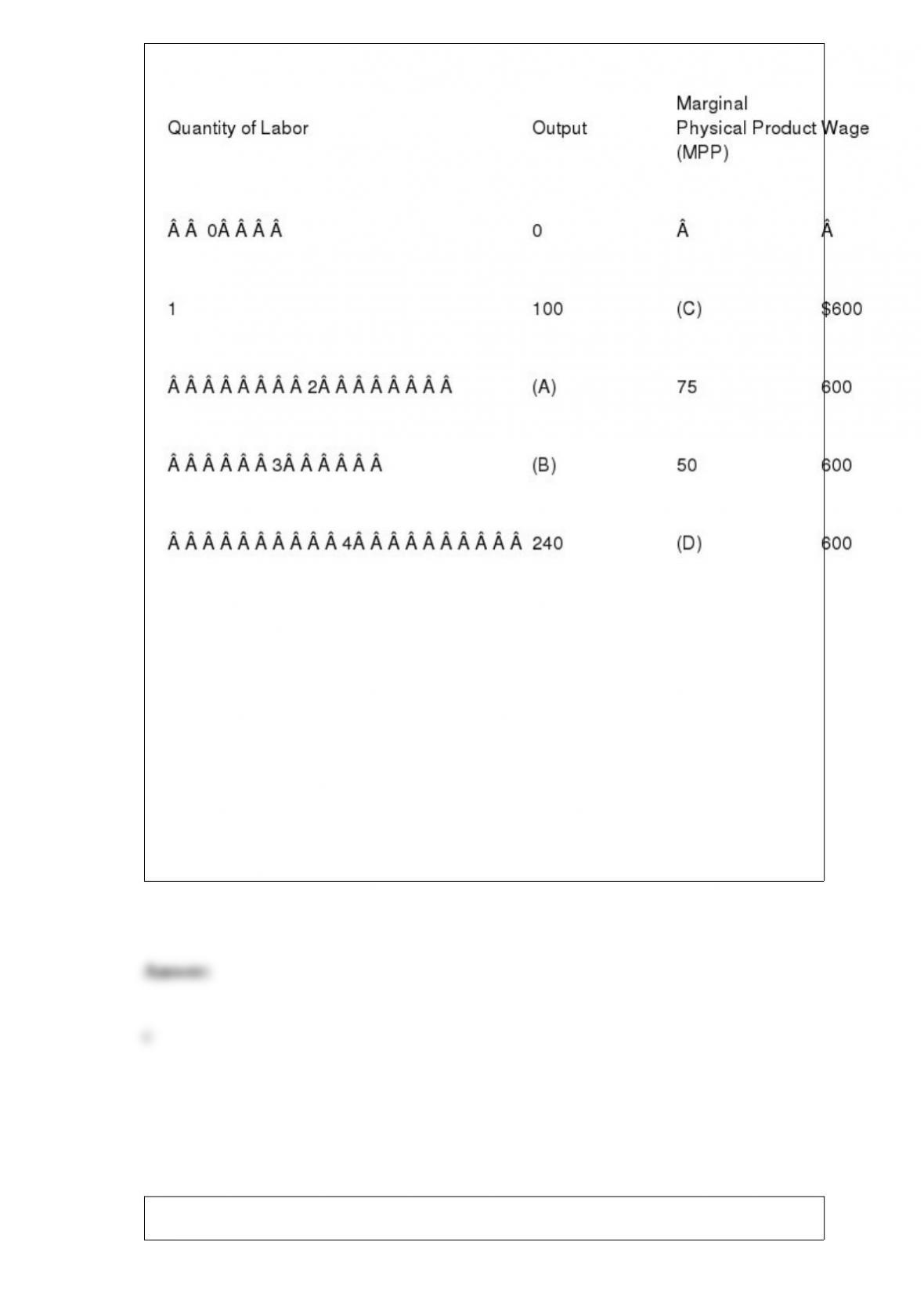
Assume that labor is the only variable input and that each additional laborer is paid
$600.
What is the MPP of the first unit of labor [blank (C)]?
a. 700 units
b. 600 units
c. 100 units
d. 50 units
Suppose someone believes that if a per-unit tax is placed on the producers of good Y,
the consumers of good Y will end up paying the full tax. This person assumes that the
demand curve for good Y is
a. elastic.
b. perfectly inelastic.
c. inelastic.
d. perfectly elastic.
e. unit elastic.
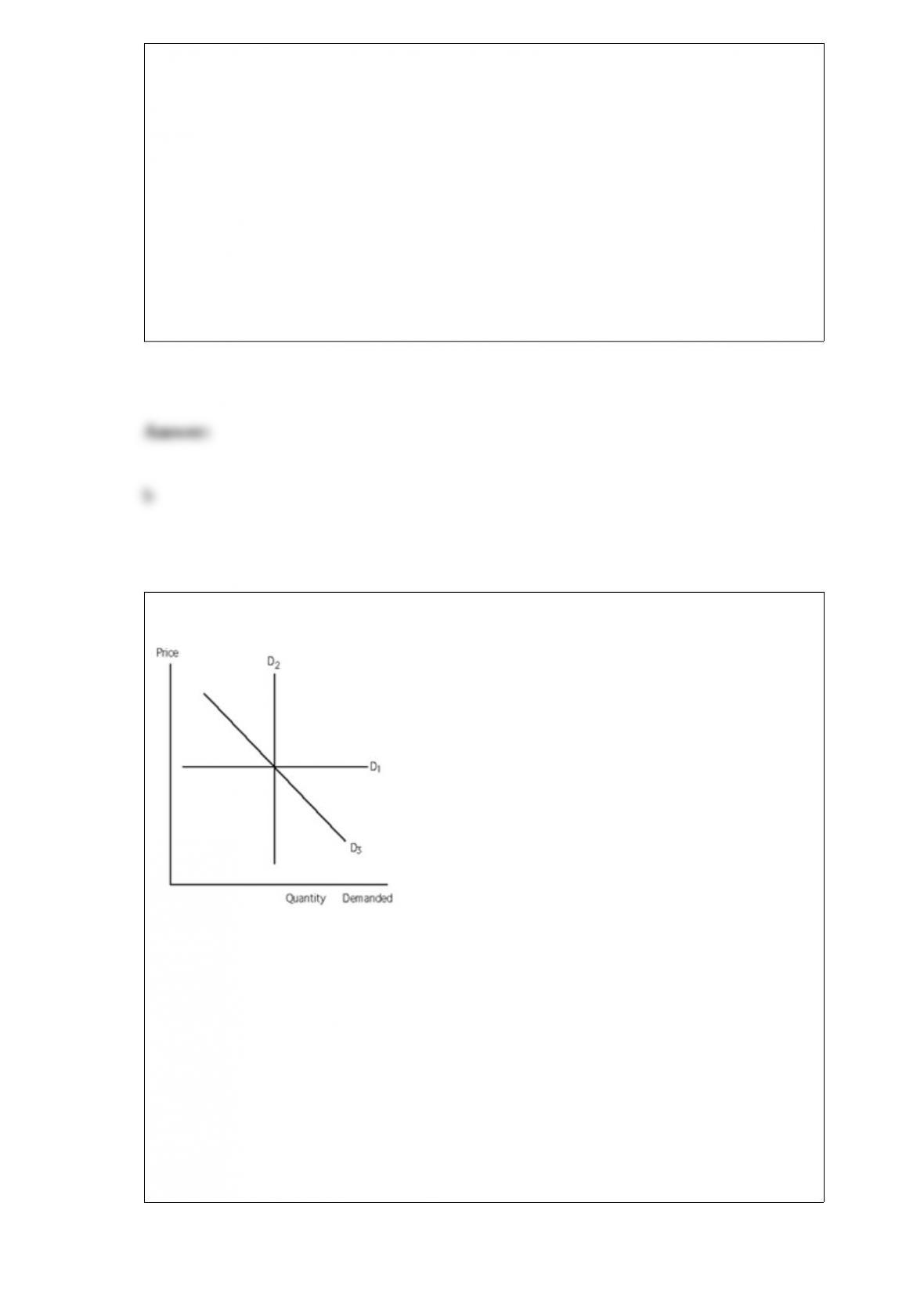
Exhibit 20-1
The demand for the good represented by demand curve D3 is
a. inelastic.
b. elastic.
c. unit elastic.
d. perfectly elastic.
e. more elastic at higher prices than at lower prices.

Perfect price discrimination is discrimination among
a. units.
b. quantities.
c. buyers.
d. prices.
Given that fixed costs are constant as output increases, average fixed costs are also
constant.
a. True
b. False
Consider two options: (A) you receive a guaranteed payment of $100; (B) a coin is
tossed and if heads comes up, you win nothing; if tails comes up, you win $200. The
expected payoff for option B is:
a. $200

b. $100
c. $300
d. $75
e. There is not enough information to answer the question.
Firm X pays firm Y $345 for a pollution permit. This expenditure on the part of firm X
is considered a __________. Firm Y ends up spending $200 to eliminate some
pollution. This expenditure on the part of firm Y is considered a __________.
a. resource cost; transfer
b. fixed cost; sunk cost
c. market environmental cost; standards cost
d. transfer; resource cost
e. none of the above
Buyers always prefer lower prices to higher prices.
a. True
b. False