1)
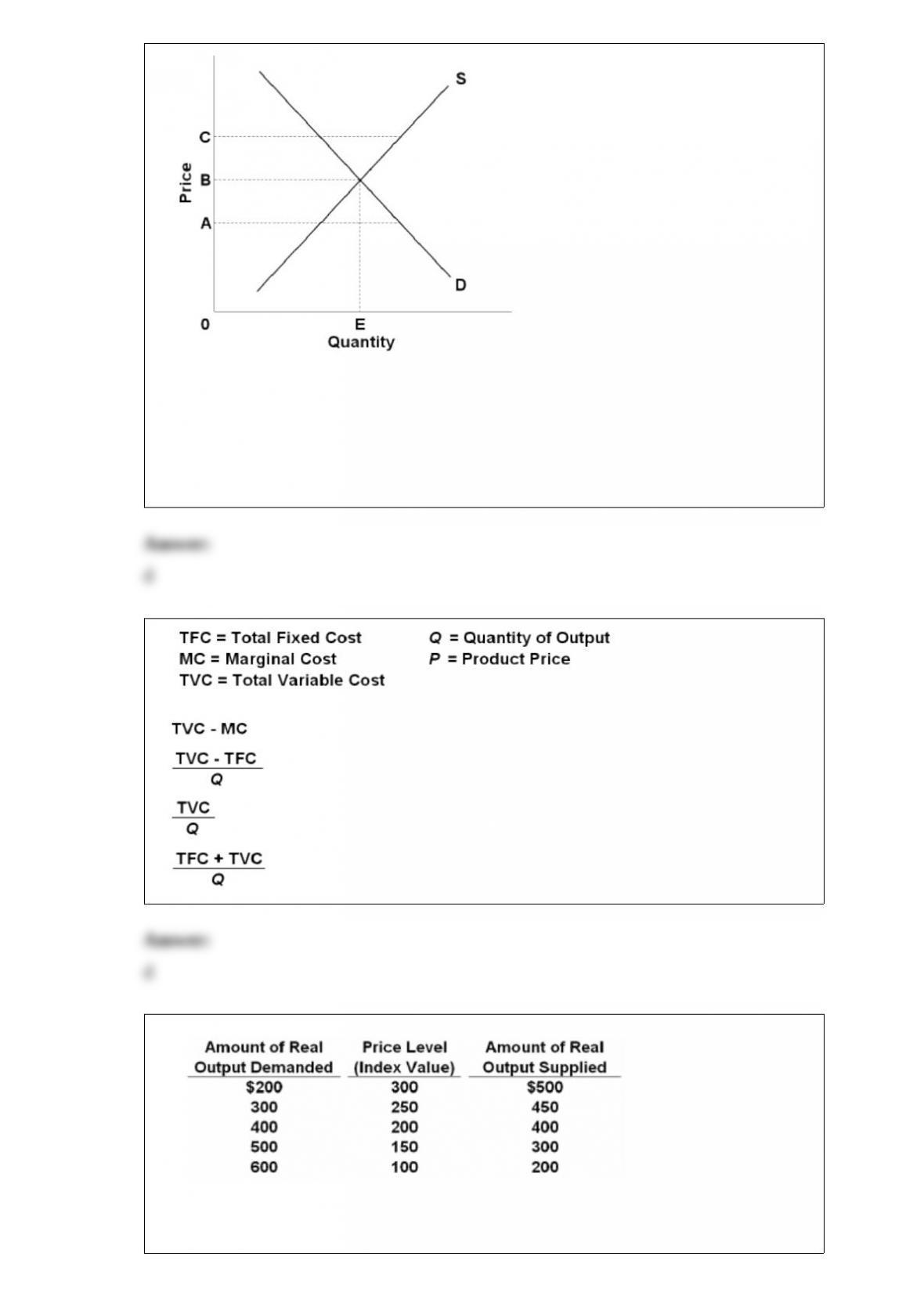
refer to the above diagram. a government-set maximum permissible interest rate is best
illustrated by:
a.price b.
b.quantity e.
c.price c.
d.price a.
2)
refer to the above information. average total cost is:
a.
b.
c.
d.
3)
Refer to the above data. If the price level is 150 and producers supply $300 of real
output:
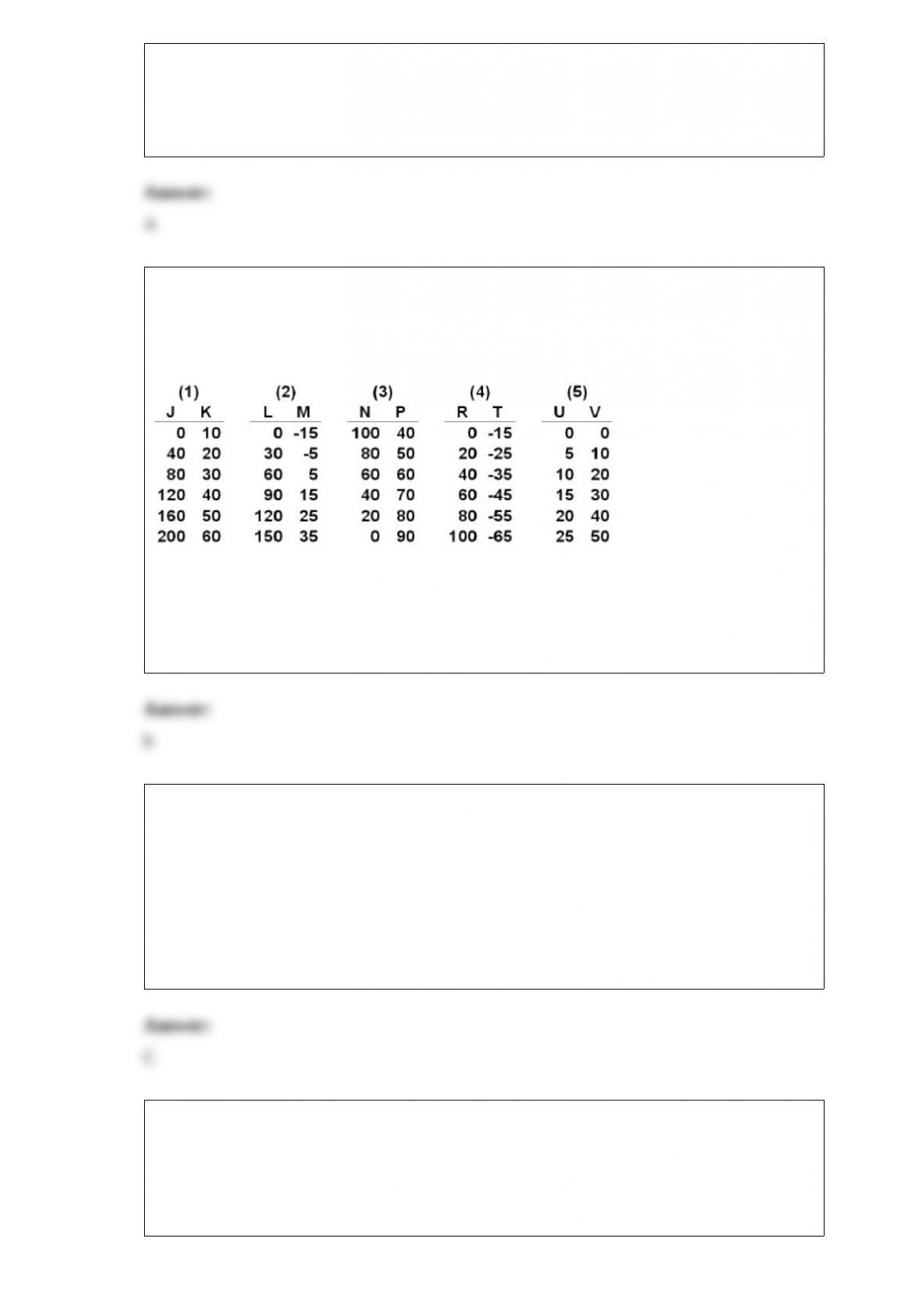
A.a shortage of real output of $200 will occur.
B.a shortage of real output of $100 will occur.
C.a surplus of real output of $300 will occur.
D.neither a shortage nor a surplus of real output will occur.
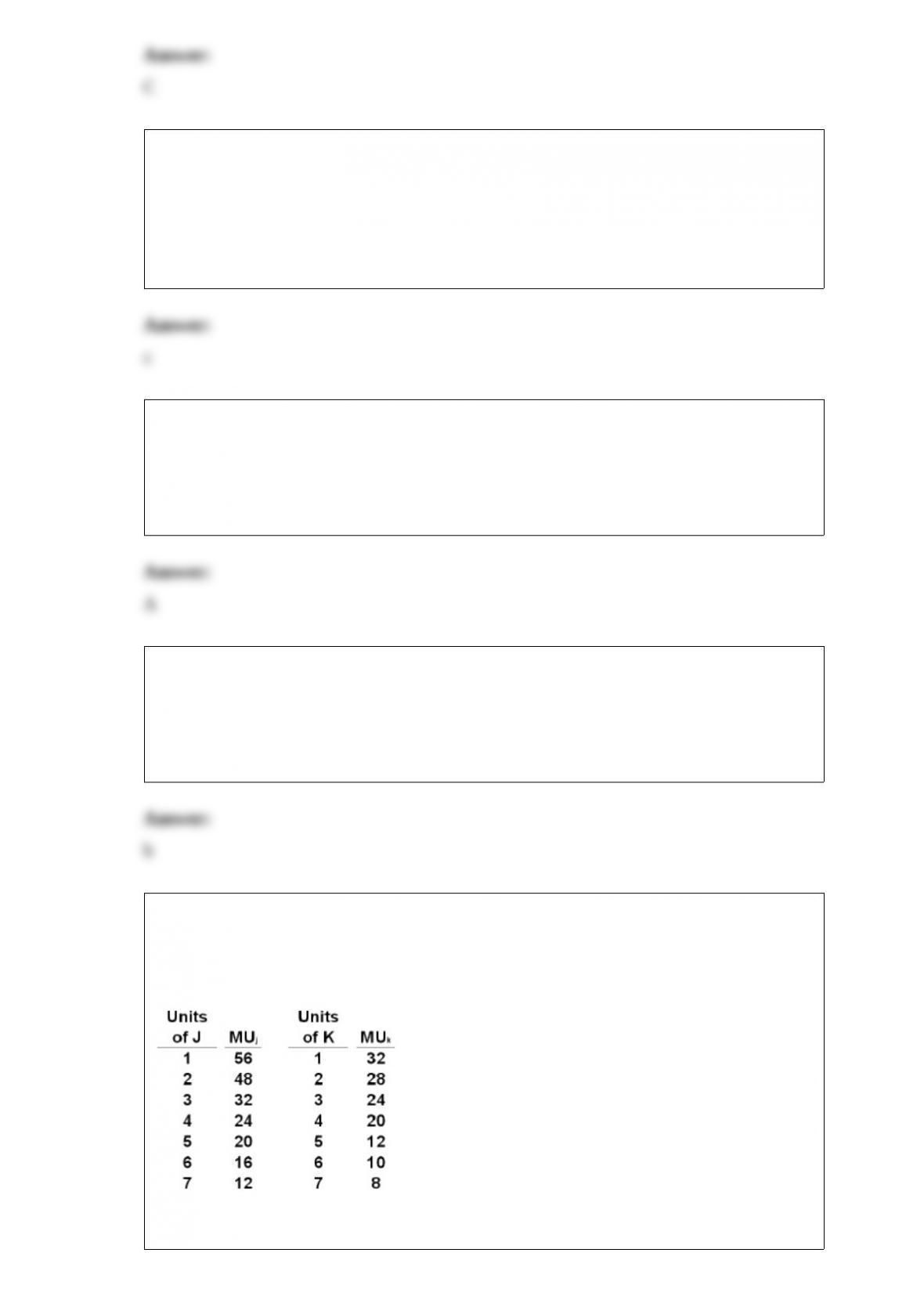
4) answer the next question(s) on the basis of the following five data sets wherein it is
assumed that the variable shown on the left is the independent variable and the one on
the right is the dependent variable. assume in graphing these data that the independent
variable is shown on the horizontal axis and the dependent variable on the vertical axis.
refer to the above data sets. for which data set(s) is the vertical intercept zero?
a.data set 4
b.data set 5
c.data sets 2 and 3
d.data set 1
5) Suppose that government imposes a specific excise tax on product X of $2 per unit
and that the price elasticity of supply of X is unitary (coefficient = 1). If the incidence
of the tax is such that the consumers of X pay $1.85 of the tax and the consumers pay
$.15, we can conclude that the:
A.supply of X is highly inelastic.
B.supply of X is highly elastic.
C.demand for X is highly inelastic.
D.demand for X is highly elastic.
6) Other things equal, an improvement in productivity will:
A.increase the equilibrium price level.
B.shift the aggregate supply curve to the left.
C.shift the aggregate supply curve to the right.
D.shift the aggregate demand curve to the left.
7) in terms of the circular flow diagram, businesses obtain revenue through the _____
market and make expenditures in the _____ market.
a.product; financial
b.resource; product
c.product; resource
d.capital; product
8) The discount rate is the rate of interest at which:
A.Federal Reserve Banks lend to commercial banks.
B.savings and loan associations lend to some builders.
C.Federal Reserve Banks lend to large corporations.
D.commercial banks lend to large corporations.
9) the price elasticity of supply measures how:
a.easily labor and capital can be substituted for one another in the production process.
b.responsive the quantity supplied of x is to changes in the price of x.
c.responsive the quantity supplied of y is to changes in the price of x.
d.responsive quantity supplied is to a change in incomes.
10) the following two schedules which show the amounts of additional satisfaction
(marginal utility) which a consumer would get from successive quantities of products j
and k.
refer to the above data. if the consumer has a money income of $52 and the prices of j
and k are $8 and $4 respectively, the consumer will maximize her utility by purchasing:
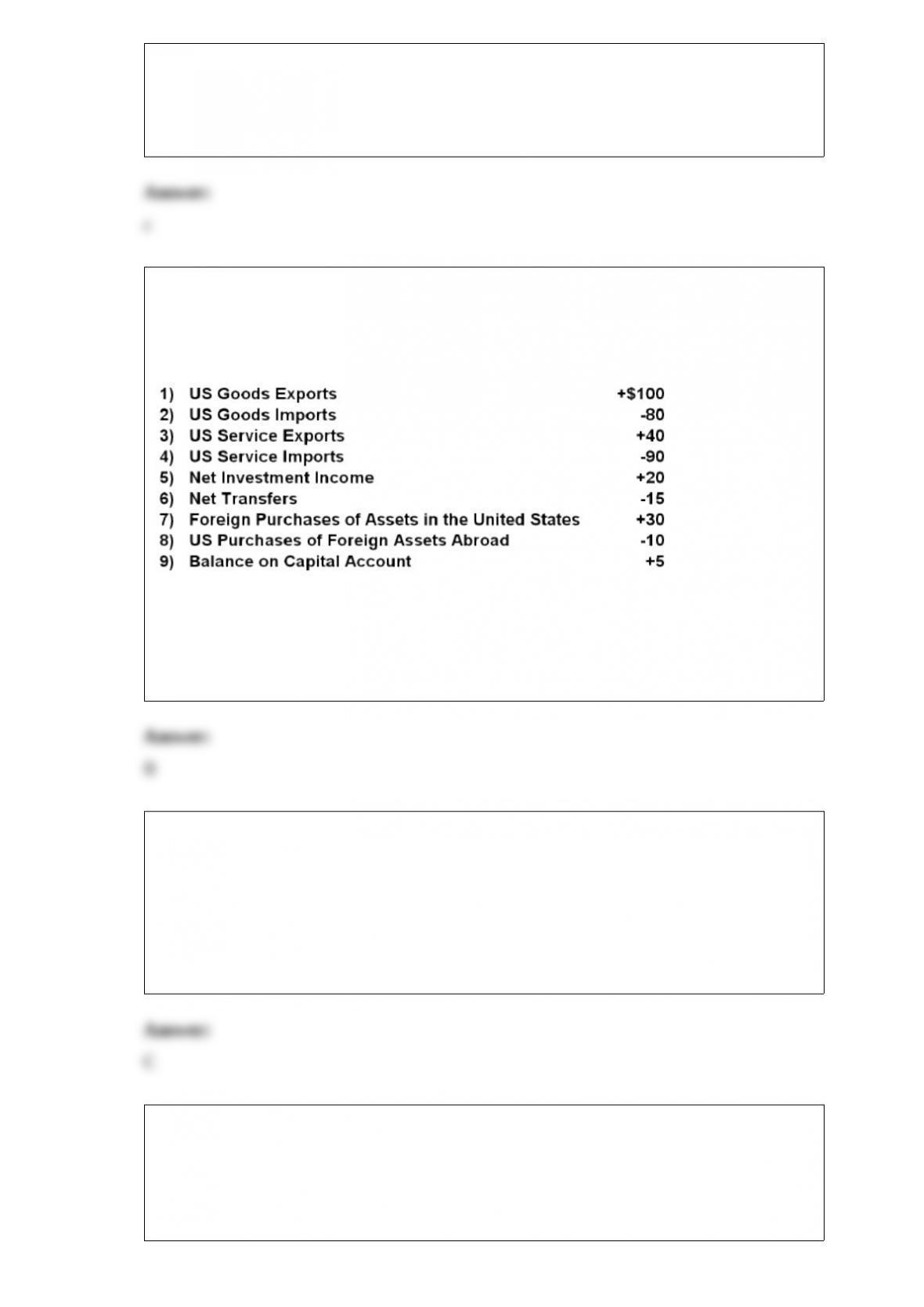
a.2 units of j and 7 units of k
b.5 units of j and 5 units of k
c.4 units of j and 5 units of k
d.6 units of j and 3 units of k
11) The following table contains hypothetical data for the 2010 U.S. balance of
payments. Answer the next question(s) on the basis of this information. All figures are
in billions of dollars.
Refer to the above data. The U.S. balance on current account is a:
A.$40 billion surplus.
B.$25 billion deficit.
C.$25 billion surplus.
D.$30 billion deficit.
12) Mainstream economists contend that, as stabilization tools:
A.discretionary fiscal policy is effective, but discretionary monetary policy is not.
B.discretionary monetary policy is effective, but discretionary fiscal policy is not.
C.both discretionary fiscal policy and monetary policy can be effective if appropriately
used.
D.discretionary fiscal policy and discretionary monetary policy cause more instability
than they cure.
13) The Economist magazine’s Commodities Price Index tracks the prices of the most:
A.important finished goods that are traded internationally.
B.important minerals that are traded internationally.
C.important productive resources that are traded internationally.
D.heavily traded agricultural-based products.
14) Occupational licensing:
A.functions essentially the same as inclusive unionism.
B.attracts large numbers of workers and therefore depresses wages.
C.often restricts occupational entry and raises the incomes of licensees.
D.has been declared illegal in the majority of states.
15)
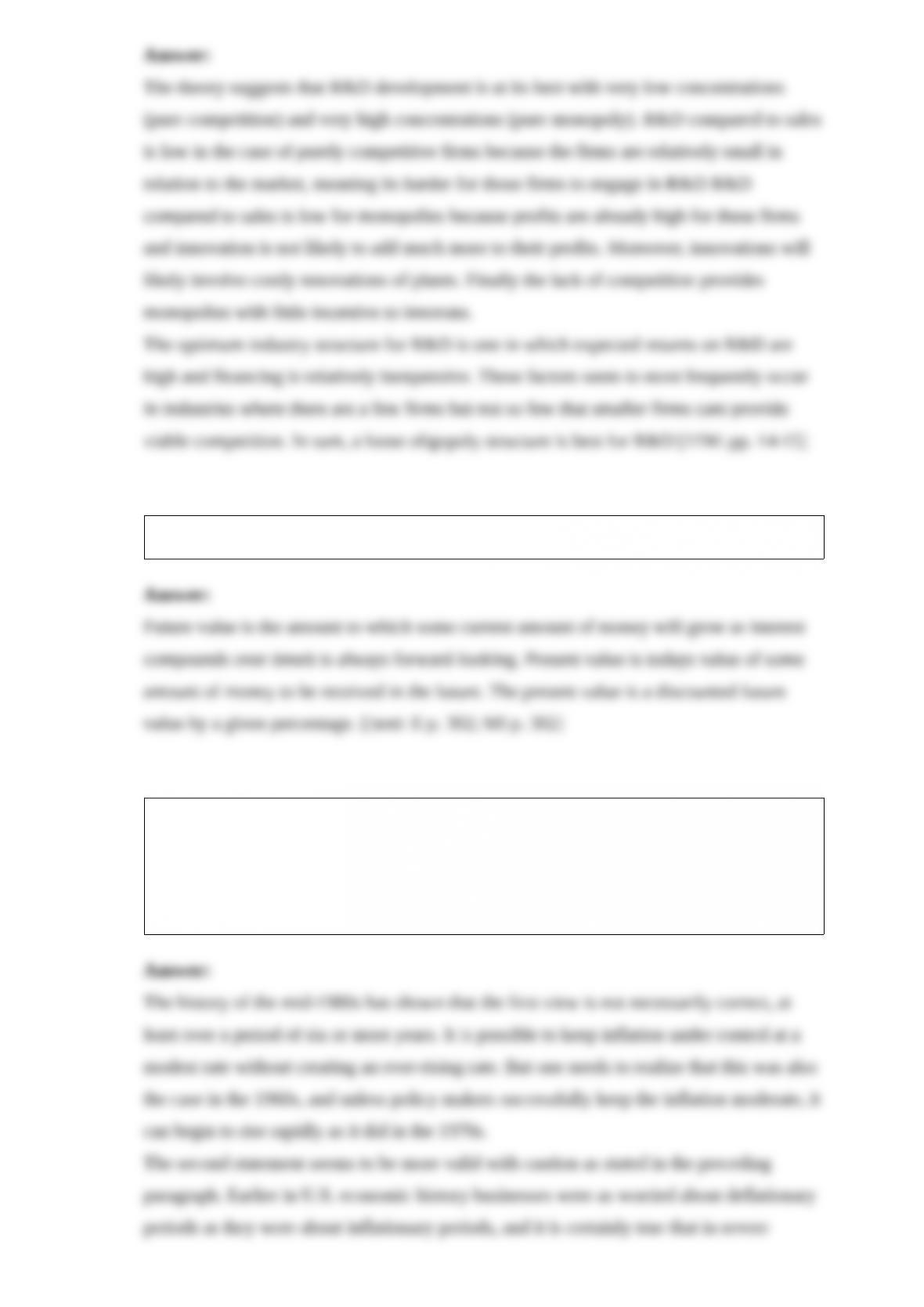
Refer to the above balance sheets. If the reserve ratio is 25%, the maximum
money-creating potential of the commercial banking system is:
A.$36.
B.$17.
C.$48.
D.$24.
16) An important routine function of the Federal Reserve Bank is to:
A.supervise the liquidation of the assets of bankrupt state banks.
B.help large commercial banks develop correspondent relationships with smaller
commercial banks.
C.advise commercial banks as to the most profitable ways of reinvesting profits.
D.provide facilities by which commercial banks and thrift institutions may collect
checks.
17) Explain the reasoning behind the inverted-U theory of R&D expenditures.
18) How do economists differentiate present value from future value?
19) Some economists believe that creeping (moderate) inflation cannot be accepted
because a gradual increase in prices leads to an ever-rising rate of inflation. Other
economists argue that in order to achieve rapid economic growth, some moderate price
increases are necessary and that rigid price stability would cause considerable
unemployment. Contrast and evaluate these two points of view.
20) How might innovation create or reduce monopoly power?
21) How can price stickiness be used to categorize macroeconomic models?
22) What are some extensions to the simplified model of the loanable funds market?