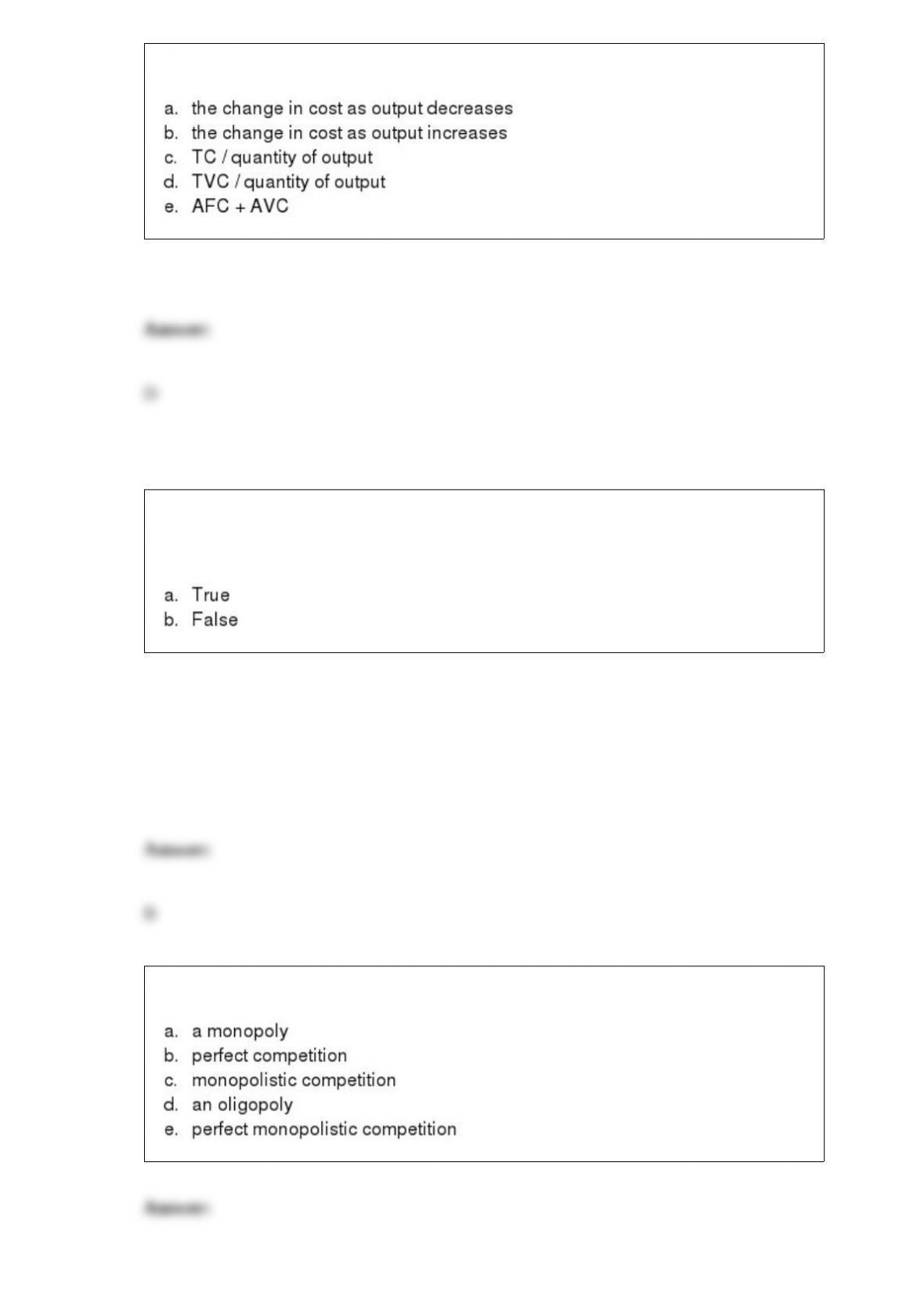
Average variable cost is
According to the classical model, if the government wanted to increase employment, it
could do so by increasing its own spending. That would lead firms to produce more
output, for which they would need to hire more workers.
A market that involves only one seller of a good or service is known as
If the economy is currently experiencing a high unemployment rate, the greatest cost is
a. extra government spending
b. rewarding those who do not work but collect government benefits
c. lost output
d. the cost of job searching
e. the extra cost of funding job fairs
Physical capital differs from raw materials in the sense that raw materials
One reason why it is difficult to regulate a natural monopoly is
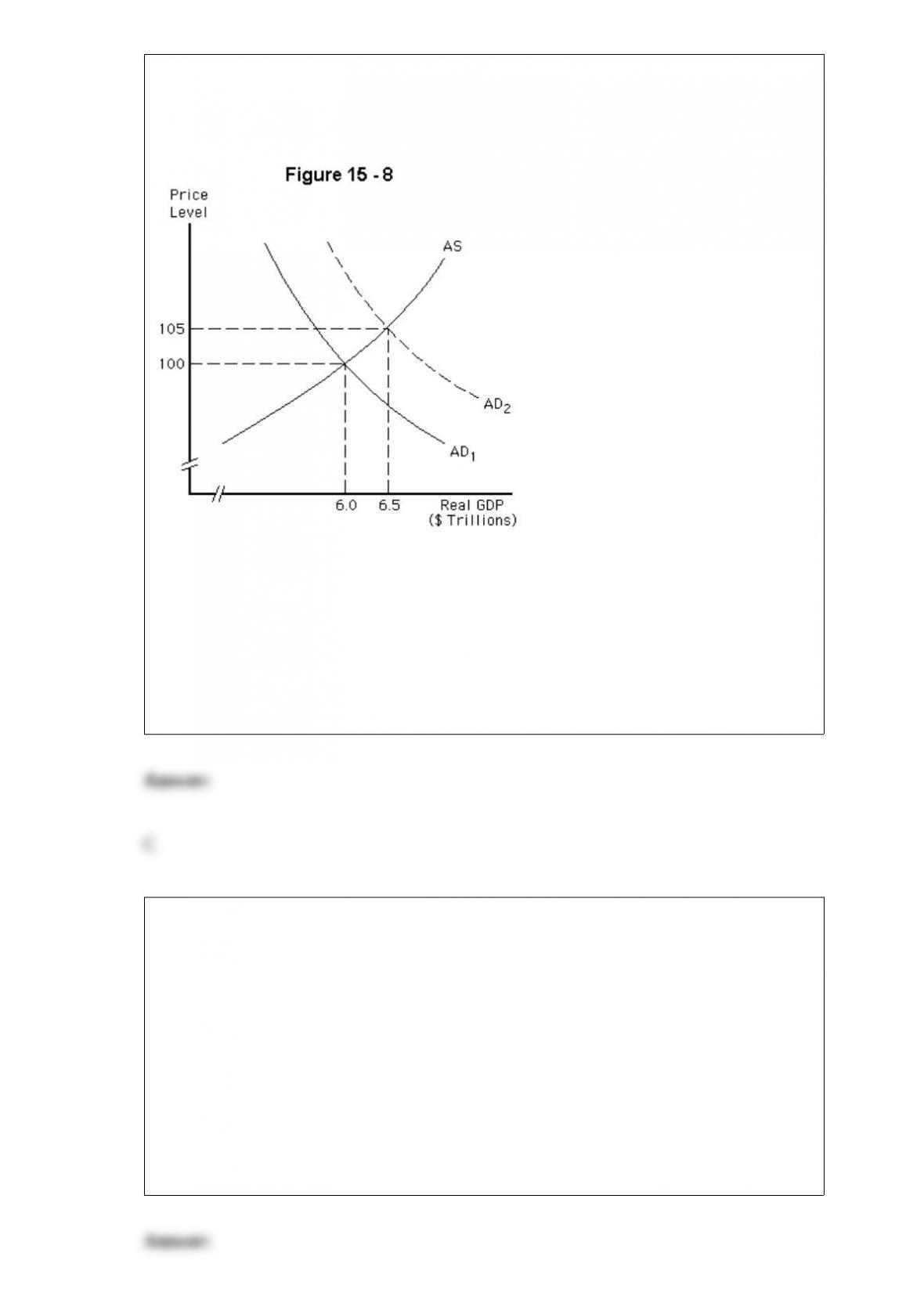
Refer to Figure 15-8. Suppose that the economy is at the full-employment level of
output of $6 trillion when a demand shock increases real GDP to $6.5 trillion. In the
long run, we would expect the
a. economy to remain at the new level of output of $6.5 trillion
b. aggregate demand curve to shift leftward until the economy returns to full
employment at the original price level
c. aggregate supply curve to shift upward until the economy returns to full employment,
but at a higher price level
d. aggregate supply curve to shift downward until the price level returns to its original
level
e. aggregate demand curve to shift further to right as the multiplier effect occurs
When free international trade takes place, in accordance with a country’s comparative
advantage,
a. producers in export industries are likely to favor it because they sell a larger quantity
at identical prices
b. producers in export industries are likely to oppose it because they sell a larger
quantity, which lowers prices in accordance with the laws of supply and demand
c. producers in import industries are likely to favor it because they sell a larger quantity
at only slightly depressed prices
d. export industry workers are likely to favor it, import industry workers are likely to
hate it
e. consumers are likely to be of two minds: they hate the more expensive import goods,
but they love the cheaper export goods
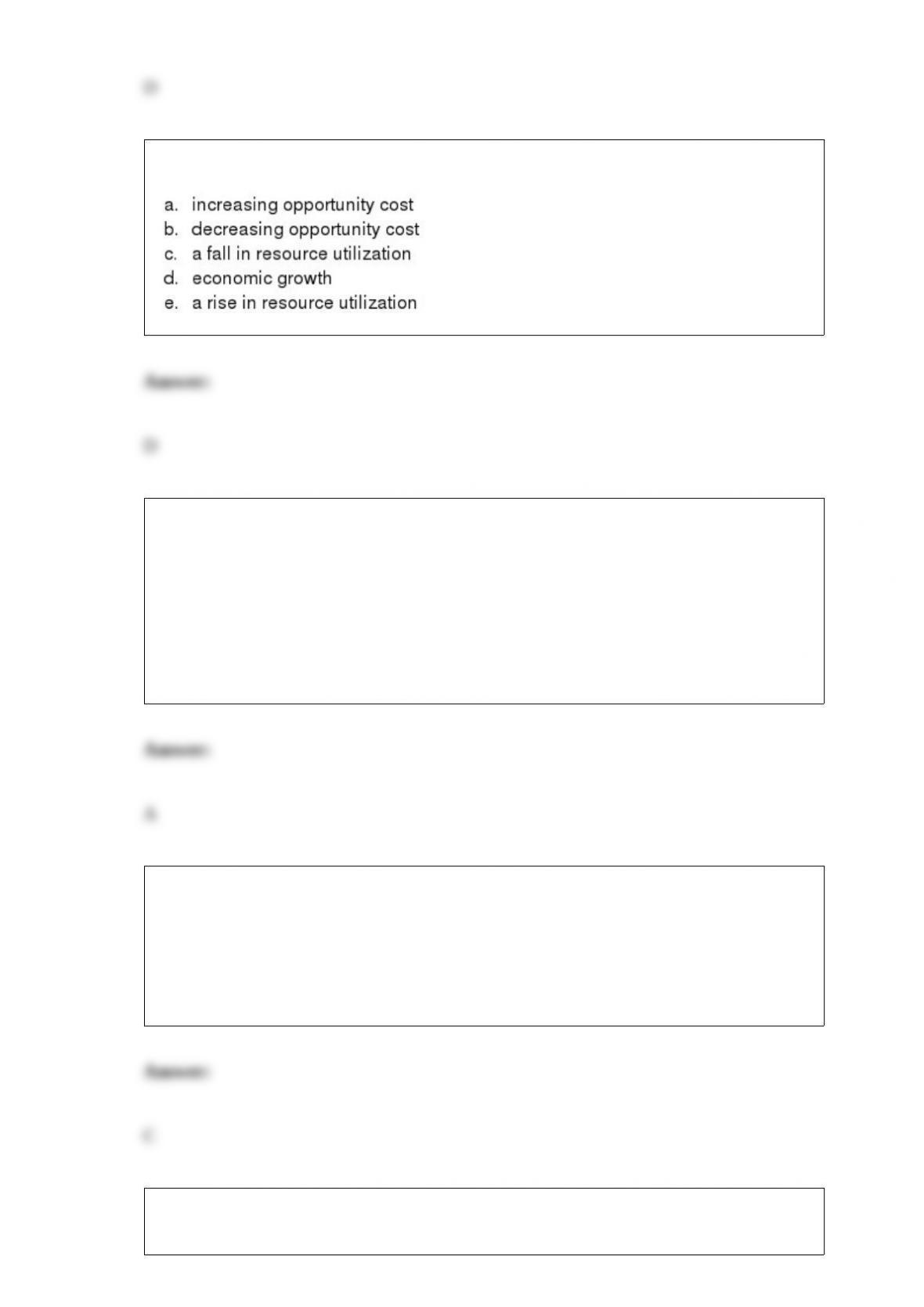
If an economy’s production possibilities frontier shifted to the right, this would illustrate
Mark is an 86-year-old watchmaker who works ten hours a week to supplement his
retirement income. In determining the U.S. unemployment rate, Mark would be
considered
a. employed
b. unemployed
c. an involuntary part-time worker
d. not in the labor force
e. a discouraged worker
To the extent that the CPI does not accurately measure the true price level,
a. the BLS will change the underlying market basket of goods
b. it is useless
c. it exaggerates the true cost of living
d. it results in underindexation of social security payments
e. it underestimates the true cost of living
The chief economic cost of unemployment is
a. the value of the leisure that is lost when people are unemployed
b. the cost to employed citizens of paying unemployment benefits
c. money spent on the job search process
d. the chance that the unemployed might turn to crime to support themselves
e. the value of output that could have been produced, but is not
Under a socialist system,
If the government thinks the price that a consumer has to pay for a good is too low, then
which of the following would solve this problem?
Most economists agree that the size of the bias in the CPI is at least
a. 0.1 percent
b. 0.5 percent
c. 1 percent
d. 1.5 percent
e. 2 percent

Which case represents the largest increase in the real national debt?
a. The price level increases by 500 percent and nominal debt increases by 500 percent.
b. The price level increases by 200 percent and nominal debt increases by 600 percent.
c. The price level decreases by 50 percent and nominal debt increases by 300 percent.
d. The price level increases by 400 percent and nominal debt increases by 200 percent.
e. The price level decreases by 90 percent and nominal debt increases by 200 percent.
Government outlays consist of
a. all governmental purchases resulting from contracts with the private sector and
foreign organizations
b. government purchases, transfer payments, and interest on the national debt
c. any purchase by an organization that is not trying to earn a profit
d. government purchases and transfer payments minus the interest on the national debt
e. total receipts from all organizations doing business with any level of government
The labor demand curve slopes
a. upward to illustrate that the more productive the worker, the higher the real wage the
employer is willing to pay that worker
b. upward to illustrate that the higher the wage rate, the fewer workers are demanded
c. upward or downward in direct proportion to the rate of inflation
d. downward to illustrate that the lower the real wage, the more workers employers are
willing to hire
e. downward to illustrate that the availability of workers is directly proportional to the
real wage
In the classical model with an open economy, an increase in government purchases can
affect a country’s exchange rate, causing its imports and exports to change.