
Beginning in 1965, the head of the Antitrust Division of the U.S. Department of Justice
began to change antitrust policy. How did antitrust policy change?
A) For the first time horizontal mergers were allowed – with government approval – and
vertical mergers were allowed without need for approval from the government.
B) For the first time concentration ratios were used to evaluate the degree of
competition in the industries of firms that proposed mergers.
C) The Division began to systematically consider the economic consequences of
proposed mergers.
D) Proposed mergers no longer needed the approval of the Federal Trade Commission
or the court system.
A constant cost, perfectly competitive market is in long-run equilibrium. At present,
there are 1,000 firms each producing 400 units of output. The price of the good is $60.
Now suppose there is a sudden increase in demand for the industry’s product which
causes the price of the good to rise to $64. In the new long-run equilibrium, how will
the average total cost of producing the good compare to what it was before the price of
the good rose?
A) The average total cost will be higher than it was before the price increase since the
increase in demand will drive up input prices.
B) The average total cost will be lower than it was before the price increase because of
economies of scale.
C) The average total cost will be higher than it was before the price increase because of
diseconomies of scale arising from the increased demand.
D) The average total cost will be the same as it was before the price increase.

When BMW, an German company, purchases a welding machine that was made in
Toronto, the purchase is
A) both a German and a Canadian import.
B) a German import and a Canadian export.
C) a German export and a Canadian import.
D) neither an export nor an import for either country.
If a corporation retains all its profits and distributes none of the profit to owners, how
can owners benefit?
A) If the retained earnings are expected to create future profits, the market price of the
firm’s stock will increase and create a capital gain for stockholders if the stock is sold.
B) Shares of stock can be converted into bonds so stockholders will be able to earn
coupon payments.
C) Owners will only benefit if some profits are paid out in the form of dividends.
D) Owners will benefit by changing the board of directors.
If the United States lifted the embargo on Cuban products, what would happen in the
U.S. market for Cuban cigars?

A) The supply curve would shift to the left.
B) The supply curve would shift to the right.
C) The demand curve would shift to the right.
D) The demand curve would shift to the left.
Economists first began studying the relationship between changes in aggregate
expenditures and changes in GDP
A) in the 1950s.
B) during the Great Depression.
C) at the end of the Civil War.
D) during the Industrial Revolution.
Assume that the price elasticity of demand for gasoline is -0.06. If the government tax
causes the price of gasoline to increase by 50 percent, what will be the decrease in the
quantity of gasoline demanded?
A) 0.5 percent
B) 3.0 percent
C) 8.33 percent
D) 50 percent
Which of the following is an example of foreign direct investment in China?
A) U.S. auto entrepreneur Elon Musk buys stock in Tata Motors of Mumbai, India.
B) Chinese Shenzen Airlines company buys a small U.S. midwest airline company, Air
Chicago.
C) The U.S. company Wal-Mart buys a warehouse in Shanghai.
D) The bank of China purchases U.S. Treasury bonds.
E) A U.S. foreign exchange speculator buys $200,000 worth of the Chinese currency
the yuan.
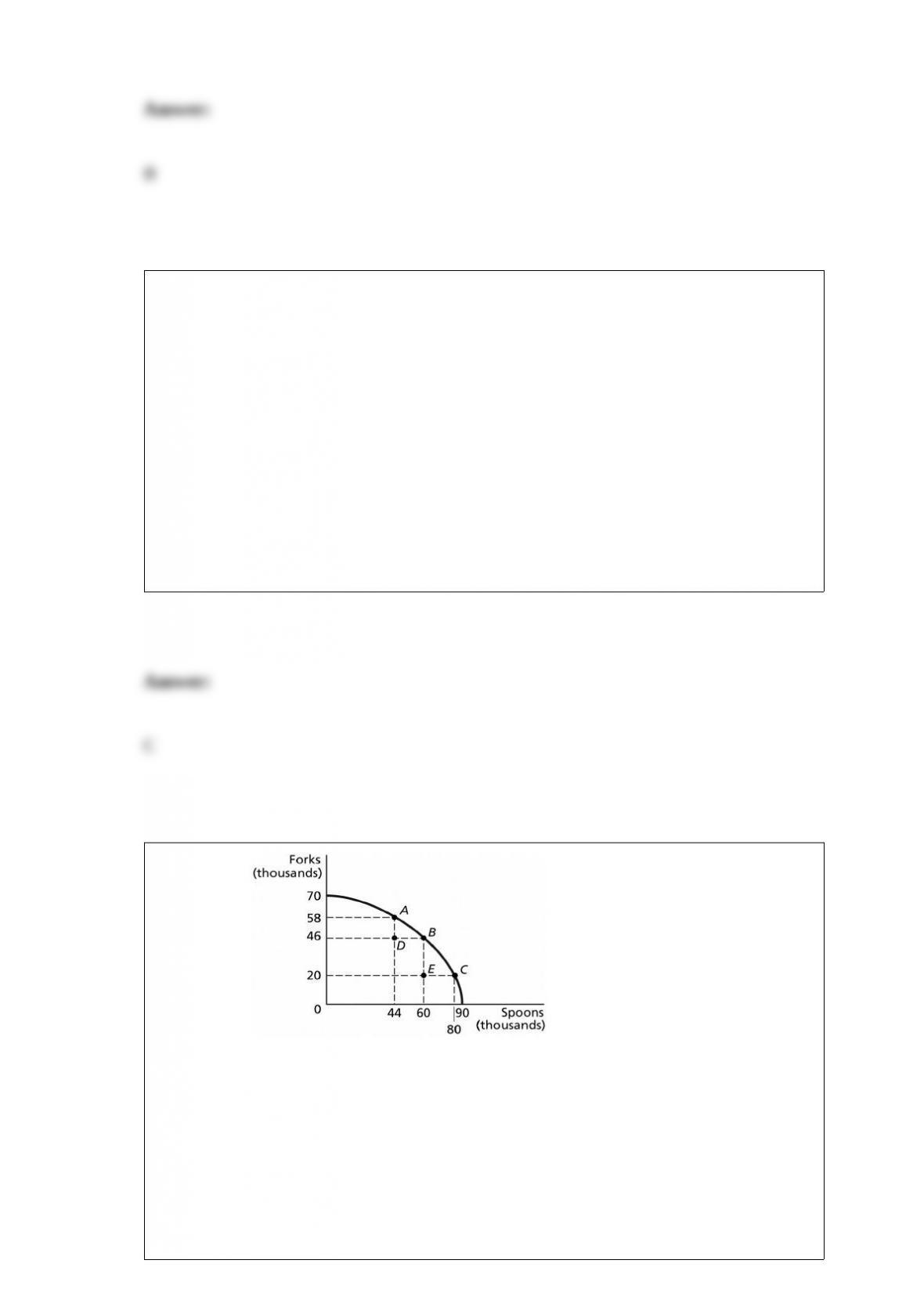
Figure 2-10
If the economy is currently producing at point D, what is the opportunity cost of
moving to point B?
A) 16 thousand spoons
B) 46 thousand forks
C) 60 thousand spoons

D) 0 forks
Which of the following will increase aggregate expenditure in the United States?
A) an increase in the value of the dollar
B) an increase in the price level
C) an increase in interest rates
D) an increase in government purchases
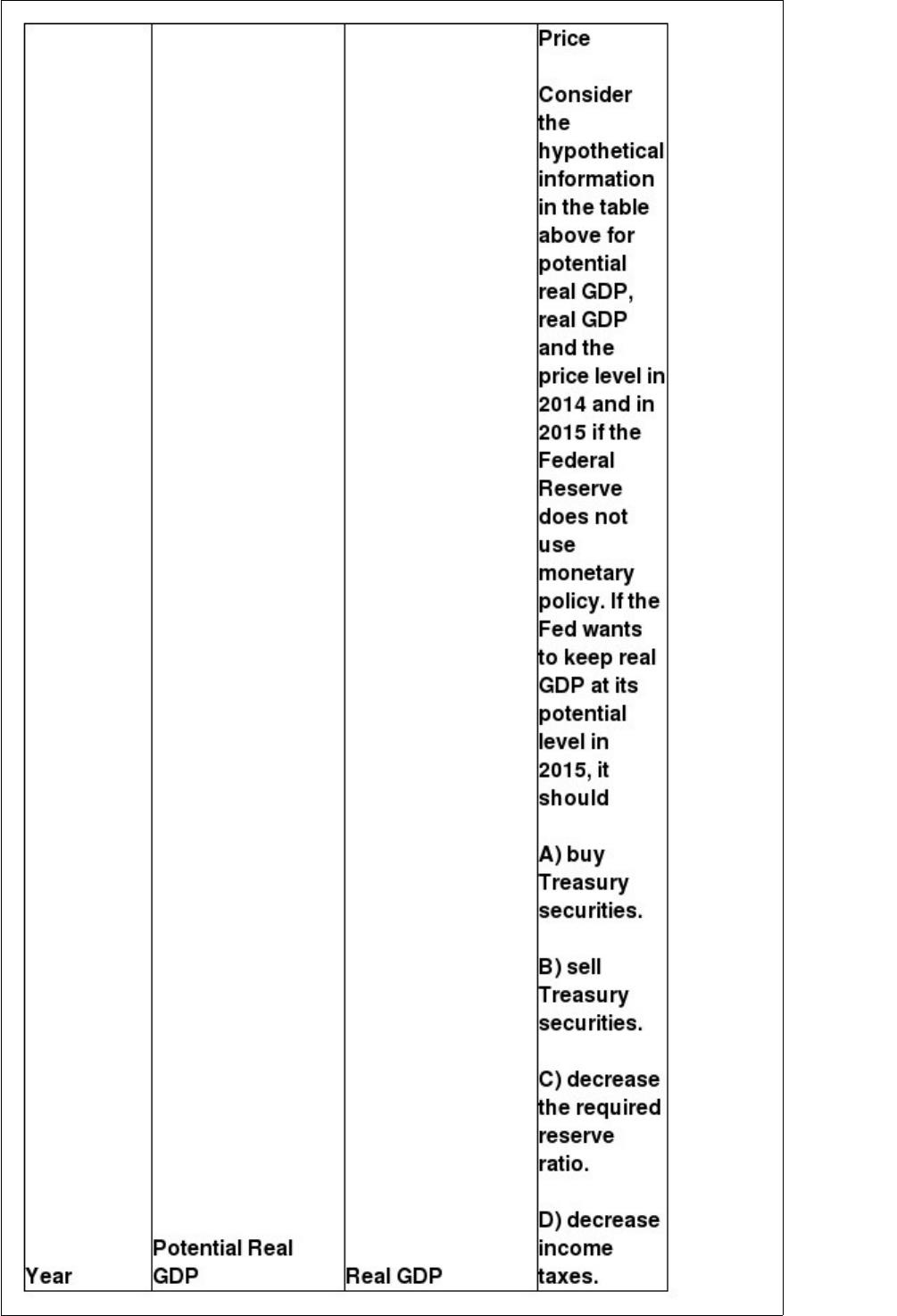
Table 15-3
In a perfectly competitive market, there are ________ buyers and ________ sellers.
A) many; few
B) few; many
C) many; many
D) few; few
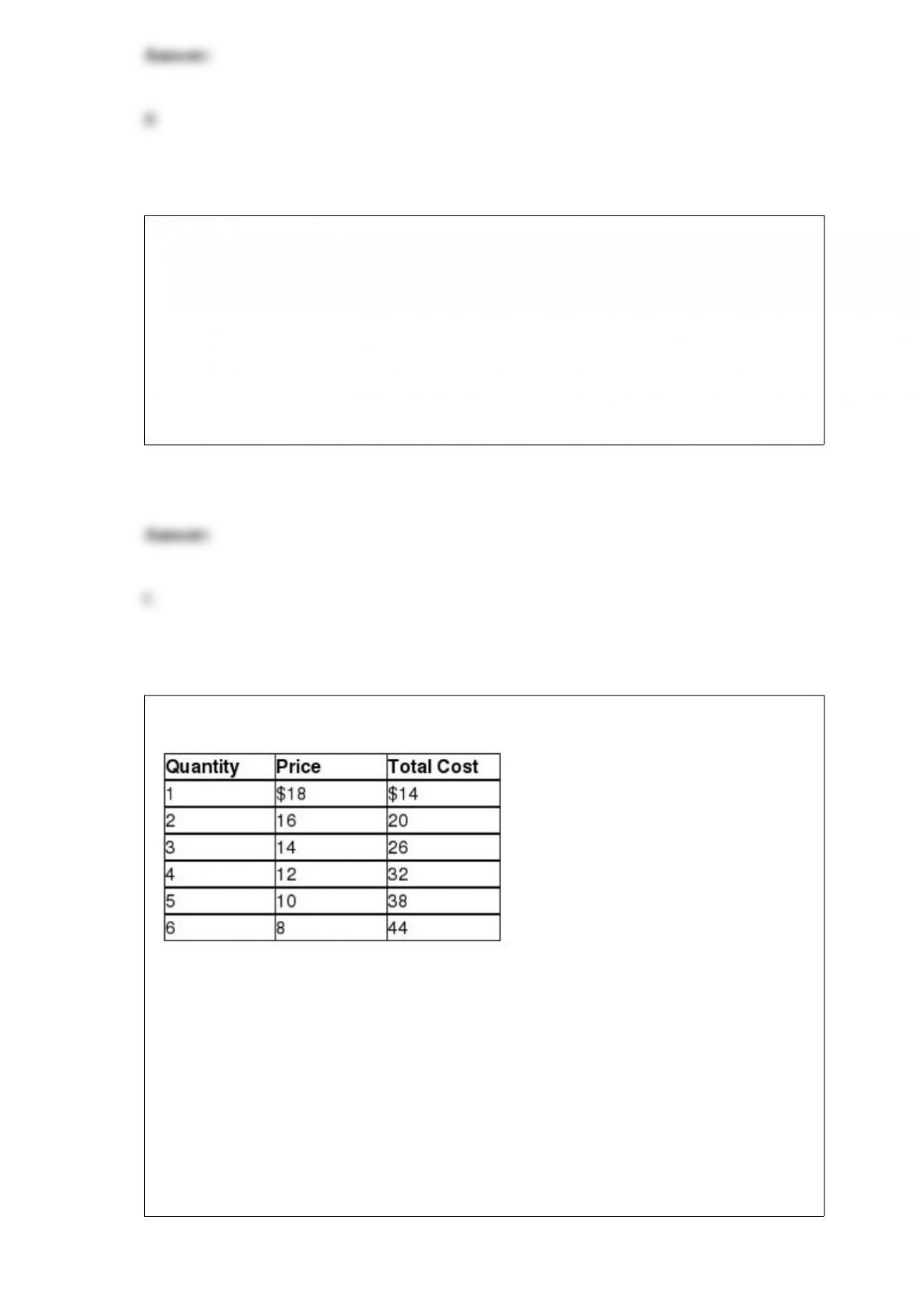
Table 13-5
Table 13-5 shows the demand and cost data facing a monopolistically competitive
producer of canvas bags. What are the firm’s profit-maximizing or loss-minimizing
price and quantity?
A) price = $10; quantity = 5.
B) price = $12; quantity = 4.
C) The firm should shut down temporarily.
D) This cannot be determined from the information given.

The demand for durable goods
A) has decreased over time.
B) declines by a greater percentage than does GDP during a recession.
C) declines by a smaller percentage than does GDP during a recession.
D) rises by a greater percentage than does GDP during a recession.
U.S. net export spending falls when
A) the price level in the United States falls relative to the price level in other countries.
B) the growth rate of U.S. GDP is faster than the growth rate of GDP in other countries.
C) the value of the U.S. dollar decreases relative to other currencies.
D) the inflation rate is lower in the United States relative to other countries.
From an initial long-run equilibrium, if aggregate demand grows more slowly than
long-run and short-run aggregate supply, then Congress and the president would most

likely
A) increase the required reserve ratio and decrease government spending.
B) decrease government spending.
C) decrease oil prices.
D) decrease taxes.
E) lower interest rates.
Let D = demand, S = supply, P = equilibrium price, Q = equilibrium quantity. What
happens in the market for solar panels if the government offers tax breaks to encourage
manufacturers to produce more solar panels?
A) D increases, S no change, P and Q increase
B) S increases, D no change, P decreases, Q increases
C) D and S increase, P and Q decrease
D) D no change, S increases, P decreases, Q decreases