
1) A coupon bond that has no maturity date and no repayment of principal is called a
A) consol
B) cabinet
C) Treasury bill
D) Treasury note
2) High interest rates might cause a corporation to ________ building a new plant that
would provide more jobs.
A) complete
B) consider
C) postpone
D) contemplate
3) One of the assumptions of the Gordon Growth Model is that dividends will continue
growing at ________ rate.
A) an increasing
B) a fast
C) a constant
D) an escalating
4) Which of the following do not provide charters?
A) The Office of the Comptroller of the Currency
B) The Federal Reserve System
C) The National Credit Union Administration
D) State banking and insurance commissions
5) If reserves in the banking system increase by $100, then checkable deposits will
increase by $100 in the simple model of deposit creation when the required reserve
ratio is
A) 0.01
B) 0.10
C) 0.20
D) 1.00

6) Automated teller machines
A) are more costly to use than human tellers, so banks discourage their use by charging
more for use of ATMs
B) cost about the same to use as human tellers in banks, so banks discourage their use
by charging more for use of ATMs
C) cost less than human tellers, so banks may encourage their use by charging less for
using ATMs
D) cost nothing to use, so banks provide their services free of charge
7) As a result of the global financial crisis several of the large, free-standing investment
banking firms chose to become bank holding companies. This means that they will now
be regulated by
A) the Federal Reserve
B) the FDIC
C) the state banking authorities
D) the Treasury
8) In emerging market countries, the deterioration in bank’s balance sheets has more
________ effects on lending and economic activity than in advanced countries.
A) negative
B) positive
C) affirming
D) advancing
9) The key factor causing life insurance companies to move into the management of
pension funds was
A) the investment expertise of insurance companies
B) a request for this change by managers of pension funds
C) a change in state laws
D) a change in federal legislation

10) A foreign exchange intervention with an offsetting open market operation that
leaves the monetary base unchanged is called
A) an unsterilized foreign exchange intervention
B) a sterilized foreign exchange intervention
C) an exchange rate feedback rule
D) a money neutral foreign exchange intervention
11) Which of the following was the fastest-growing financial intermediary of the
1970s?
A) Commercial banks
B) Credit unions
C) Finance companies
D) Money market mutual funds
12) The problem of adverse selection helps to explain
A) why firms are more likely to obtain funds from banks and other financial
intermediaries, rather than from securities markets
B) why collateral is an important feature of consumer, but not business, debt contracts
C) why direct finance is more important than indirect finance as a source of business
finance
D) why lenders refuse loans to individuals with high net worth
13) An example of the ________ problem would be if Brian borrowed money from
Sean in order to purchase a used car and instead took a trip to Atlantic City using those
funds.
A) moral hazard
B) adverse selection
C) costly state verification
D) agency
14) Everything else held constant, if the expected return on ABC stock rises from 5 to
10 percent and the expected return on CBS stock is unchanged, then the expected return
of holding CBS stock ________ relative to ABC stock and the demand for CBS stock

________.
A) rises; rises
B) rises; falls
C) falls; rises
D) falls; falls
15) In the bond market, the market equilibrium shows the market-clearing ________
and market-clearing ________.
A) price; deposit
B) interest rate; deposit
C) price; interest rate
D) interest rate; premium
16) Forward contracts are of limited usefulness to financial institutions because
A) of default risk
B) it is impossible to hedge risk
C) they are relatively inflexible
D) of interest-rate risk
17) One way for banks to reduce the principal-agent problems associated with trading
activities is to
A) set limits on the total amount of a traders’ transactions
B) make sure that the person conducting the trades is also the person responsible for
recording the transactions
C) encourage traders to take on more risk if the potential rewards are higher
D) reduce the regulations on the traders so that they have more flexibility in conducting
trades
18) The time it takes for the policy actually to have an impact on the economy is called
A) the data lag
B) the recognition lag
C) the legislative lag
D) the implementation lag
E) the effectiveness lag
19) Assume you are holding Treasury securities and have sold futures to hedge against
interest-rate risk. If interest rates fall
A) the increase in the value of the securities equals the decrease in the value of the
futures contracts
B) the decrease in the value of the securities equals the increase in the value of the
futures contracts
C) both the securities and the futures contracts decrease in value
D) both the securities and the futures contracts increase in value
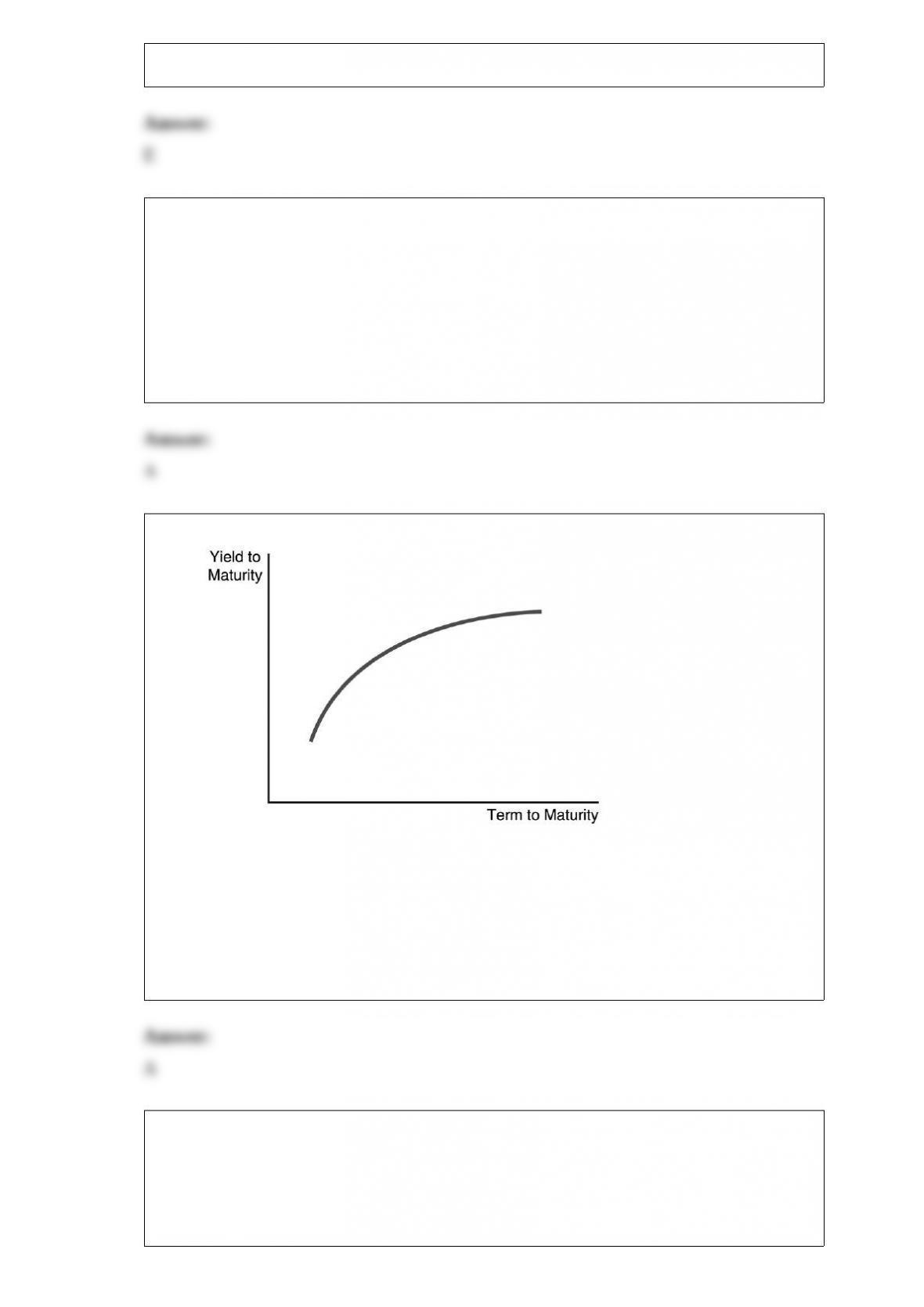
20)
The steeply upward sloping yield curve in the figure above indicates that ________
interest rates are expected to ________ in the future.
A) short-term; rise
B) short-term; fall moderately
C) short-term; remain unchanged
D) long-term; fall moderately
21) A system of deposit insurance
A) attracts risk-taking entrepreneurs into the banking industry
B) encourages bank managers to decrease risk
C) increases the incentives of depositors to monitor the riskiness of their bank’s asset
portfolio

D) increases the likelihood of bank runs
22) By hedging a portfolio, a bank manager
A) reduces interest-rate risk
B) increases reinvestment risk
C) increases exchange-rate risk
D) increases the probability of gains
23) Although foreign exchange market trades are said to involve the buying and selling
of currencies, most trades involve the buying and selling of
A) bank deposits denominated in different currencies
B) SDRs
C) gold
D) ECUs
24) Mutual funds in which a fixed number of nonredeemable shares are sold at an initial
offering and are then traded in the over-the-counter market, like shares of common
stock, are called
A) open-end funds
B) close-end funds
C) OTC funds
D) primary-issue funds
25) Under the Bretton Woods system, a country running a balance of payments deficit
________ international reserves, and had to implement ________ monetary policy to
strengthen its currency.
A) lost; expansionary
B) lost; contractionary
C) gained; expansionary
D) gained; contractionary

26) Which of the following statements are true?
A) An increase in tax rates will increase the demand for Treasury bonds, lowering their
interest rates
B) Because the tax-exempt status of municipal bonds was of little benefit to bond
holders when tax rates were low, they had higher interest rates than U.S. government
bonds before World War II
C) Interest rates on municipal bonds will be higher than comparable bonds without the
tax exemption
D) Because coupon payments on municipal bonds are exempt from federal income tax,
the expected after-tax return on them will be higher for individuals in lower income tax
brackets
27) According to aggregate demand and supply analysis, the favorable supply shock of
1995-1999 had the effect of
A) increasing aggregate output, lowering unemployment, and raising inflation
B) decreasing aggregate output, raising unemployment, and raising inflation
C) increasing aggregate output, lowering unemployment, and lowering inflation
D) decreasing aggregate output, raising unemployment, and lowering inflation
28) If a borrower takes out a $200 million loan in a repo agreement and is asked to post
$220 million of mortgage-backed securities as collateral, the “haircut” is
A) 5%
B) 10%
C) 20%
D) 50%
29) Everything else held constant, an autonomous monetary policy easing ________
aggregate ________.
A) increases; demand
B) decreases; demand
C) decreases; supply
D) increases; supply
30) When a member of the nonbank public withdraws currency from her bank account,
A) both the monetary base and bank reserves fall
B) both the monetary base and bank reserves rise
C) the monetary base falls, but bank reserves remain unchanged
D) bank reserves fall, but the monetary base remains unchanged
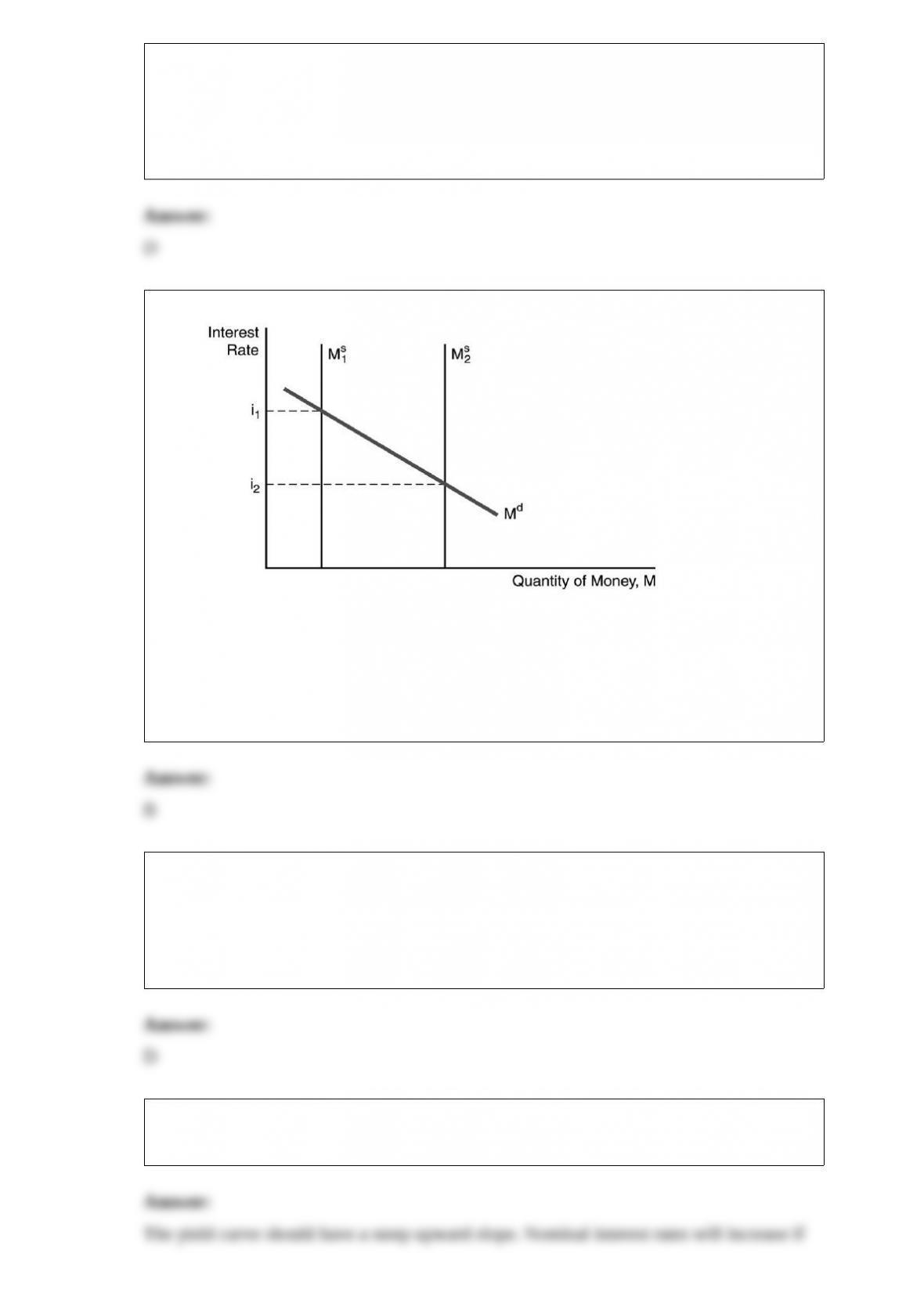
31)
In the figure above, the decrease in the interest rate from i1 to i2 can be explained by
A) a decrease in money growth
B) an increase in money growth
C) a decline in the expected price level
D) an increase in income
32) Savings and loan associations are regulated by the
A) Federal Reserve System
B) Securities and Exchange Commission
C) Office of the Comptroller of the Currency
D) Office of Thrift Supervision
33) If a higher inflation is expected, what would you expect to happen to the shape of
the yield curve? Why?
34) Describe what is meant by economies of scope and explain how financial
institutions’ realizing economies of scope has led to an increase in conflicts of interest.
35) Explain how expansionary and contractionary monetary policies affect aggregate
demand through the exchange rate channel.
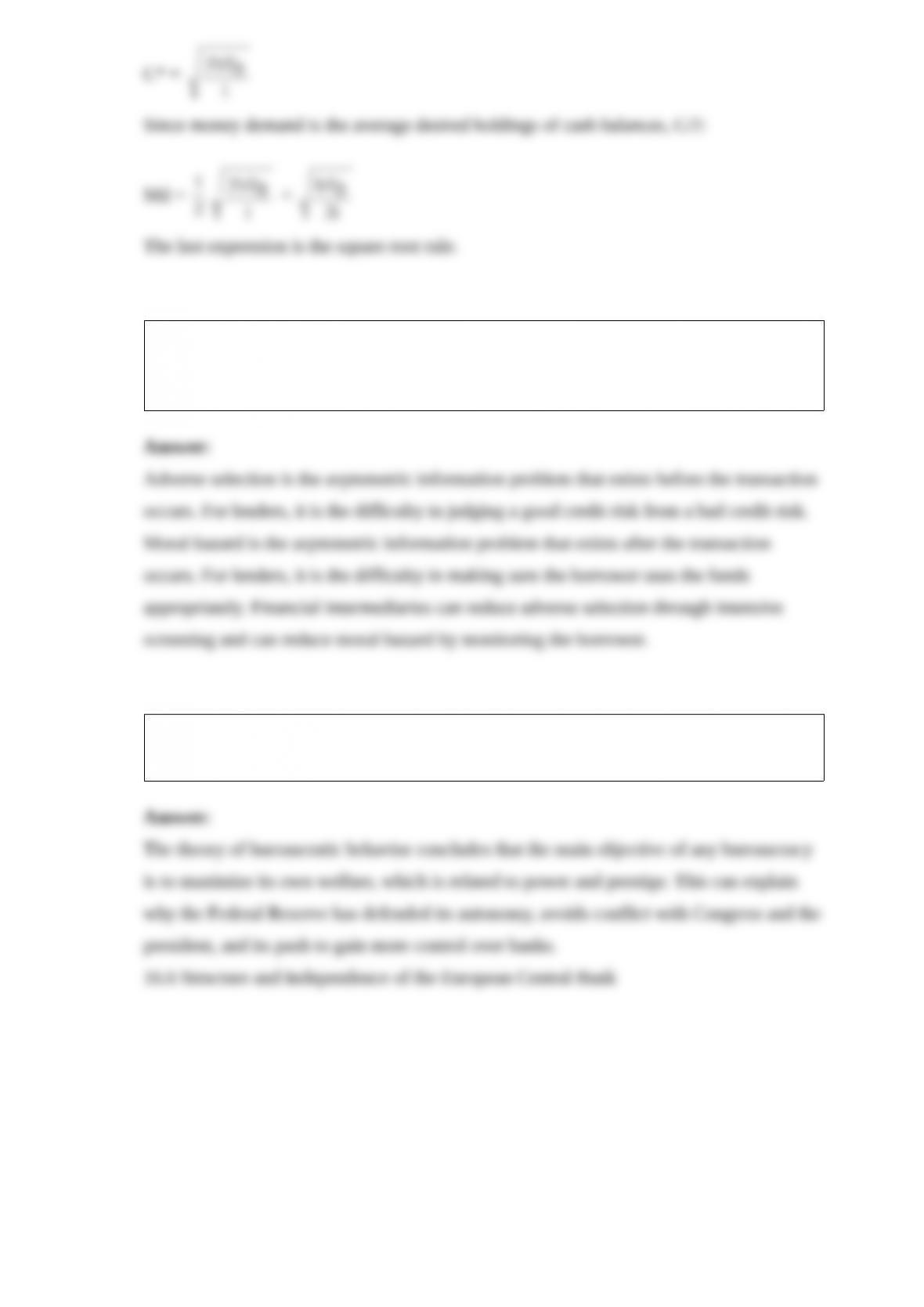
36) In the Baumol-Tobin model, given that total costs for an individual equals +
, where T0 = monthly income, b = brokerage costs, and C = amount raised from
each bond transaction, derive the so-called square root rule.
37) Because there is an imbalance of information in a lending situation, we must deal
with the problems of adverse selection and moral hazard. Define these terms and
explain how financial intermediaries can reduce these problems.
38) What is the theory of bureaucratic behavior and how can it be used to explain the
behavior of the Federal Reserve?