
1) extensive network effects may drive a market toward natural monopoly because
consumers tend to choose a common, standard product that everyone else is using.
2) increasing taxes and reducing government expenditures might be helpful in
constraining inflation.
3) when there are negative externalities involved in the production of a good, fewer
resources are allocated to its production than if all costs were internalized.
4) third-party (insurance) payment of health care costs causes health care to be
overconsumed.
5) a tax is progressive if the average tax rate rises as income increases.
6) critics of economic growth say studies show that people are not interested in
achieving higher standards of living.
7) In the last half of the 1990s monetary policy was highly effective in the United States
but highly ineffective in Japan.

8) The higher the reserve requirement, the lower is the monetary multiplier.
9) The concept of parity has provided a rationale for government price supports for
farm products.
10) A restrictive monetary policy reduces investment spending and shifts the economy’s
aggregate demand curve to the right.
11) limited liability means all members of a partnership are liable for the debts incurred
by one another.
12) Efficiency wages are established at below-equilibrium levels.
13) when the price of a product falls, the income effect induces the consumer to
purchase more of it while the substitution effect prompts her to buy less.
14) The interest-rate cost-of-funds curve is perfectly elastic because expected rates of
return on R&D are constant.
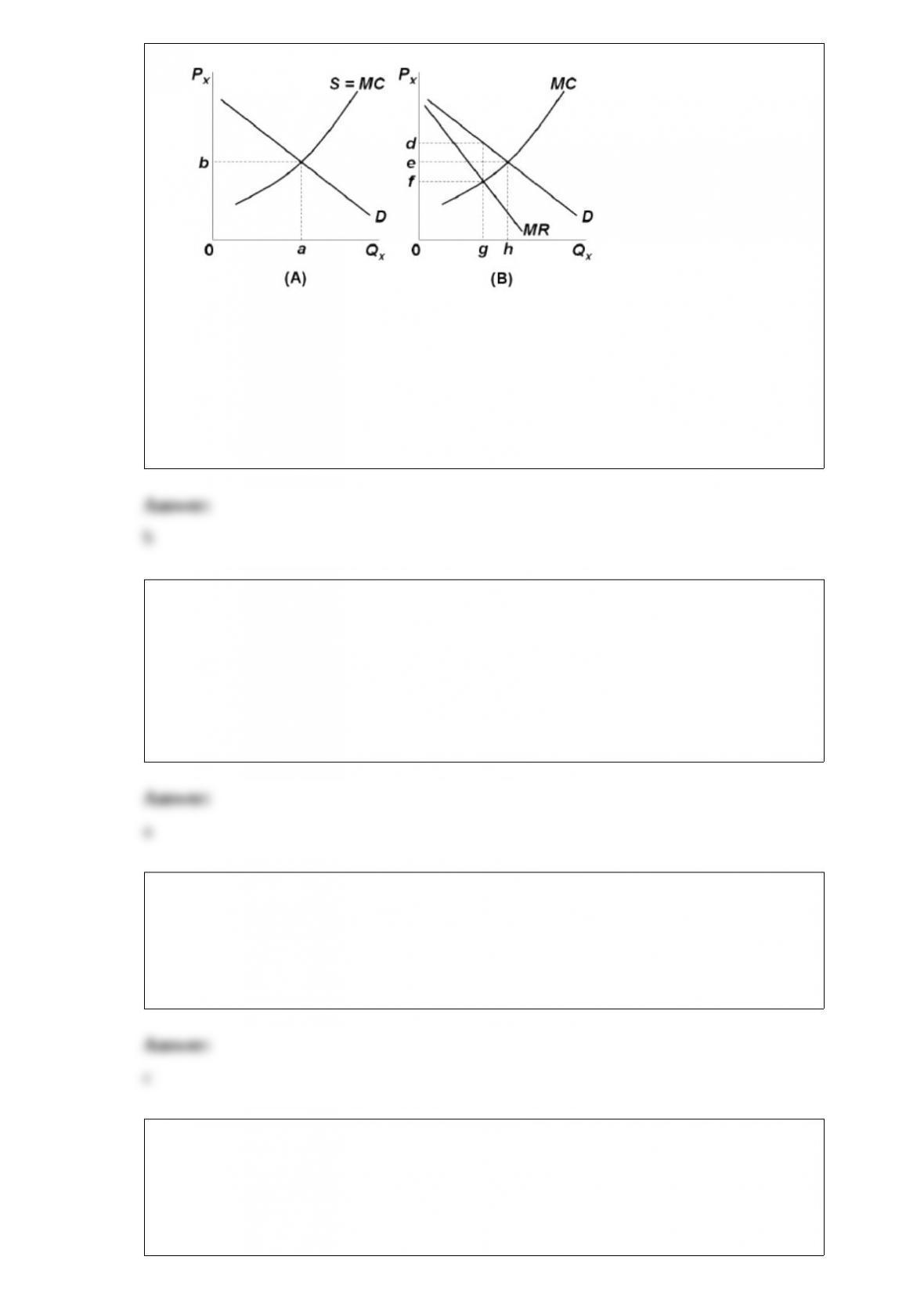
15)
refer to the above diagrams. the price will be _______ and the quantity will be _______
with the industry structure represented by diagram (b) compared to the one represented
in (a).
a.higher; higher
b.higher; lower
c.lower; lower
d.lower; higher
16) suppose nominal gdp was $360 billion in 1990 and $450 billion in 2000. the
appropriate price index (1985 = 100) was 120 in 1990 and 125 in 2000. between 1990
and 2000 real gdp:
a.increased by $60 billion.
b.decreased by $32 billion.
c.increased by $100 billion.
d.increased by $117 billion.
17) as a percentage of gdp, health care spending in the united states has:
a.decreased substantially since 1960.
b.increased slightly since 1960.
c.increased substantially since 1960.
d.remained relatively constant since 1960.
18) Money functions as:
A.a store of value.
B.a unit of account.
C.a medium of exchange.
D.all of these.
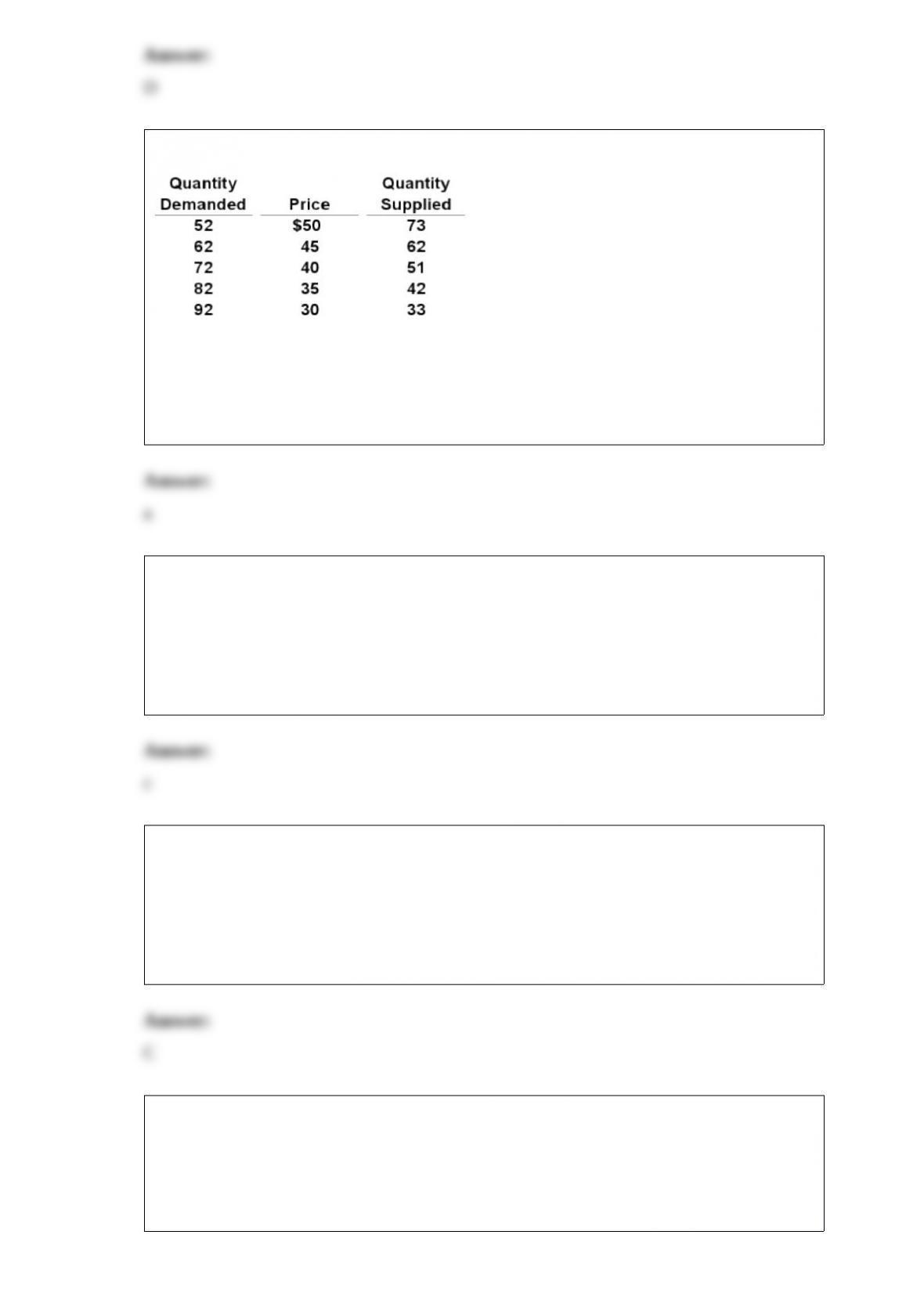
19) government-set prices
in the above market, economists would call a government-set maximum price of $40 a:
a.price ceiling.
b.price floor.
c.equilibrium price.
d.fair price.
20) a number of european nations have agreed to use the ___________ as a common
currency:
a.mark
b.pound
c.euro
d.continental
21) If the demand for money increases and the Fed wants interest rates to remain
unchanged, which of the following would be appropriate policy?
A.recall Federal Reserve Notes from circulation
B.raise the legal reserve requirement
C.buy bonds in the open market
D.raise the discount rate
22) A BTU is the amount of energy needed to:
A.raise the temperature of one pound of water by one degree Fahrenheit.
B.boil one gallon of water for one minute.
C.raise the air temperature one degree Celsius for one hour.
D.raise the temperature of one pint of water by one degree Celsius.
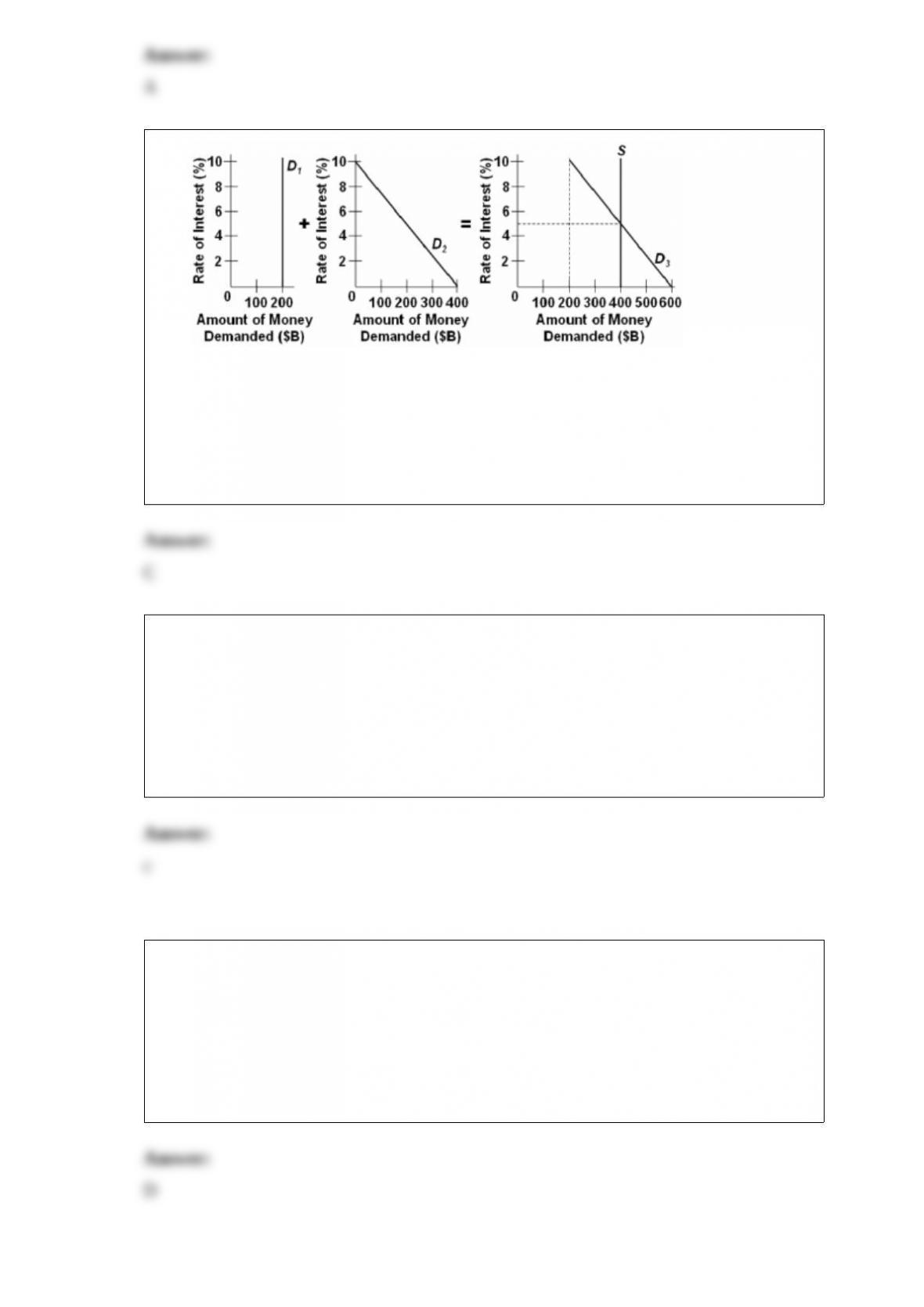
23)
Refer to the above market for money diagrams. The total demand for money is shown
by:
A.D1.
B.D2.
C.D3.
D.S.
24) the zzz corporation issued $25 million in new common stock in 2008. it used $18
million of the proceeds to replace obsolete equipment in its factory and $7 million to
repay bank loans. as a result, investment:
a.of $7 million has occurred.
b.of $25 million has occurred.
c.of $18 million has occurred.
d. has not occurred.
25) Assume that Smith deposits $600 in currency into her checking account in the XYZ
Bank. Later that same day Jones negotiates a loan for $1,200 at the same bank. In what
direction and by what amount has the supply of money changed?
A.decreased by $600
B.increased by $1,800
C.increased by $600
D.increased by $1,200
26) the coordination problem in the centrally planned economies refers to the idea that:
a.planners had to direct required inputs to each enterprise.
b.the price level and the level of employment were inversely related.
c.the immediate effect of more investment was less consumption.
d.exports had to be equal to imports for a central plan to work.
27) with respect to state finance:
a.estate taxes are the major source of revenue and most expenditures are for health
services.
b.the corporate income tax is the major source of revenue and natural resource
development the major type of expenditure.
c.property taxes are the basic source of revenue and education is the major type of
expenditure.
d.sales and excise taxes are the major source of revenue and education is the major type
of expenditure.
28) Since its inception in 1996, the Temporary Assistance for Needy Families (TANF)
program has:
A.increased, rather than reduced, the number of people on welfare.
B.reduced the number of people on welfare by more than one-half.
C.aided the poor by automatically increasing welfare payments when inflation occurs.
D.greatly increased the unemployment rate.
29) positive externalities refer to:
a.benefits that accrue to parties other than the producer and buyer of a good.
b.the benefits that resource suppliers obtain from the production and sale of a good.
c.the benefit that a consumer receives from buying a good.
d.the combined benefits that buyer and seller receive from a voluntary market
transaction.
30) Unexpected inflation is more beneficial to those who save than those who borrow.
Evaluate this statement. How does your answer change if the inflation is expected?
31) Describe the major demand and supply factors that have turned the beer industry
into an oligopoly over the years.
32) Money will always be a physical entity. Evaluate this statement.
33) Households are the principal source of savings. But businesses are the main
economic investors. Briefly explain.
34) What have been the trends in income inequality since 1970?
35) What are four-firm concentration ratios? How do economists use them to define
monopolistically competitive industries and oligopolistic industries?
36) Compare the factors that explain the elasticity of resource and product demand.