
The author of the textbook defines economics as the
a. science of efficiency.
b. science of scarcity.
c. study of markets.
d. study of human activity.
Marginal revenue product (MRP) is the
a. additional output generated by employing an additional factor unit.
b. additional profit generated by employing an additional factor unit.
c. additional revenue generated by employing an additional factor unit minus the
additional cost.
d. additional revenue generated by employing an additional factor unit.
e. total revenue from the sale of a product divided by the total output of the product.
Kristie currently spends her $1,000 a week income as follows: $500 on X, $300 on Y,
and $200 on Z.Her mother then gives her a $100 bill and tells her to use it to buy more
Z.Kristie actually takes the $100 her mother gave to her, adds $40 to the $200 she
usually spends on Z, and buys $240 worth of Z.Did Kristie’s mother’s $100 go to buy
only Z?
a. Yes, because Kristie used her mother’s actual $100 bill to buy Z.

b. No, because if it had, Kristie would have bought $300 worth of Z.Some of Kristie’s
mother’s money went for what Kristie had next on her list of desired purchases.
c. Yes, since Kristie bought $240 worth of Z, and the amount of money her mother gave
her is less than $240.
d. There is not enough information to answer the question.
If the percentage change in quantity demanded of a good is less than the percentage
change in buyer’s income, then the good is said to be
a. income elastic.
b. income inelastic.
c. income unit elastic.
d. price elastic.
e. price inelastic.
The ability to produce a good at a lower opportunity cost than others is called a(n)
__________ advantage.
a. complementary
b. comparative
c. natural

d. indigenous
Logrolling is the exchange of votes to gain support for legislation.
a. True
b. False
Suppose there are two labor markets, A and B, and labor is homogeneous between
markets. The wage rate in labor market A falls relative to the wage rate in labor market
B. What happens in labor market B?
a. The supply curve of labor shifts leftward.
b. The supply curve of labor shifts rightward.
c. The demand curve for labor shifts leftward.
d. b and c
e. none of the above

Consider the following data: equilibrium price = $8.50, quantity of output produced =
100 units, average total cost = $10, and average variable cost = $9. What will the firm
do and why?
a. Shut down in the short run, because price is below average variable cost.
b. Shut down in the short run, because it will be taking a loss of $100.
c. Continue to produce in the short run, because price is greater than average variable
cost.
d. Continue to produce in the short run, because firms are always stuck with having to
produce in the short run.
e. none of the above
In an interview an economist states, “This problem should be of greater concern to the
federal government.” We can explicitly put this statement in the category of
a. microeconomics.
b. macroeconomics.
c. positive economics.
d. normative economics.
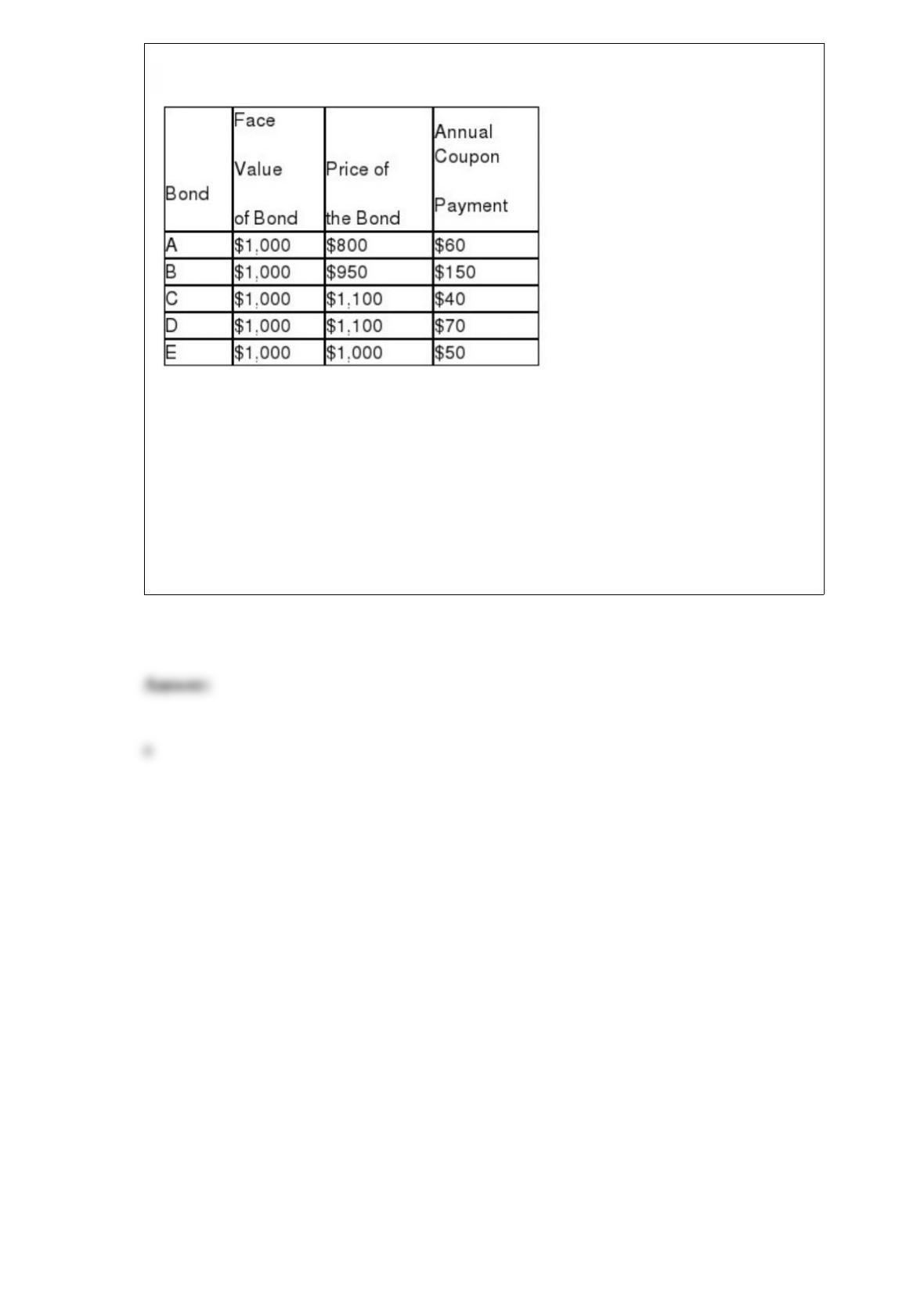
Exhibit 38-1
The yield on bond A is approximately
a. 7.5 percent.
b. 0.06 percent.
c. 6.0 percent.
d. 0.075 percent.