
1) a decrease in the price of digital cameras will:
a.cause the demand curve for memory cards to become vertical.
b.shift the demand curve for memory cards to the right.
c.shift the demand curve for memory cards to the left.
d.not affect the demand for memory cards.
2) An expansionary fiscal policy is shown as a:
A.rightward shift in the economy’s aggregate demand curve.
B.movement along an existing aggregate demand curve.
C.leftward shift in the economy’s aggregate supply curve.
D.leftward shift in the economy’s aggregate demand curve.
3) an increase in consumer incomes will:
a.increase the demand for an inferior good.
b.increase the supply of an inferior good.
c.increase the demand for a normal good.
d.decrease the supply of a normal good.
4) In the United States monetary policy is the responsibility of the:
A.U.S. Treasury.
B.Department of Commerce.
C.Board of Governors of the Federal Reserve System.
D.U.S. Congress.
5) At the $180 billion equilibrium level of income, saving is $38 billion in a private
closed economy. Planned investment must be:
A.$138 billion.
B.$126 billion.
C.$38 billion.
D.$180 billion.

6) if an economy is operating inside its production possibilities curve for consumer
goods and capital goods, it:
a.can only produce more consumer goods by producing fewer capital goods.
b.can only produce more capital goods by producing fewer consumer goods.
c.can produce more of both consumer goods and capital goods by using resources that
are currently idle.
d.must improve its technology to produce more output.
7) Smart cards sold by retailers, such as single-store gift cards and prepaid phone cards,
are known as:
A.credit cards.
B.debit cards.
C.stored-value cards.
D.E-cards.
8) Other things being constant, what will be the effect of each of the following on
consumption and saving schedules?
(a)Credit card companies increase the interest-free periods on their cards to compete for
customers.
(b)Concern grows over rising prices.
(c)A weakening of the housing market lowers home values.
(d)Real interest rates fall.
(e)Congress officially approves the Presidents plan for tax cuts.

9) Interlocking directorates are:
A.legal if the two firms have small market shares.
B.illegal under provisions of the Federal Trade Commission Act of 1914.
C.illegal under provisions of the Celler-Kefauver Act of 1950.
D.illegal under provisions of the Clayton Act of 1914.
10) (consider this) in terms of a reservoir analogy, the:
a.outflow below the dam is gross investment.
b.inflow from the river is the stock of capital.
c.level of water in the reservoir is the stock of capital.
d.level of water in the reservoir is net investment.
11) Economists generally agree that the most significant cause of the recent increase in
income inequality in the United States is:
A.the failure of the legal minimum wage to keep pace with inflation.
B.increased international competition.
C.increased immigration.
D.increased demand for, and hence pay to, highly skilled workers.
12) Which of the following is not a tool of monetary policy?
A.open market operations
B.changes in banking laws
C.changes in the amount of reserves available at the term auction facility
D.changes in the reserve ratio
13) if an industry’s long-run average total cost curve has an extended range of constant
returns to scale, this implies that:
a.technology precludes both economies and diseconomies of scale.
b.the industry will be a natural monopoly.
c.both relatively small and relatively large firms can be viable in the industry.
d.the industry will be comprised of a very large number of small firms.
14) The entrance of large numbers of “baby boomers” into the labor force in the 1970s
and 1980s:
A.caused substantial reductions in permanent unemployment.
B.lessened income inequality.
C.increased income inequality.
D.had no impact on income inequality.
15) New classical economist say that an unanticipated increase in aggregate demand
first:
A.increases the price level and real output, and then reduces short-run aggregate supply
such that the economy returns to the full-employment level of output.
B.increases the price level and real output, and then increases long-run aggregate
supply.
C.increases long-run aggregate supply, and then increases the price level and real
output.
D.reduces short-run aggregate supply, and then reduces long-run aggregate supply.
16)
refer to the above tables. opportunity costs are:
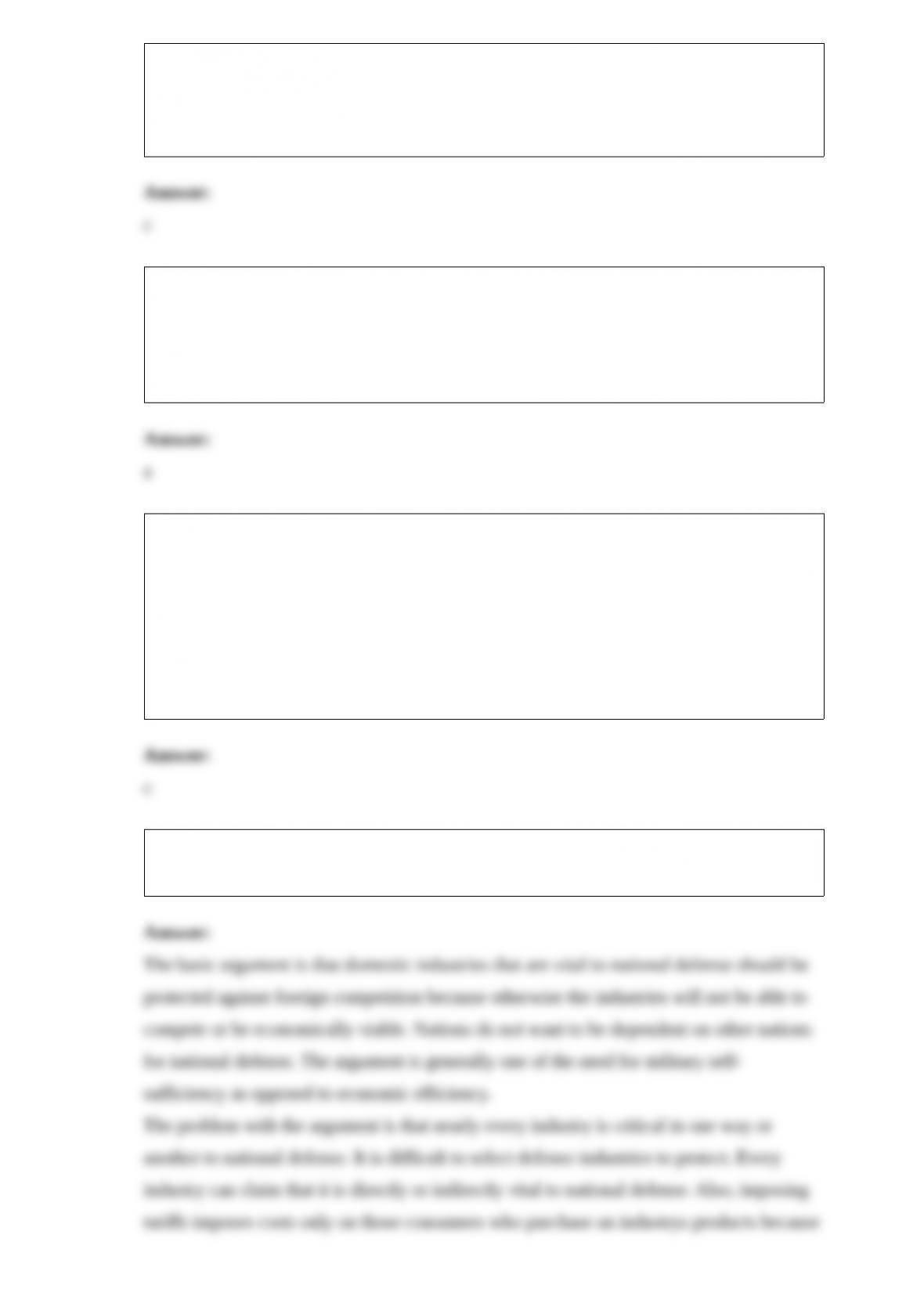
a.constant in both duckistan and herbania.
b.larger in duckistan than in herbania.
c.increasing in both duckistan and herbania.
d.increasing in duckistan and constant in herbania.
17) the nondiscriminating pure monopolist’s demand curve:
a.is the industry demand curve.
b.shows a direct or positive relationship between price and quantity demanded.
c.tends to be inelastic at high prices and elastic at low prices.
d.is identical to its marginal revenue curve.
18) suppose that in 2007 ford sold 500,000 mustangs at an average price of $18,800 per
car; in 2008, 600,000 mustangs were sold at an average price of $19,500 per car. these
statements:
a.suggest that the demand for mustangs decreased between 2007 and 2008.
b.suggest that the supply of mustangs must have increased between 2007 and 2008.
c.suggest that the demand for mustangs increased between 2007 and 2008.
d.constitute an exception to the law of demand in that they suggest an upsloping
demand curve.
19) Explain and evaluate the validity of the military self-sufficiency argument for trade
protection.
20) What is meant by the Federal funds market and what is the Federal funds rate?
21) What is the difference between average, total, and marginal revenue? What is the
shape of the total and marginal revenue curves for the individual competitive firm?
22) Why are financial institutions required to keep reserves?
23) Discuss the relative merits of monetary policy under conditions of demand-pull
inflation or recession.
24) If a nations productivity grows by 3% rather than 1.5% over many years, what will
be the difference in the nations standard of living? Explain.
25) Explain: Ironically, by taking the rough edges off of capitalism, social regulation
may be a strong pro-capitalist force.