
In the United States, health care spending as a percentage of GDP has declined since
1965.
If planned investment is equal to actual investment, then aggregate expenditure is equal
to GDP.
By the 2000s, investment banks had become significant participants in the secondary
market for mortgages.
A change in supply is represented by a shift of the supply curve.
A doctor pursuing the interests of his patients rather than his own interests is an
example of the principal-agent problem.
An increase in quantity supplied is represented by a rightward shift of the supply curve.
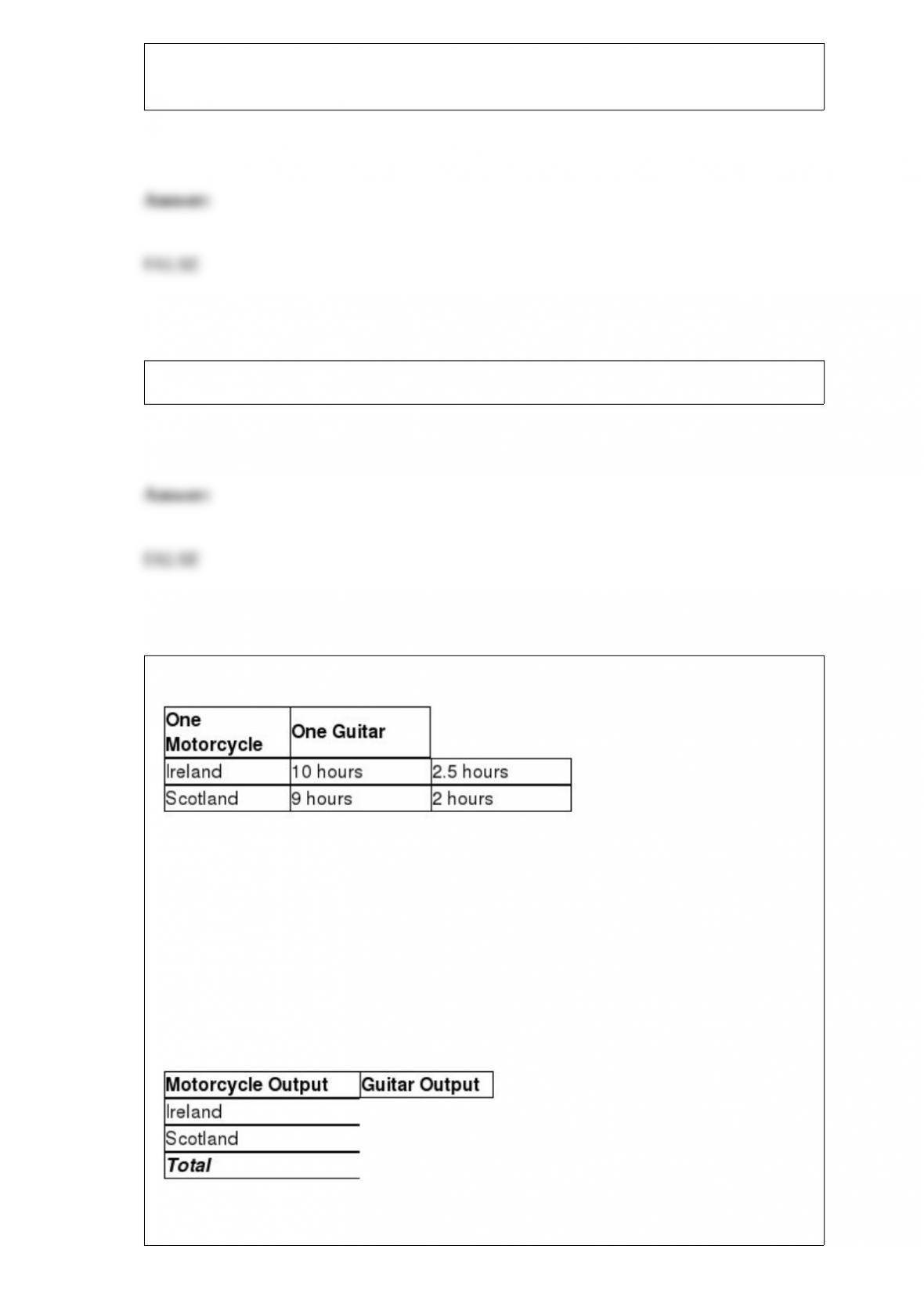
Table 2-26
This table shows the number of labor hours required to produce a motorcycle and a
guitar in Ireland and Scotland. a. If each country has a total of 2,700 labor hours to
devote to the production of the two goods, draw the production possibilities frontier for
each country. Put “Motorcycle” on the horizontal axis and “Guitar” on the vertical axis.
Be sure to identify the intercept values on your graphs.
b. Suppose each country allocates 55% its labor hours to guitar production and 45% to
the production of motorcycles. Complete Table 2-27 below to show each country’s
output of the two products. Table 2-27: Production and Consumption with no Trade
c. If the two countries do not trade and consume whatever they produce, identify the
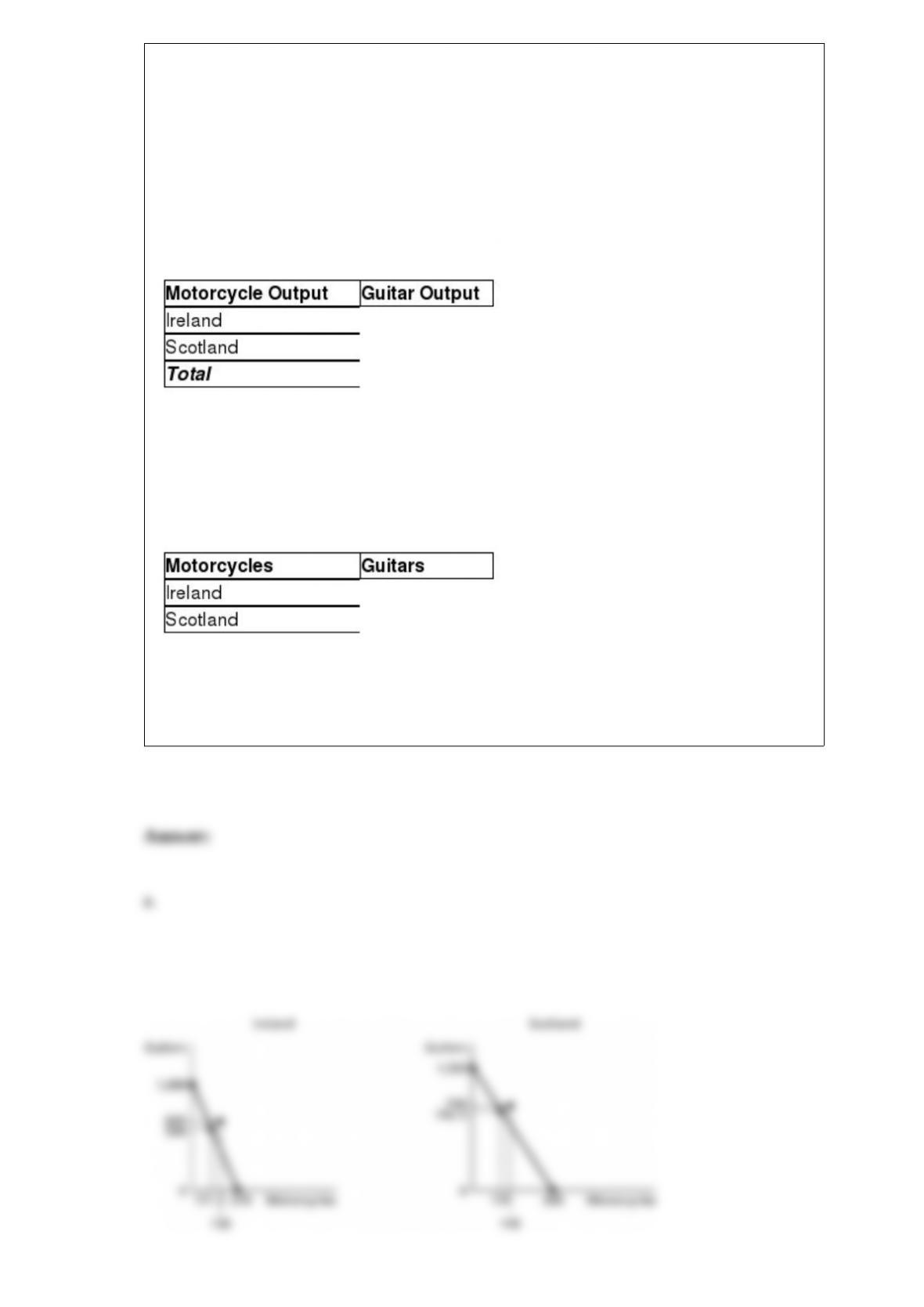
current production and consumption point for each country on their respective
production possibilities frontiers. Label Ireland’s consumption point “I” and Scotland’s
consumption point, “S.”
d. Suppose the two countries specialize and trade. Who should produce motorcycles and
who should produce guitars? Explain your answer.
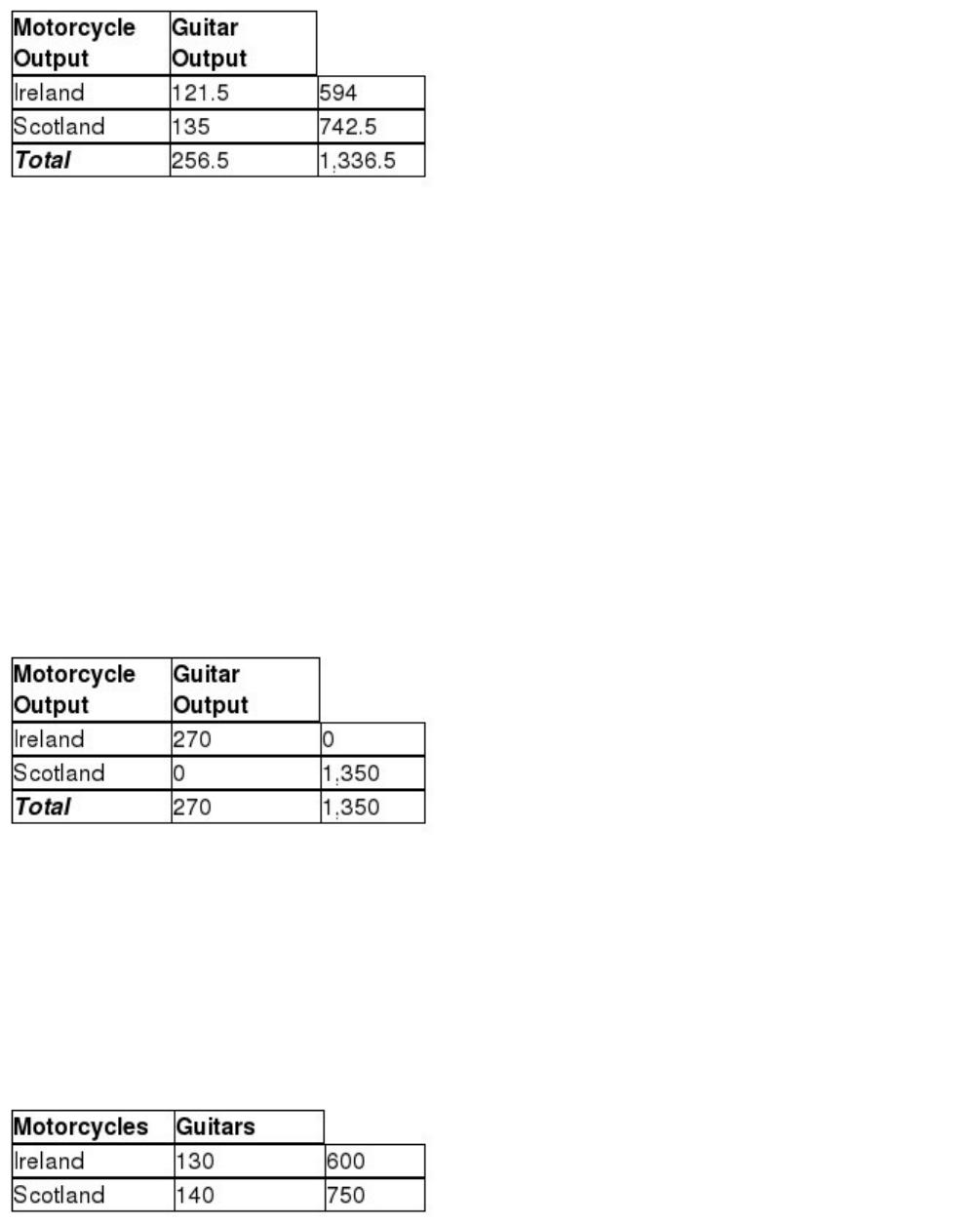
e. Complete Table 2-28 below to show each country’s output with specialization. Table
2-28: Output with Specialization
f. Did specialization increase the combined output for the two countries without any
increase in resources? If so, by how much?
g. Suppose Ireland and Scotland agree to trade so that in exchange for 600 guitars, the
exporter of guitars receives 140 motorcycles. Complete Table 2-29 below to show each
country’s consumption bundle after trade. Table 2-29: Consumption with Trade
h. Show the consumption points after trade on each country’s production possibilities
frontier. Label these points “X” for Ireland and “Y” for Scotland.
i. Has trade made the two countries better off? Explain your answer.

The long-run aggregate supply curve shows the relationship between the ________ and
________.
A) inflation rate; quantity of real GDP demanded
B) real interest rate; quantity of real GDP supplied
C) nominal interest rate; quantity of real GDP supplied
D) price level; quantity of real GDP supplied
If the Fed pursues expansionary monetary policy then
A) the money supply will decrease, interest rates will rise and GDP will fall.
B) the money supply will decrease, interest rates will fall and GDP will fall.
C) the money supply will increase, interest rates will rise and GDP will rise.
D) the money supply will increase, interest rates will fall and GDP will rise.

If a brewery wants to raise funds to purchase a new fermenting vat, it does so in the
A) factor market.
B) output market.
C) product market.
D) alcoholic beverages market.
The purchase of a new house is included in
A) consumption expenditures.
B) investment expenditures.
C) government purchases.
D) net exports.
Of the following high-income countries, which has the highest life expectancy at birth?
A) Canada
B) Japan
C) the United Kingdom
D) the United States

If Californians increase their purchases of Italian wine, assuming all else remains
constant, this will ________ of the United States.
A) decrease the balance of trade
B) increase net exports
C) increase the current account balance
D) decrease the trade deficit
E) decrease the balance of payments
A merger between firms at different stages of production of a good
A) is a vertical merger.
B) was made illegal by the Sherman Act.
C) was made legal by the Clayton Act.
D) is a horizontal merger.

The slope of the consumption function is equal to
A) the change in consumption divided by the change in disposable income.
B) the change in consumption divided by the change in personal income.
C) the change in disposable income divided by the change in consumption.
D) the change in national income divided by the change in consumption.
Of the following high-income countries, which has the lowest mortality ratio for
cancer?
A) Canada
B) Japan
C) the United Kingdom
D) the United States
________ exists because unlimited wants exceed the limited resources available to
fulfill those wants.
A) Scarcity
B) Productive efficiency

C) The command economy
D) Economic growth
Assuming no change in the nominal exchange rate, how will a higher rate of inflation in
the United States relative to France affect the real exchange rate between the two
countries? (Assume the United States is the “domestic” country.)
A) The real exchange rate will rise.
B) The real exchange rate will fall.
C) The real exchange rate will be unaffected.
D) The impact on the real exchange rate cannot be predicted.
The town of Saddle Peak has a fixed supply of mountain view lots. In this case, the
price per square foot of mountain view lots is
A) determined only by supply.
B) determined only by demand.
C) set by government officials of Saddle Peak.
D) negotiated by environmental groups and property developers.

The central bank of the European Union is called the
A) Bundesbank.
B) Banco Europe.
C) Federal Reserve.
D) European Central Bank.
The cost of group health insurance is lower than if an individual buys a policy on his
own because
A) the problem of adverse selection is reduced.
B) moral hazard costs of a group tend to move to a low average.
C) it is easier for the company to deny claims from a large group.
D) insuring a group eliminates the problem of buyers having more information than the
seller.
When consumers are less confident about their jobs or incomes, they are more likely to
A) reduce purchases of durable goods than nondurable goods.
B) reduce purchases of nondurable goods and increase purchases of durable goods.
C) increase investment spending and decrease consumption spending.
D) increase consumption spending and decrease investment spending.
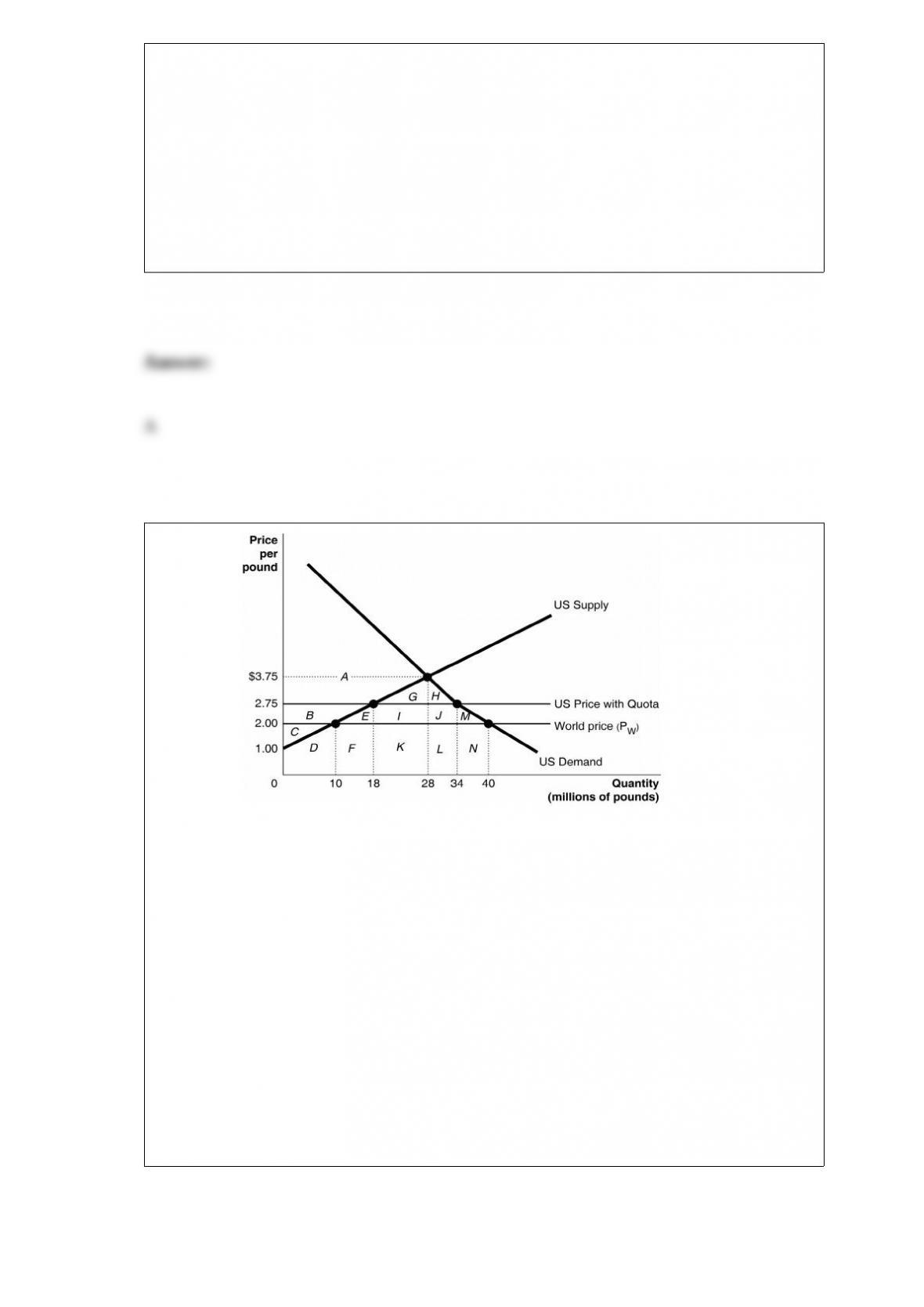
Figure 7-3 Since 1953 the
United States has imposed a quota to limit the imports of peanuts. Figure 7-3 illustrates
the impact of the quota. With a quota in place, what is the quantity consumed in the
domestic market and what portion of this is supplied by imports?
A) Domestic consumption equals 28 million pounds of which 18 million pounds are
imports.
B) Domestic consumption equals 40 million pounds of which 22 million pounds are
imports.
C) Domestic consumption equals 34 million pounds of which 16 million pounds are
imports.
D) Domestic consumption equals 34 million pounds of which 18 million pounds are
imports.

Which of the following statements is true?
A) An inverse relationship has a positive slope value.
B) A direct relationship has a negative slope value.
C) A curved line has slope values that change at every point.
D) A straight line has a slope of one.
During the recession of 2007-2009 in the United States, ________ relative to potential
GDP.
A) business fixed investment spending rose and net export spending declined
B) consumption spending rose and residential construction spending declined
C) federal government purchases rose and changes in business inventories declined
D) net export spending rose and consumption spending declined
Explain the differences between total revenue, average revenue, and marginal revenue.

What is the difference between product markets and factor markets?
Article Summary. According to Edmunds.com, incentives for the purchase of
automobiles rose to an average of $2,500 per vehicle in the United States in May
2013, or about 8 percent of market value. The incentives offered by the big 3 U.S.
auto companies were higher than the average, with Chrysler at 10.3 percent of
market value, General Motors at 10 percent, and Ford at 9 percent. Despite the
increase in incentives, there was little change in sales volume for the first half of
2013.
Source: Kyle Stock, “Lauderdale CVB ramps up LGBT summer marketing,”
Bloomberg Businessweek, June 11, 2013.
What happens to the profit a car company makes on each car sold if it offers incentives
such as cash rebates to customers? What happens to the company’s profit per car if it
offers zero percent financing as an incentive? How might a car company decide which
of these strategies to use?

What is a banking panic, and what role did banking panics play in the decision by
Congress to establish the Federal Reserve?
Use the information below to explain adjustments that move the economy to a long-run
equilibrium. Assume that firms and workers have adaptive expectations. The current
unemployment rate = 4%.
The natural rate of unemployment = 6%.
Last year’s inflation rate = 3%.
This year’s inflation rate = 4%.
What is the difference between the terms “marketing” and “advertising”?
If net taxes rise by $150 billion, would you expect household saving to fall by $150
billion, by more than $150 billion, or by less than $150 billion?
Give an example of an automatic stabilizer. Explain how automatic stabilizers work in
the case of recession.
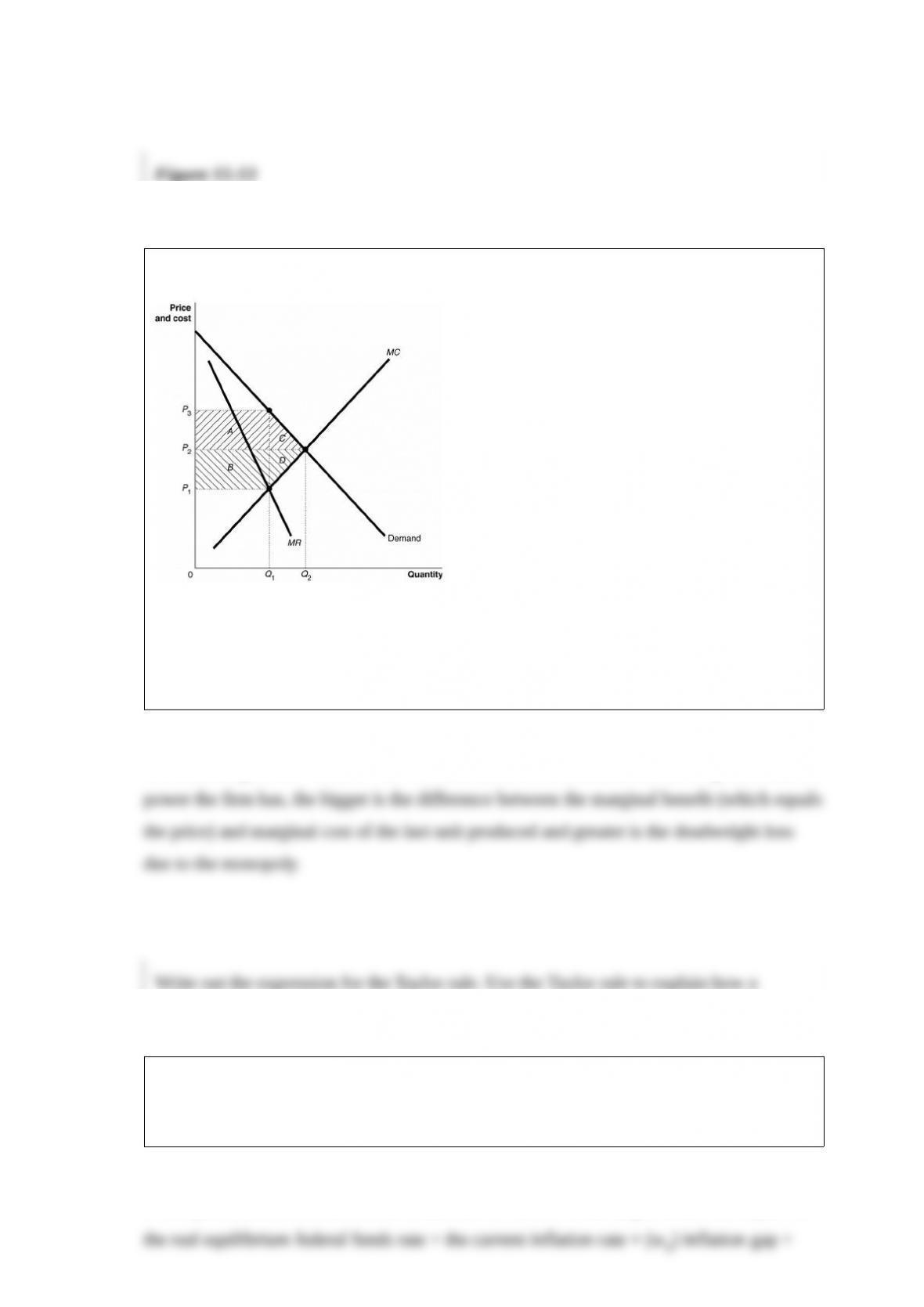
Figure 15-13
From the monopoly graph above, identify the area representing the deadweight loss.
Would the deadweight loss be larger if the demand curve was more elastic or less
elastic?
Write out the expression for the Taylor rule. Use the Taylor rule to explain how a
decline in real GDP below potential GDP will affect the Federal Reserve’s target for the
federal funds rate.