
Most of the investment decisions in the U.S. economy are made by
a. consumers.
b. businesses.
c. governmental institutions.
d. international financial agencies.
Rent seeking is the term given
a. to an attempt by firms to create a profitable monopoly even though resources may be
wasted in the process.
b. to filing a lawsuit, which wastes resources, in the hope of obtaining monetary gain or
a strategic market position.
c. to attempts by firms to obtain earnings without contributing to production.
d. All of the above are correct.
Market demand curves may slope downward even if some individual demand curves do
not because
a. the law of demand requires that this is true.
b. lower prices may bring more purchasers into the market.
c. merchants try to sell more at lower prices.
d. people believe expensive goods are better goods.
The concept of poverty is culturally determined, and hence people are defined as “poor”
in relation to others.
a. True
b. False
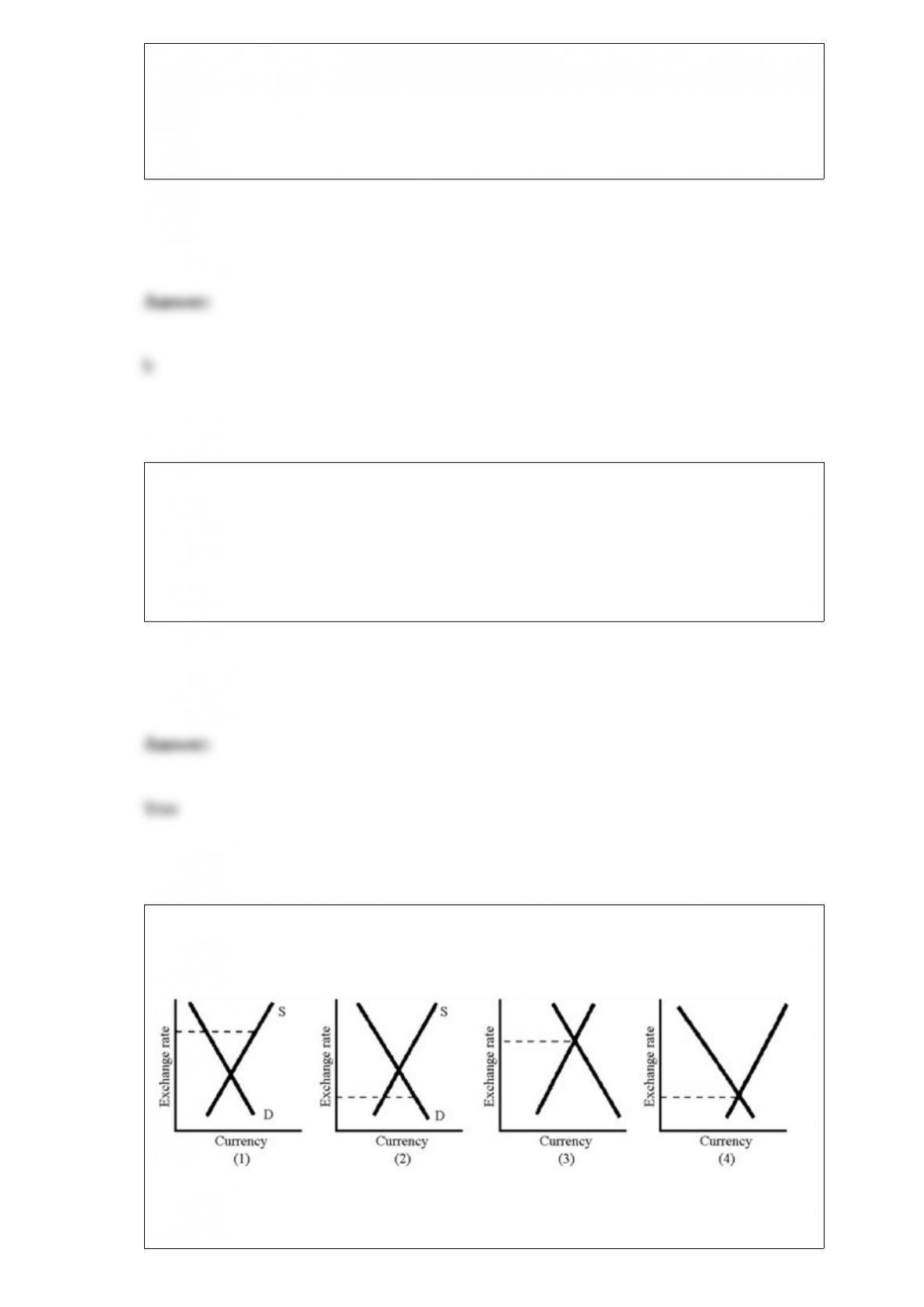
Figure 19-3
Of the graphs in Figure 19-3, where the dotted line shows the actual exchange rate,
which one shows a country with an undervalued currency and a balance of trade

surplus?
a. 1
b. 2
c. 3
d. 4
The shares of GDP taken in taxes by federal, state & local governments
a. have risen steadily in the past 40 years to about 22 percent.
b. have dropped steadily in the past 40 years to about 6 or 7 percent.
c. grew substantially until the early 1970s and have leveled off at about 10 to 11
percent.
d. fell steadily until the early 1970s and has risen steadily since then.
If the price level falls, what will happen to the aggregate supply curve?
a. It will shift outward.
b. It will shift inward.

c. Nothing.
d. It will get steeper.
e. It will get flatter.
The decisions on the part of the government to increase spending by $5 billion will
have the largest impact on aggregate demand when the spending is financed by the sale
of bonds to
a. the member banks.
b. the public.
c. the Fed.
d. foreigners.
Market demand curves are found by
a. vertically summing individual demand curves.
b. horizontally summing individual demand curves.
c. summing individual demand curves in a parallel fashion.
d. adding the slopes of individual demand curves.

The market’s contribution to the general welfare has been its
a. stimulation of growth in productivity.
b. yield of an abundance of consumers’ goods.
c. contribution to human longevity.
d. All of the above are correct.
Beneficial externalities would be removed if the recipients of the benefit paid the
producer of the externality.
a. True
b. False
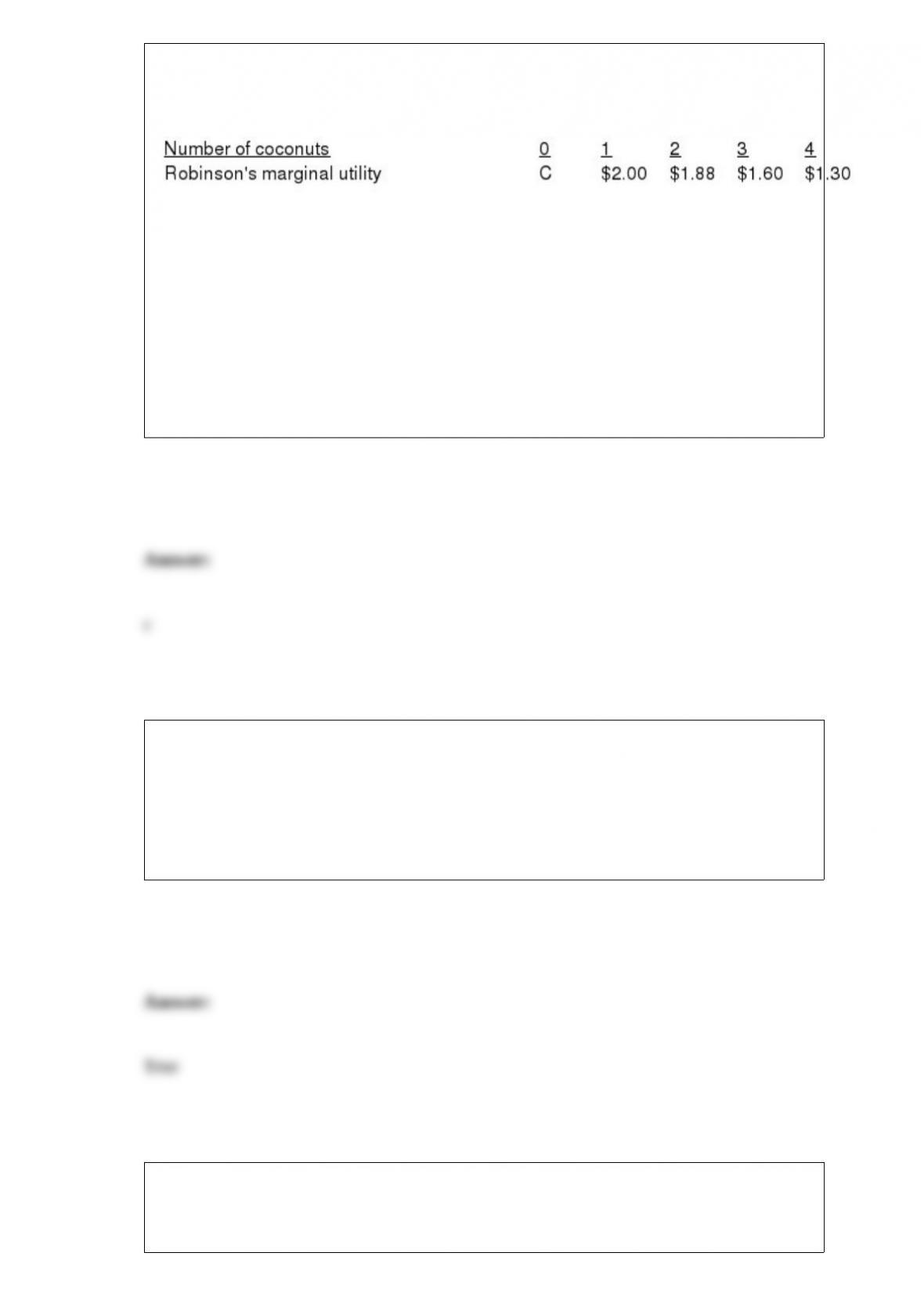
Table 5-2
According to Table 5-2, Robinson’s total utility from having two coconuts is ____.
a. $1.87
b. $1.66
c. $3.88
d. This is not determinable from the information in the table.
In a laissez-faire system, the price mechanism dictates the production planning
decisions.
a. True
b. False
Why might the Fed decide to monetize the deficit?
a. to keep inflation low

b. to reduce the structural deficit
c. to reduce the budget deficit
d. to keep interest rates low
Bonds can be risky investments because
a. bondholders are paid from whatever remains after stockholders have been paid what
the corporation owes them.
b. if the corporation loses its assets, the bondholders may never recover their
investments.
c. the general price level may fall.
d. the voting power of an individual bondholder may be more apparent than real.
The growth rates of actual and potential GDP
a. are similar in both the short and long run.
b. are similar in the short run but not the long run.
c. are similar in the long run but not the short run.
d. are different in both the short and long run.
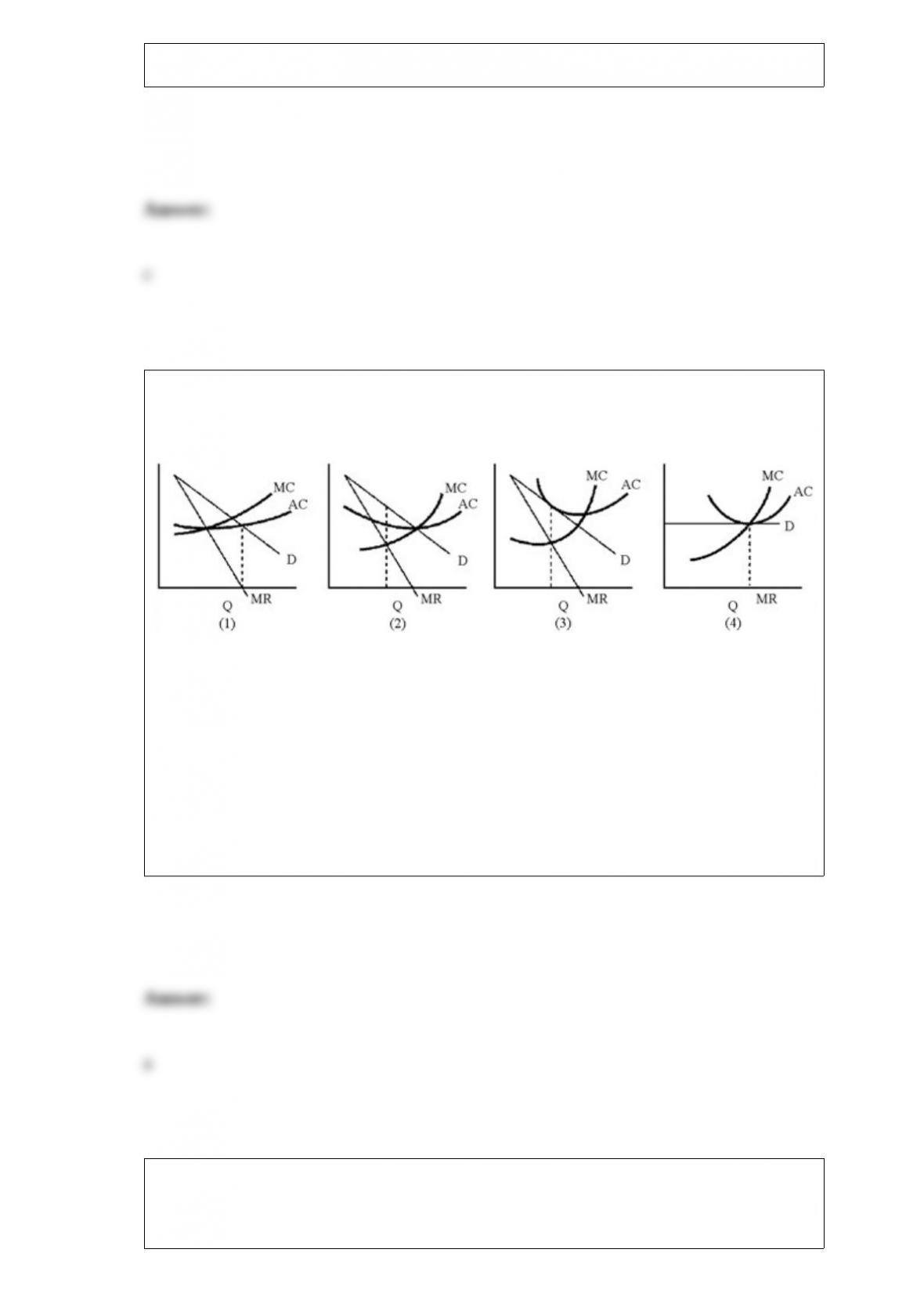
Figure 12-2
In Figure 12-2, which of the graphs represents a firm that is a sales revenue maximizer?
a. 1
b. 2
c. 3
d. 4
When the dollar depreciates, the cost to Americans of foreign goods
a. rises and the CPI falls.

b. rises and the CPI rises.
c. falls and the CPI rises.
d. falls and the CPI falls.
Entrepreneurship is the act of starting new firms and taking the risks that are necessary
in business opportunities.
a. True
b. False
Banks will keep excess reserves when:
a. they do not foresee profitable opportunities to make loans
b. business conditions generally are depressed
c. they do not foresee opportunities to make secure loans
d. All of the above are correct.

John Maynard Keynes wrote that economies can suffer recession or depression for
many years if the government does not intervene.
a. True
b. False
In the short run the firm has no more than one fixed input.
a. True
b. False
The new growth theory would be most likely to lend support for increased government
support for
a. land acquisition.
b. natural resource development.

c. stricter environmental standards.
d. higher education.
When an inflationary gap exists, the job prospects of new college graduates are
a. very dim.
b. somewhat encouraging.
c. worse in comparison to a recessionary gap.
d. excellent.
Corporations produce most of the output in the United States.
a. True
b. False

Since women earn less on average than men, we would expect that the substitution
effect of a wage change would be more likely to dominate for women and the income
effect would be more likely to dominate for men.
a. True
b. False
Government transfer payments act as automatic stabilizers because as labor income
decreases, transfer payments
a. decrease as well.
b. remain constant.
c. increase.
d. to the government increase.
Most economists believe that
a. speculation on financial markets reduces their efficiency and should either be
abolished or heavily regulated.
b. speculation on financial markets does not need to be regulated because it has been

largely eliminated by regulations on program trading.
c. speculation socially benefits financial markets but harms nonfinancial markets.
d. speculation helps both financial and nonfinancial markets function more efficiently.
Real wages usually lag behind the increases in labor productivity.
a. True
b. False
The United States has not experienced a recession as severe as the 2007-2009 downturn
since the 1930s.
a. True
b. False

The key explanation for the prevalence of waterway pollution is
a. the inclusion in production of all costs involving use of the waterway.
b. that there are private costs but no costs to society.
c. that waterways are not private property and can be used free of charge.
d. that waterways are subject to the market’s normal control procedures.
The questions of what to produce, how to produce, and for whom are answered by
a. free-market economies.
b. economies that are a mixture of planning and markets.
c. command economies.
d. all economic systems in some manner.