A recent news story reported that the Organization of Petroleum Exporting Countries is
expected to decrease the supply of oil next summer. Summer is traditionally a time of
increased demand for oil because of vacation travel. What would be the combined
effect of these two events on the summer market for gasoline?
A) an increase in the price and the quantity
B) an increase in the price and an unpredictable change in the quantity
C) an unpredictable change in both the price and the quantity
D) an unpredictable change in the price and a decrease in the quantity
An action is a dominant strategy when it is a player’s best action:
A) regardless of the actions by other players.
B) given certain profit-maximizing actions of other players.

C) assuming the other players do not correctly anticipate the action.
D) if there is only one other competitor.
Bob runs a pedicure business in a perfectly competitive industry. He knows that he will
break even if the price of pedicures is $15 but that he will have to shut down if the price
is $11. If the market demand in the industry is P = 30 ” (0.2)Q and the market supply is
P = (0.2)Q, in the short run, Bob will:
A) shut down, since he cannot cover any of his variable costs.
B) produce but just break even.
C) produce with a loss, since he is operating below his break-even level.
D) shut down, although he is making a positive economic profit.
Network externalities are often:
A) separate from positive feedback.
B) a reason for natural monopolies.
C) less likely to occur in the communications or technology industries than in other
industries.
D) not likely to move toward market domination.

A good is likely to have an inelastic demand curve if:
A) the consumer has significant time to respond to the price change.
B) the good has few available substitutes.
C) the good is a luxury.
D) the good accounts for a large share of consumer income.
If the price elasticity of demand equals 0, the demand curve is:
A) horizontal.
B) vertical.
C) upward-sloping.
D) unit-elastic.
You decide whether to eat one more slice of pizza based on how hungry you feel. This
statement best represents this economic concept:
A) Resources are scarce.
B) The real cost of something is what you must give up to get it.
C) “How much” is a decision at the margin.
D) There are gains from trade.
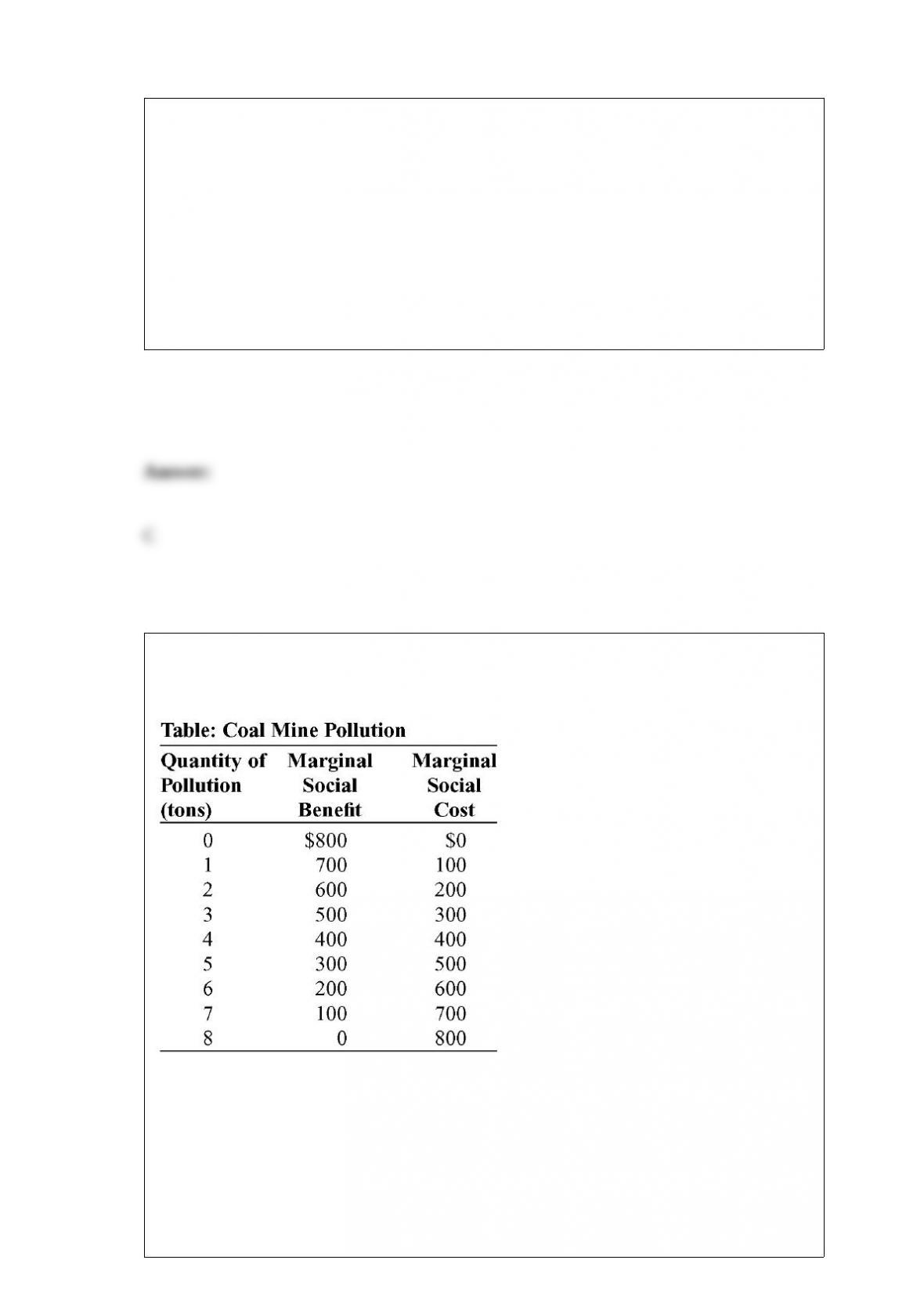
(Table: Coal Mine Pollution) The table Coal Mine Pollution shows the marginal social
benefit and cost of various amounts of pollution from a coal mine. If 5 tons of pollution
is produced, the marginal social benefit is _____, and the marginal social cost is _____.
A) $0; $800
B) $300; $500

C) $400; $400
D) $800; $0
Consumption bundles that yield equal levels of total utility are shown on the same:
A) budget line.
B) marginal utility curve.
C) indifference curve.
D) utility maximizing curve.
In the circular-flow diagram, an individual or a group of people (usually a family) who
share their income is a(n):
A) market.
B) factor.
C) household.
D) business.

If an excise tax is imposed on automobiles and collected from consumers:
A) the demand curve will shift downward by the amount of the tax.
B) the supply curve will shift upward by the amount of the tax.
C) the equilibrium quantity supplied will increase relative to the pretax level.
D) the equilibrium quantity demanded will increase relative to the pretax level.
Substitutes in production suggest that a producer with a fixed set of resources initially
will need to reduce production of one good when the producer:
A) produces less of the other good.
B) produces more of the other good.
C) has an increase in resources.
D) produces more of the other good and has an increase in resources.
If the price of chocolate-covered peanuts increases and the demand for strawberry
licorice twists increases, this indicates that these two goods are:
A) complementary goods.
B) normal goods.
C) inferior goods.
D) substitute goods.
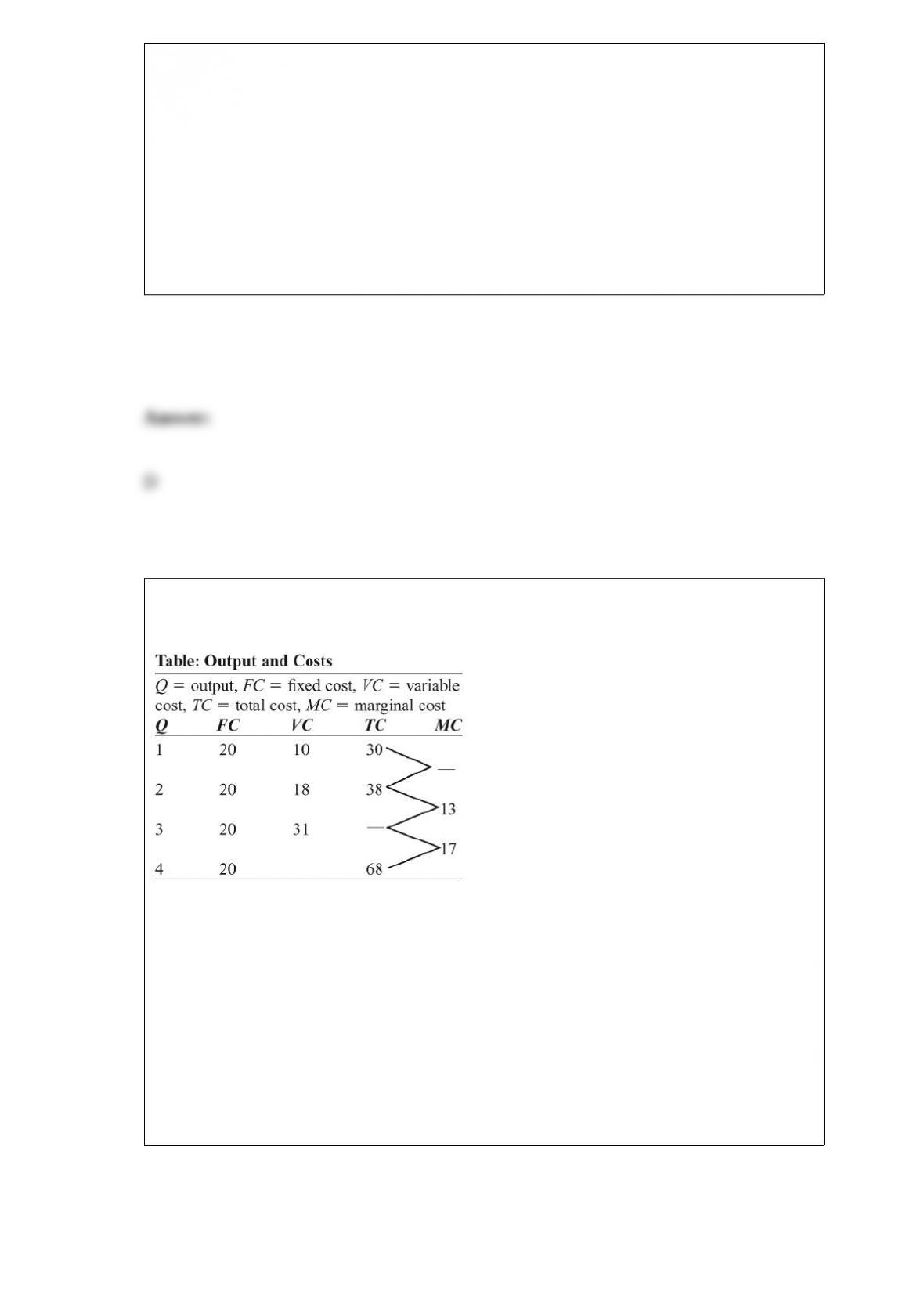
(Table: Output and Costs) Look at the table Output and Costs. When output is 3,
average total cost equals:
A) $13.
B) $10.
C) $8.
D) $17.

In the short run, if a monopoly is forced to charge a price equal to marginal cost:
A) output will fall.
B) the deadweight loss will decrease.
C) consumer surplus will decrease.
D) other firms will enter the industry.
An increase in the consumer surplus in the market for milkshakes may result from a(n)
_____ in the _____ of milkshakes.
A) increase; price
B) increase; supply
C) decrease; demand
D) decrease; supply
Scenario: Monopolist
The demand curve for a monopolist is P = 75 ” 0.5Q, and the monopolist has the
following MC expressed as P = 2Q. Assume also that ATC at the profit-maximizing
level of production is equal to $12.50.
(Scenario: Monopolist) Look at the scenario Monopolist. The total profit”maximizing
level of profit per unit is:
A) $62.50.
B) $0.00
C) $75.00.
D) $50.00.

For a public good, nonpayers _____ excluded from obtaining the benefits of the good.
A) can be
B) are automatically
C) usually are
D) cannot be
When the allocation of resources is such that a different allocation would increase
society’s welfare, economists say:
A) market failure has occurred.
B) the efficiency condition is met.
C) decision makers have faced the full marginal benefits and marginal costs of their
decisions.
D) producers have maximized total cost.
A factor demand curve will shift because:
A) of a change in the price of the good the factor produces.
B) the elasticity of demand for the final product is high.

C) of a change in the proportion of the factor’s cost relative to total cost.
D) the slope of the MP curve is negative.
A Pigouvian tax can lead to the efficient level of production and consumption of:
A) a public good.
B) a common resource.
C) an artificially scarce good.
D) no goods, since all taxes cause inefficiency.
(Table: Total Product of Labor at Debbie’s Bakery) Look at the table Total Product of
Labor at Debbie’s Bakery. Debbie can sell cakes at $10 each. What is the value of the
marginal product for the fourth worker?
A) five cakes
B) $50
C) $210

D) 21 cakes
If two goods are complements, their cross-price elasticity of demand is:
A) less than 0.
B) equal to 0.
C) positive but almost equal to 0.
D) greater than 0.
The largest Herfindahl”Hirschman index possible is _____, and the industry is a(n)
_____.
A) 10; monopoly
B) 10,000; monopoly
C) 100,000; monopoly
D) 100,000; oligopoly
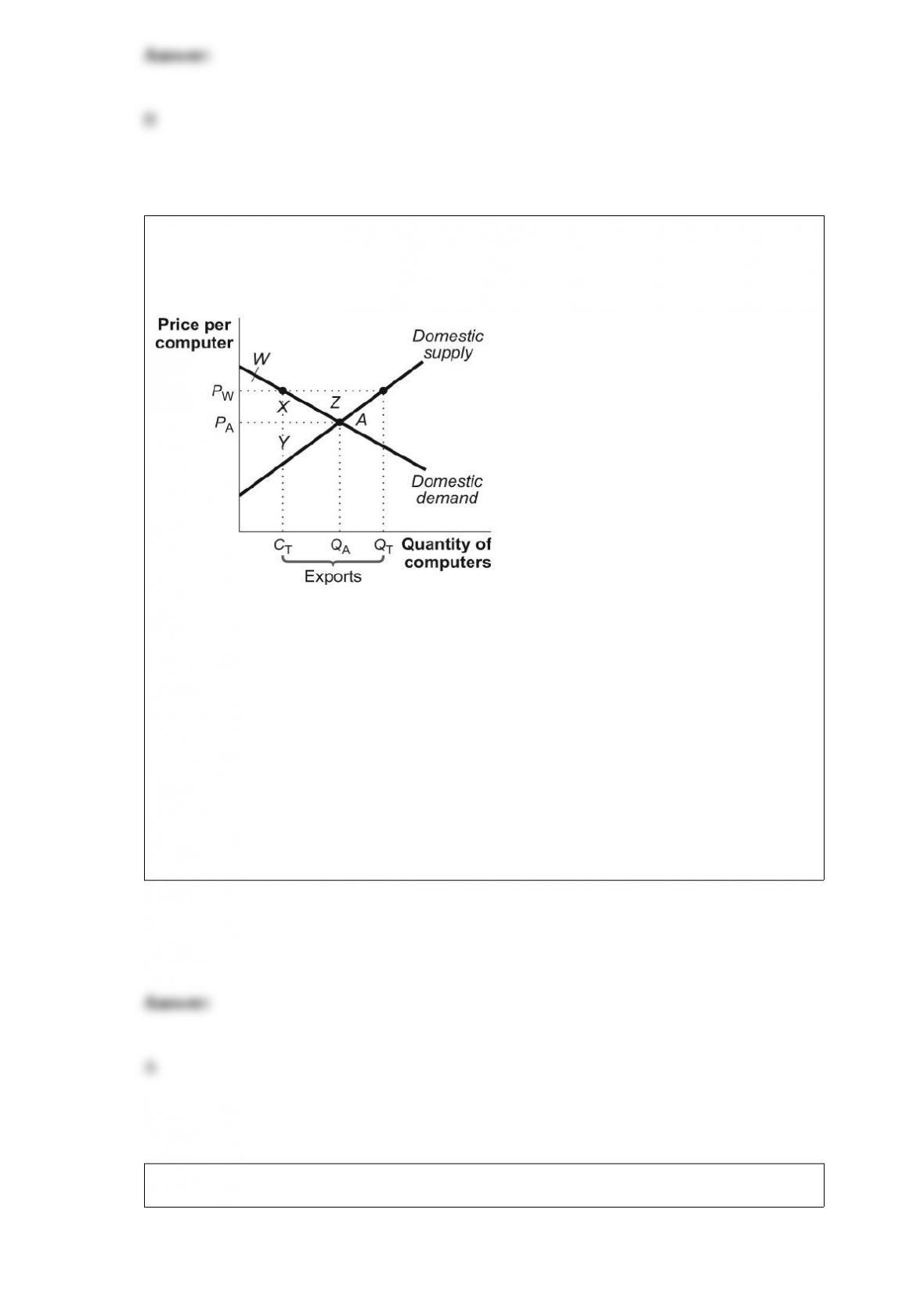
Figure: The Market for Computers
(Figure: The Market for Computers) Look at the figure The Market for Computers.
Assume that PA is the autarky price and PW is the world price. Producer surplus with
international trade would be area:
A) X + Y + Z.
B) W + X + Y.
C) X + Y.
D) Y.
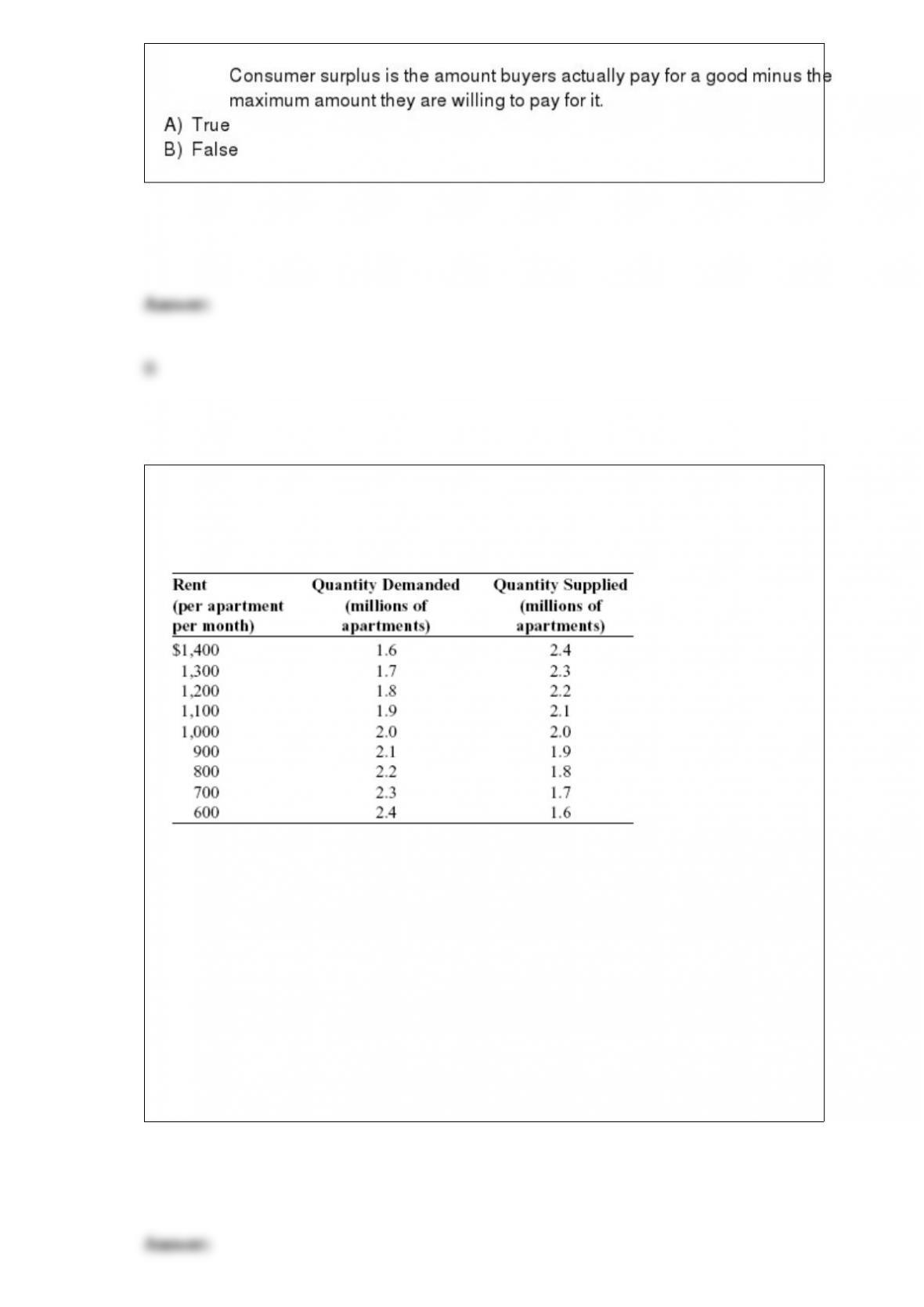
Table: Market for Apartments
(Table: Market for Apartments) Look at the table Market for Apartments. If a price
ceiling of $900 is imposed on this market, the result will be an inefficiency in the form
of a _____ million apartments.
A) surplus of 0.6
B) shortage of 0.6
C) surplus of 0.2
D) shortage of 0.2
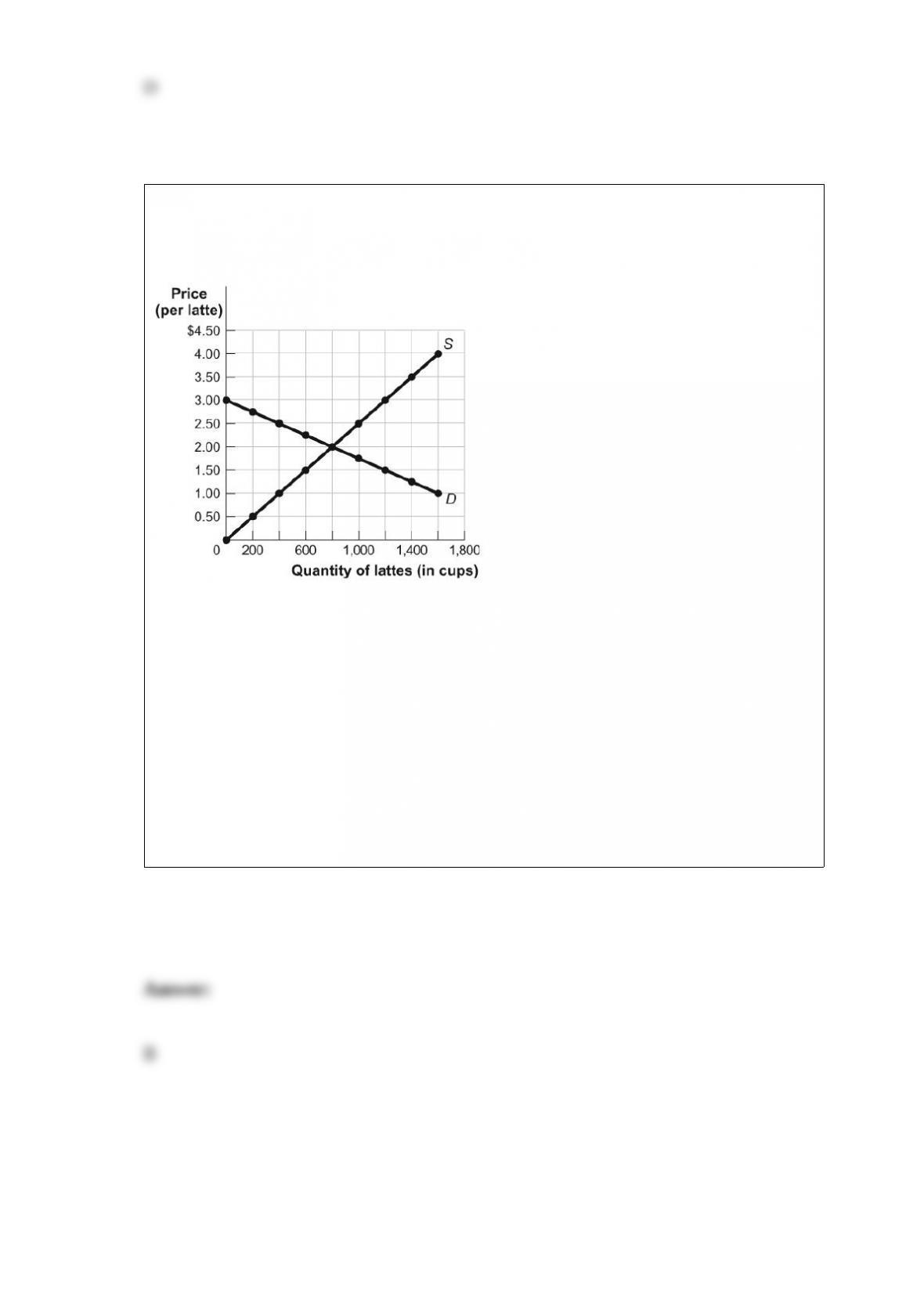
Figure: The Market for Lattes
(Figure: The Market for Lattes) Look at the figure The Market for Lattes. If the
government assesses a tax of $0.75 on sellers of lattes, the price producers will receive
for a latte after the tax will:
A) decrease from $2 to $1.75.
B) decrease from $2 to $1.50.
C) decrease from $2 to $1.25.
D) change, but we cannot determine by how much.