
1) An individual bank can safely lend out a multiple of its excess reserves, but the
banking system can safely lend out only an amount equal to the excess reserves in the
banking system.
2) the short run is a period of time during which all costs are fixed costs.
3) Seniority pay is the same as piece rate pay.
4) It is more meaningful economically to measure the public debt relative to the GDP
than to measure it in absolute terms.
5) within the circular flow model, the level of total resource income and total spending
on output will be approximately equal.
6) Forestry companies with secure property rights have a greater incentive to harvest
and replant in a sustainable manner.
7) DVCs might increase their rates of economic growth through privatization of state
industries, encouraging direct foreign investment, controlling population growth, and
opening economies to international trade.
8) In the aggregate expenditure model presented in the textbook, investment is assumed
to rise with increases in real GDP and fall with decreases in real GDP.
9) Venture capital is another name for retained earnings.
10) An increase in business excise taxes will shift the aggregate supply curve leftward.
11) “backflows” are payments made by immigrants back to their home countries.
12) Which of the following is not a social insurance program?
A.TANF
B.Medicaid
C.Supplemental Security Income
D.unemployment compensation
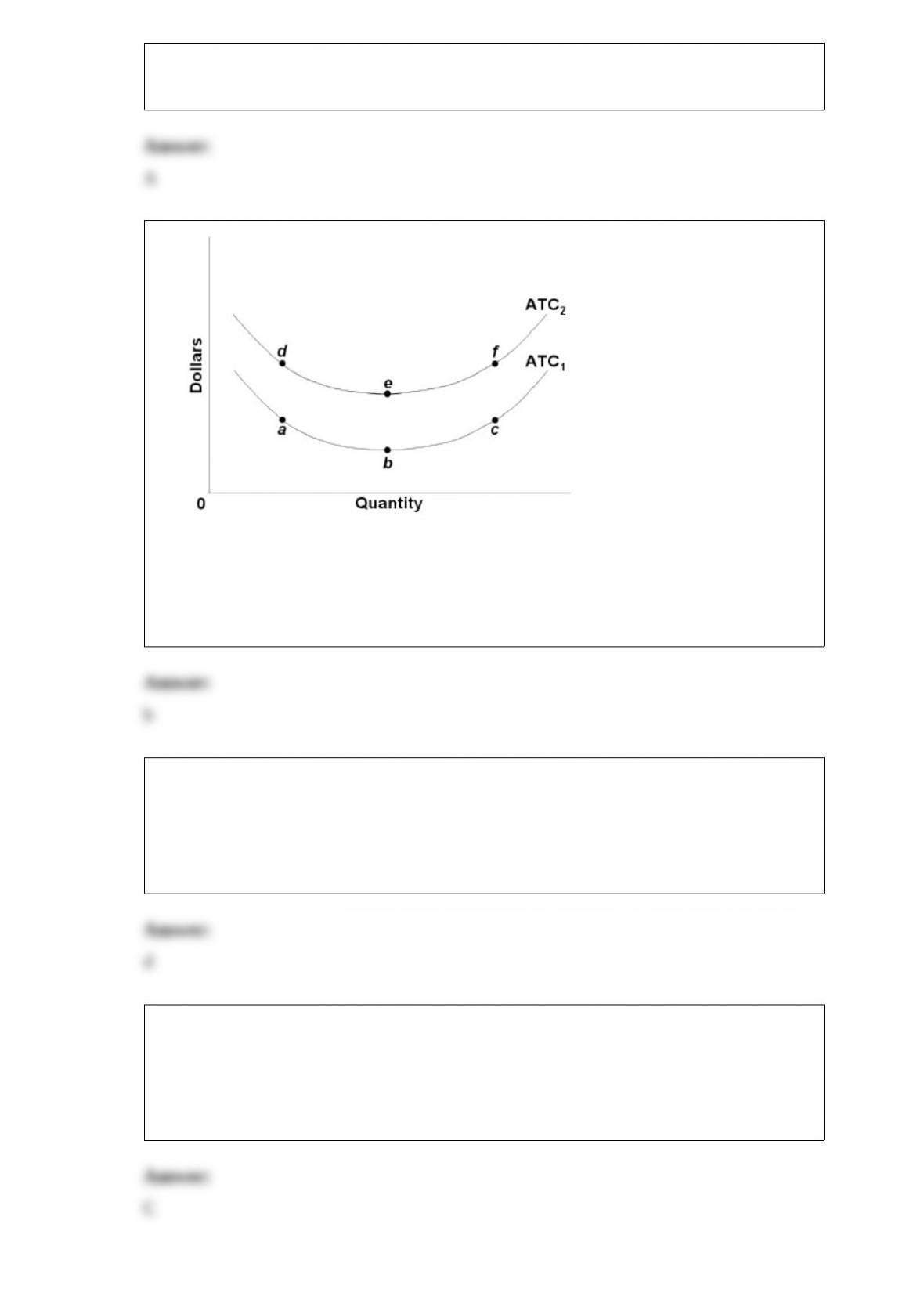
13)
Refer to the above data. If the prices of labor and capital are $9 and $15 respectively,
and labor and capital are the only inputs, the firm’s economic profits will be:
A.$102.
B.$82.
C.$67.
D.$28.
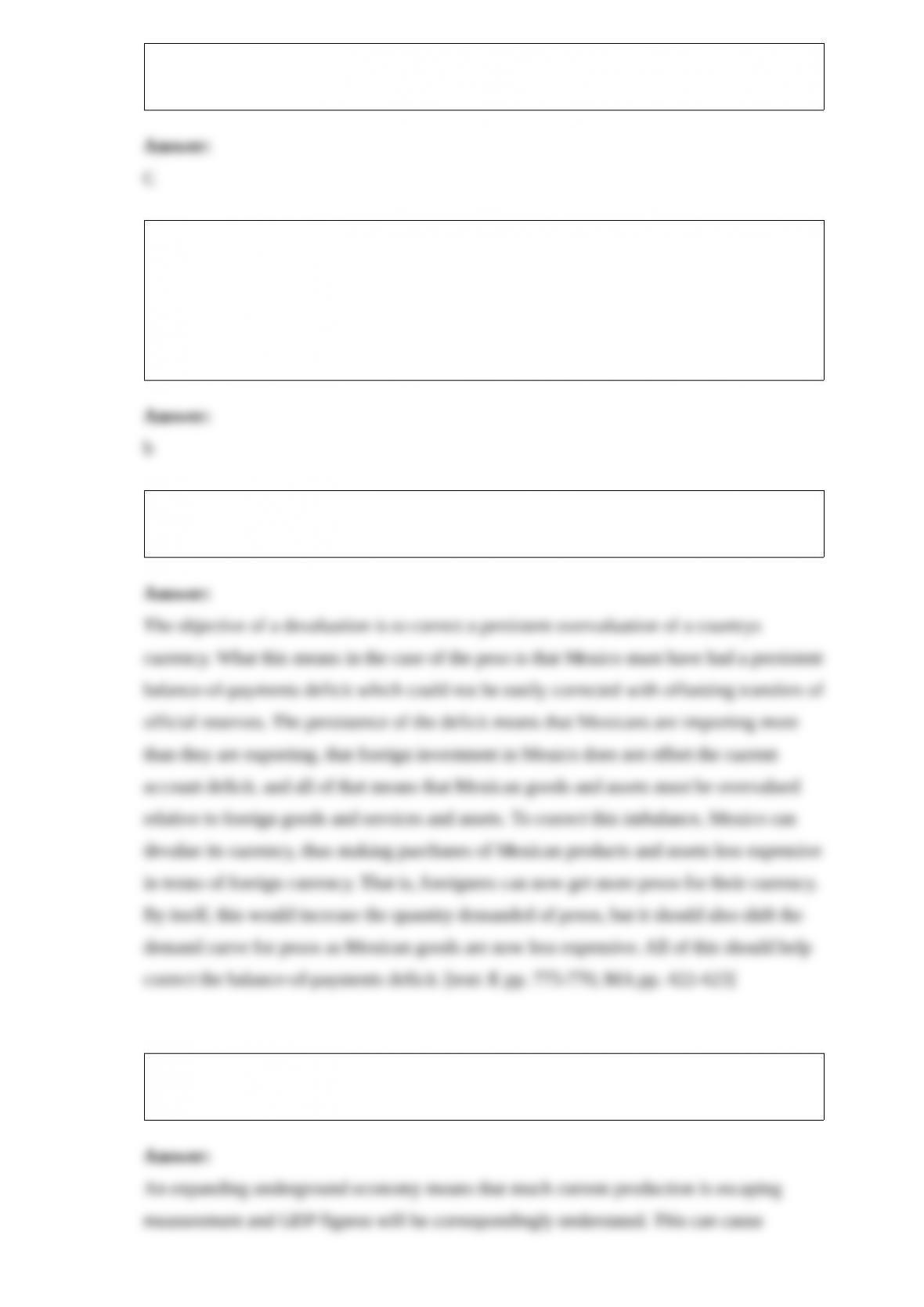
14)
refer to the above graph. diminishing marginal returns are reflected in:
a.the shift of the short-run average total cost curve from atc2 to atc1.
b.a move along short-run average total cost curve atc2 from point e to point f.
c.a move along short-run average total cost curve atc1 from point b to point a.
d.the shift of the short-run average total cost curve from atc1 to atc2.
15) pollution:
a.should be corrected by the subsidization of offending firms.
b.is not an economic problem because it is external to the market system.
c.is an example of private production costs.
d.is an example of an external cost.
16) Which of the following allegedly contributed to the stagflation in the mid-1970s?
A.appreciation of the dollar
B.a sharp drop in the prices of farm products
C.a dramatic increase in oil prices
D.rising productivity in manufacturing

17) demand-pull inflation:
a.occurs when total spending in the economy is excessive.
b.is measured differently than cost-push inflation.
c.can be present even during an economic depression.
d.is also called “hyperinflation.”
18) If actual reserves in the banking system are $50,000, excess reserves are $5,000,
and checkable deposits are $225,000, then the monetary multiplier is:
A.10.
B.4.
C.5.
D.2.
19) the most efficient combination of resources in producing any output is the
combination that:
a.comes closest to using the same quantities of land, labor, capital, and entrepreneurial
ability.
b.can be obtained for the smallest money outlay.
c.uses the smallest total quantity of all resources.
d.conserves most on the use of labor.
20) the official unemployment rate:
a.involves people over 16 years of age who are not currently seeking employment.
b.is the ratio of unemployed to employed workers.
c.is the percentage of the labor force that is unemployed.
d. is the percentage of the total population that is not working.
21) In the balance of payments of the United States, U.S. goods imports are recorded as
a:
A.positive entry.
B.capital account entry.
C.current account entry.
D.official reserves entry.
22) the market system does not produce public goods because:
a.there is no need or demand for such goods.
b.private firms cannot stop consumers who are unwilling to pay for such goods from
benefiting from them.
c.public enterprises can produce such goods at lower cost than can private enterprises.
d.their production seriously distorts the distribution of income.
23) Suppose that Mexico devalues the peso. What objectives would prompt the
devaluation? Be specific.
24) The expanding underground economy creates problems for economic policy
makers. Explain.
25) Why may majority voting produce economically inefficient outcomes? Give a
numerical example that leads to the rejection of a public good.
26) What is insideroutsider theory? How does it explain the downward inflexibility of
wages?
27) What are the two main investor preferences and how do they conflict?
28) What is the profit-maximizing condition for the use of a resource?
29) Identify at least four transactions and other variables which are not included in the
Gross Domestic Product.
30) Compare and contrast the modern view of technological advance with the
traditional view.
31) Describe how a market for externality rights would work in terms of supply and
demand.