1) Which of the following would contribute to a United States balance of payments
surplus?
A.the United States makes a unilateral tariff reduction on imported goods
B.General Motors pays a dividend to a Swiss stockholder
C.the United States cuts back on U.S. military personnel stationed in Germany
D.Russian vodka becomes increasingly popular in the United States
2) because the marginal product of a variable resource at first increases and then
decreases as the output of the firm is increased:
a.total cost at first increases at a decreasing rate and then increases at an increasing rate.
b.total variable cost at first increases at an increasing rate and then increases at a
decreasing rate.
c.average total cost at first increases and then diminishes.
d.average fixed cost will rise beyond the point of diminishing returns.
3) if the demand for farm products is price inelastic, a good harvest will cause farm
revenues to:
a.increase.
b.decrease.
c.be unchanged.
d.either increase or decrease, depending on what happens to supply.
4) suppose that an economy’s labor productivity rose by 3 percent and its total
worker-hours remained constant between year 1 and year 2. we could conclude that this
economy’s:
a.capital stock increased.
b.real gdp increased.
c.production possibilities curve shifted inward.
d. natural resource base expanded.
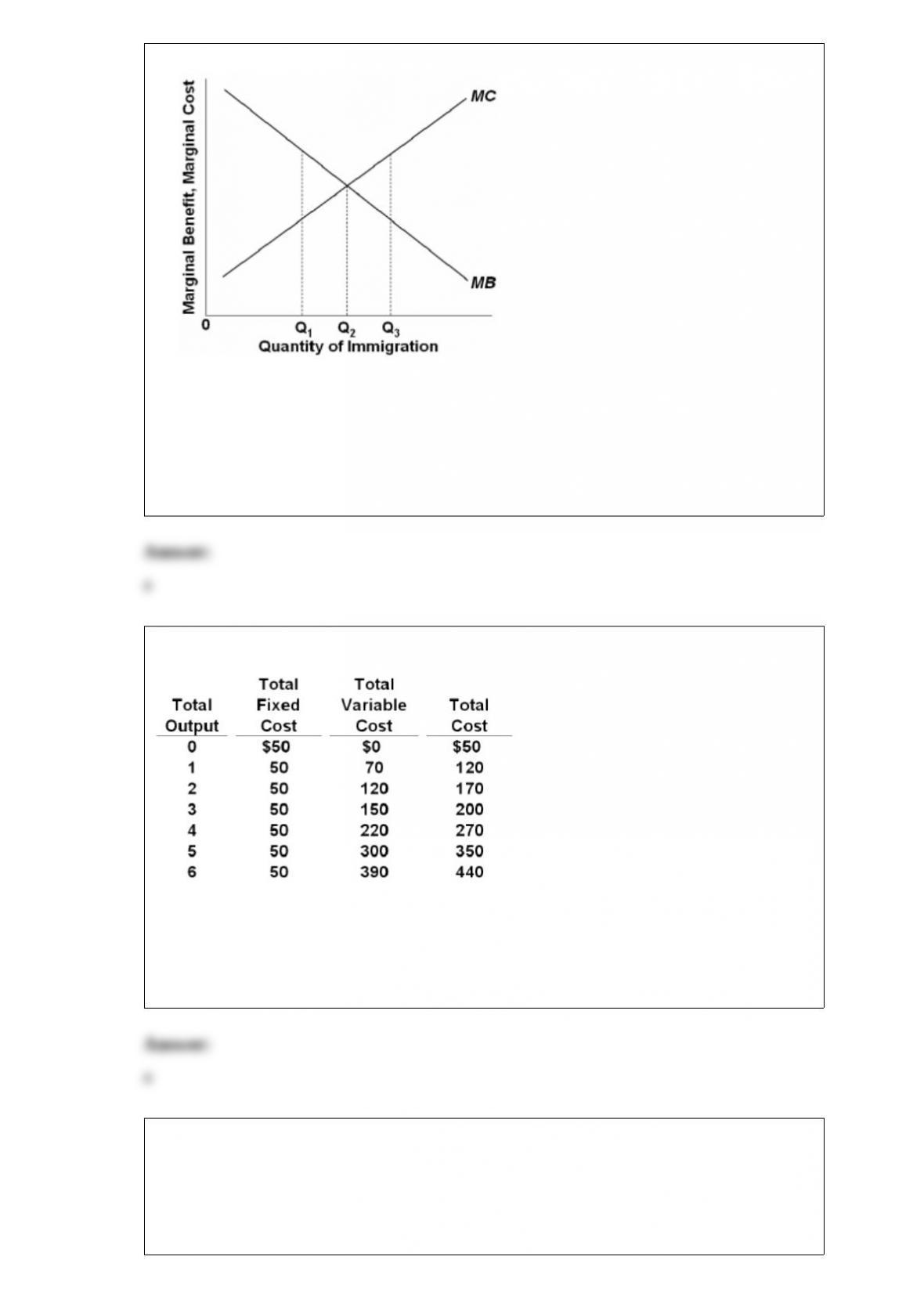
5)
refer to the above figure. if more criminals are in the mix of potential immigrants, how
will this affect the optimal quantity of immigrants?
a.it will increase mc and reduce the optimal quantity.
b.it will increase mc and raise the optimal quantity.
c.it will lower mc and raise the optimal quantity.
d.it will lower mc and reduce the optimal quantity.
6) the following cost data for a purely competitive seller:
refer to the above data. the marginal cost of the fifth unit of output is:
a.$80.
b.$90.
c.$50.
d.$20.
7) Suppose the Federal government had budget deficits of $40 billion in year 1 and $50
billion in year 2 but had budget surpluses of $20 billion in year 3 and $50 billion in year
4. Also assume that it used its budget surpluses to pay down the public debt. At the end
of these four years, the Federal government’s public debt would have:
A.increased by $90 billion.
B.increased by $20 billion.
C.decreased by $70 billion.
D.decreased by $20 billion.
8) Which of the following statements is correct?
A.The parity ratio has not exceeded 100 in the 20th or 21st century.
B.An increase in prices paid by farmers relative to prices received by farmers will
increase the parity ratio.
C.The parity ratio has generally been greater than 100 in the past four decades.
D.The parity ratio has generally declined over the past five decades.
9) The economy’s long-run AS curve assumes that wages and other resource prices:
A.eventually rise and fall to match upward or downward changes in the price level.
B.are flexible upward but inflexible downward.
C.rise and fall more rapidly than the price level.
D.are relatively inflexible both upward and downward.
10)
refer to the above diagram. physicians likely would argue that health care should be
provided to patients in:
a.some amount less than q1.
b.amount q1
c.some amount between q1 and q2.
d.amount q2.
11) economic scarcity:
a.is peculiar to the united states economy.
b.applies to all economies.
c.is peculiar to command systems.
d.is peculiar to market systems.
12) Melanie and Oli are competing Pacific Halibut fishers. Both have been allocated
ITQs that limit their catch to 1,000 tons of Pacific Halibut each. Melanie’s cost per ton
is $20; Oli’s cost per ton is $28.
Refer to the information above. If the market price of Pacific Halibut is $40 per ton, and
Melanie and Oli both catch their quota, their combined profit will be:
A.$12,000.
B.$22,000.
C.$25,000.
D.$32,000
13)
in the above diagram the vertical intercept and slope are:
a.4 and -11/3 respectively.
b.3 and -11/3 respectively.
c.3 and + 3/4 respectively.
d.4 and + 3/4 respectively.
14) If in a system of fixed exchange rates the dollar price of euros is above the market
equilibrium level:
A.gold will flow from the United States to Europe.
B.there will be a surplus of euros.
C.the United States government will have to ration euros to U.S. importers.
D.there will be a shortage of euros.
15) Which of the following tools of monetary policy is flexible, and able to affect bank
reserves quickly and by relatively specific amounts?
A.the discount rate
B.the reserve ratio
C.open market operations
D.the Federal funds rate
16) The recessionary expenditure gap associated with the recession of 2001 resulted
from:
A.the government’s attempt to control hyperinflation.
B.a major increase in personal and corporate taxes.
C.a rapid decline in investment spending.
D.a rapid increase in imports resulting from large tariff reductions.
17)
refer to the above figure. an increase in the number of highly motivated and skilled
potential immigrants will:
a.reduce mb and increase mc, lowering the optimal quantity of immigrants.
b.increase mb and reduce mc, raising the optimal quantity of immigrants.
c.increase both mb and mc, and the effect on the optimal quantity is uncertain.
d.reduce both mb and mc, and the effect on the optimal quantity is uncertain.
18) other things equal, in which of the following cases would economic profit be the
greatest?
a.an unregulated monopolist which is able to engage in price discrimination
b.an unregulated, nondiscriminating monopolist
c.a regulated monopolist charging a price equal to average total cost
d.a regulated monopolist charging a price equal to marginal cost
19) Suppose the G8 nations decide that the dollar is too strong (high in value) relative
to the yen. These nations might:
A.use official reserves of yen to buy dollars.
B.use official reserves of dollars to buy yen.
C.encourage Japan to print more yen.
D.encourage the United States to increase interest rates.