1) suppose the president lowers tariffs on radios as the result of negotiations under the
trade agreements program. radio producers in the united states can appeal under the:
a.escape clause if rising imports substantially injure the u.s. radio industry
b.escape clause if rising unemployment occurs even though imports remain unchanged
c.infant industry clause if rising imports cause unemployment to rise among u.s. radio
workers
d.infant industry clause if rising imports result in losses for u.s. radio companies
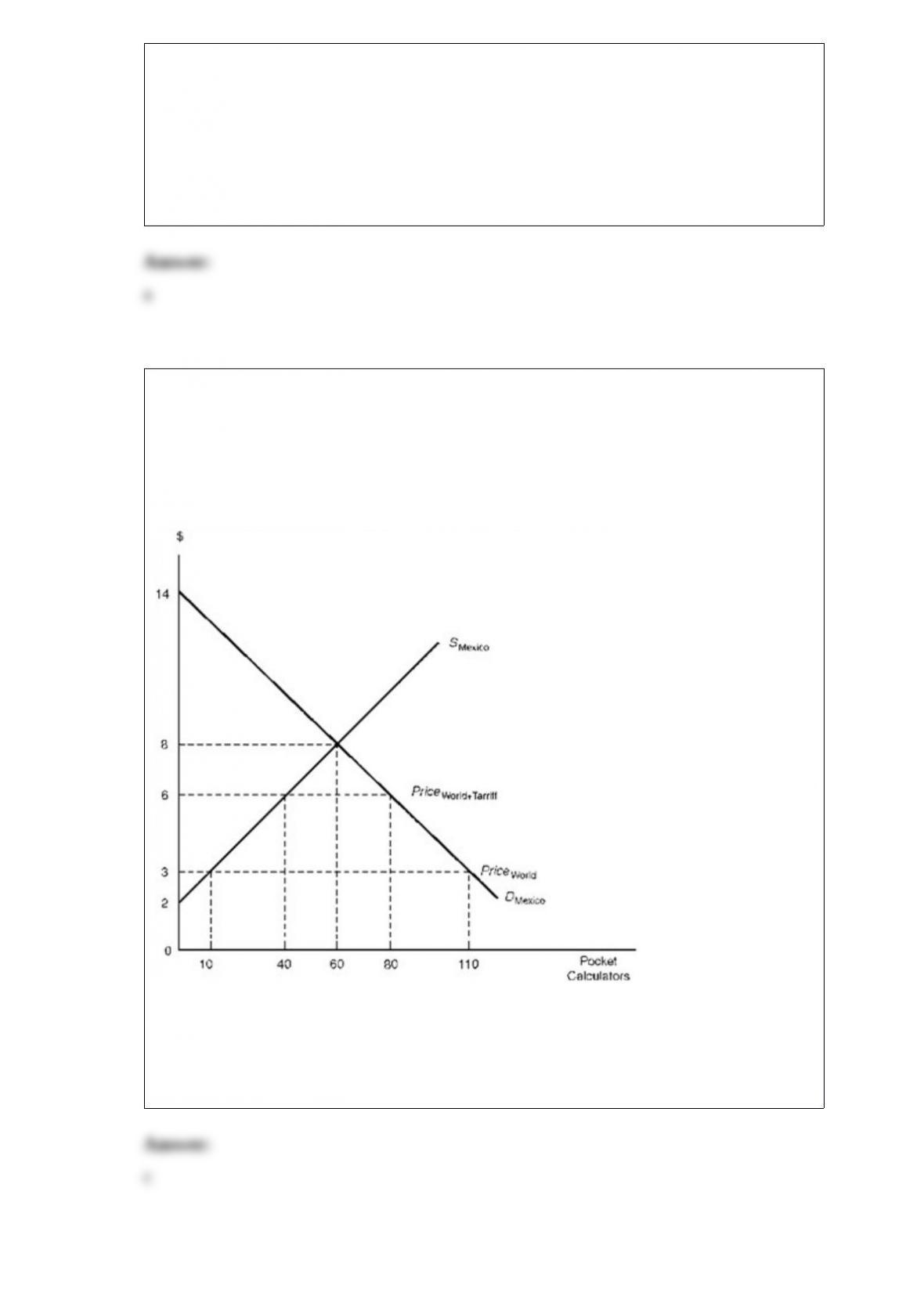
2) figure 4.1 illustrates the demand and supply schedules for pocket calculators in
mexico, a ‘small” nation that is unable to affect the world price.
figure 4.1. import tariff levied by a ‘small” country
consider figure 4.1. in the absence of trade, mexico produces and consumes:
a.10 calculators
b.40 calculators
c.60 calculators
d.80 calculators
3) the most important determinants of sanctions include
a.cultural factors including nationalistic attitudes
b.strength of political opposition in the targeting nation
c.the number of nations imposing sanctions
d.all of the above
4) should the home country be “large” relative to the world, its imposition of a tariff on
imports would lead to an increase in domestic welfare if the terms-of-trade effect
exceeds the sum of the:
a.revenue effect plus redistribution effect
b.protective effect plus revenue effect
c.consumption effect plus redistribution effect
d.protective effect plus consumption effect
5) an expenditure-reducing policy would consist of a decrease in:
a.the par value of a currency
b.government expenditures
c.import duties
d.business or household taxes
6) by reducing the overall volume of trade, import restrictions tend to reduce a nation’s
gains from trade.
a.true
b.false
7) most foreign exchange trading is carried out in the forward market.
a.true
b.false
8) for an open economy subject to international trade, equilibrium income occurs where
saving plus investment equals imports plus exports.
a.true
b.false
9) joint ventures may lead to
a.welfare increases
b.welfare decreases
c.no changes in welfare
d.all of the above
10) according to the j-curve effect, a depreciation of the pound’s exchange value has:
a.no impact on a u.k. balance-of-trade deficit in the short run
b.no impact on a u.k. balance-of-trade deficit in the long run
c.an immediate negative effect on the u.k. balance of trade
d.an immediate positive effect on the u.k. balance of trade
11) if real interest rates decline in the united states relative to real interest rates abroad,
the dollar’s exchange value will appreciate under a floating exchange-rate system.
a.true
b.false
12) “borrowed” international reserves consist of:
a.imf drawings
b.foreign currencies
c.gold
d.special drawing rights
13) assume that you are the chase manhattan bank of the united states, and you have 1
million swiss francs in your vault that you will need to use in 30 days. moreover, you
need 500,000 british pounds for the next 30 days. you arrange to loan your francs to
barclays bank of london for 30 days in exchange for 500,000 pounds today, and reverse
the transaction at the end of 30 days. you have just arranged a:
a.forward contract
b.futures contract
c.spot contract
d.currency swap
14) pegging to a single currency is generally done by developing nations whose trade
and financial relationships are mainly with a single industrial-country partner.
a.true
b.false
15) when the economy is in deep recession or depression, it is operating on that portion
of its aggregate supply curve that is horizontal.
a.true
b.false