
In the long run, a decrease in the money supply growth rate
a. shifts both the long-run and the short-run Phillips curves right.
b. shifts the long-run Phillips curve left and the short-run Phillips curve right.
c. shifts the long-run Phillips curve right and the short-run Phillips curve left.
d. None of the above is correct.
If the federal funds rate were above the level the Federal Reserve had targeted, the Fed
could move the rate back towards its target by
a. buying bonds. This buying would increase the money supply.
b. buying bonds. This buying would reduce the money supply.
c. selling bonds. This selling would increase the money supply.
d. selling bonds. This selling would reduce the money supply.
The banking system currently has $100 billion of reserves, none of which are excess.
People hold only deposits and no currency, and the reserve requirement is 10 percent. If
the Fed lowers the reserve requirement to 5 percent and at the same time buys $10
billion worth of bonds, then by how much does the money supply change?
a. It rises by $200 billion.

b. It rises by $800 billion.
c. It rises by $1,200 billion.
d. None of the above is correct.
If the Canadian nominal exchange rate does not change, but prices rise faster abroad
than in Canada, then the Canadian real exchange rate
a. does not change.
b. rises.
c. declines.
d. None of the above is necessarily correct.
If the reserve ratio is 15 percent, and banks do not hold excess reserves, and people
hold only deposits and no currency, then when the Fed sells $25.5 million worth of
bonds to the public, bank reserves
a. increase by $25.5 million and the money supply eventually increases by $382.5
million.
b. increase by $25.5 million and the money supply eventually increases by $170
million.

c. decrease by $25.5 million and the money supply eventually decreases by $382.5
million.
d. decrease by $25.5 million and the money supply eventually decreases by $170
million.
A dollar figure from 1908 is converted into 2008 dollars by dividing the 2008 price
level by the 1908 price level, then multiplying by the 1908 dollar figure.
a. True
b. False
Historically, as recessions have ended the unemployment rate declined
a. gradually to near zero.
b. rapidly to near zero.
c. gradually to a rate of about 5%-6%.
d. rapidly to a rate of about 5%-6%.

Scenario 24-3
Sue Holloway was an accountant in 1944 and earned $12,000 that year. Her son, Josh
Holloway, is an accountant today and he earned $210,000 in 2013. The price index was
17.6 in 1944 and 218.4 in 2013.
RefertoScenario24-3. In real terms, Josh Holloway’s income amounts to about what
percentage of Sue Holloway’s income?
a. 71 percent
b. 141 percent
c. 165 percent
d. 198 percent
Nominal GDP will definitely increase when
a. prices increase and output increases.
b. prices increase and output decreases.
c. prices decrease and output increases.
d. All of the above are correct.
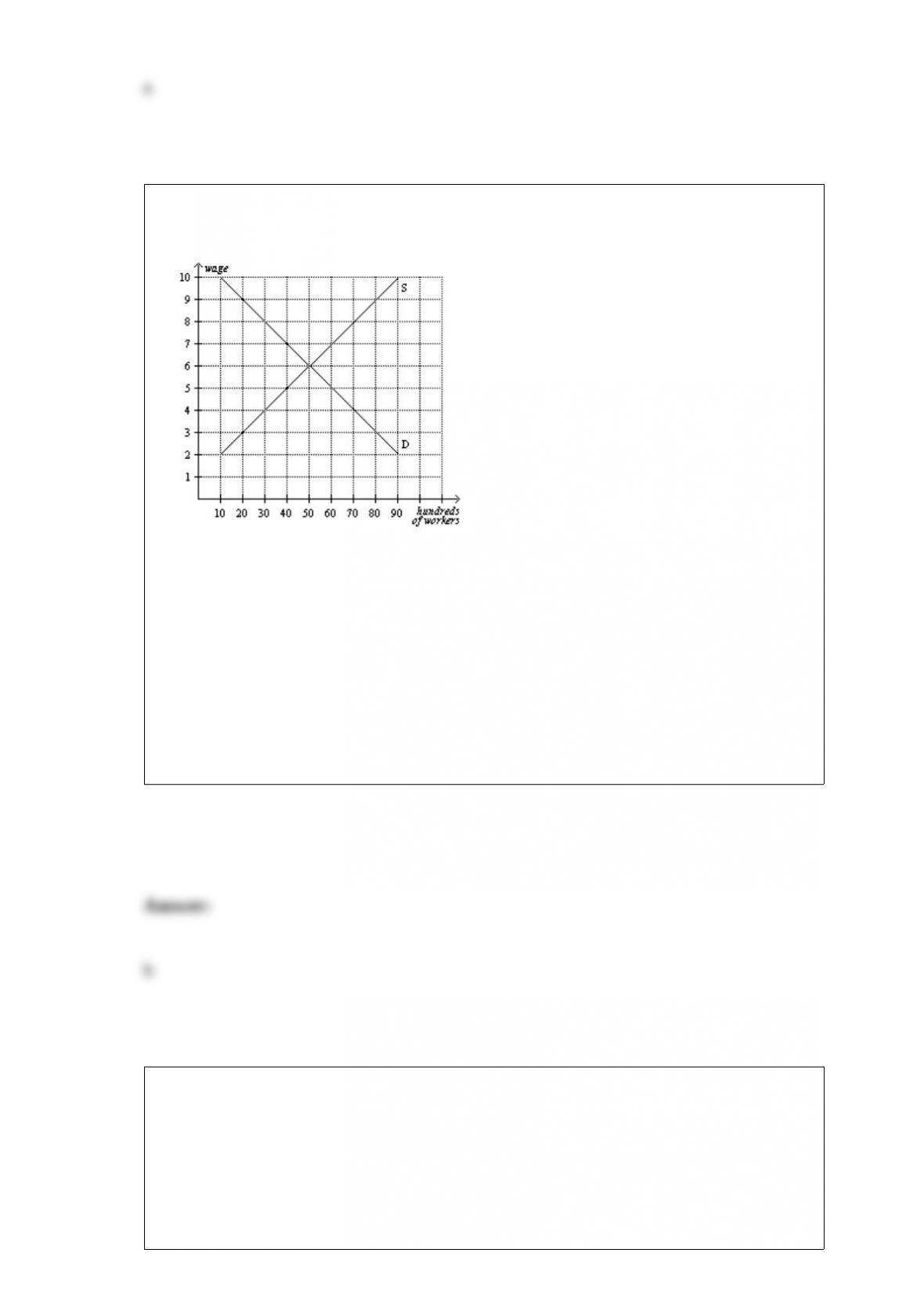
Figure 28-3
RefetoFigure28-3.If the government imposes a minimum wage of $8, then
employment will decrease by
a. 0 workers.
b. 2,000 workers.
c. 3,000 workers.
d. 4,000 workers.
In 1970, Professor Plum earned $12,000; in 1980, he earned $24,000; and in 1990, he
earned $36,000. If the CPI was 40 in 1970, 60 in 1980, and 100 in 1990, then in real
terms, Professor Plum’s salary was highest in
a. 1980 and lowest in 1970.
b. 1980 and lowest in 1990.

c. 1990 and lowest in 1970.
d. 1990 and lowest in 1980.
The money supply is 4,000, nominal GDP is 8,000, and real GDP is 2,000. Which of the
following is 2?
a. the price level and velocity.
b. the price level but not velocity.
c. velocity but not the price level.
d. neither the price level nor velocity.
Which of the following can banks use to borrow from the Federal Reserve?
a. the discount window or the term auction facility
b. the discount window but not the term auction facility
c. the term auction facility but not the discount window
d. Banks cannot borrow from the Federal Reserve, only the government can.

If the public correctly perceives that the central bank will reduce inflation, then
a. the short-run Phillips curve shifts right, and the sacrifice ratio will be higher.
b. the short-run Phillips curve shifts right, and the sacrifice ratio will be lower.
c. the short-run Phillips curve shifts left, and the sacrifice ratio will be higher.
d. the short-run Phillips curve shifts left, and the sacrifice ratio will be lower.
An increase in the MPC
a. increases the multiplier, so that changes in government expenditures have a larger
effect on aggregate demand.
b. increases the multiplier, so that changes in government expenditures have a smaller
effect on aggregate demand.
c. decreases the multiplier, so that changes in government expenditures have a larger
effect on aggregate demand.
d. decreases the multiplier, so that changes in government expenditures have a smaller
effect on aggregate demand.

Which of the following is an important cause of inflation in an economy?
a. increases in productivity in the economy
b. the influence of positive externalities on the economy
c. lack of property rights in the economy
d. growth in the quantity of money in the economy
In the 19th century, when crop failures often led to bank runs, banks would make
relatively fewer loans and hold relatively more excess reserves. By itself, these actions
by the banks should have
a. increased the money multiplier and the money supply.
b. decreased the money multiplier and increased the money supply.
c. increased the money multiplier and decreased the money supply.
d. decreased both the money multiplier and the money supply.
Suppose interest of 5% for two years can be earned on $1,000 saved today with no risk.
What is the leastamount a person would need to have a 50% chance of winning to be
willing to face a 50% chance of losing $1,000 today andbe considered risk averse?

a. $907.03 to be paid in two years
b. $1,000.01 to be paid in two years
c. $1,100.01 to be paid in two years
d. $1,102.51 to be paid in two years
Minimum-wage laws are leastlikely to affect the wages paid to
a. teenagers.
b. low-skill workers.
c. inexperienced workers.
d. highly-educated workers.
Figure 35-4. The left-hand graph shows a short-run aggregate-supply (SRAS) curve
and two aggregate-demand (AD) curves. On the left-hand diagram, the price level is
measured on the vertical axis; on the right-hand diagram, the inflation rate is measured
on the vertical axis.
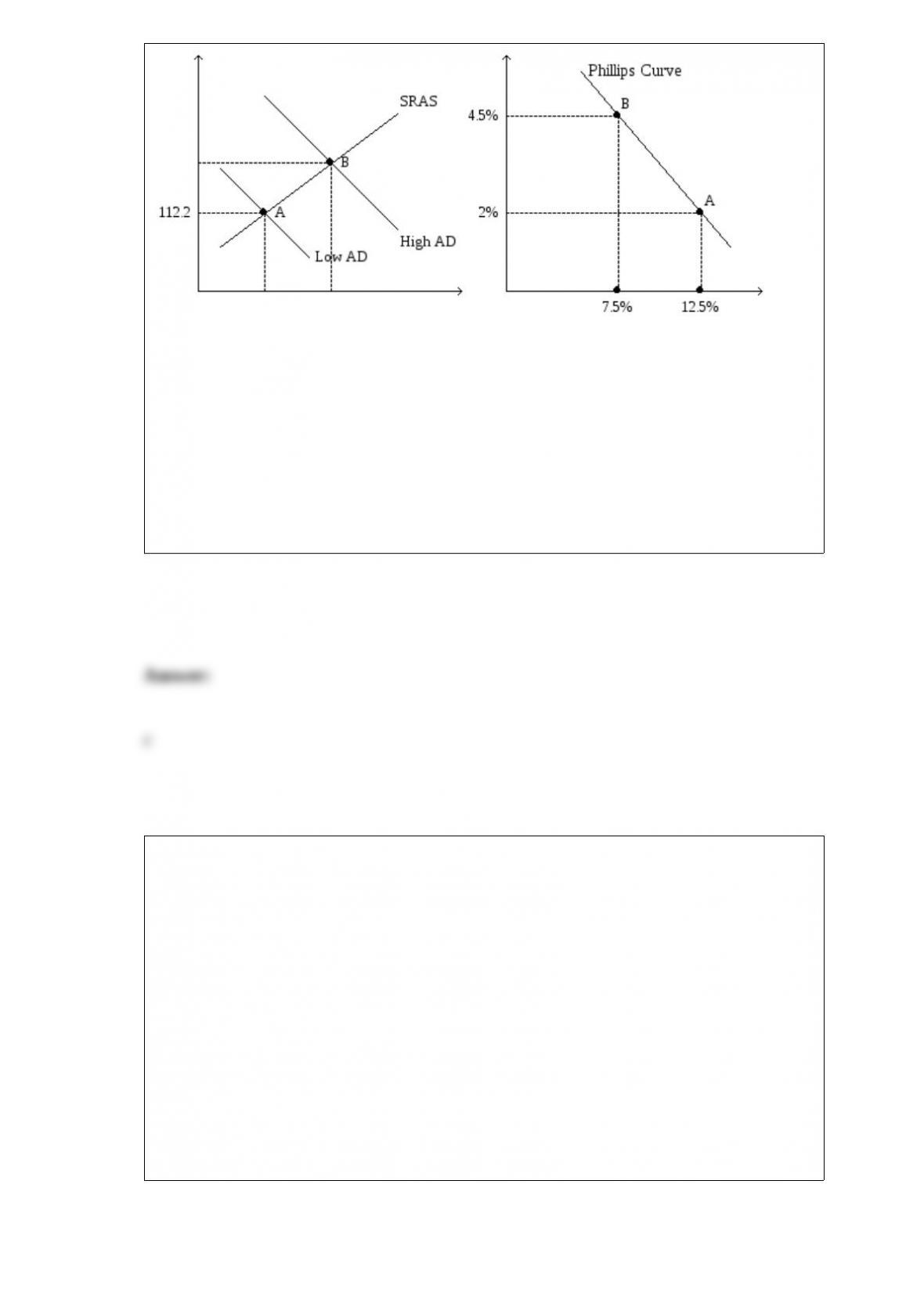
RefertoFigure35-4.What is measured along the horizontal axis of the left-hand graph?
a. the wage rate
b. the inflation rate
c. output
d. the interest rate
A worker in Vietnam can earn $6 per day making cotton cloth on a hand loom. A
worker in the United States can earn $85 per day making cotton cloth with a mechanical
loom. What is the likely explanation for the difference in wages?
a. U.S. textile workers belong to a union, whereas Vietnamese textile workers do not
belong to a union.
b. There is little demand for cotton cloth in Vietnam and great demand in the U.S.
c. Labor is more productive making cotton cloth with a mechanical loom than with a
hand loom.
d. Vietnam has a low-wage policy to make its textile industry more competitive in
world markets.
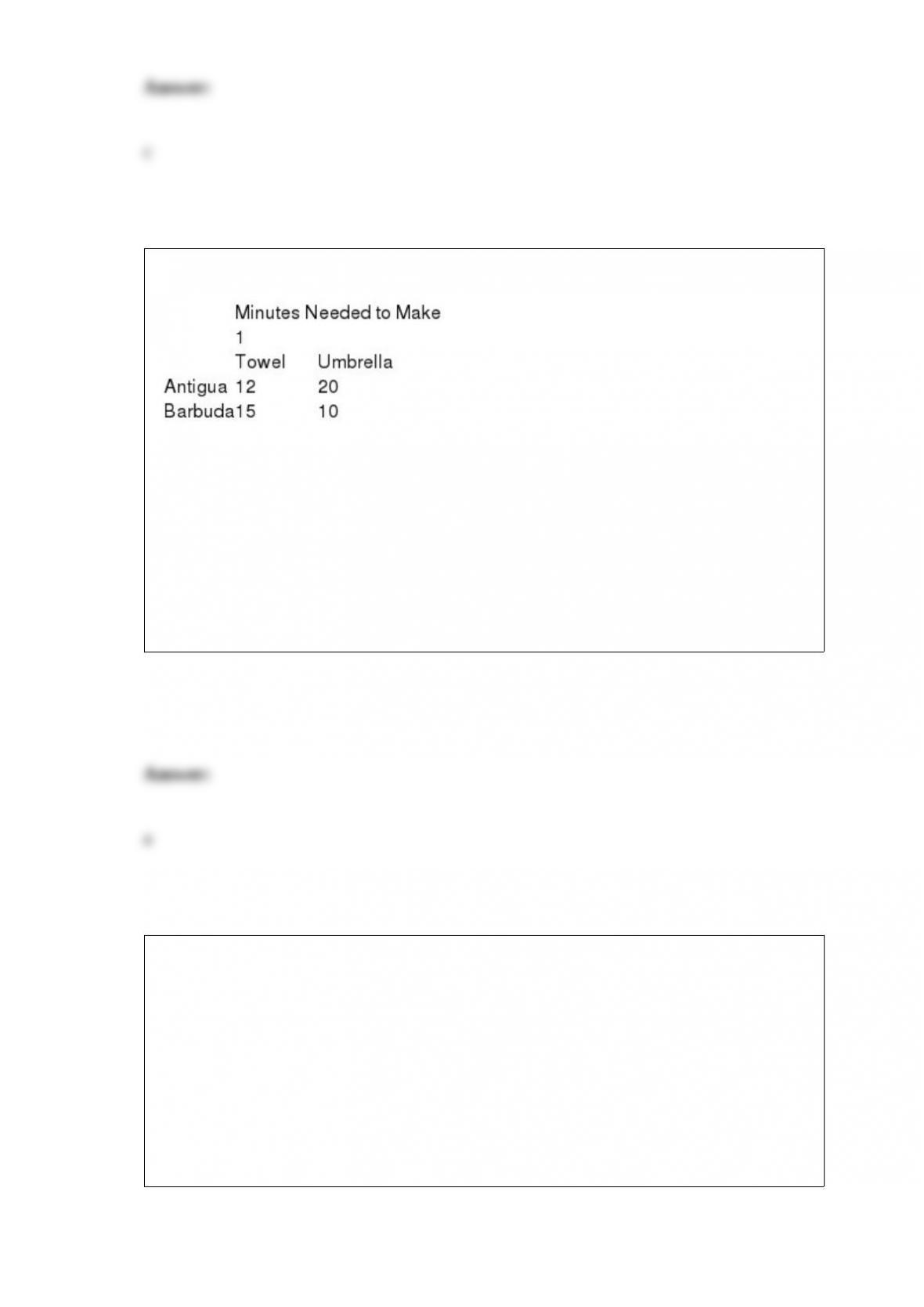
Table 3-36
RefertoTable3-36.Antigua has an absolute advantage in the production of
a. towels and Barbuda has an absolute advantage in the production of umbrellas.
b. umbrellas and Barbuda has an absolute advantage in the production of towels.
c. both goods and Barbuda has an absolute advantage in the production of neither good.
d. neither good and Barbuda has an absolute advantage in the production of both goods.
If the multiplier is 6 and if there is no crowding-out effect, then a $60 billion increase in
government expenditures causes aggregate demand to
a. increase by $250 billion.
b. increase by $333 billion.
c. increase by $360 billion.
d. None of the above are correct.

Which of these activities will most likely result in an external benefit?
a. A college student buys a deck of cards to play solitaire in her dorm room.
b. An elderly woman plants a flower garden on the vacant lot next to her house.
c. An executive purchases a book to read on a business trip.
d. A ten-year-old uses his allowance to buy new Nike shoes.
The Fed’s control of the money supply is not precise because
a. Congress can also make changes to the money supply.
b. there are not always government bonds available for purchase when the Fed wants to
perform open-market operations.
c. the Fed does not know where all U.S. currency is located.
d. the amount of money in the economy depends in part on the behavior of depositors
and bankers.

A relatively mild period of falling incomes and rising unemployment is called a(n)
a. depression.
b. recession.
c. expansion.
d. business cycle.
If the demand for loanable funds shifts to the right, then initially there is a
a. surplus so the interest rate will fall.
b. surplus so the interest rate will rise.
c. shortage so the interest rate will fall.
d. shortage so the interest rate will rise.
The Bureau of Labor Statistics counts a member of a surveyed household as an adult if
that person is at least
a. 14 years old.

b. 16 years old.
c. 18 years old.
d. 21 years old.
If the Fed buys bonds in the open market, the money supply decreases.
a. True
b. False
Figure 3-11
The graph below represents the various combinations of ham and cheese (in pounds)
that the nation of Bonovia could produce in a given month.
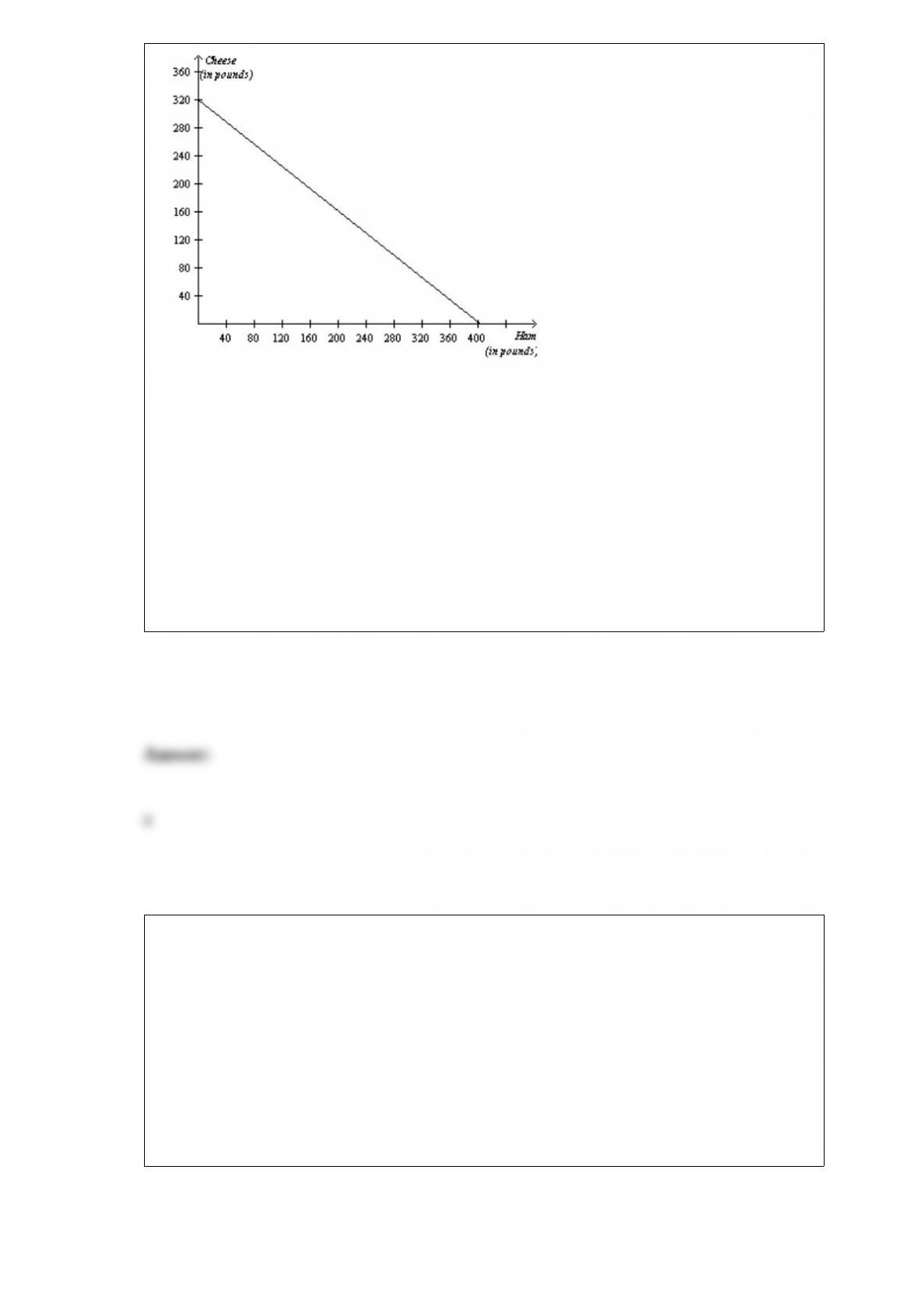
Refer to Figure3-11. If the production possibilities frontier shown is for 240 hours of
production, then which of the following combinations of ham and cheese could
Bonovia produce in 240 hours?
a. 225 pounds of ham and 140 pounds of cheese
b. 280 pounds of ham and 100 pounds of cheese
c. 355 pounds of ham and 80 pounds of cheese
d. 330 pounds of ham and 60 pounds of cheese
Other things the same, which of the following would shift the supply of dollars in the
market for foreign exchange to the right?
a. foreigners want to buy more U.S. bonds
b. foreigners want to buy fewer U.S. bonds
c. foreigners want to buy more U.S. goods and services.
d. foreigners want to buy fewer U.S. goods and services.

Explain why the demand for loanable funds slopes downward and why the supply of
loanable funds slopes upward.
The nominal exchange rate is 3 Malaysian ringgits per dollar. The real exchange rate is
8/5. If a Big Mac costs 7.5 ringgits in Malaysia, how much does a Big Mac cost in the
U.S.? Show your work.
Explain how government policies that redistribute income from the rich to the poor
might reduce efficiency.

Do economists believe that labor unions are good or bad for the U.S. economy?
In the market for foreign-currency exchange, the source of the supply of dollars is
_________. The supply curve is _________ because _____________.
What does the natural-rate hypothesis claim?
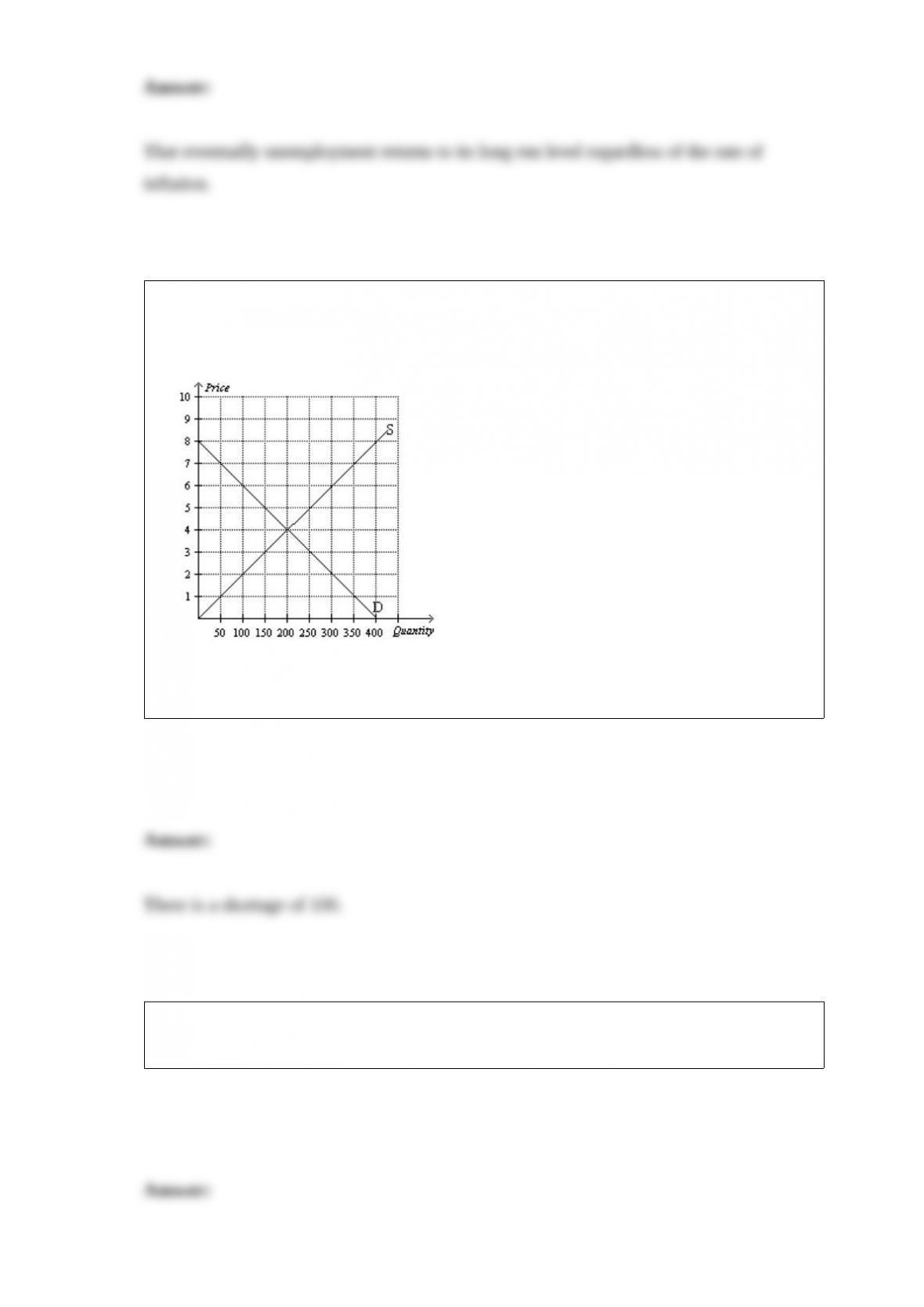
Figure 4-31
Consider the market for 2-packs of light bulbs below.
RefertoFigure4-31.At a price of $3, is there a shortage or surplus, and how large is the
shortage/surplus?
If the price level this year was 140 and was 135 last year, what was the inflation rate to
the nearest decimal?
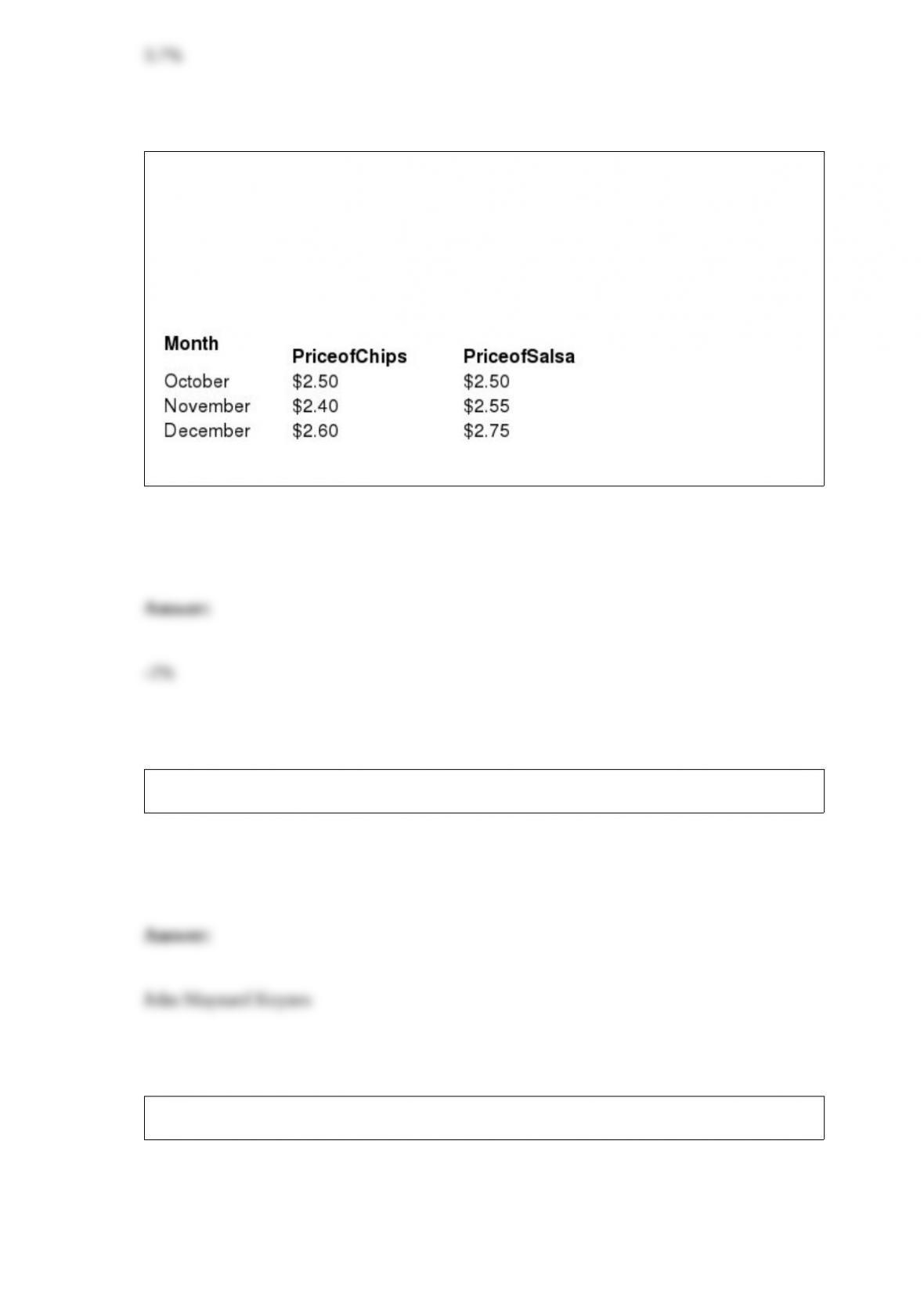
Table 24-15
The table below lists the prices of chips and salsa for the months of October, November,
and December. Assume that the typical consumer buys 8 bags of chips and 4 jars of
salsa each month, and that October is the base period.
RefertoTable24-15. Calculate the inflation rate for November.
Who wrote the 1936 book titled TheGeneralTheoryofEmployment,Interest,andMoney?
Calculate the inflation rate for a country where the GDP deflator rises from 120 to 165.

Depositors Move Funds out of Greek Banks.
In 2011 Greek citizens were concerned about the size of government debt. Fearful that
the government might be unable to fulfill its promise to insure depositors in Greek
banks against losses created by bank failures, depositors moved funds out of Greek
banks.
RefertoDepositorsMoveFunds outofGreekBanks.Because of depositors reactions
what happened to net capital outflow?
Why does a downward-sloping Phillips curve imply a positive sacrifice ratio?
A bank operates with reserves of $100, loans of $300 and securities of $100. The bank’s
only liability is deposits of $400 since it has zero debt. Calculate the bank’s leverage
ratio.

What does a production possibilities frontier represent?