
When an industry’s raw material costs increase, other things remaining the same,
A) the supply curve shifts to the left.
B) the supply curve shifts to the right.
C) output increases regardless of the market price and the supply curve shifts upward.
D) output decreases and the market price also decreases.
After graduation, you start an internet-based firm that allows people to buy and sell
books online. Based on your market research, you believe there are two basic types of
customers. The first type is the casual reader who has relatively low willingness-to-pay
for your services, and their annual demand is
Q1 = 30 – 40P where Q1 is the number of books traded per year and P is the price you
charge per book traded. The second type of customer is the avid reader who has
relatively high willingness-to-pay for your services, and their demand is Q2 = 100 –
50P. The marginal cost of your online service is $0.40 per book traded.
a. If you set your usage fee equal to the marginal cost, how many books will each type
of customer trade on your system? What is the consumer surplus enjoyed by each type
of customer?
b. What is the optimal entry fee that you should charge under a two-part tariff pricing
scheme for access to your online market? How much consumer surplus is left for the
two types of customers after they pay the entry fee and usage fee?
A few sellers may behave as if they operate in a perfectly competitive market if the
market demand is:
A) highly inelastic.
B) very elastic.
C) unitary elastic.
D) composed of many small buyers.
Why can’t two firms in a Prisoners’ Dilemma enforce a better outcome that has higher
payoffs?
A) Under an outcome with higher payoffs, the outcome is not a Nash equilibrium and
each firm has an incentive to change their actions.
B) Barriers to entry
C) Barriers to exit
D) The Nash equilibrium in a Prisoners’ Dilemma has the highest possible payoffs for
both firms.
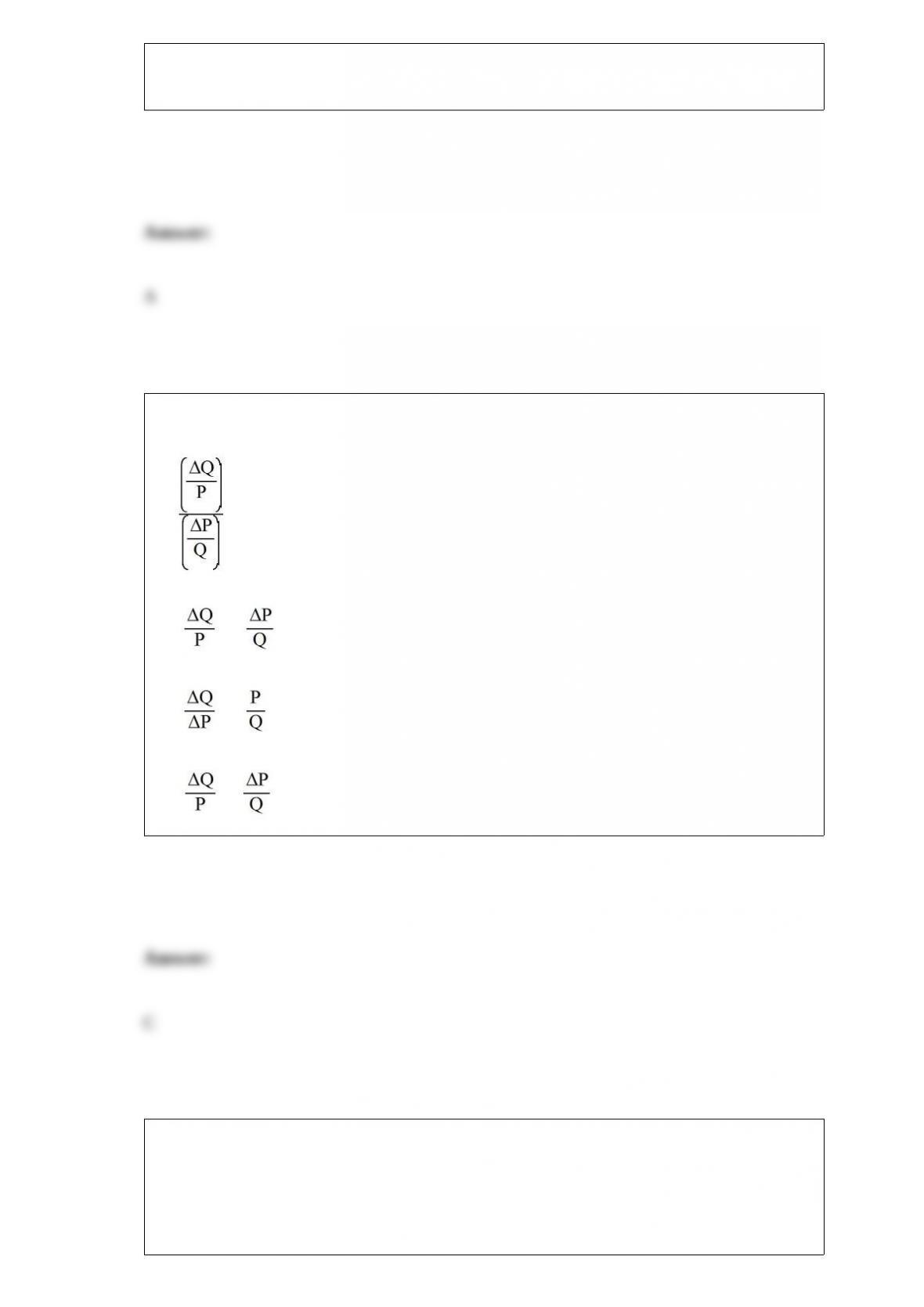
Which of the following represents the price elasticity of demand?
A)
B) ( ) + ( )
C) ( ) × ( )
D) ( ) – ( )
To avoid the stock versus flow issue in production, some economists discuss capital
usage in terms of rented capital. For example, your firm may not directly own some of
the capital inputs to your production operation, and these capital inputs are employed
on an hourly or daily basis. Which of the following inputs is a good example of a
capital input that acts like a flow?

A) Land and buildings that are owned by the firm
B) A long-term licensing agreements that allow you to use a patented idea owned by
another firm
C) A forklift that is rented on an hourly basis
D) all of the above
Which of the following are examples of situations in which the standard model of the
consumer may not be realistic?
A) Impulse purchases
B) Following fads and fashions instead of one’s own preferences
C) Addictions or other strong habits in consumption
D) all of the above
Use the following statements to answer this question:
I. When the market price is held above the competitive price level, it is possible for the
loss in consumer surplus to be fully captured by producers.
II. When the market price is held above the competitive level, there is no deadweight
loss because producer gains exactly equal consumer losses.
A) I and II are true.
B) I is true and II is false.
C) II is true and I is false.
D) I and II are false.
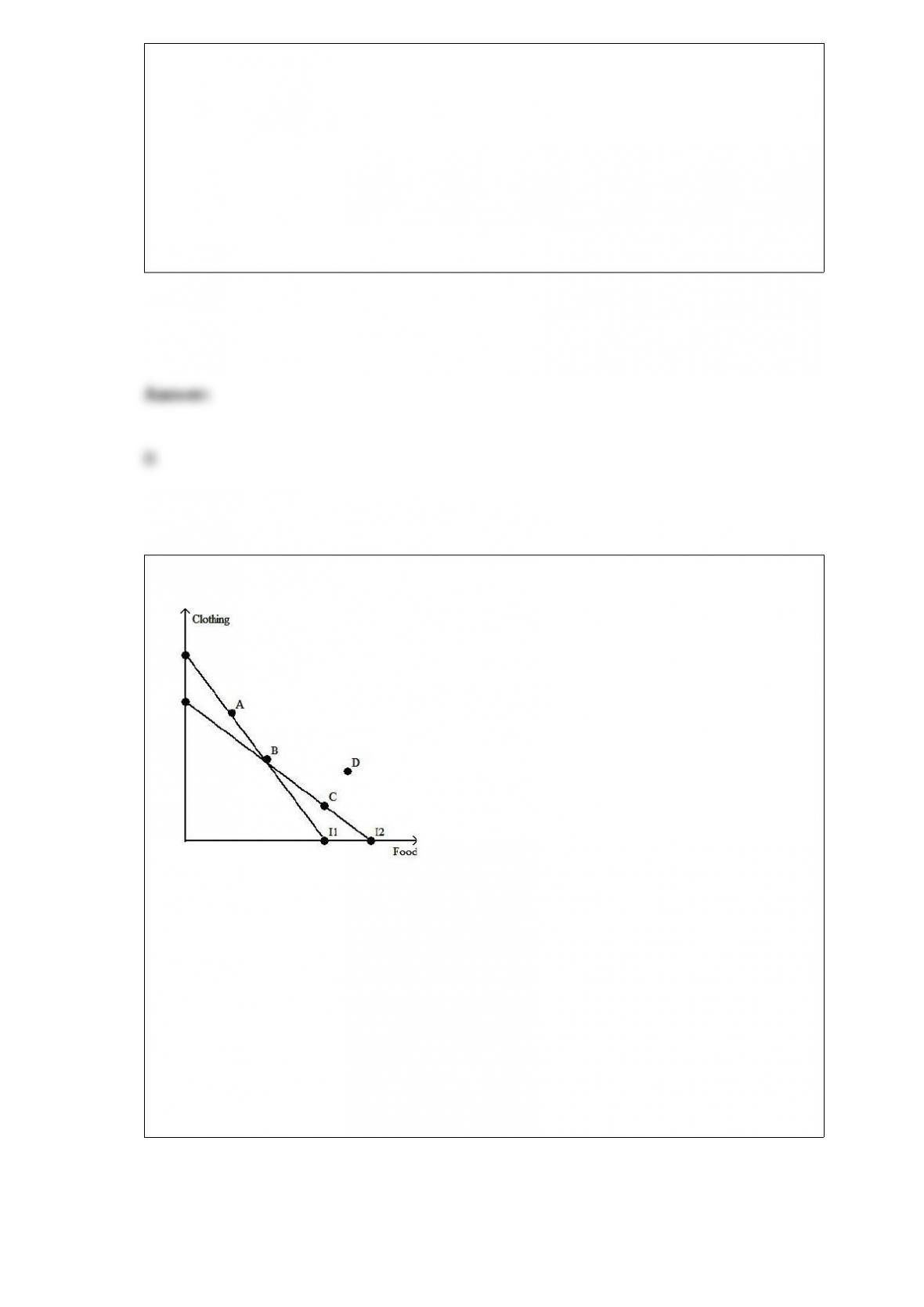
Please consider the following figure:
The consumer chooses A on budget line I1 and B on budget line I2. Which of the
following statements is NOT true?
A) A is preferred to B.
B) B is preferred to C.
C) C is preferred to D.
D) A is preferred to C.

Suppose the supply of non-OPEC oil increases due to new petroleum discoveries in
other countries. What happens OPEC’s share of the world oil market?
A) Increases
B) Decreases
C) Remains the same
D) We do not have enough information to answer this question.
The authors explain that the international copper cartel (CIPEC) has been largely
ineffective in raising the price of copper in world markets, and the reason is mainly due
to the relatively elastic demand for copper. Suppose the cartel recognized that there are
multiple uses for copper, and some of the uses have few substitute products (e.g.,
copper electrical wire) while others have several close substitutes (e.g., copper water
pipes). To increase profits, the cartel could raise the price of copper in the sub-markets
with relatively inelastic demand. What else would the cartel have to do in order to make
the cartel’s action effective?
A) The cartel would have to seek permission from the U.S. Department of Justice.
B) The cartel would have to get the cooperation of all other copper producers in order to
raise the price by some positive amount.
C) The cartel would have to find a way to keep the buyers in the low-price market from
reselling the copper to buyers in the high-price market.
D) none of the above
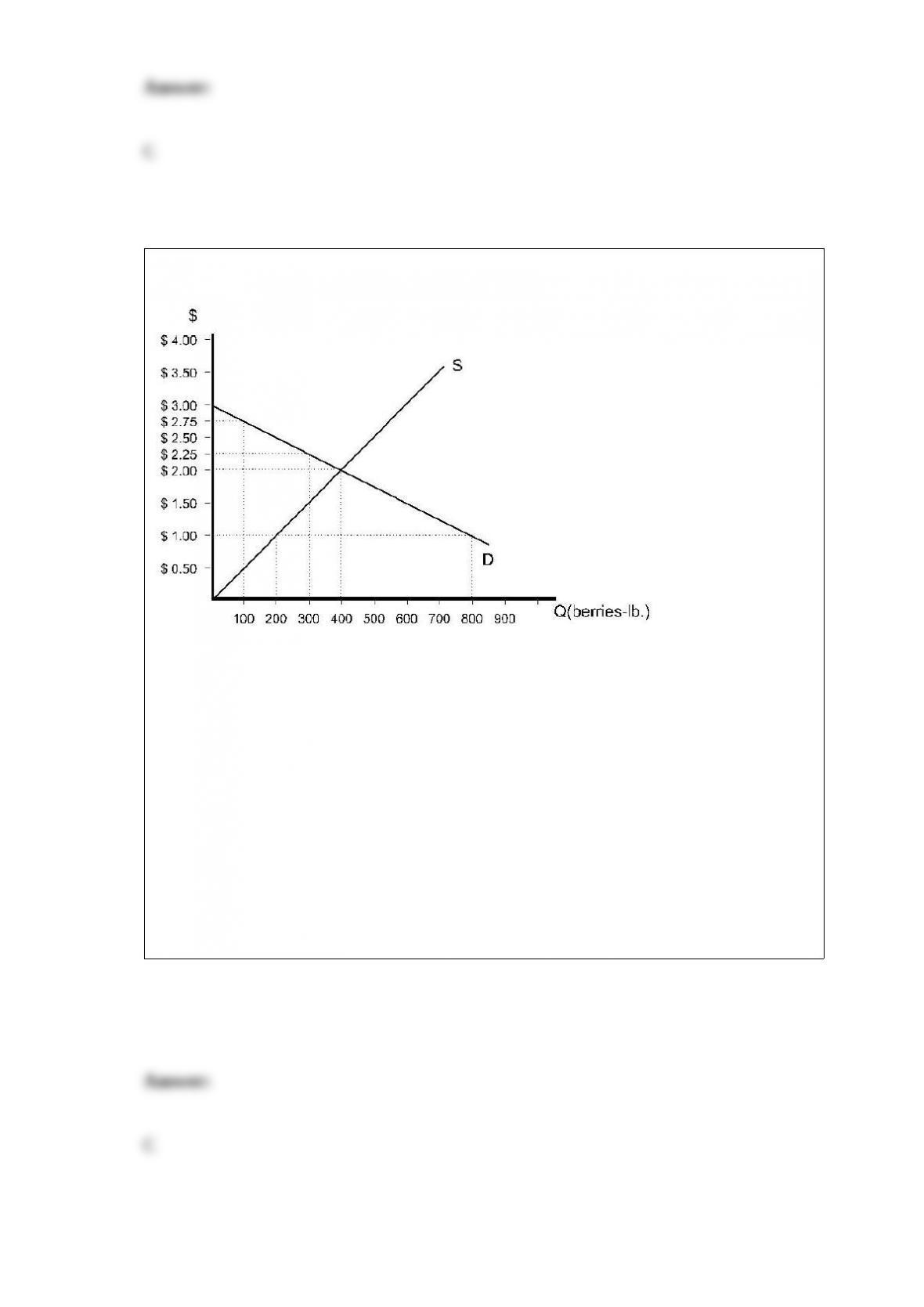
Figure 9.3
Refer to Figure 9.3. If the market is in equilibrium, the producer surplus earned by the
seller of the 100th unit is
A) $0.50.
B) $0.75.
C) $1.50.
D) $2.00.
E) $2.75.

Scenario 3:
Sam and Sally are the only consumers in an economy where tee shirts and candy are the
only commodities that are consumed. The marginal utility schedule for each appears
below.
Sam tee shirts MU(tee shirts) Candy MU(Candy)
1 10 1 6
2 9 2 5
3 8 3 4
4 7 4 5
5 6 5 4
Sally tee shirts MU(tee shirts) Candy MU(Candy)
1 24 1 12
2 19 2 9
3 18 3 8
4 14 4 7
5 10 5 3
There are 7 candies and 7 tee shirts total in the economy.
Consider the case when the goods are redistributed such that Sam has 4 tee shirts and 4
candies. Sally has 3 tee shirts and 3 candies.
What is Sally’s marginal rate of substitution of tee shirts for candy at the current
distribution?
A) 9/4.
B) 2
C) 4/9.
D) It is impossible to determine without the prices of each commodity.

The information in the table below describes choices for a new doctor. The outcomes
represent different macroeconomic environments, which the individual cannot predict.
Table 5.3
Refer to Table 5.3. Rank the doctor’s job choices in order, least risky first.
A) Work for HMO, open own practice, do research
B) Work for HMO, do research, open own practice
C) Do research, open own practice, work for HMO
D) Do research, work for HMO, open own practice
E) Open own practice, work for HMO, do research
The indifference curve between expected return and the standard deviation of return for
a risk-averse investor
A) is downward-sloping.
B) is upward-sloping.
C) is horizontal.
D) is vertical.
E) can take any shape.
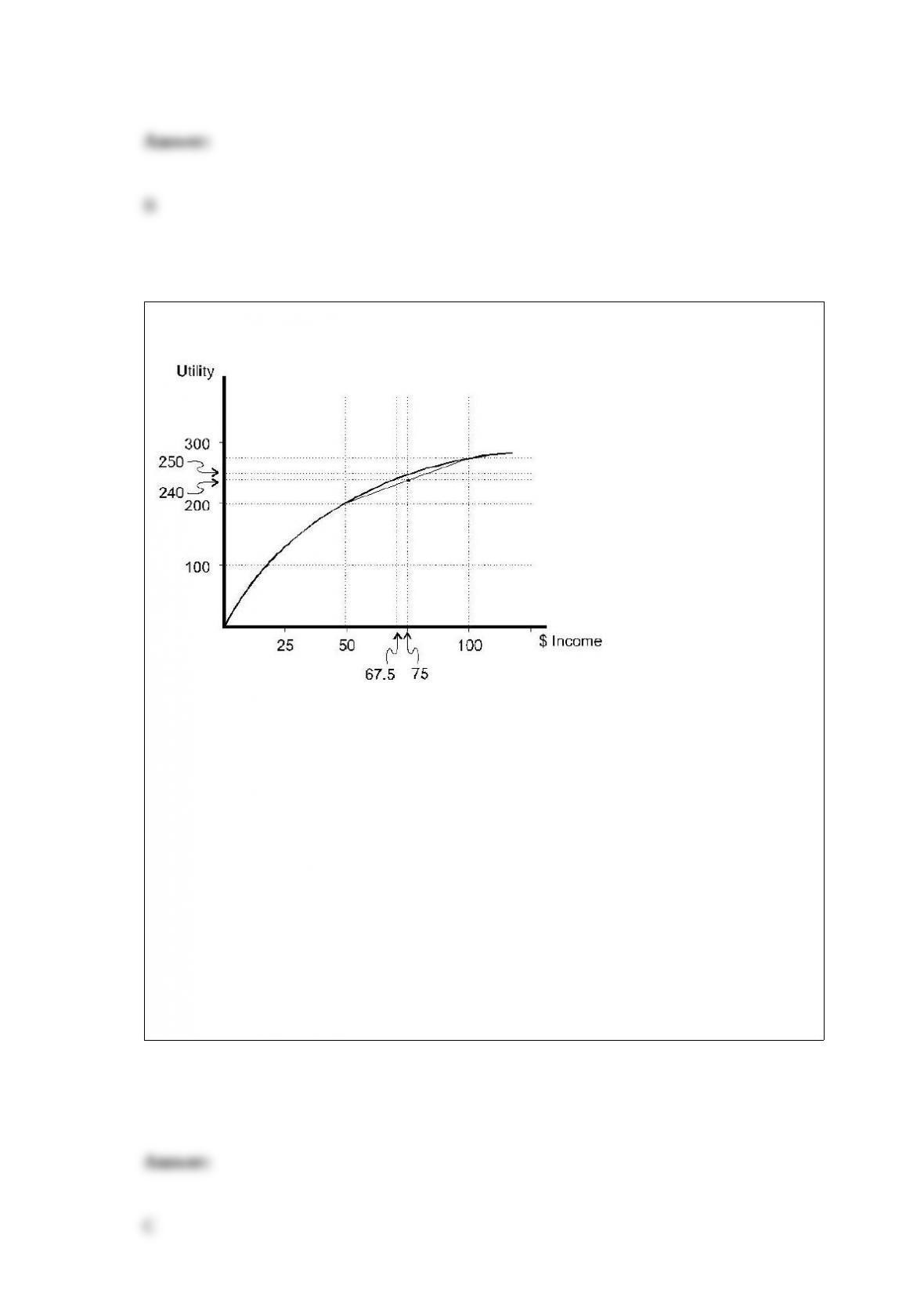
Figure 5.2
When facing a 50% chance of receiving $50 and a 50% chance of receiving $100, the
individual pictured in Figure 5.2
A) would pay a risk premium of 10 utils to avoid facing the two outcomes.
B) would want to be paid a risk premium of 10 utils to give up the opportunity of facing
the two outcomes.
C) would pay a risk premium of $7.50 to avoid facing the two outcomes.
D) would want to be paid a risk premium of $7.50 to avoid facing the two outcomes.
E) has a risk premium of 10 utils.
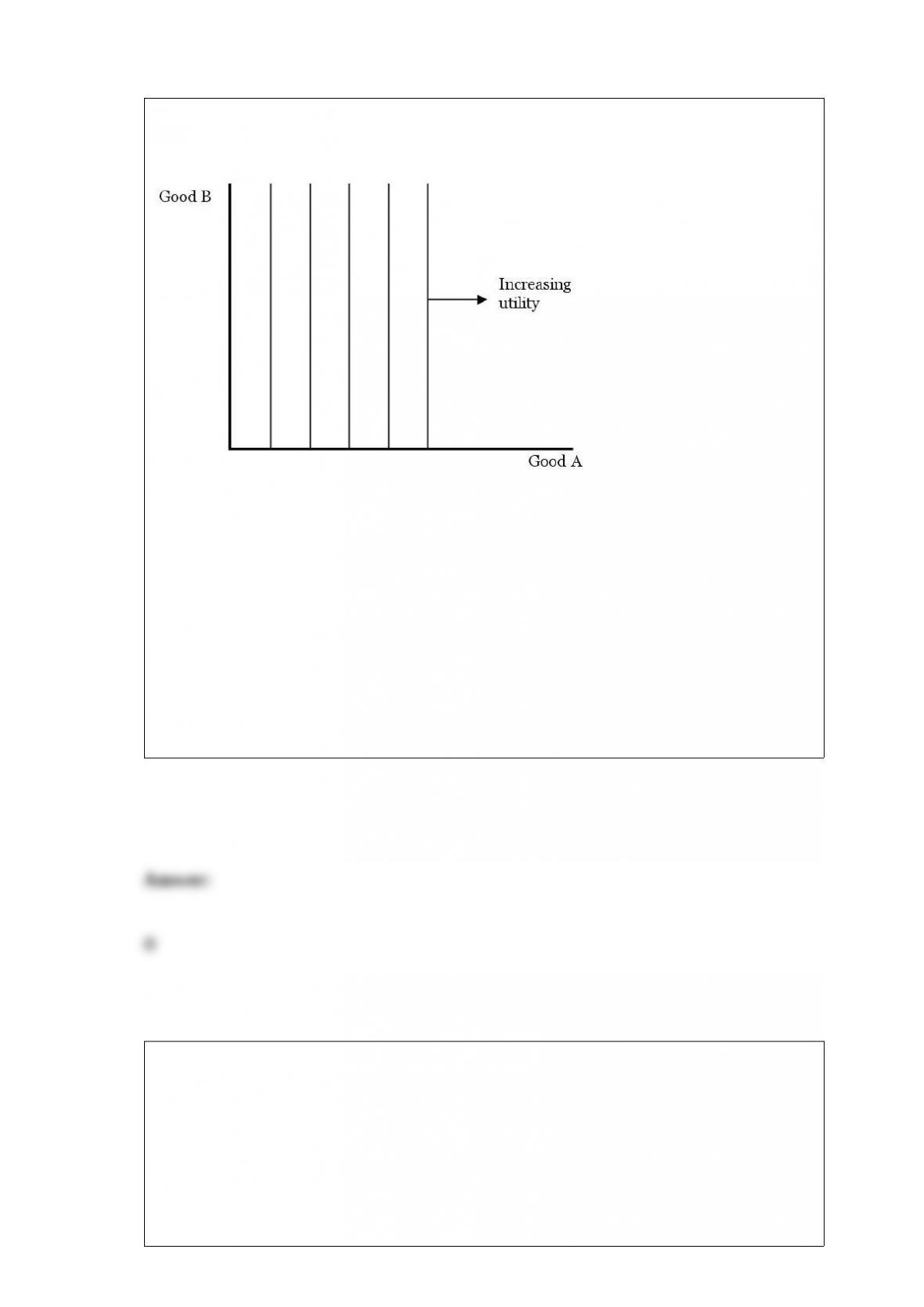
Figure 3.3
Refer to the indifference curve in Figure 3.3. Which of the following statements about
marginal utility (MU) is correct?
A) MU(A) = 0.
B) MU(B) = 0.
C) MU(A) is negative.
D) MU(B) is negative.
Firms that have several plants that produce the same or related products are said to be:
A) horizontally integrated.
B) vertically integrated.
C) conglomerates.

D) cooperatives.
The Matching Pennies game is an example of a:
A) constant-sum game.
B) nonconstant sum game.
C) game with an equilibrium in dominant strategies.
D) none of the above
This year, on advice from your sister, you bought tobacco company stock at $50/share.
During the year, you collected an $8 dividend, but due to the company’s losses in
medical lawsuits its stock fell to $40/share. At this point, you sell, realizing a
A) dividend yield of -16% and a capital loss of 20%.
B) dividend yield of 16% and a capital loss of 20%.
C) dividend loss 10%.
D) capital loss of 10%.
E) total loss of 20%.

Plants, trees, and soils naturally emit carbon dioxide (CO2) that enters the atmosphere.
To form a benchmark level for this greenhouse gas, we can determine the amount of
CO2 that would end up in the atmosphere if there were no human activity on the planet.
Suppose naturally occurring CO2 emissions are 5 million tons per year, the social
discount rate is 5%, and the stock dissipation rate is 2%. What is the eventual level of
CO2 in the atmosphere if these natural emissions continue at this rate forever?
A) 100 million tons
B) 250 million tons
C) 25 million tons
D) We do not have enough information to answer this question.
The Acme Oil Company is a vertically integrated firm. It explores for and extracts
crude oil. It also refines the crude oil into gasoline and other products, and sells these
products to consumers. There are many other firms that extract and sell crude oil so that
the market for crude oil is regarded by Acme Oil as competitive. The internal price that
Acme Oil uses when the crude oil that it extracts is ‘sold” to one of its refineries:
A) equals the market price for crude oil.
B) equals the market price for crude oil less a discount because Acme Oil does not to
profit from itself.
C) is unrelated to the market price of crude oil.
D) is greater than the marginal cost of extracting crude oil.
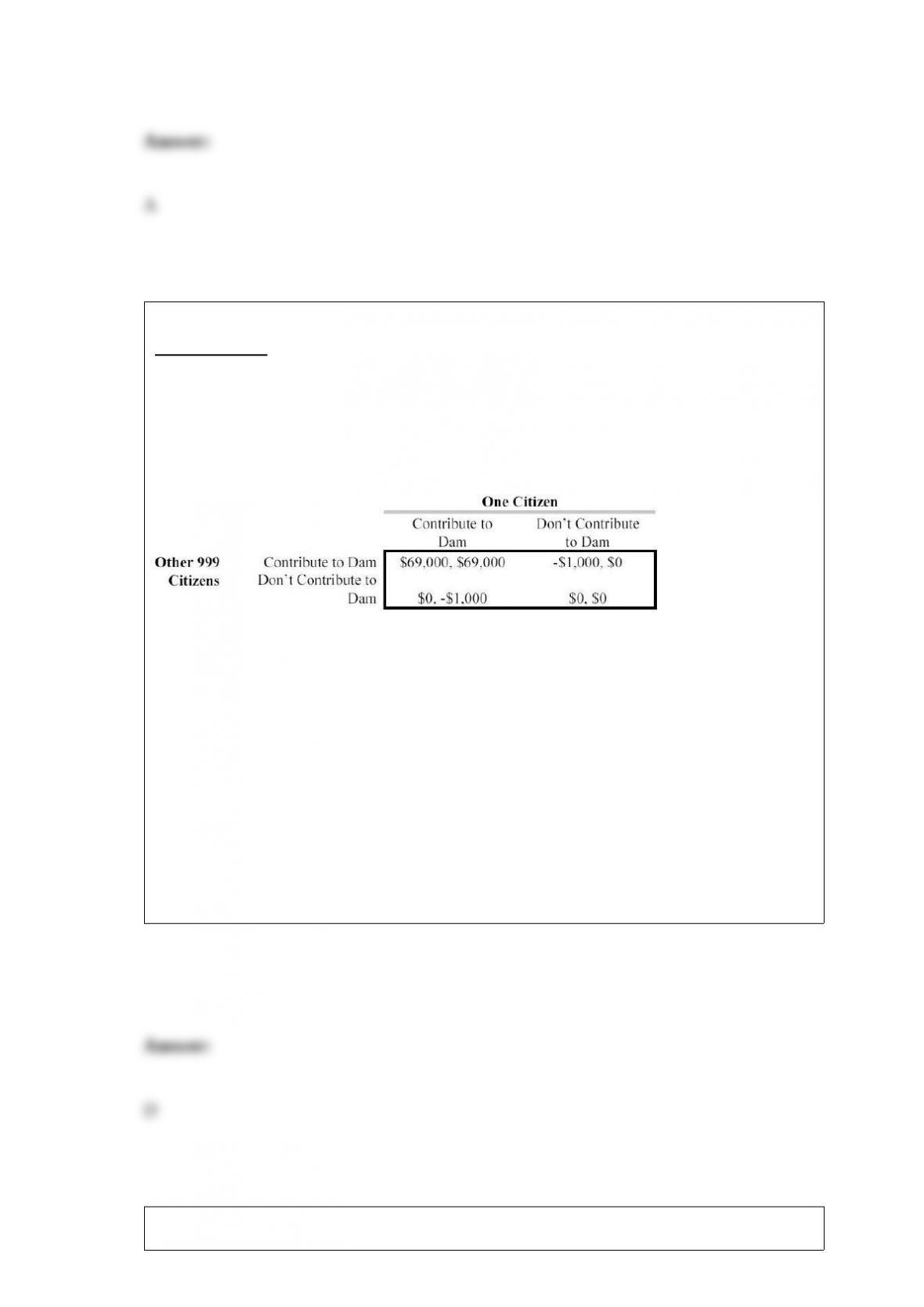
Scenario 13.7:
Consider the game below about funding and construction of a dam to protect a
1,000-person town. Contributions to the Dam Fund, once made, cannot be recovered,
and all citizens must contribute $1,000 to the dam in order for it to be built. The dam, if
built, is worth $70,000 to each citizen.
Refer to the game in Scenario 13.7. If each player chose a maximin strategy, the
outcome would be
A) $69,000, $69,000.
B) $0, -$1000.
C) -$1000, $0.
D) $0, $0.
E) a mixed strategy equilibrium.
Blanca has her choice of either a certain income of $20,000 or a gamble with a 0.5

probability of $10,000 and a 0.5 probability of $30,000. The expected value of the
gamble:
A) is less than $20,000.
B) is $20,000.
C) is greater than $20,000.
D) cannot be determined with the information provided.
The variance of an investment opportunity:
A) cannot be negative.
B) has the same unit of measure as the variable from which it is derived.
C) is a measure of central tendency.
D) is unrelated to the standard deviation.
Travelers driving through Gotham City can use a freeway or the Cross Town Tollway to
get through the city. The tollway charges $1.00 per car during the morning rush hour
(6-9 AM) and the afternoon rush hour (4-7 PM), and the toll is $0.40 per car at all other
times. The weekly demand for using the tollway during rush hour is Q1 = 800 – 200P1
where quantity demanded is measured in thousands of cars, and the weekly demand for
the non-rush hour period is Q2 = 2000 – 1000P2. Gotham City’s marginal cost of
operating the tollway is MC = 0.02 + 001Q per car.
a. What are the marginal revenue curves associated with the two demand curves?
b. Has the city set the profit maximizing tolls for the Cross Town Tollway? If not, do
the current tolls generate too much or too little traffic on the tollway?
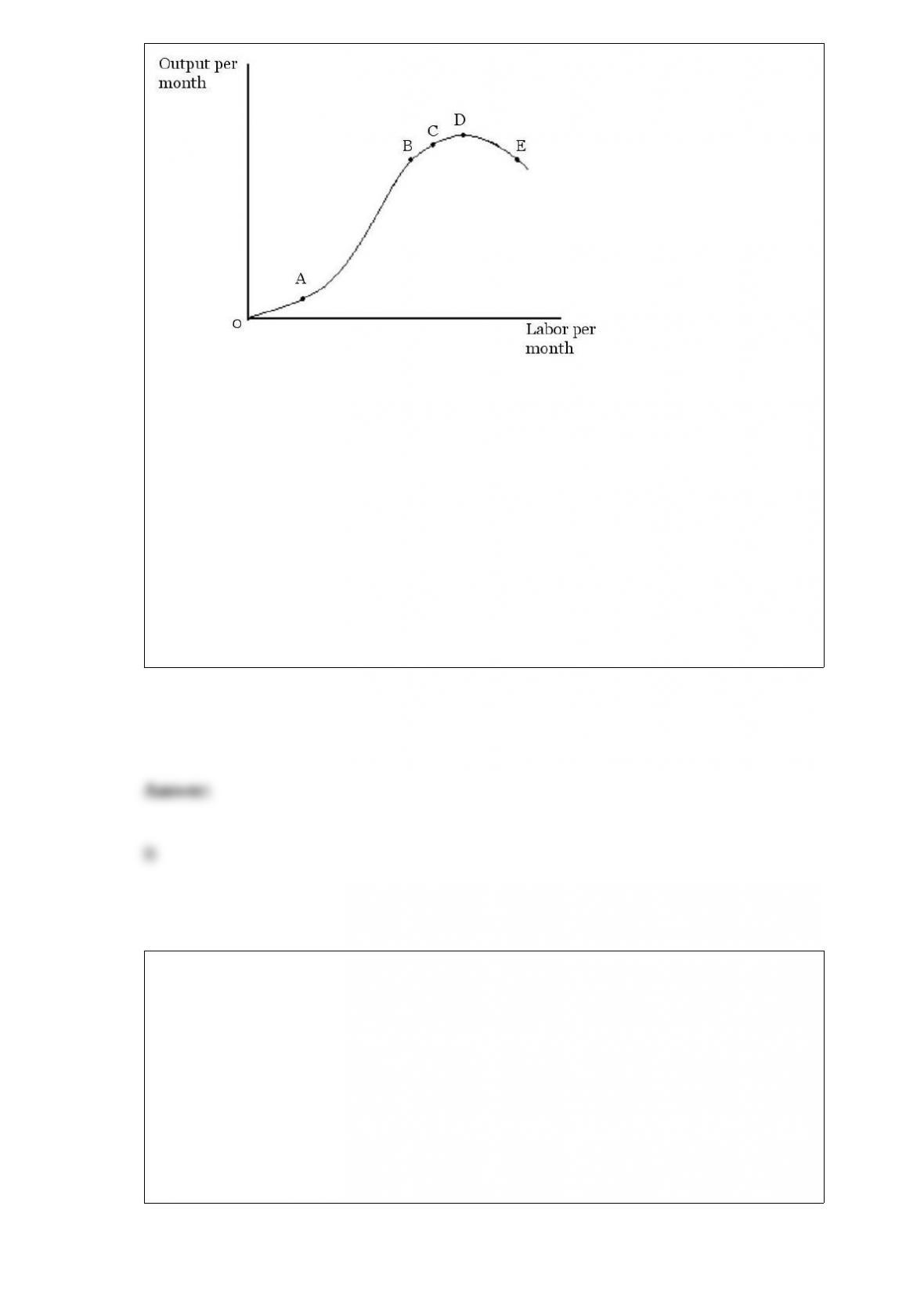
Figure 6.1
Refer to Figure 6.1. At point C
A) the marginal product of labor is greater than the average product of labor.
B) the average product of labor is greater than the marginal product of labor.
C) the marginal product of labor and the average product of labor are equal.
D) the marginal product of labor and the average product of labor are both increasing.
E) Both B and D are correct.
Under what circumstances will the economic rent earned by a factor of production
always be zero?
A) Infinitely inelastic supply curve
B) Infinitely elastic supply curve
C) Somewhat inelastic supply curve
D) Elastic demand curve

When a drug company develops a new drug it is granted a ________ making it illegal
for other firms to enter the market until the ________ expires.
A) franchise; franchise
B) copyright; copyright
C) government license; government license
D) patent; patent
A competitive firm sells its product at a price of $0.10 per unit. Its total and marginal
cost functions are:
TC = 5 – 0.5Q + 0.001Q2
MC = -0.5 + 0.002Q,
where TC is total cost ($) and Q is output rate (units per time period).
a. Determine the output rate that maximizes profit or minimizes losses in the shortterm.
b. If input prices increase and cause the cost functions to become
TC = 5 – 0.10Q + 0.002Q2
MC = -0.10 + 0.004Q,
what will the new equilibrium output rate be? Explain what happened to the profit
maximizing output rate when input prices were increased.
McDonald’s restaurant located near the high school offered a Tuesday special for high
school students. If high school students showed their student ID cards, they would be
given 50 cents off any medium combination meal. This practice is an example of:
A) collusion.
B) price discrimination.
C) two-part tariff.
D) bundling.
E) tying.

The European demand for access to satellite transmissions can be divided into three
groups: A, B, and C. The demand curves for the three groups are:
PA = 500 – 2QA (for Q < 250)
PB = 300 – QB (for Q < 300)
PC = 400 – 2QC (for Q < 200),
where Q = number of hours access per month, and P = price per hour. Satellite
transmission is a pure public good with zero marginal cost.
a. Explain the difference between horizontal and vertical summation of demand curves.
Derive the horizontally and vertically summed demand curves. Explain the
circumstances under which vertical summation is appropriate. When is horizontal
summation appropriate?
b. Determine the efficient quantity of satellite service. Explain the process of finding
the efficient quantity including a justification for the demand curve. What price is
optimal?

The change in the price of one good has no effect on the quantity demanded of another
good. These goods are:
A) complements.
B) substitutes.
C) both inferior.
D) both Giffen goods.
E) none of the above
Your income response for bicycle riding changes with the amount of income you earn.
At low levels of income, you view bicycle riding as an inferior good and substitute
other types of transportation (e.g., auto travel) as your income rises. However, you view
bicycle riding as a normal good after your income rises above a particular level. What
shape does your Engel curve for bicycle riding have?
A) Vertical line
B) Horizontal line
C) C-shaped
D) Upward sloping
E) none of the above