
1) Elasticity of resource demand is measured by dividing “percentage change in
resource price” by “percentage change in resource quantity.”
2) if the marginal cost curve lies below the average variable cost curve, the
average-variable-cost curve must be falling.
3) the business cycle is so named because upswings and downswings in business
activity are equal in terms of duration and intensity.
4) Logrolling can either increase or diminish economic efficiency.
5) central planning in the soviet union and pre-reform china emphasized the expansion
of the production of consumer goods to raise the domestic standard of living.
6) The user cost of a resource is the market price paid by the buyer of the resource.
7) Cost-benefit analysis is frequently difficult to apply because it is difficult to quantify
the full benefits of a public good or service.

8) products and services are scarce because resources are scarce.
9) if marginal utility is diminishing, total utility must also be declining.
10) The Consumer Product Safety Commission engages in social regulation, rather than
industrial regulation.
11) In 2007, approximately 5 percent of all work time lost was due to work stoppages.
12) the u.s. census bureau estimates that more than one million illegal immigrants enter
the united states each year.
13) the demand curve for a purely competitive industry is perfectly elastic, but the
demand curves faced by individual firms in such an industry are downsloping.
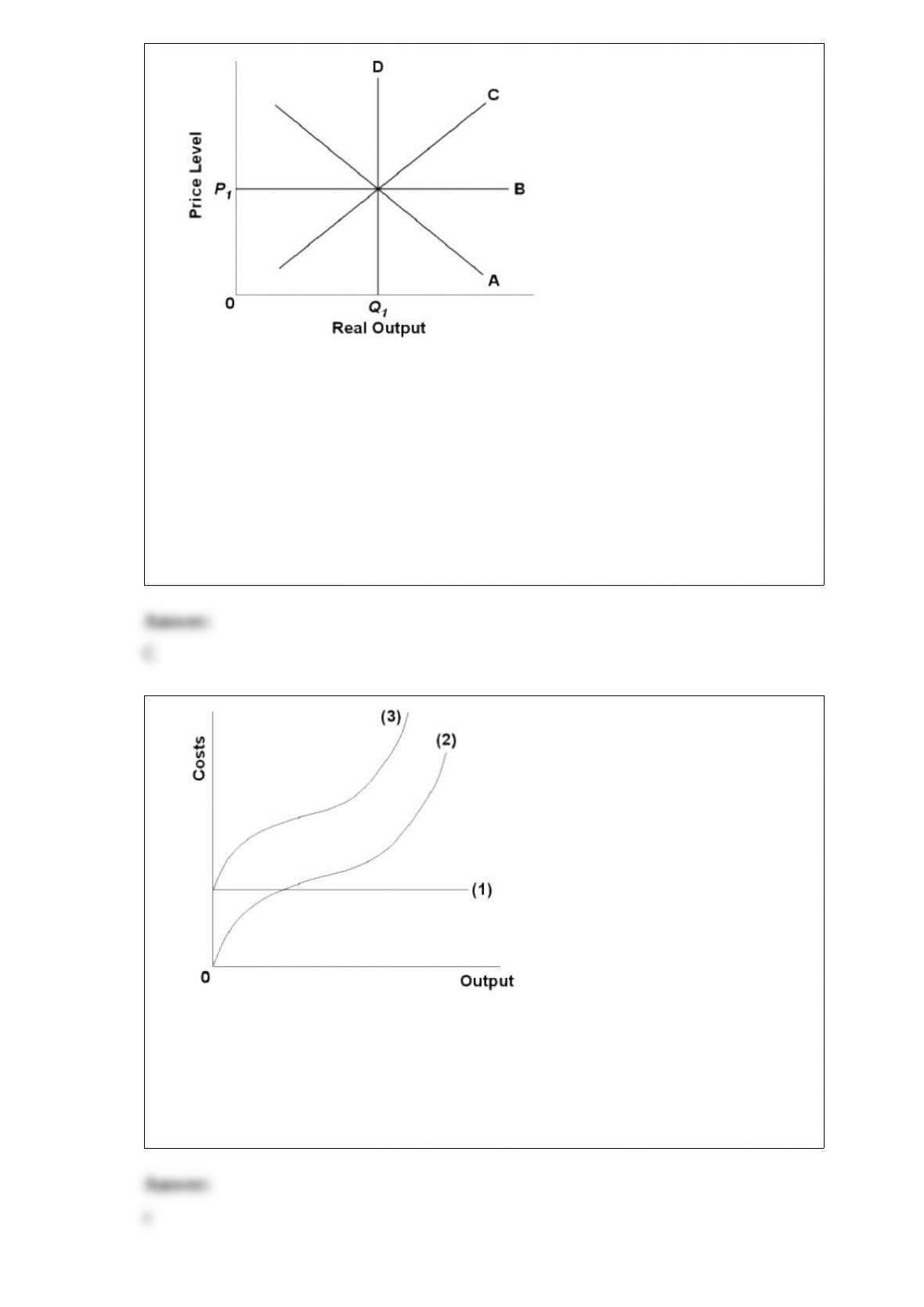
14)
Refer to the above diagram and assume that prices and wages are flexible both upward
and downward in the economy. In the extended AD-AS model:
A.demand-pull inflation would involve a rightward shift of curve A, followed by a
rightward shift of curve C
B.cost-push inflation would involve a rightward shift of curve A, followed by a leftward
shift of curve C
C.recession would involve a leftward shift of curve A, followed by a rightward shift of
curve C
D.recession would involve a rightward shift of curve D, followed by leftward shifts of
curves A and C
15)
in the above diagram curves 1, 2, and 3 represent:
a.average variable cost, marginal cost, and average fixed cost respectively.
b.total variable cost, total fixed cost, and total cost respectively.
c.total fixed cost, total variable cost, and total cost respectively.
d.marginal product, average variable cost, and average total cost respectively.

16) The difference between M1 and M2 is that:
A.the former includes time deposits.
B.the latter includes small time deposits, noncheckable savings accounts, money market
deposit accounts, and money market mutual fund balances.
C.the latter includes negotiable government bonds.
D.the latter includes cash held by commercial banks and the U.S. Treasury.
17) Some economists claim that unions reduce economic efficiency by:
A.providing a voice mechanism for workers.
B.insisting that promotions be based on ability rather than seniority.
C.imposing restrictions on the kinds of jobs workers may perform.
D.increasing worker turnover.
18) The world’s largest debtor nation in terms of debt owed to foreign citizens and
governments is:
A.Russia.
B.Argentina.
C.Japan.
D.The United States.
19) specialization-the division of labor-enhances productivity and efficiency by:
a.allowing workers to take advantage of existing differences in their abilities and skills.
b.avoiding the time loss involved in shifting from one production task to another.
c.allowing workers to develop skills by working on one, or a limited number, of tasks.
d.all of the means identified in the other answers.
20) which of the following is least likely to be considered economic immigration?
a.bob migrates to canada to improve his access to health care.
b.manuela migrates to the united states to open an authentic italian cooking school.
c.myklos migrates to switzerland because the public pension system is more generous
than in his home country.
d.alexander migrates to the united states because his political writings are censored in
his home country.
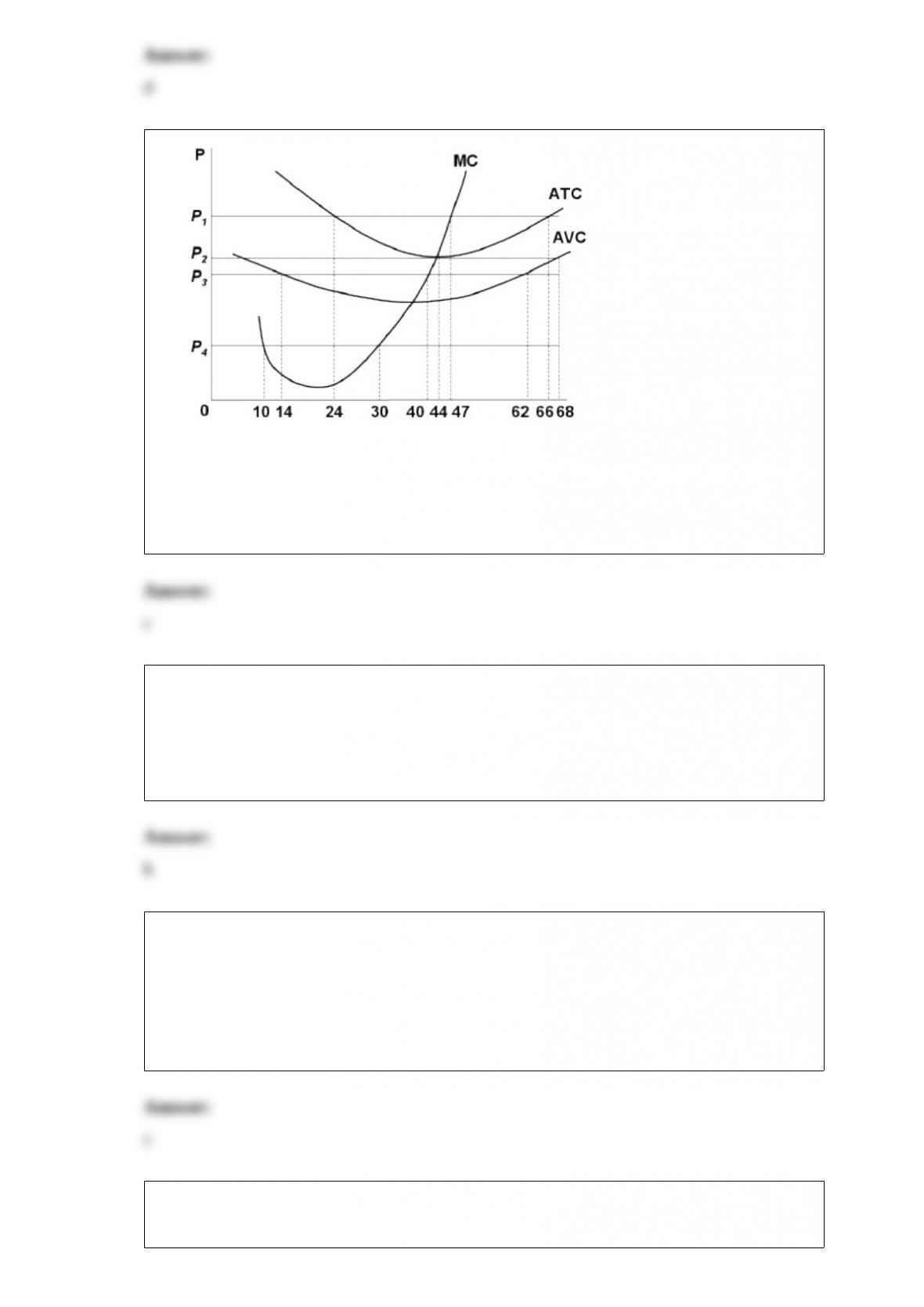
21)
refer to the above diagram. at p3, this firm will:
a.produce 14 units and realize an economic profit.
b.produce 62 units and earn only a normal profit.
c.produce 40 units and incur a loss.
d.shut down in the short run.
22) the supply of known monet paintings is:
a.perfectly elastic.
b.perfectly inelastic.
c.relatively elastic.
d.relatively inelastic.
23) the rationing function of prices refers to the:
a.tendency of supply and demand to shift in opposite directions.
b.fact that ration coupons are needed to alleviate wartime shortages of goods.
c.capacity of a competitive market to equate the quantity demanded and the quantity
supplied.
d.ability of the market system to generate an equitable distribution of income.
24) The following production possibilities data for Gamma and Sigma. All data are in
tons.
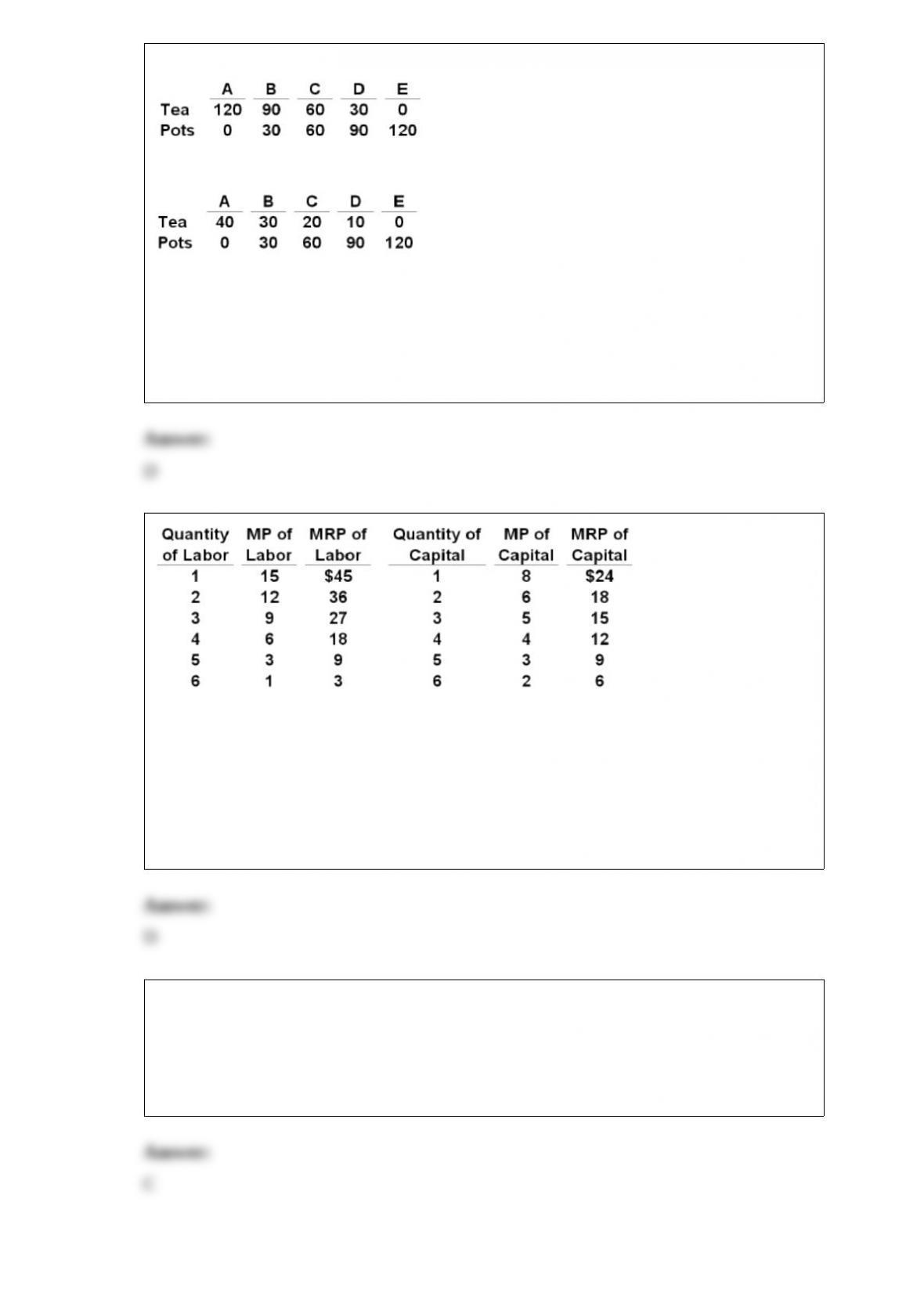
Gamma production possibilities:
Sigma production possibilities:
Refer to the above data. What are the limits of the terms of trade between Gamma and
Sigma?
A.1 tea = 2 pots to 1 tea = 6 pots
B.1 tea = 3 pots to 1 tea = 6 pots
C.1 tea = 2 pots to 1 tea = 3.5 pots
D.1 tea = 1 pot to 1 tea = 3 pots
25) Refer to the above
data. If the prices of labor and capital are $9 and $15 respectively, and labor and capital
are the only inputs, at the profit-maximizing level of output the firm’s total costs will
be:
A.$106.
B.$126.
C.$47.
D.$90.
26) Other things equal, an increase in the equilibrium interest rate will:
A.increase R&D spending.
B.rise when the supply of loanable funds increases.
C.decrease purchases of capital goods and reduce R&D spending.
D.increase bank lending.
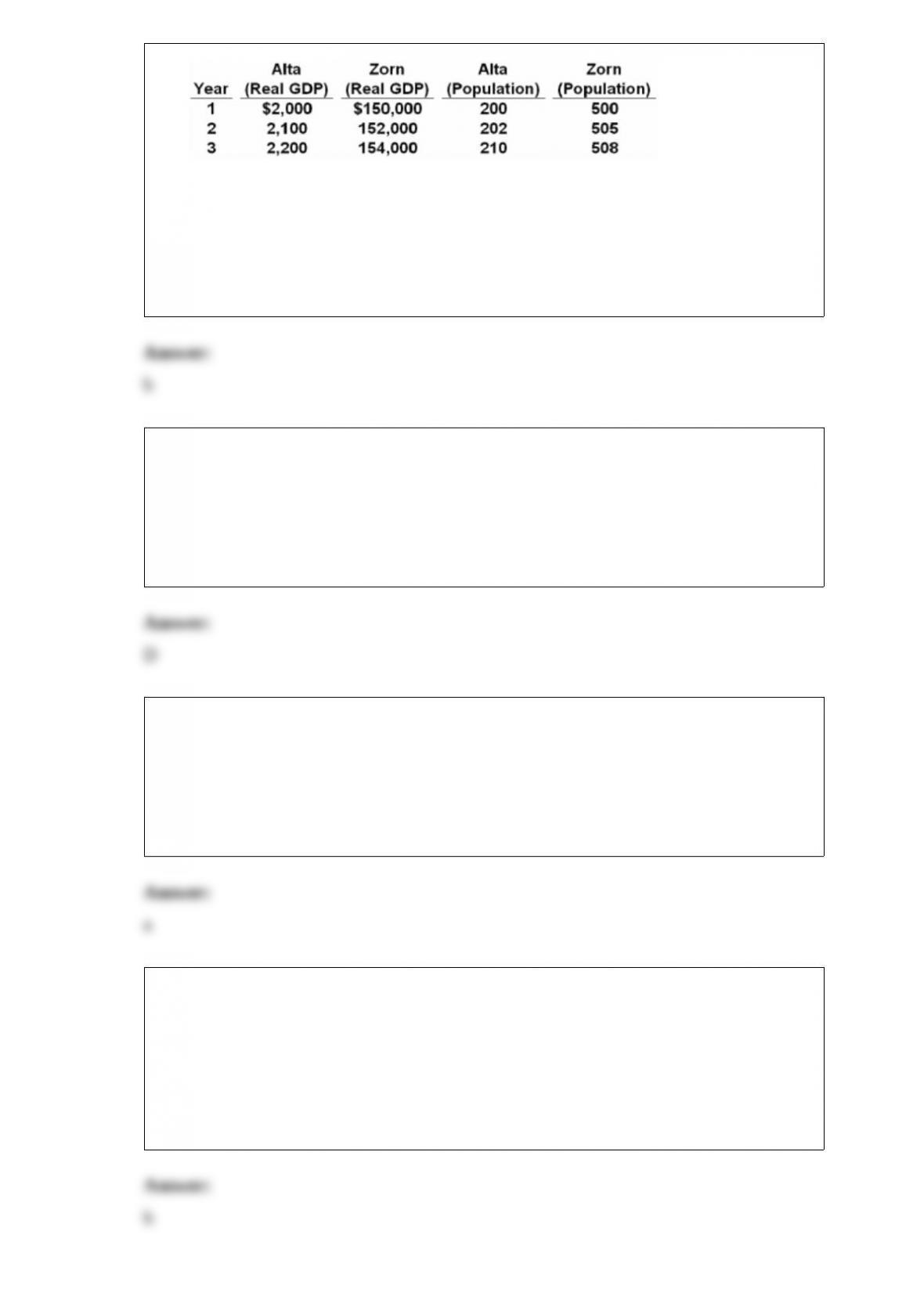
27)
refer to the above table. between years 1 and 2, real gdp per capita grew by __________
percent in alta:
a.3
b.4
c.5
d.10
28) A major function of the National Labor Relations Board is to:
A.monitor potentially inflationary increases in wages.
B.provide compulsory arbitration so that strikes and lockouts do not occur.
C.set annual wage increases on an industry-by-industry basis.
D.investigate and rule on charges of unfair labor practices by either management or
unions.
29) which of the following is not considered by economists to be an economic
resource?
a.money
b.factory workers
c.computers at a retail store
d.a forest
30) assume that a manufacturer of stereo speakers purchases $40 worth of components
for each speaker. the completed speaker sells for $70. the value added by the
manufacturer for each speaker is:
a.$110.
b.$30.
c.$40.
d.$70.
31) the medicare prescription drug, improvement, and modernization act of 2003:
a.created both a prescription drug benefit for medicare enrollees and health savings
accounts (hsas).
b.authorized the purchase of lower cost prescription medicine from canada and europe.
c.established limits on malpractice awards for “pain and suffering” cases relating to the
elderly.
d.provides prescription drugs to those over the age of 65 at no direct cost to the patient.
32)
refer to the above graph of the market for asparagus. at the market price of $2, area a
represents:
a.total consumer utility.
b.total revenue to sellers.
c.consumer surplus.
d.economic profit.
33)
refer to the above diagram. if this is a competitive market, price and quantity will move
toward:
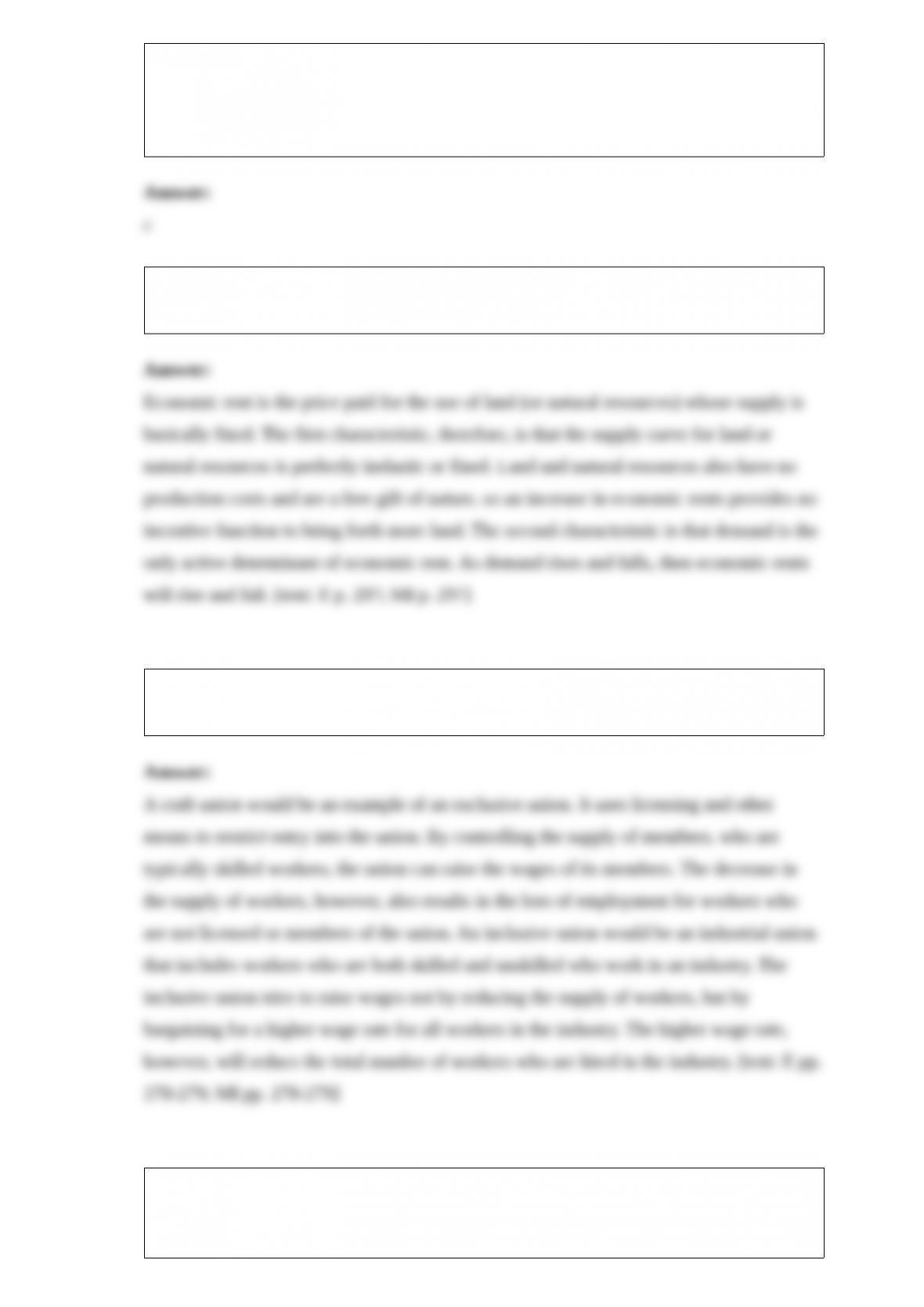
a.$60 and 100 respectively.
b.$60 and 200 respectively.
c.$40 and 150 respectively.
d.$20 and 150 respectively.
34) What determines the economic rent for land? Explain from a supply and demand
perspective.
35) What is the difference between an exclusive union and an inclusive union? What
are the economic effects of each type?
36) How do profit incentives and property rights affect the management of a renewable
resource such as a forest? Why do some nations have growing or sustainable forests and
other nations experience deforestation?
37) What are the two types of demand that make up total demand for money?
38) Define the full-employment or natural rate of unemployment and give its
approximate percentage rate as economists currently define it.
39) Evaluate the statement that unexpected declines in demand, with inflexible prices,
generate a rise in unemployment and a fall in output.
40) Why is the monopolistic competitors demand curve more elastic than a pure
monopolists, but less elastic than a pure competitors? What factors determine the price
elasticity of demand for a monopolistic competitor?
41) Why would illegal immigration have an effect on the prices of goods and services
produced by illegal workers? Who benefits from these lower product and service
prices?
42) Explain the difference between real and nominal income. How can you get an
approximation of the percentage change in real income from one time period to
another?
43) Use aggregate supply and demand analysis to explain real business cycle theory.