Cash flows from a firm’s normal business activities are reflected in:
a. cash flows from investing.
b. cash flows from financing.
c. cash flows from operations.
d. cash flows from income.
e. cash flows from budgeting.
Answer:
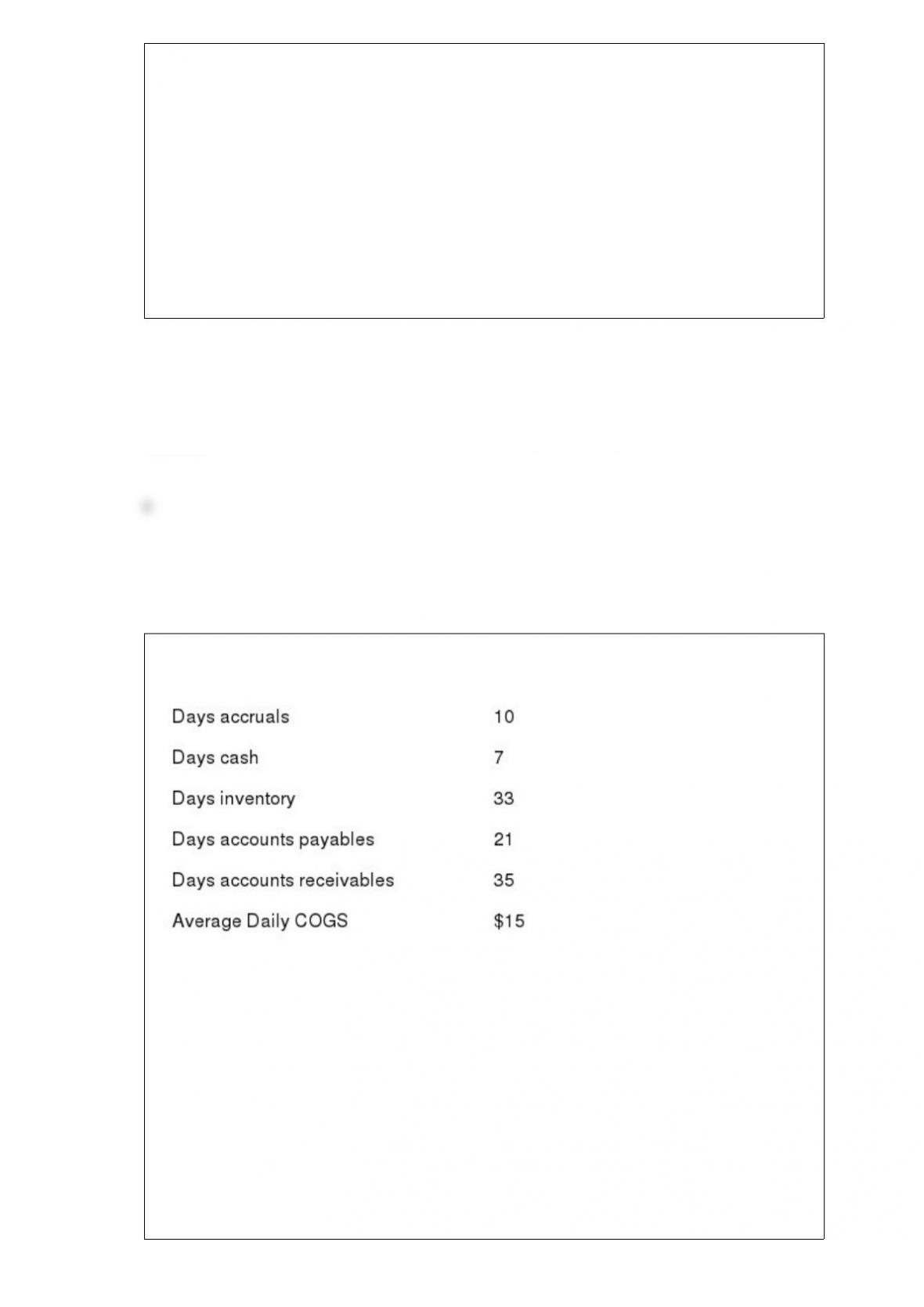
Use the following firm working capital cycle information.
What is the firm’s cash-to-cash asset cycle?
a. 31 days
b. 44 days
c. 65 days
d. 75 days
e. 121 days

Answer:
In an interest rate swap, the notional principle:
a. is the difference in the fixed and floating interest rates.
b. is the difference in the fixed and floating interest payments.
c. is used to calculate the FRA basis.
d. is used to calculate the value of the interest payments.
e. is used to calculate the hedge ratio.
Answer:
Use the following bank information.
What is the bank’s duration gap?
a. 0.53
b. 0.73
c. 0.91
d. 1.88
e. 4.58
Answer:
Which of the following institutions’ customers have a “common bond”?
a. credit union
b. commercial bank
c. mortgage company
d. savings bank
e. thrift
Answer:

Which of the following is an advantage of static GAP analysis?
a. Static GAP analysis considers the time value of money.
b. Static GAP analysis indicates the specific balance sheet items that are responsible for
the interest rate risk.
c. Static GAP analysis considers the cumulative impact of interest rate changes on the
bank’s position.
d. Static GAP analysis considers the embedded options in loans, such as mortgage
pre-payments.
e. All of the above are advantages of static GAP analysis.
Answer:
A bank buys a $10,000 Treasury bill with a maturity of 1 year. Current market rates are
8%. If interest rates rise to 8.25%, what is the approximate change in the price of the
T-bill?
a. -0.02%
b. -0.23%
c. -2.31%
d. -23.15%
e. -231.15%
Answer:

Under FASB 157, the valuation of Level 2 assets is labeled:
a. marking to market.
b. marking to matrix.
c. marking to myth.
d. marking to major.
e. marking to minor.
Answer:
Everything else the same, a bank’s “burden” would most likely increase given:
a. a decrease in overhead expenses.
b. an increase in interest rates.
c. a decrease in interest rates.
d. an increase in executive salaries.
e. an increase in service charges collected by the bank.
Answer:

A bank is currently exactly meeting its reserve requirements of 10%. If the bank has a
deposit inflow of $10,000,000, what is the impact on its required reserve position?
a. It now has excess reserves in the amount of $9,000,000.
b. It now has excess reserves in the amount of $10,000,000.
c. It is now deficient $1,000,000 in required reserves.
d. It is now deficient $9,000,000 in required reserves.
e. There would be no impact on the bank’s required reserves.
Answer:
A bond’s Macaulay duration is 95 years. If the current annual interest rate is 7%, what
is the modified duration of this bond?
a. 7.00 years
b. 7.88 years
c. 7.43 years
d. 7.95 years
e. 8.51 years
Answer:

Which of the following has the lowest weight in determining a consumer’s FICO score?
a. Types of credit
b. Amounts owed
c. Payment history
d. Length of credit history
e. Number of delinquencies
Answer:
What is the return on equity for a bank that has an equity multiplier of 14, an interest
expense ratio of 4%, and a return on assets of .9%?
a. 1.3%
b. 4.0%
c. 9.0%
d. 12.6%
e. 8.6%
Answer:

Under current capital requirements, Tier 1 Capital takes of all of the following into
account except :
a. common stockholder’s equity.
b. equity in subsidiaries.
c. goodwill.
d. allowance for loan and lease losses.
e. noncumulative perpetual preferred stock.
Answer:
Which of the following would a bank generally classify as a short-term investment?
a. Demand deposits
b. Deposits at the Federal Reserve
c. Repurchase agreements
d. Fed Funds purchased
e. Vault cash

Answer:
Which of the following is a discretionary factor that will increase a bank’s daily
reserves held at the Federal Reserve?
a. Yesterday’s immediate cash letter
b. Federal funds purchased
c. Security purchases
d. Currency received from Federal Reserve
e. Deficit in local clearinghouse
Answer:
Most interest rate swaps are set up for:
a. less than 6 months.
b. 6 months to 1 year.
c. 1 year to 10 years.
d. 11 to 20 years.
e. over 20 years.

Answer:
The primary federal regulator of state banks that are not members of the Fed is the:
a. FDIC.
b. Office of the Comptroller of the Currency.
c. Office of Thrift Supervision.
d. State’s banking department.
e. National Credit Union Administration.
Answer:
In general, _______________ are the major non-credit cost for commercial customers.
a. personnel expenses
b. check-processing costs
c. loan administration expenses
d. fraud costs
e. default costs

Answer:
A legal document that orders a firm to sop an unfair practice under full penalty of law is
a:
a. cease and desist order.
b. capital request.
c. memorandum of understanding.
d. quality assurance directive.
e. national bank order.
Answer:
Firms may need cash for all of the following except:
a. operating purposes.
b. pay taxes.
c. pay employee salaries.
d. pay overdue suppliers.
e. liquidate fixed assets.

Answer:
Which type of financial institution has seen the largest drop in their share of U.S.
financial assets?
a. Depository institutions
b. Mutual funds
c. Insurance companies
d. Pension plans
e. Finance companies
Answer:
The lender’s secondary source of repayment in case of default is:
a. capacity.
b. collateral.
c. character.
d. capital.
e. credit.

Answer:
Small time deposits are characterized by all of the following except:
a. they have denominations are less than $250,000.
b. they have substantial interest penalties for early withdrawal.
c. banks can pay market interest rates on them.
d. there is a substantial interest penalty for early withdrawal.
e. they have a minimum maturity of 3 days.
Answer:
A _______________________ is a post office box number controlled by the bank.
a. syndication
b. local
c. lockbox
d. maintenance box
e. microhedge
Answer:

It is best for a bank to use average historical costs:
a. to make pricing decisions.
b. to evaluate past performance.
c. when deciding to issue preferred stock..
d. A bank should use average historical cost for all these decisions.
e. A bank should not use average historical cost for any of these decisions.
Answer:
Relative to wholesale banks, retail banks:
a. focus on individual consumer banking relationships.
b. operate with fewer consumer deposits.
c. purchase more non-core liabilities.
d. hold proportionally more business loans to large firms.
e. All of the above.
Answer:

Which of the following is not considered a highly liquid asset?
a. Federal funds sold
b. 90-day Treasury bills
c. AAA-rated commercial paper
d. A Federal Home Loan Bank Board bond with 6 months until maturity
e. Repurchase agreement
Answer:
What is the equity multiplier for a bank where equity is equal to 8% of total assets?
a. 1.08
b. 8.00
c. 0.92
d. 12.5
e. 1.25
Answer:

A bank currently owns a municipal bond paying a tax-exempt rate of 5%. If the banks
marginal tax rate is 35%, what is the taxable equivalent yield?
a. 7.69%
b. 3.25%
c. 6.75%
d. 3.70%
e. 9.32%
Answer:
Under the current capital requirements, assets in Category 3, such as 1-4 family real
estate loans, have an effective total capital-to-total-assets ratio of:
a. 1.6%.
b. 2.0%.
c. 4.0%.

d. 8.0%.
e. 8.6%.
Answer:
Which of the following are sources of a bond’s total return?
a. Coupon interest
b. Reinvestment income
c. Capital gains or losses realize at maturity
d. All of the above are sources of a bond’s total return
e. a. and c. only
Answer:
Which of the following is an example of an indirect loan?
a. An automobile dealer negotiates the loan terms with the individual and then presents
the agreement to the bank. The bank then makes the loan.
b. An automobile dealer refers a customer to the local credit union. The customer goes
to the credit union and gets an auto loan secured by the customer’s certificates of
deposit.

c. A homebuyer gets a mortgage over the Internet.
d. A student gets a student loan guaranteed by Sallie Mae.
e. None of the above.
Answer:
The expense ratio is calculated as:
a. total revenue – total operating expenses.
b. total revenue – total operating expenses – taxes.
c. interest expense ratio – non-interest expense ratio – provision for loan loss ratio.
d. asset utilization – expense ratio – tax ratio.
e. interest expense ratio + non-interest expense ratio + provision for loan loss ratio.
Answer:
A firm’s mix of debt and equity is measured by:
a. liquidity ratios.
b. market value ratios.

c. profitability ratios.
d. activity ratios.
e. leverage ratios.
Answer: