
Real GDP is the value of goods and services
A) adjusted only for unanticipated inflation.
B) adjusted only for anticipated inflation.
C) using base-year prices.
D) using current-year prices.
Suppose for every dollar change in household wealth, consumption expenditures
change by $0.05. If real household wealth declines by $45 billion, potential GDP is
$120 billion, and the multiplier effect for the second year after an expenditure shock is
1.1, what is the total change in output relative to potential for the second year?
A) -1.28%
B) -1.73%
C) -2.06%
D) -5.78%
If potential GDP for the third quarter of 2013 = $20.4 billion, and the deviation from
potential GDP for the third quarter of 2013 = $1.6 billion, then Real GDP for the third
quarter of 2013 equals

A) $6.5 billion.
B) $18.8 billion.
C) $22 billion.
D) $32.64 billion.
A key reason that most people did not anticipate the severity of the recession of
2007-2009 is that
A) they thought the Fed would reduce the target for the federal funds rate to a lower
level.
B) they did not believe that the federal government would actually bail out large
financial institutions.
C) they failed to see the financial crisis coming.
D) they were more worried about rising inflation than about falling real GDP.
The actions that the Federal Reserve takes to manage the money supply and interest
rates to pursue macroeconomic policy XOAXOAs refer to
A) fiscal policy.
B) monetary policy.

C) quantitative analysis.
D) Federal Reserve transparency.
Suppose that the production function for the economy is Y = AK0.2L0.8. If the capital
stock = 40,000, the quantity of labor = 10,000, and the efficiency index = 1, the
marginal product of capital is
A) $0.066.
B) $0.20.
C) $1.05.
D) $1.58.
The critical determinant of real GDP per capita is
A) the size of the labor force.
B) labor productivity.
C) the population.
D) the size of the working-age population.

If you were building a macroeconomic model that explores the effect of an increase in
income tax rates on the size of the labor force, the exogenous variable(s) would be
A) income tax rates.
B) the size of the labor force.
C) both income tax rates and the size of the labor force.
D) neither income tax rates nor the size of the labor force.
Positive supply shocks can have a tendency to ________ costs of production and
________ the inflation rate.
A) increase; increase
B) increase; decrease
C) decrease; increase
D) decrease; decrease

Briefly explain the effects on potential GDP of cutting each of the following taxes:
a. Individual income tax
b. Corporate income tax
c. Taxes on dividends and capital gains
Classical economics refers to the perspective that the business cycle can be explained
A) using equilibrium analysis.
B) using disequilibrium analysis.
C) by long-run macroeconomic fluctuations.
D) by short-run macroeconomic instability.
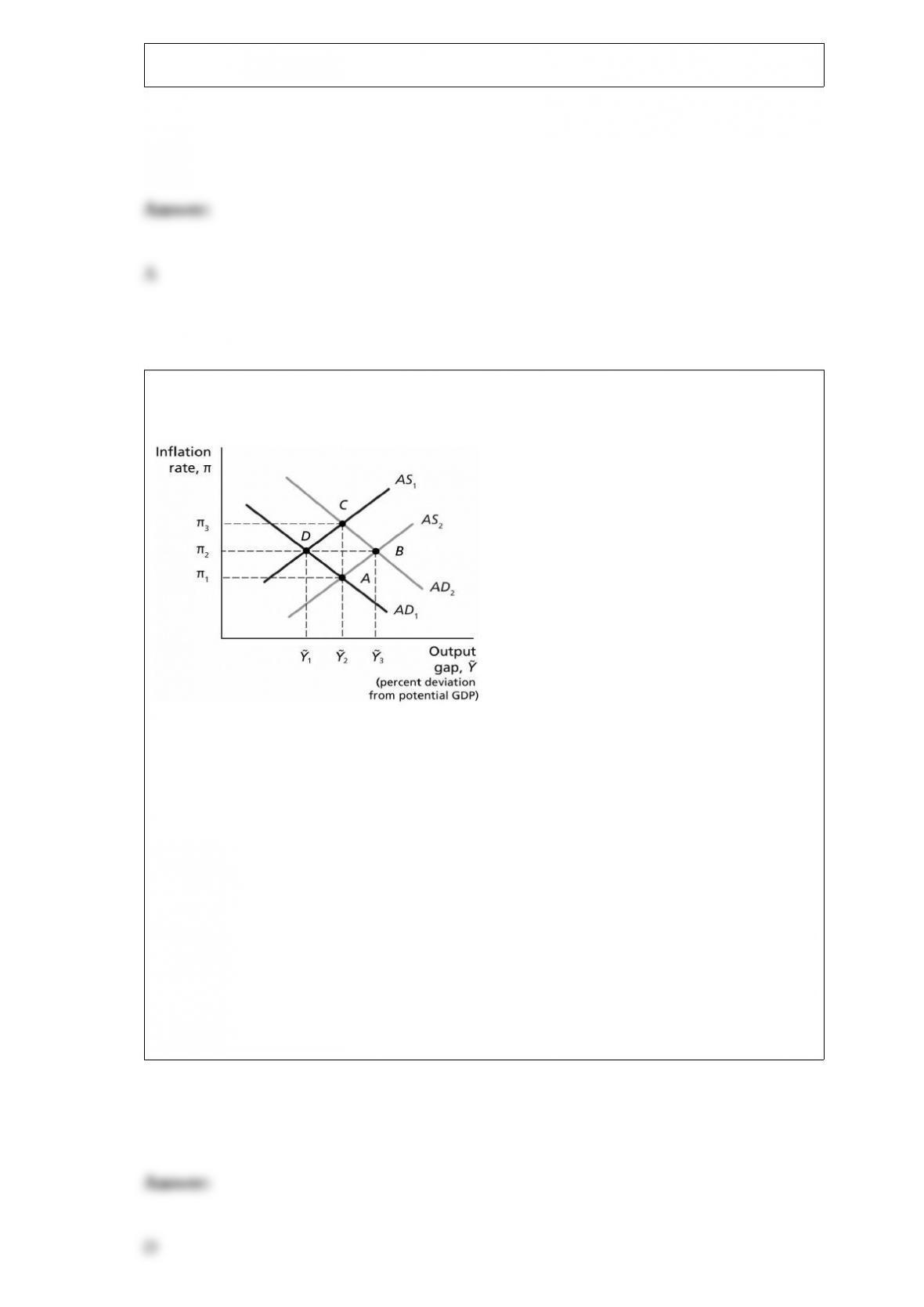
Figure 14.3
Refer to Figure 14.3. Suppose the economy is initially at long-run equilibrium and the
economy experiences a demand shock such as a stock market crash. The economy then
reaches a new, short-run equilibrium point. Assuming expectations are adaptive, this
will allow the central bank to decrease the real interest rate, moving the economy to a
another new equilibrium point. The stock market crash is temporary, so as the economy
works its way back to long-run equilibrium, real GDP will increase. As the expected
rate of inflation changes, the economy will move from
A) point A to point C.
B) point D to point C.
C) point A to point D.
D) point B to point C.

With its goal of high employment, the Fed attempts to
A) keep unemployment at its natural rate.
B) keep the unemployment rate as close to zero as is possible.
C) eliminate all but cyclical unemployment from the economy.
D) maintain equal rates of frictional, structural, and cyclical unemployment.
Table 2.3
2007 2010 2013
Quantity Price Quantity Price Quantity Price
Table 3 gives quantities and prices for each good produced in a simple economy in
2007, 2010, and 2013.
Refer to Table 2.3. Assume that 2010 is the base year. Real GDP in 2007 is
A) $490.00.
B) $568.00.
C) $580.00.
D) $671.00.

One event that undermined the belief that the Phillips curve represented a structural
relationship was
A) the belief of Milton Friedman and Edmund Phelps that expected inflation remains
constant.
B) the erratic behavior of unemployment rates and inflation rates during the 1960s.
C) the extended period of time that both unemployment and inflation remained high
during the Great Depression.
D) the increase in both the inflation rate and the unemployment rate in the 1970s.
A reason that the inflation rate did not increase substantially following the recession of
2007-2009 is that
A) the increase in the monetary base was accompanied by larger-than expected
increases in the money supply.
B) even though the recovery was slow, the U.S. economy benefitted from a small output
gap.
C) the recovery was slow and the unemployment rate remained high through
D) the Federal Reserve quickly implemented contractionary policy to prevent an
increase in the inflation rate.

Suppose Richard Branson withdraws $5 million from his checking account at Bank of
America. If the required reserve ratio is 25%, what is the maximum change in deposits
in the banking system?
A) -$25 million
B) -$20 million
C) -$5 million
D) -$1.25 million
A negative demand shock causes a ________ the IS curve and a ________ the
aggregate demand curve.
A) movement up along; shift to the left of
B) shift to the right of; movement up along
C) movement down along; movement down along
D) shift to the left; shift to the left of
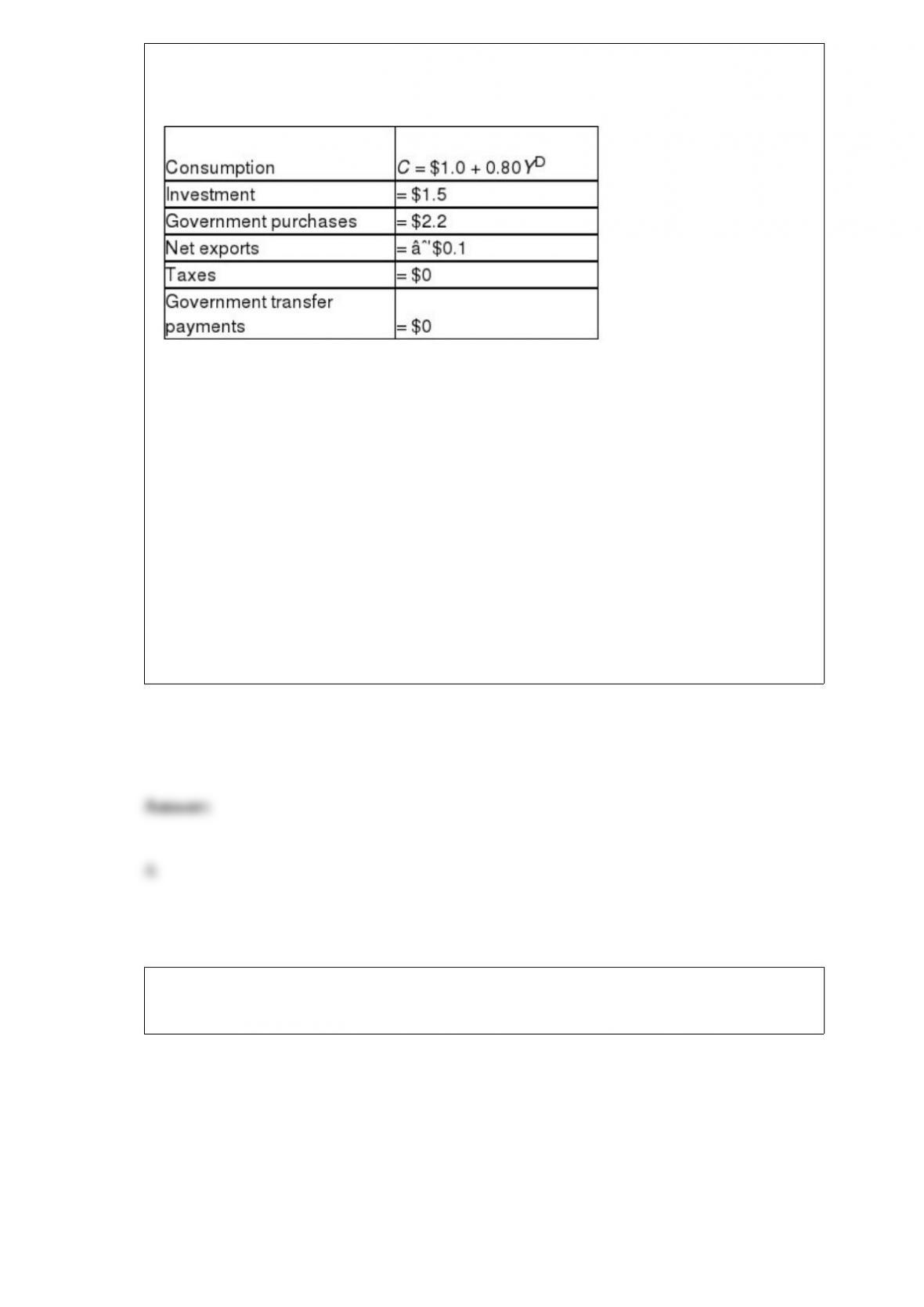
Table 10.1
(all values are in billions of dollars)
Refer to Table 10.1. Suppose that all of the information given in the Table remains the
same except that taxes increase by $1.0 billion and transfers increase by $1.5 billion. If
potential GDP equals $30 billion, by how much would government purchases have to
change for equilibrium GDP to equal potential GDP?
A) $1 billion
B) $1.25 billion
C) $1.5 billion
D) $5 billion
Figure 14.2
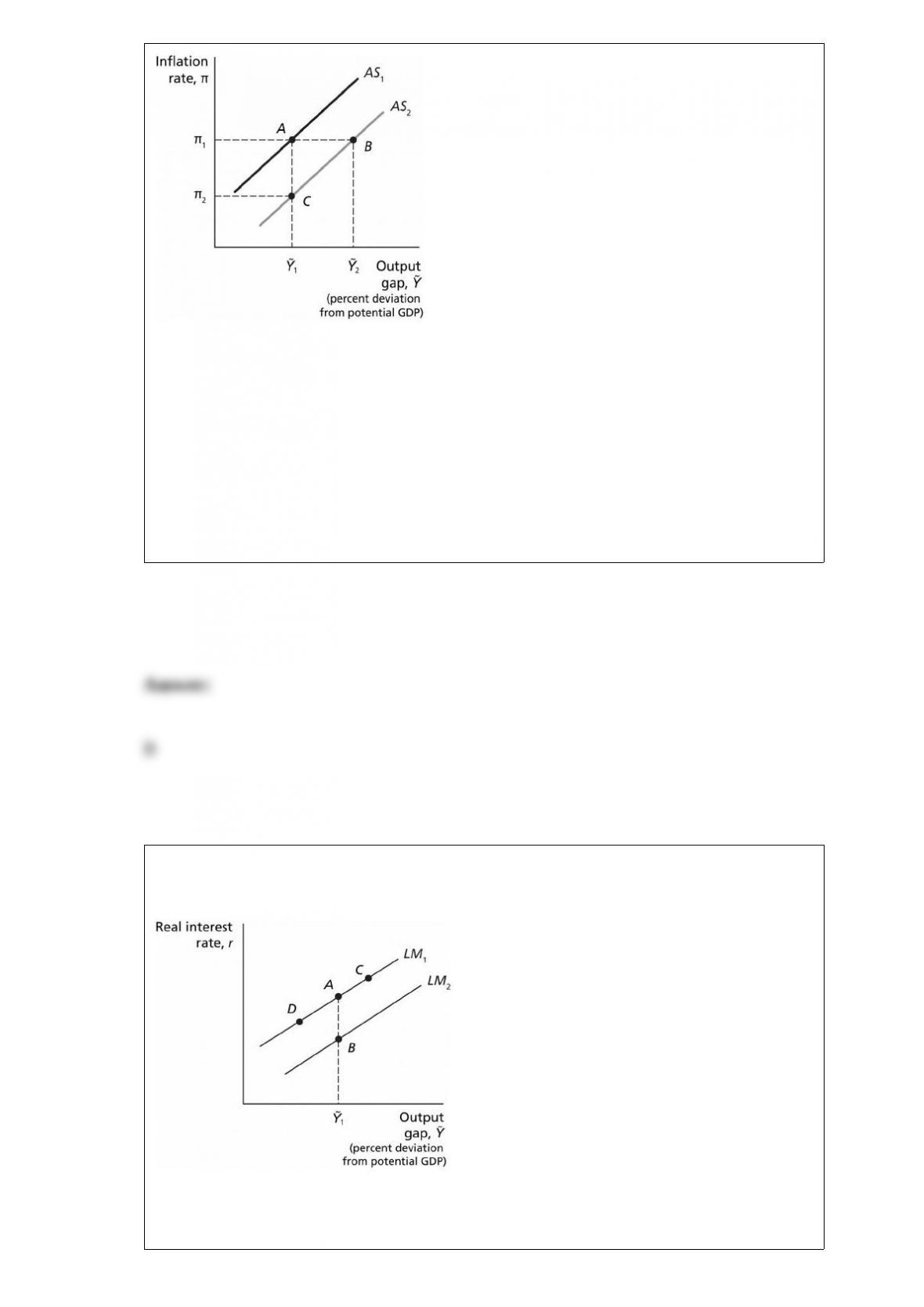
Refer to Figure 14.2. Suppose workers expect inflation to rise from 1% to 3% next
year. Other things equal, this would best be represented by a movement from
A) point A to point B.
B) point B to point A.
C) point B to point C.
D) point A to point C.
Figure 10.8
Refer to Figure 10.8. Other things equal, a decrease in the nominal money supply
would best be represented by
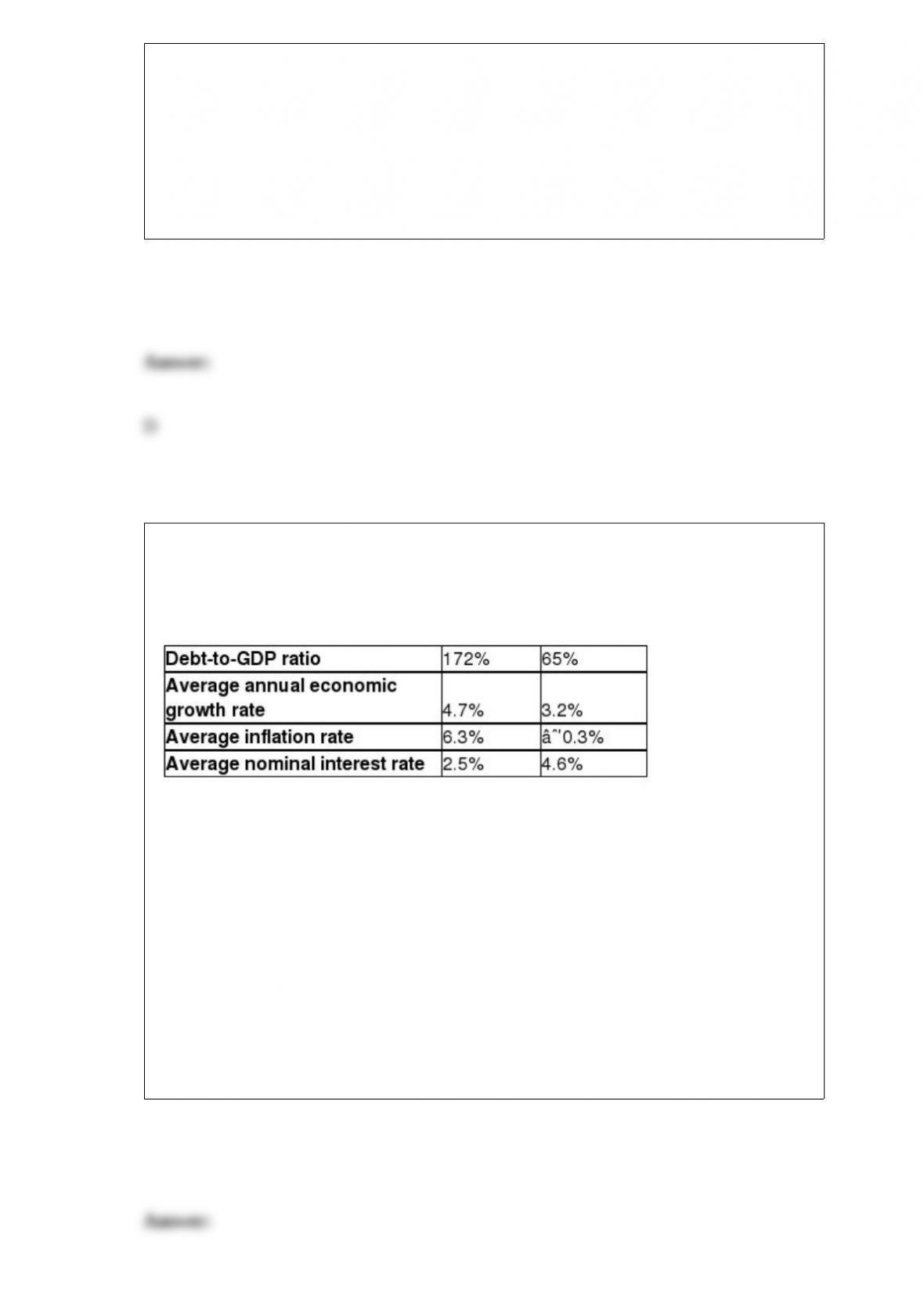
A) a movement from point A to point C.
B) a movement from point A to point D.
C) a shift from LM1 to LM2.
D) a shift from LM2 to LM1.
Table 3
Cordelia Saldinia
The above table contains data for the nations of Cordelia and Saldinia for 2012. Assume
seigniorage is zero.
Refer to Table 15.3. Based on the data in the table, the primary budget deficit necessary
to make fiscal policy sustainable in Saldinia is ________ of GDP.
A) -5.3%
B) -1.1%
C) 1%
D) 5%

An efficiency wage is ________ and results in ________.
A) equal to the equilibrium wage; full employment
B) above the equilibrium wage; a surplus of labor
C) below the equilibrium wage; a shortage of labor
D) above or below the equilibrium wage; a surplus or shortage of labor
Economists assume that households and firms share two important characteristics. One
of these characteristics is that
A) they smooth spending during recessions and expansions.
B) they act rationally to meet their objectives.
C) they only consider the present when making decisions.
D) the growth rate in spending by each is equally volatile.
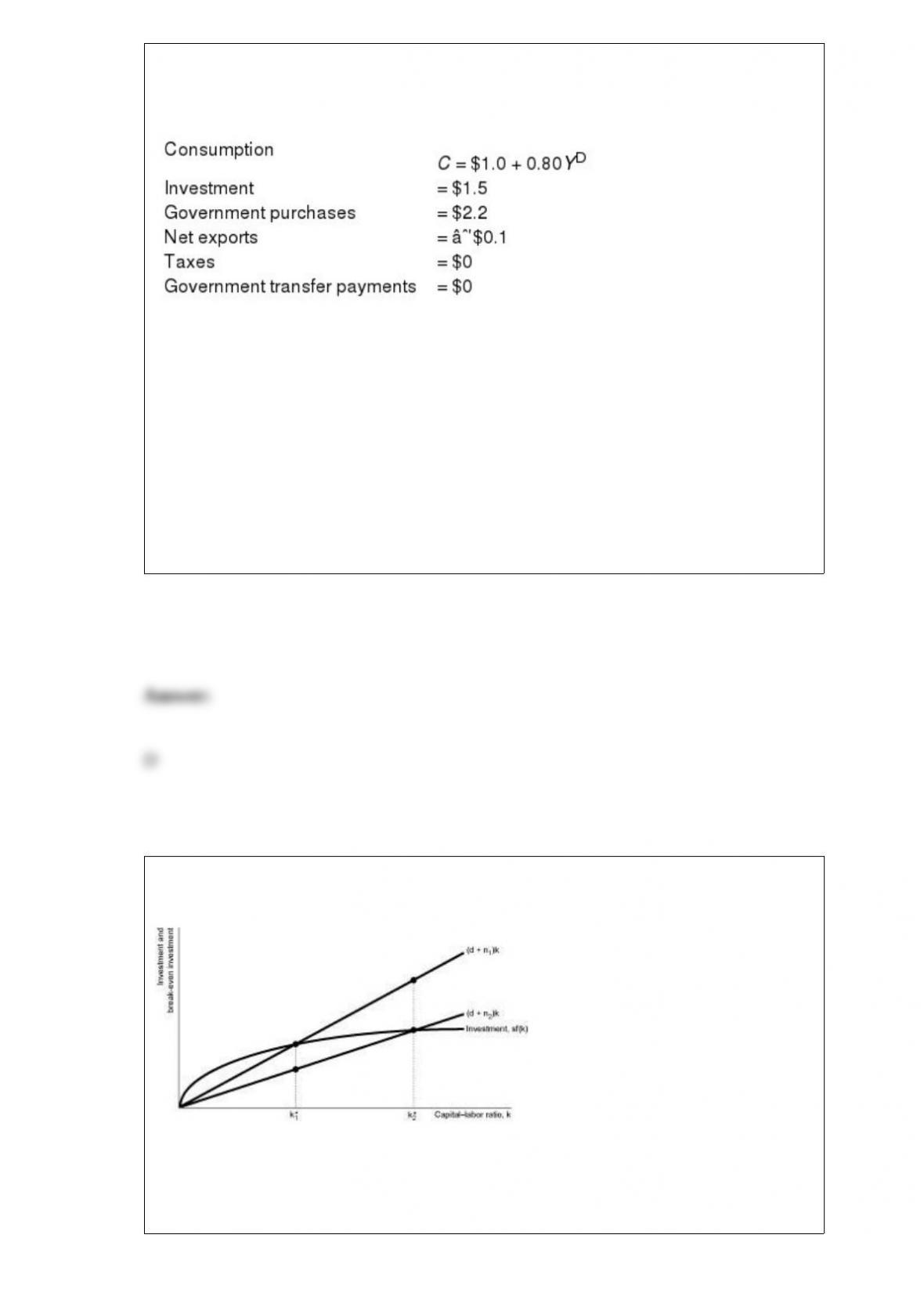
Table 10.1
(all values are in billions of dollars)
Refer to Table 10.1. The value of the government purchases multiplier in this economy
is
A) 0.2
B) 0.8
C) 4
D) 5
Figure 6.2
Refer to Figure 6.2. Suppose the economy is originally in steady state at k*1. All else
equal, if the labor force growth rate decreases , the change in the capital-labor ratio is
represented by the vertical distance between

A) sf(k) and (d + n2)k.
B) sf(k) and (d + n1)k.
C) (d + n1)k and (d + n2)k.
D) k*2 and(d + n2)k.
Once the Phillips curve has shifted down, the economy is ________ because ________.
A) better off; every unemployment rate becomes associated with a higher inflation rate
B) better off; every inflation rate becomes associated with a lower unemployment rate
C) worse off; every inflation rate becomes associated with a higher unemployment rate
D) worse off; every unemployment rate becomes associated with a lower inflation rate
The processes a firm uses to turn inputs into outputs of goods and services are the firm’s
A) production function.
B) technology.
C) total factor productivity.

D) manufacturing ideology.
Suppose the money supply is set to grow at 12%, real GDP grows at 4%, and the
nominal interest rate on Aaa corporate bonds is 10%. Using the quantity theory of
money and the Fisher equation, the expected real interest rate on Aaa corporate bonds
should average
A) -2%.
B) 2%.
C) 6%.
D) 7%.
Figure 11.2
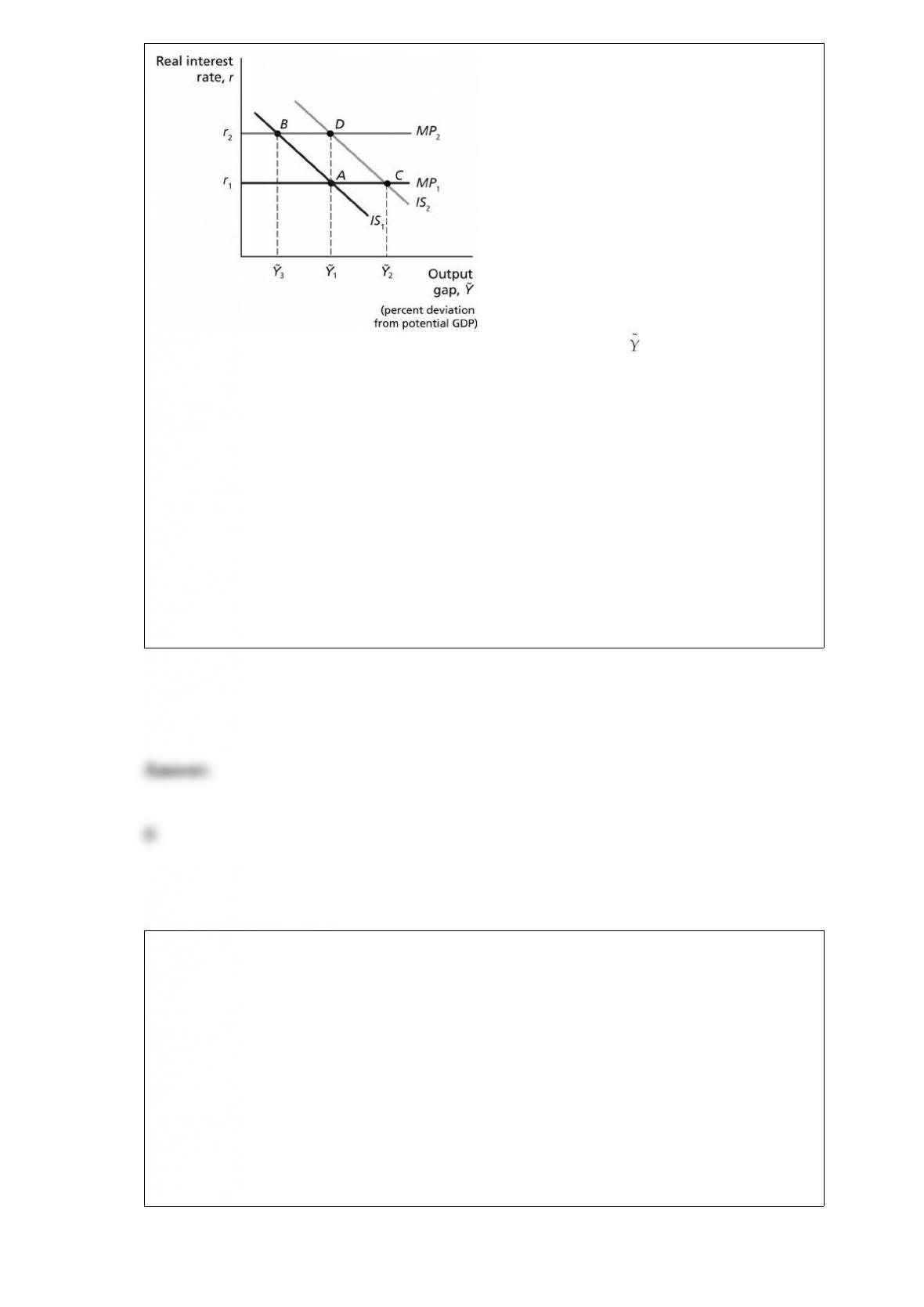
Refer to Figure 11.2. Assume the economy is in equilibrium at 1, where real GDP
equals potential GDP. The economy experiences a positive demand shock, and the Fed
responds by increasing real interest rates to bring real GDP and inflation back to their
original levels. Other things equal, the Fed’s response following the positive demand
shock is best represented by a(n)
A) movement up along the Phillips curve.
B) movement down along the Phillips curve.
C) upward shift of the Phillips curve.
D) downward shift of the Phillips curve.
Other things equal, which of the following will lead to an increase in output and
employment?
A) The federal government decides to eliminate the Department of Education.
B) The federal government implements a national value-added tax (VAT).
C) The federal government passes a tax incentive for firms that employ returning war
veterans.
D) The federal government reduces the duration and amount of unemployment benefits.

How will each of the following affect the steady-state growth rate of the standard of
living? Assume the economy is currently in the steady state.
a. an increase in the depreciation rate
b. an increase in the growth rate of labor-augmenting technological change
c. a decrease in the saving rate
d. a decrease in the labor-force growth rate
What is the name of the group which decides when recessions begin and end?
A) the Business Cycle Dating Committee
B) the Bureau of Labor Statistics
C) the Commerce Department
D) the Federal Reserve Open Market Committee

By the 2000s, an important change in the mortgage market had occurred when
________ became significant participants in the secondary market for mortgages by
buying, bundling, and reselling mortgages as mortgage-backed securities.
A) commercial banks
B) investment banks
C) financial markets
D) foreign governments