
Otherwise legal transactions that go unreported or unrecorded are called
a. the underground economy.
b. the shadow economy.
c. the informal economy.
d. All of the above are correct.
What actions could be taken to stabilize output in response to a large decrease in U.S.
net exports?
a. increase taxes or increase the money supply
b. increase taxes or decrease the money supply
c. decrease taxes or increase the money supply
d. decrease taxes or decrease the money supply
Fundamental analysis shows that stock in Garske Software Corporation has a present
value that is higher than its price.
a. This stock is overvalued; you should consider adding it to your portfolio.
b. This stock is overvalued; you shouldn’t consider adding it to your portfolio.

c. This stock is undervalued; you should consider adding it to your portfolio.
d. This stock is undervalued; you shouldn’t consider adding it to your portfolio.
If the efficient market hypothesis is correct, then
a. index funds should typically beat managed funds, and usually do.
b. index fund should typically beat managed funds, but usually do not.
c. mutual funds should typically beat index funds, and usually do.
d. mutual funds should typically beat index funds, but usually do not.
A country has $60 million of saving and domestic investment of $40 million. Net
exports are
a. $20 million.
b. -$20 million.
c. $100 million.
d. -$100 million.

According to the rule of 70, if the interest rate is 10 percent, about how long will it take
for the value of a savings account to double?
a. about 6.3 years
b. about 7 years
c. about 7.7 years
d. about 10 years
One of the 20th century’s worst episodes of inflation occurred in
a. the United States in the 1960s.
b. Italy in the 1950s.
c. Russia in the 1930s.
d. Germany in the 1920s.

Which of the following shifts short-run aggregate supply left?
a. an increase in the actual price level
b. an increase in the expected price level
c. an increase in the capital stock
d. None of the above is correct.
The Bureau of Labor Statistics’ household survey and establishment survey both yield
the same results about total employment.
a. True
b. False
If a German firm buys goods from a U.S. firm with dollars it obtains by exchanging
euros for dollars, both U.S. net exports and U.S. net capital outflow increase.
a. True
b. False

Sectoral shifts contribute to frictional unemployment.
a. True
b. False
The price level is determined by the supply of, and demand for, money.
a. True
b. False
You want to have $100,000 in five years. If the interest rate is 8 percent, about how
much do you need to have today?
a. $66,225.25
b. $67,556.42
c. $68,058.32

d. $71,428.57
Henri earned a salary of $50,000 in 2001 and $70,000 in 2006. The consumer price
index was 177 in 2001 and 265.5 in 2006. Henri’s 2006 salary in 2001 dollars is
a. $35,000.00.
b. $46,666.67.
c. $61,950.00
d. $105,000.00.
An increase in the money supply shifts the aggregate-supply curve to the right.
a. True
b. False

Because of its effect on the amount of capital per worker, in the short term an increase
in the working population is likely to
a. raise productivity. Other things the same, this increase will be larger in a poor
country.
b. raise productivity. Other things the same, this increase will be larger in a rich country.
c. reduce productivity. Other things the same, this decrease will be larger in a poor
country.
d. reduce productivity. Other things the same, this decrease will be larger in a rich
country.
A U.S. firm called EcoWind produces windmills for households to generate electricity.
It uses 25,000 recently obtained pesos to buy copper from a mining company in
Argentina. As a result of this exchange, by how much, if at all, and in which direction
did:
A. U.S. net exports change?
B. U.S. net capital outflow change?

Which of the following is correct?
a. A period of hyperinflation is a period of extraordinarily low inflation.
b. A period of deflation is any period during which the inflation rate is decreasing.
c. From 2002 to 2012, U.S. inflation averaged about 2.5 percent per year.
d. All of the above are correct.
Suppose the economy is in long-run equilibrium at an inflation rate of 1% Then
inflation expectations rise to 2% and inflation rises to 3%. The increase in expected
inflation shifts the short-run Phillips curve
a. right. Overall, unemployment moves above its natural rate.
b. right. Overall, unemployment moves below its natural rate.
c. left. Overall, unemployment moves above its natural rate.
d. left. Overall, unemployment moves below its natural rate.
The Bureau of Labor Statistics reported in 2005 that there were 53.23 million people
over age 25 who had at least a bachelor’s degree, 40.59 million of whom were
employed and 0.98 million of whom were unemployed. What were the labor-force
participation rate and the unemployment rate for this group?

a. 76.3% and 1.8%
b. 76.3% and 2.4%
c. 78.1% and 1.8%
d. 78.1% and 2.4%
A market demand curve shows
a. the relationship between price and the number of buyers in a market.
b. how quantity demanded changes when the number of sellers changes.
c. the sum of all prices that individual buyers are willing and able to pay for each
possible quantity of the good.
d. how much of a good all buyers are willing and able to buy at each possible price.
One of the differences between the GDP deflator and the consumer price index is
a. the GDP deflator includes income earned by American citizens working in foreign
countries and the consumer price index is based solely on purchases made in the U.S.
b. the consumer price index basket of goods is updated constantly by the Bureau of
Labor Statistics whereas the GDP deflator is updated only occasionally.

c. the consumer price index includes items not included in the GDP deflator such as
airplanes purchased by the Air Force.
d. the GDP deflator reflects prices for all goods and services produced domestically and
the consumer price index reflects prices for some goods and services bought by
consumers.
If the nominal interest rate is 4.2 percent and the rate of inflation is -0.5 percent, then
the real interest rate is
a. -8.4 percent.
b. -2.1 percent.
c. 3.7 percent.
d. 4.7 percent.
Municipal bonds pay a relatively
a. low rate of interest because of their high default risk and because the interest they pay
is subject to federal income tax.
b. low rate of interest because of their low default risk and because the interest they pay
is not subject to federal income tax.
c. high rate of interest because of their high default risk and because federal taxes must
be paid on the interest they pay.
d. high rate of interest because of their low default risk and because the interest they
pay is not subject to federal income tax.
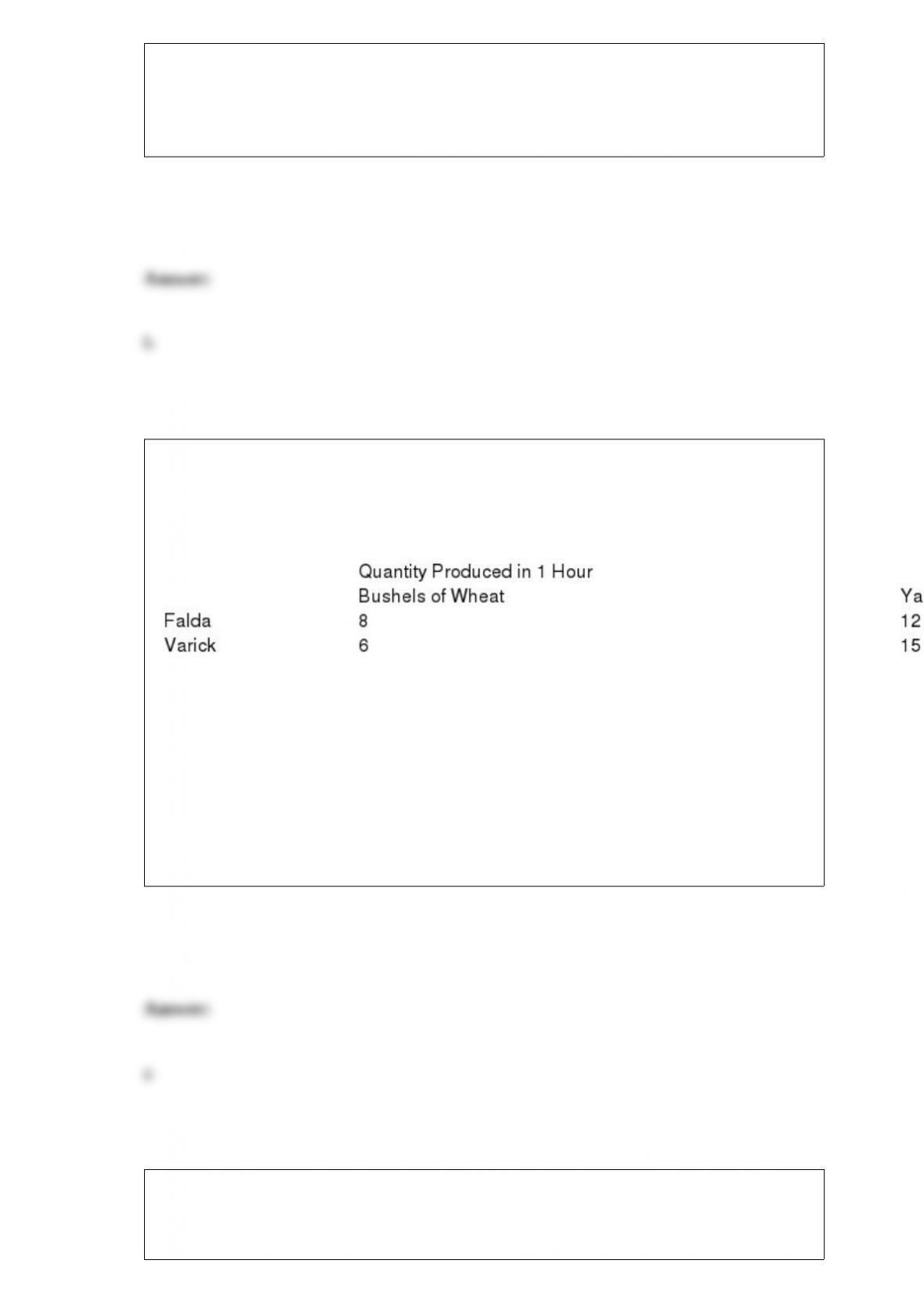
Table 3-30
Assume that Falda and Varick can switch between producing wheat and producing cloth
at a constant rate.
RefertoTable3-30.Falda has a comparative advantage in the production of
a. wheat.
b. cloth.
c. both goods.
d. neither good.
Which of the following would shift the demand curve for gasoline to the right?
a. a decrease in the price of gasoline

b. an increase in consumer income, assuming gasoline is a normal good
c. an increase in the price of cars, a complement for gasoline
d. a decrease in the expected future price of gasoline
Suppose that some people are counted as unemployed when, to maintain unemployment
compensation, they search for work only at places where they are unlikely to be hired.
If these individuals were counted as out of the labor force instead of as unemployed,
then
a. both the unemployment rate and labor-force participation rate would be higher.
b. both the unemployment rate and labor-force participation rate would be lower.
c. the unemployment rate would be lower, and the labor-force participation rate would
be higher.
d. the unemployment rate would be higher, and the labor-force participation rate would
be lower.
If a country places tariffs on imported goods, then
a. its currency appreciates which reduces exports.
b. its currency appreciates which increases exports.
c. its currency depreciates which reduces exports.
d. its currency depreciates which increases exports.
The consumer price index is used to monitor changes in an economy’s production of
goods and services over time.
a. True
b. False
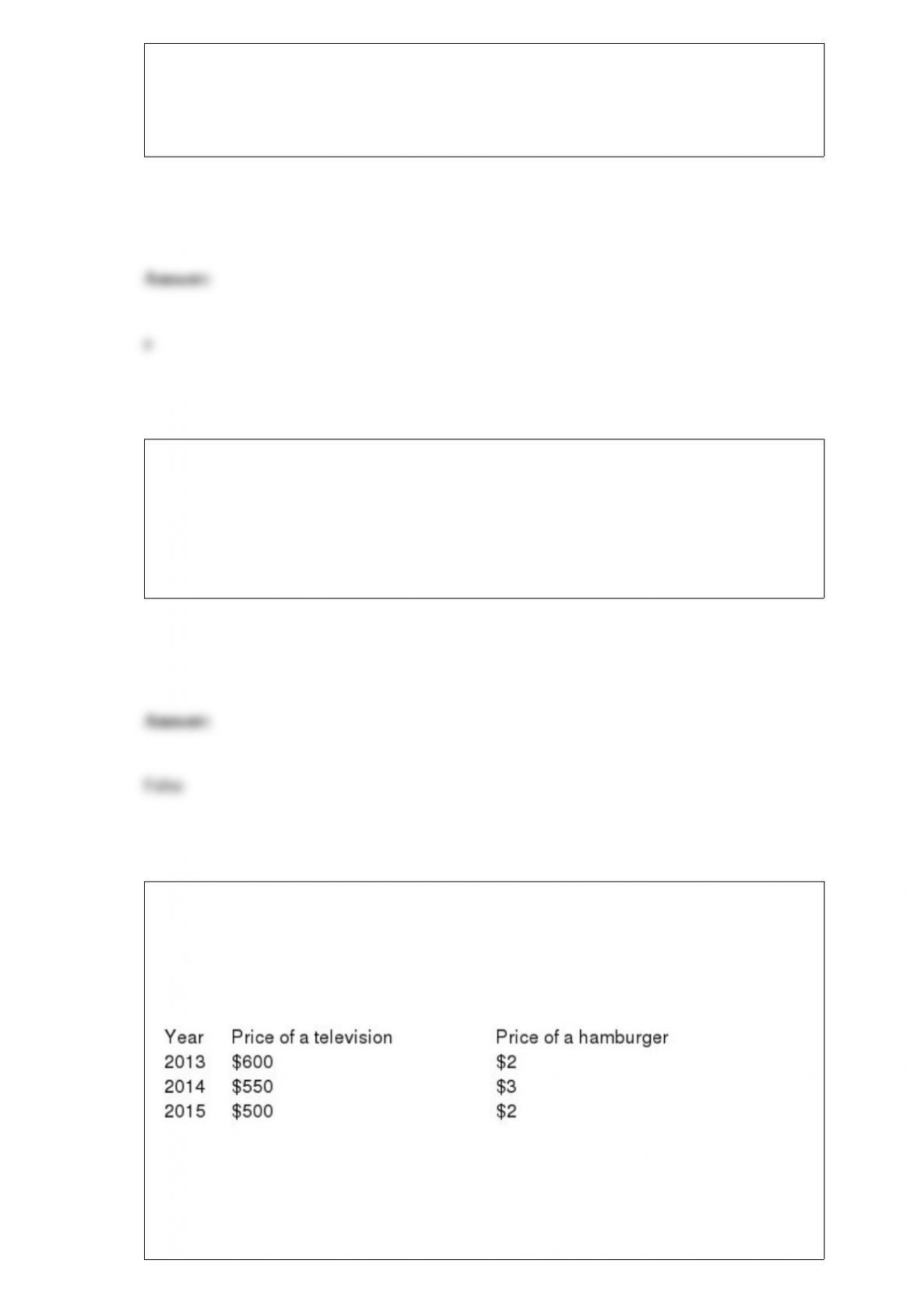
Table 24-8
The table below relates to the economy of Mainland, where the typical consumer’s
market basket consists of 2 televisions and 300 hamburgers.
RefertoTable24-8. If the base year is 2013, then the consumer price index was
a. 80 in 2013, 100 in 2014, and 60 in 2015.
b. 100 in 2013, 300 in 2014, and -100 in 2015.

c. 180 in 2013, 200 in 2014, and 160 in 2015.
d. 100 in 2013, 111.1 in 2014, and 88.9 in 2015.
Proponents of zero-inflation policies acknowledge that the public is unconcerned about
the inflation rate.
a. True
b. False
According to 2012 data on the U.S. population, which of the following groups of adults
of prime working age (ages 25-54) had the lowest labor-force participation rate?
a. white males
b. white females
c. black males
d. black females

People are likely to respond to a policy change
a. only if they think the policy is a good one.
b. only if the policy change changes the costs of their behavior.
c. only if the policy change changes the benefits of their behavior.
d. if the policy changes either the costs or benefits of their behavior.
Which of the following is included in the calculation of GDP?
a. The purchase of tutoring services from a tutor who holds citizenship outside the
country but resides within the country.
b. The purchase of a new edition of a foreign textbook that was produced in a different
nation.
c. The purchase of ink and paper supplies by a textbook company for the production of
new textbooks.
d. The purchase of a used textbook from a friend who took the same class last year.
Suppose your college institutes a new policy requiring you to pay for a permit to park
your car in a campus parking lot.

a. The cost of the parking permit is not part of the opportunity cost of attending college
if you would not have to pay for parking otherwise.
b. The cost of the parking permit is part of the opportunity cost of attending college if
you would not have to pay for parking otherwise.
c. Only half of the cost of the parking permit is part of the opportunity cost of attending
college.
d. The cost of the parking permit is not part of the opportunity cost of attending college
under any circumstances.