The poverty rate is defined as the percentage of the
A) labor force that is poor according to the federal government’s definition of poverty.
B) population that is exempt from paying federal income taxes.
C) population who qualify to receive welfare payments and food stamps.
D) population that is poor according to the federal government’s definition of poverty.
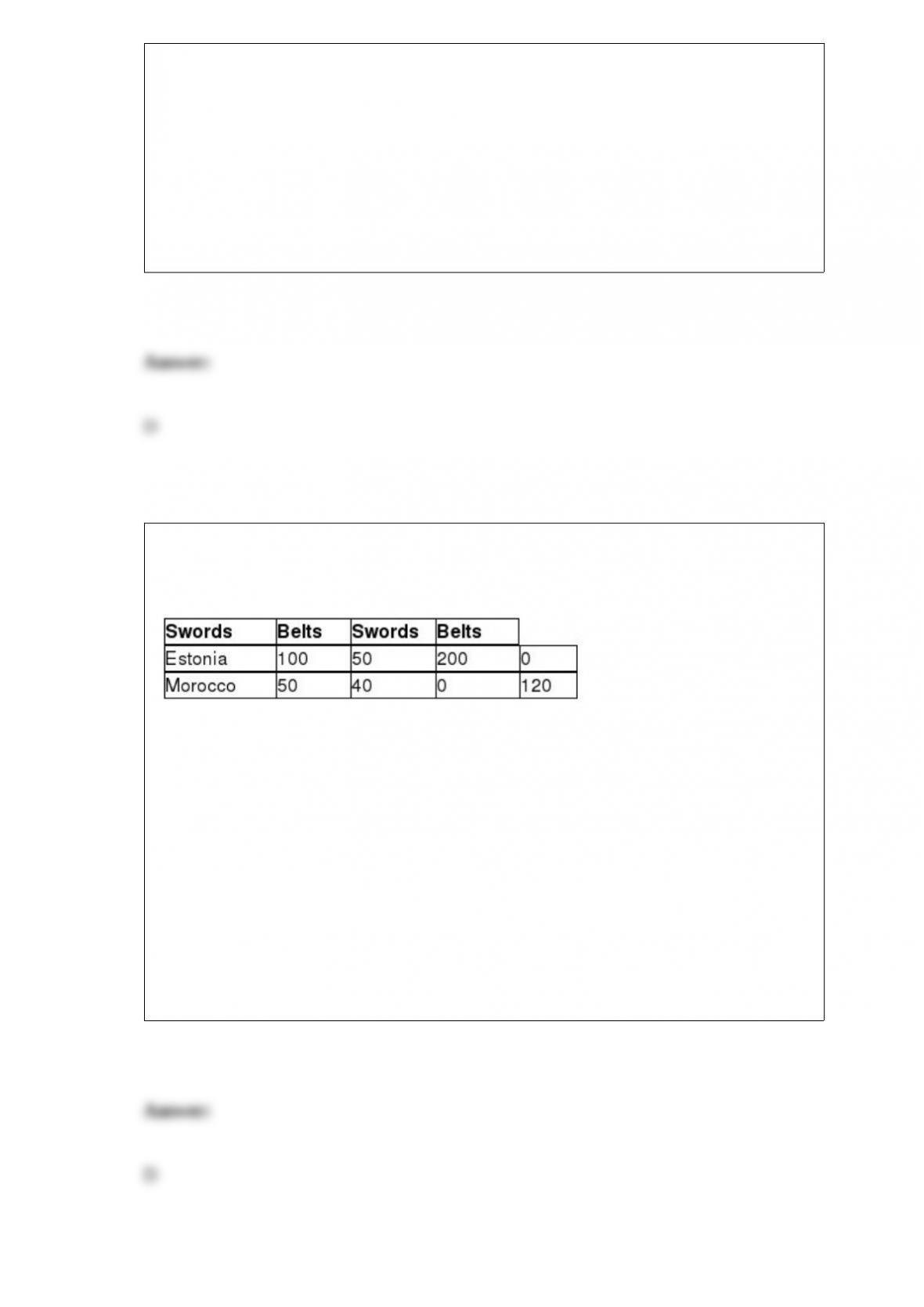
Table 9-12 Production and
Consumption Production
Without Trade With Trade
Estonia and Morocco can produce both swords and belts. Table 9-12 shows the
production and consumption quantities without trade, and the production numbers with
trade.
All of the following are terms of trade that could possibly benefit both countries except
A) 2/3 of a belt : 1 sword
B) 3/5 of a belt : 1 sword
C) 7/10 of a belt : 1 sword
D) 1/4 of a belt : 1 sword

During the month of May, 10 million workers moved from being classified as
“unemployed” to being classified as “employed.” As a result,
A) the unemployment rate rose.
B) the labor force participation rate fell.
C) the unemployment rate fell.
D) the labor force participation rate rose.
Which of the following is not included in the balance of the financial account of the
United States?
A) a purchase of Toyota stock by Ford
B) a purchase of GE stock by a firm in China
C) a purchase of U.S. car manufacturing plant by Toyota
D) a purchase of a German brewery by the U.S. company, Budweiser
E) a purchase of German financial services by Chase Manhattan bank
Which of the following would encourage economic growth through increases in the
capital stock?
A) a change from an income tax to a consumption tax
B) an increase in household saving
C) a decrease in the government deficit
D) all of the above
From the 1960s to 2012, transfer payments
A) have risen from about 25 percent to 46 percent of federal government expenditures.
B) remained the same percentage of total federal government expenditures.
C) have declined by half as a percentage of total federal government expenditures.
D) have grown very slowly as a percentage of total federal government expenditures.
Figure 17-3
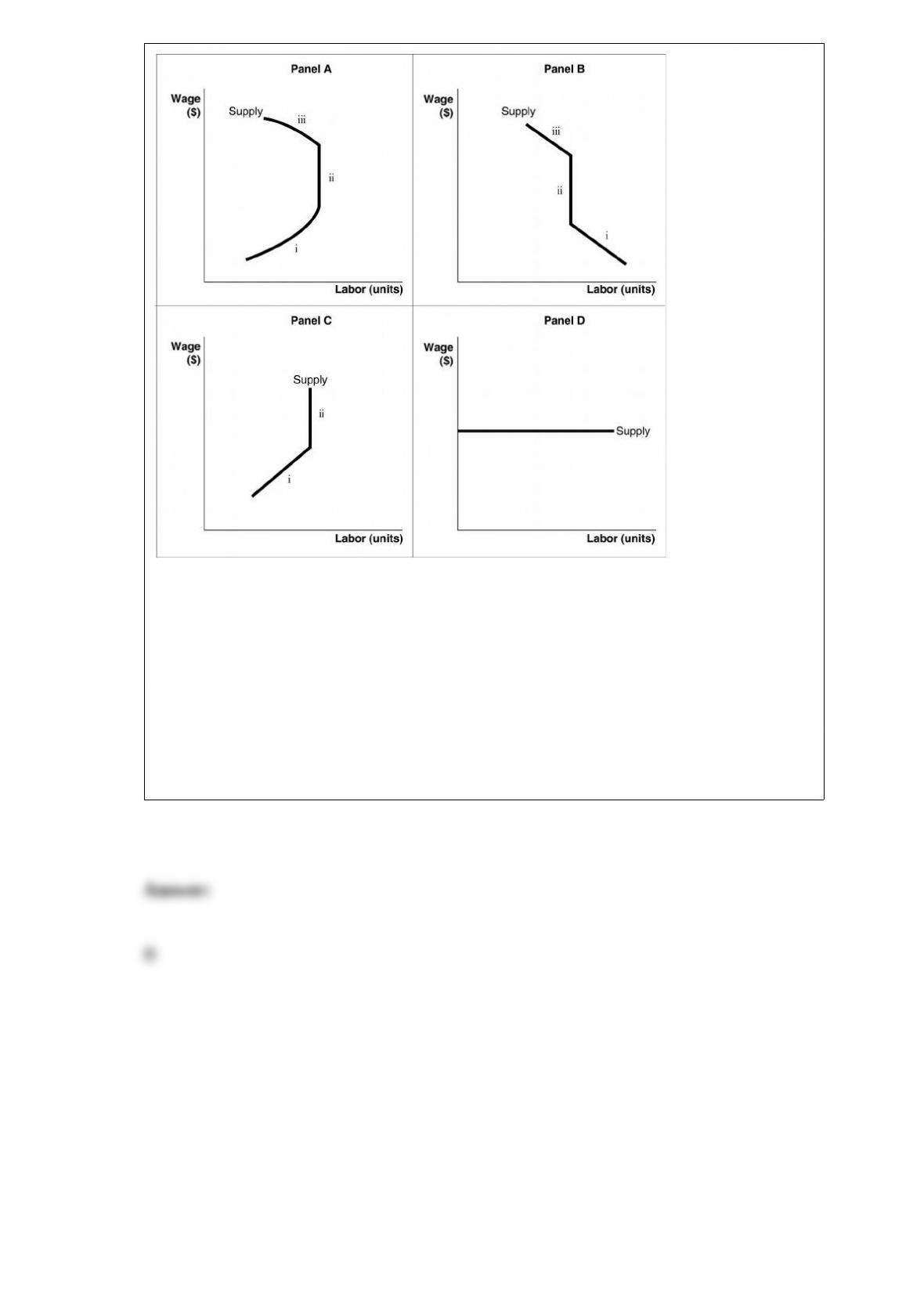
Panel D is appropriate when used to represent
A) the quantity of labor demanded by an input price taker.
B) the labor supply curve facing an input price taker.
C) the quantity of labor supplied by someone working a fixed number of hours.
D) the highly-skilled labor market supply curve.
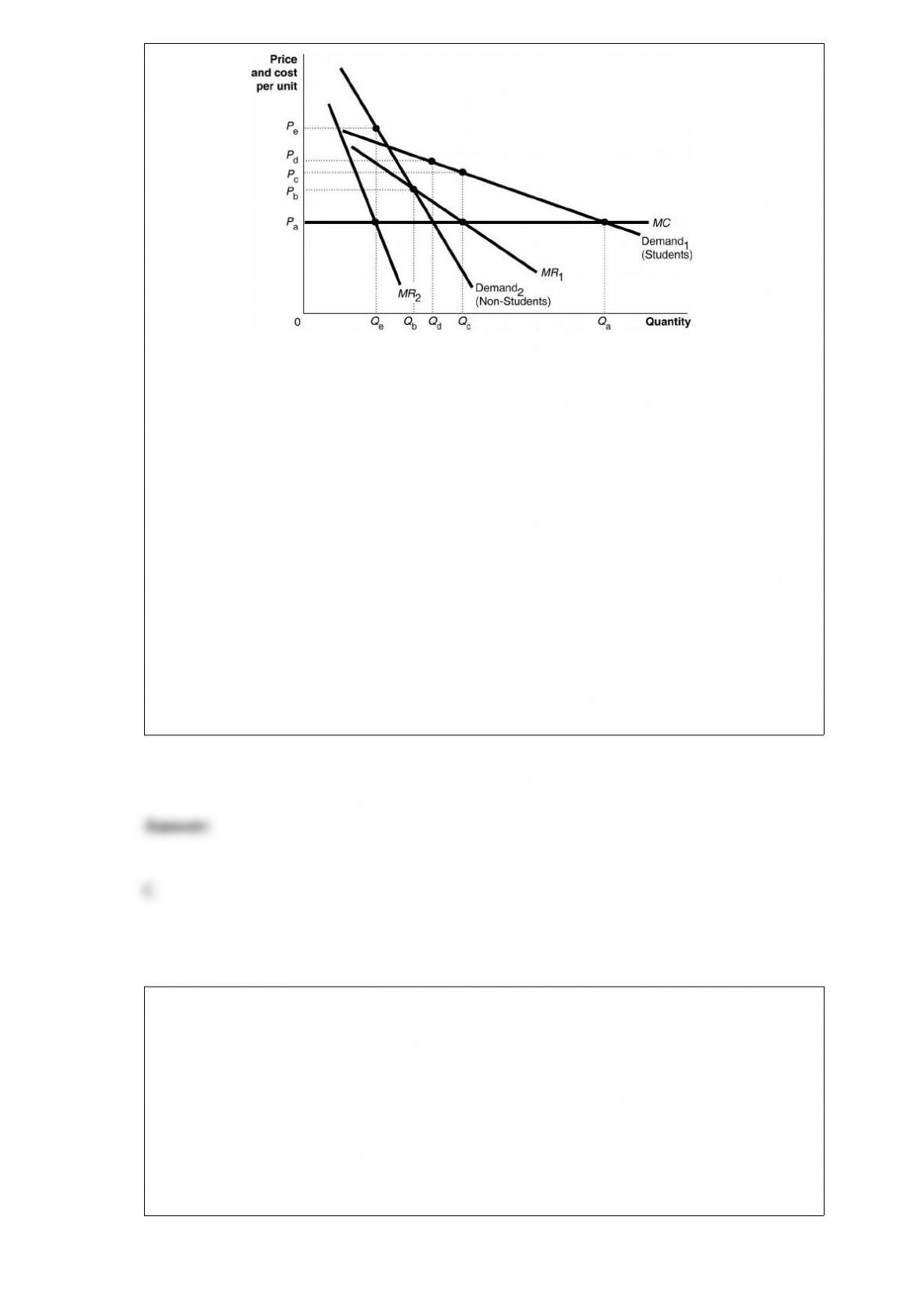
Figure 16-2 Plato
Playhouse, a theatre company in the university town of Wegg, caters to two groups of
customers: students and the non-student population. Figure 16-2 shows the demand
curves for the two groups of customers.
What is the quantity sold to each group of customer and what is the total quantity sold?
A) quantity sold to students = Qquantity sold to non-students = Q; total sales = Qa
B) quantity sold to students = Qc;quantity sold to non-students = Q; total sales = Q+Qc
C) quantity sold to students = Qc;quantity sold to non-students = Qe; total sales =
Qe+Qc
D) quantity sold to students = Qc;quantity sold to non-students = Qd; total sales =
Qd+Qc
Which of the following is not a characteristic of monopolistic competition?
A) Firms are price takers.
B) There are many buyers and sellers.
C) Barriers to entry are low.
D) Firms sell similar, but not identical, products.
Determine if each of the products below displays any of the following characteristics:
(i) rivalry
(ii) nonrivalry
(iii) excludability
(iv) nonexcludability. a. a freeway during peak commute hours
b. an online college course
c. infectious disease prevention
d. open source software such as Linux
e. a movie showing at Century Theatres
Which of the following statements about the importance of trade to the U.S. economy is
true?
A) Since 1950, both exports and imports have steadily decreased as a fraction of U.S.
gross domestic product.
B) Overall, about 80 percent of U.S. manufacturing jobs depend directly or indirectly
on exports.
C) The United States is the second largest exporter in the world.
D) The U.S. economy is highly dependent on international trade for growth in its gross
domestic product.
Which of the following is true about the occurrence of the twin deficits?
A) They always occur together.
B) They only occur when exchange rates are fixed.
C) They did not occur after 1990 in the United States.
D) They occur consistently in all the economies of the world except the United States.
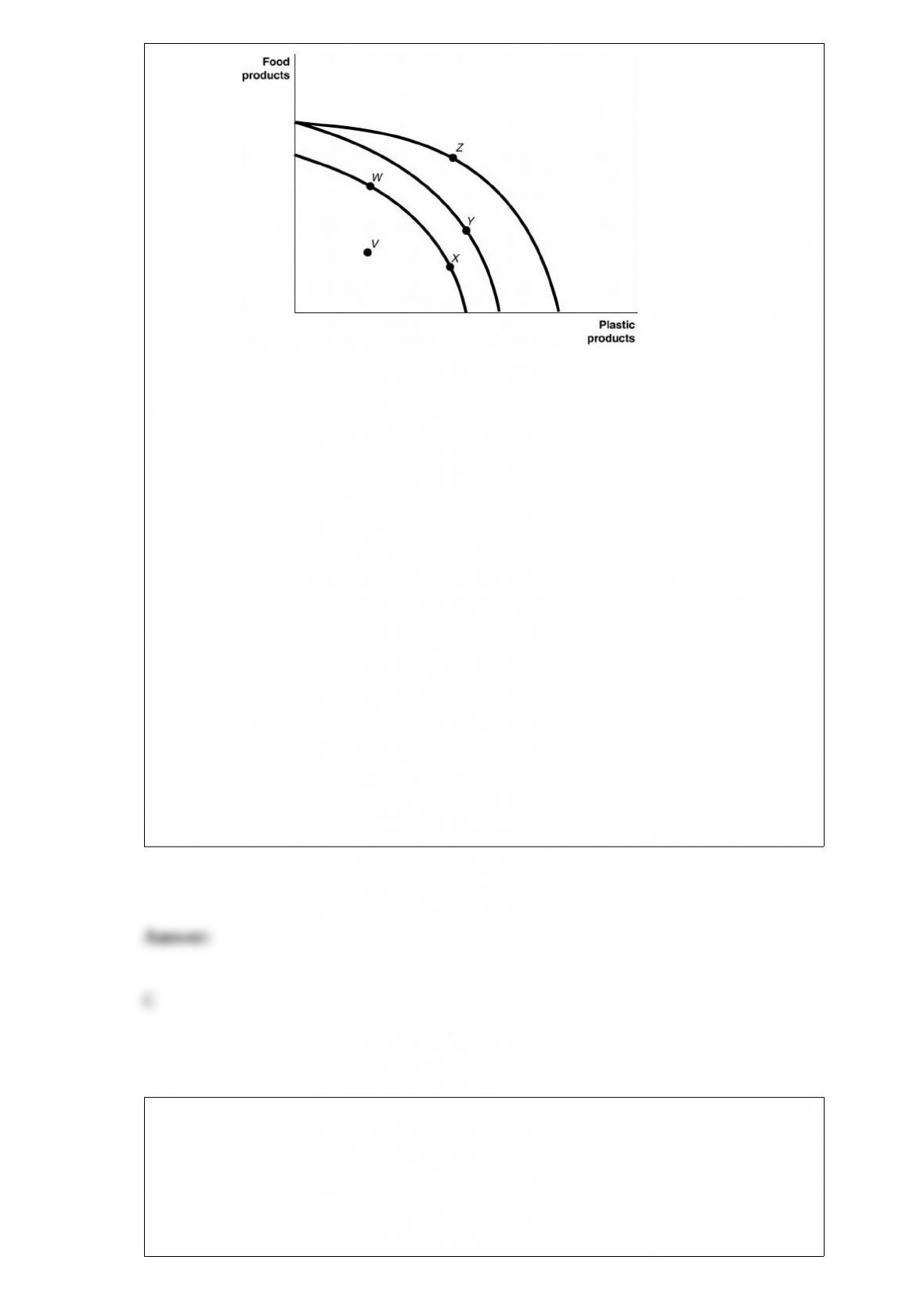
Figure 2-4
Figure 2-4 shows various points on three Different production possibilities frontiers for
a nation.
Consider the following movements:
a. from point V to point W
b. from point W to point Y
c. from point Y to point Z Which of the movements listed above represents
advancements in technology with respect to both plastic production and food
production?
A) a, b, and c
B) b and c only
C) b only
D) c only
The Stogie Shop, a cigar store in the mall, sells hand-rolled cigars for $10.00 and
machine-made cigars for $2.50 each. What is the opportunity cost of buying a
hand-rolled cigar?
A) 4 machine-made cigars
B) one-quarter of a machine-made cigar
C) $10.00
D) $2.50
A tariff
A) makes domestic consumers worse off.
B) makes both domestic producers and consumers worse off.
C) makes everyone better off.
D) makes domestic producers worse off.
What takes place in the indirect finance market?
A) Part ownership of corporations is sold in the form of stocks.
B) Corporate and government bonds are sold to savers.
C) Deposits of savers are accepted and loans made to borrowers.
D) Government purchases of buildings and equipment are sold to the highest bidder.