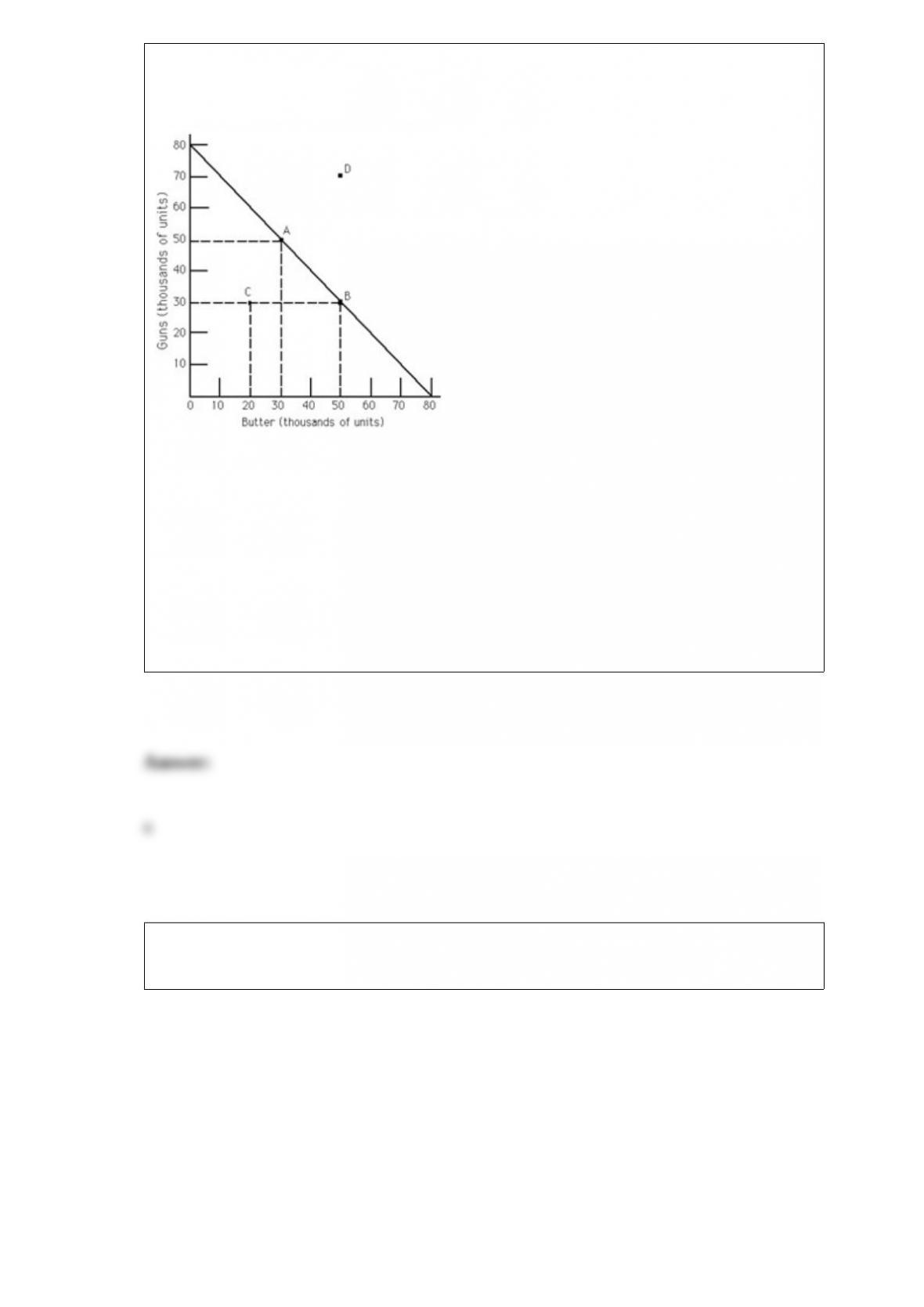
Refer to Exhibit 2-1. A movement from point B to point D
Exhibit 2-1
a. could only happen through economic growth.
b. is necessarily a movement from a productive efficient point to a productive
inefficient point.
c. isa movement from a productive efficient point to another productive efficient point.
d. is necessarily a movement from a productive inefficient point to another productive
inefficient point.
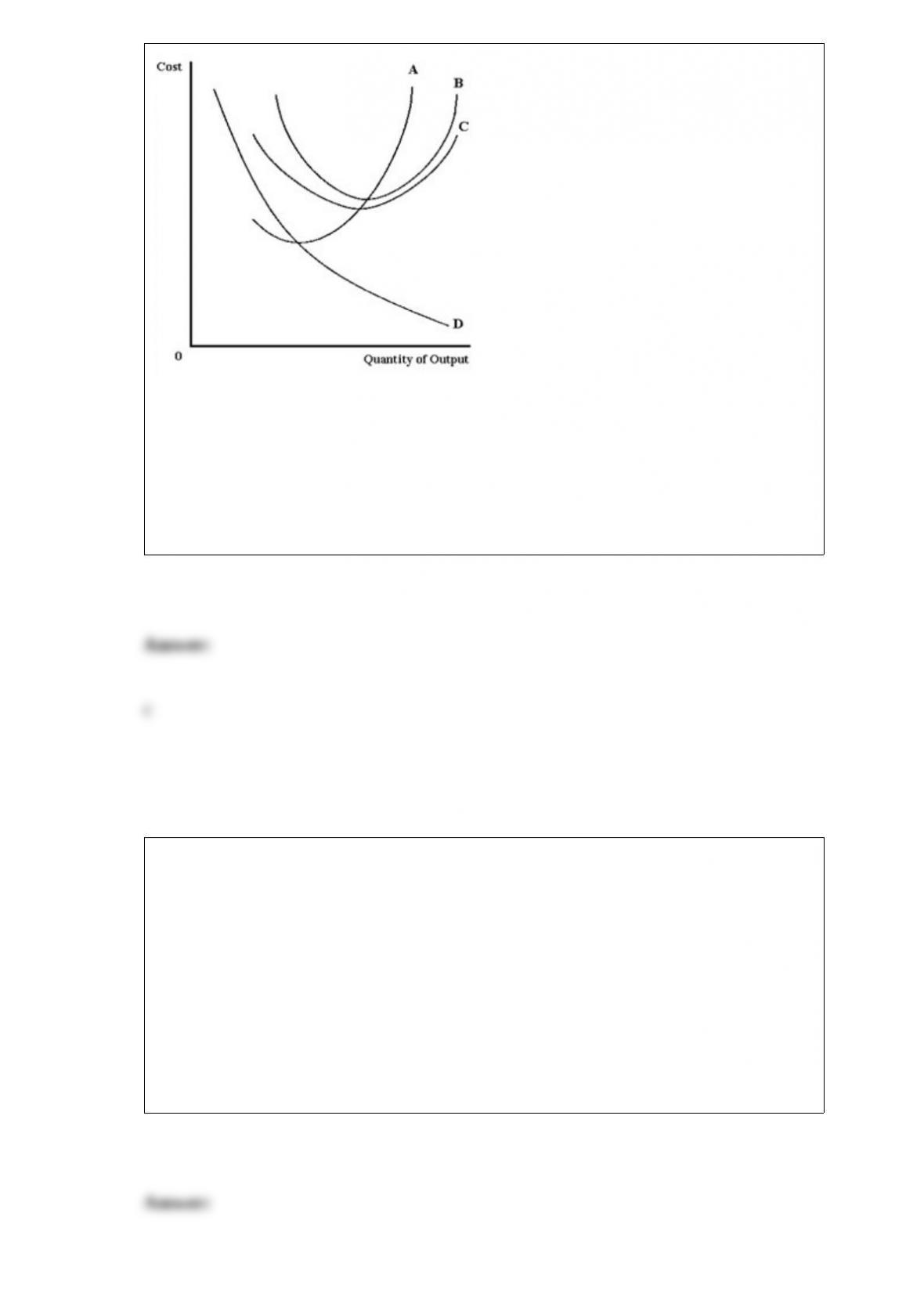
Refer to Exhibit 22-4. Curve B is a(n) __________ cost curve.
Exhibit 22-4
a. marginal
b. average variable
c. average total
d. average fixed
Which of the following is not an assumption of the theory of perfect competition?
a. There are many sellers and many buyers, none of which is large in relation to total
sales or purchases.
b. Each firm produces and sells a differentiated product.
c. Buyers and sellers have all relevant information with respect to prices, product
quality, and sources of supply.
d. There is easy entry and exit.

Productive inefficiency implies that
a. it is possible to obtain gains in one area without losses in another.
b. it is impossible to obtain gains in one area without losses in another.
c. there are too many resources.
d. there are too few resources.
e. none of the above
Income elasticity of demand for an inferior good is
a. less than 0.
b. greater than 1.
c. equal to 1.
d. equal to 0.
e. none of the above
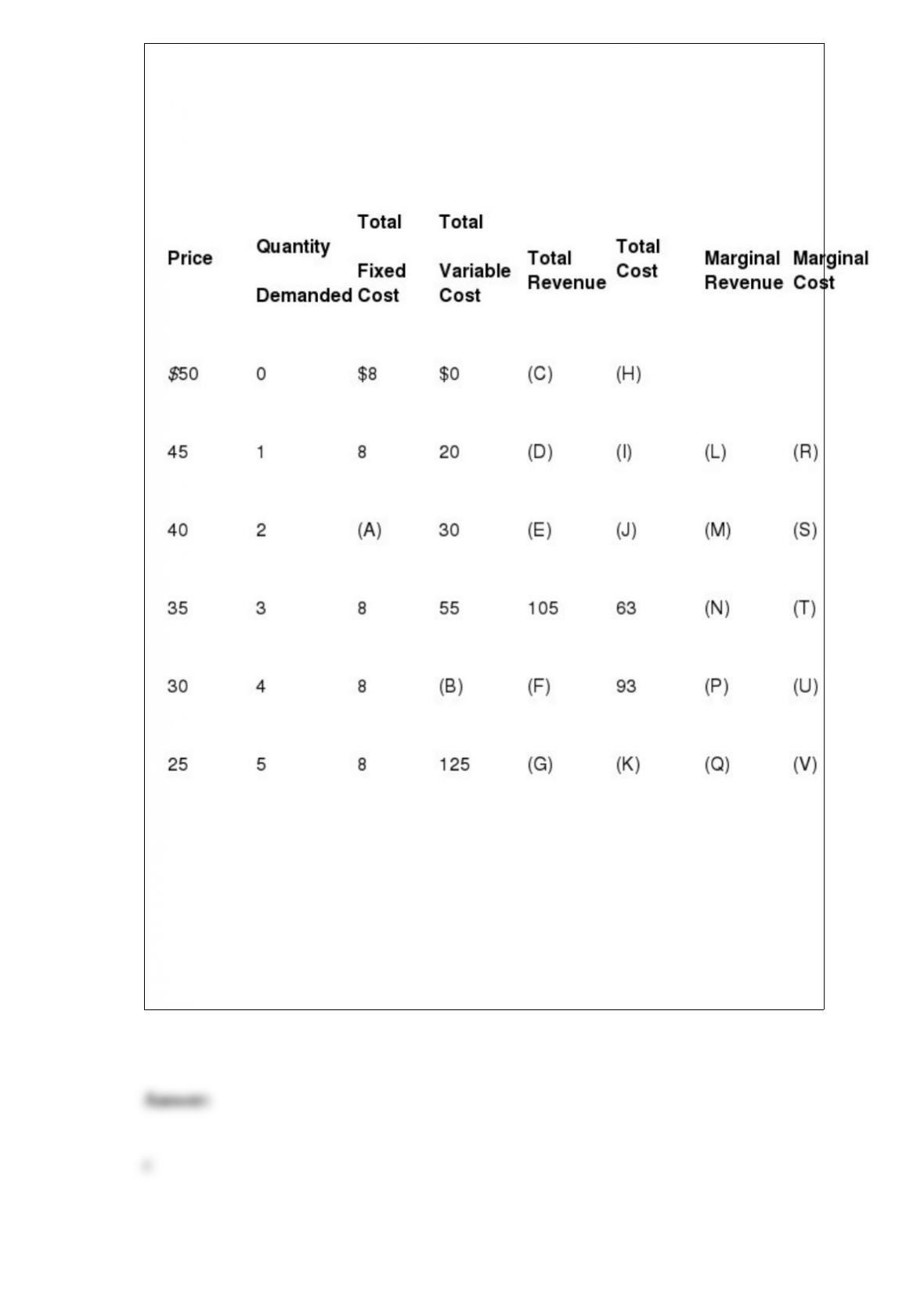
Refer to Exhibit 24-4.What dollar amounts go in blanks (P), (Q), (R), and (S),
respectively?
Exhibit 24-4
a. $90;$80; $53.33; and $60
b. $10; $0; $28; and $19
c. $15; $5; $20; and $10
d. $75; $45; $33.33; and $32.50

If a perfectly competitive firm and a monopolistic competitive firm face the same
demand and cost curves, then
a. the perfectly competitive firm will attain resource-allocative efficiency, but the
monopolistic competitive firm will not.
b. the perfectly competitive firm will attain resource-allocative efficiency, but the
monopolistic competitive firm may or may not, depending upon the demand for its
product.
c. the perfectly competitive firm will not attain resource-allocative efficiency, but the
monopolistic competitive firm will.
d. both the perfectly competitive firm and the monopolistic competitive firm will attain
resource-allocative efficiency.
e. neither the perfectly competitive firm nor the monopolistic competitive firm will
attain resource-allocative efficiency.
If quantity demanded rises by 10 percent as price falls by 4 percent, the price elasticity
of demand equals
a. 0.40.
b. 2.50.
c. 0.04.
d. 14.00.

Points that lie outside (or beyond) the PPF are
a. attainable.
b. unattainable.
c. efficient.
d. inefficient.
Value marginal product (VMP) is
a. a measure of additional revenue minus additional cost as a result of additional output.
b. the price of the product multiplied by the additional output resulting from an
additional factor unit employed.
c. the marginal revenue of the product divided by the additional output resulting from
an additional factor unit employed.
d. the value of an additional unit of product as measured in terms of additional factor
cost.
e. the total value of the total output of a firm divided by the total quantity of output.
If the equilibrium exchange rate between U.S. dollars and Japanese yen is $0.01 = 1

yen, but currently the exchange rate is $0.009 = 1 yen, then with flexible exchange rates
the dollar price of a yen will __________ and the yen will __________.
a. increase; appreciate
b. decrease; appreciate
c. increase; depreciate
d. decrease; depreciate
By looking at the different slices of a pie chart, and comparing one slice to another, it is
possible to quickly estimate
a. relative relationships.
b. absolute relationships.
c. the slope of a line.
d. the slope of a curve.
e. none of the above
“In-kind” transfer payments are made
a. when the recipient performs some service in return for the payment.
b. in the form of goods and services.
c. in the form of lower taxes or tax breaks.
d. in the form of cash.
Minimum efficient scale refers to the
a. smallest plant size a firm can utilize and still maintain production.
b. lowest point on a given SRATC curve.
c. output level at which the LRATC curve touches each SRATC curve.
d. lowest output level at which average total costs are minimized.
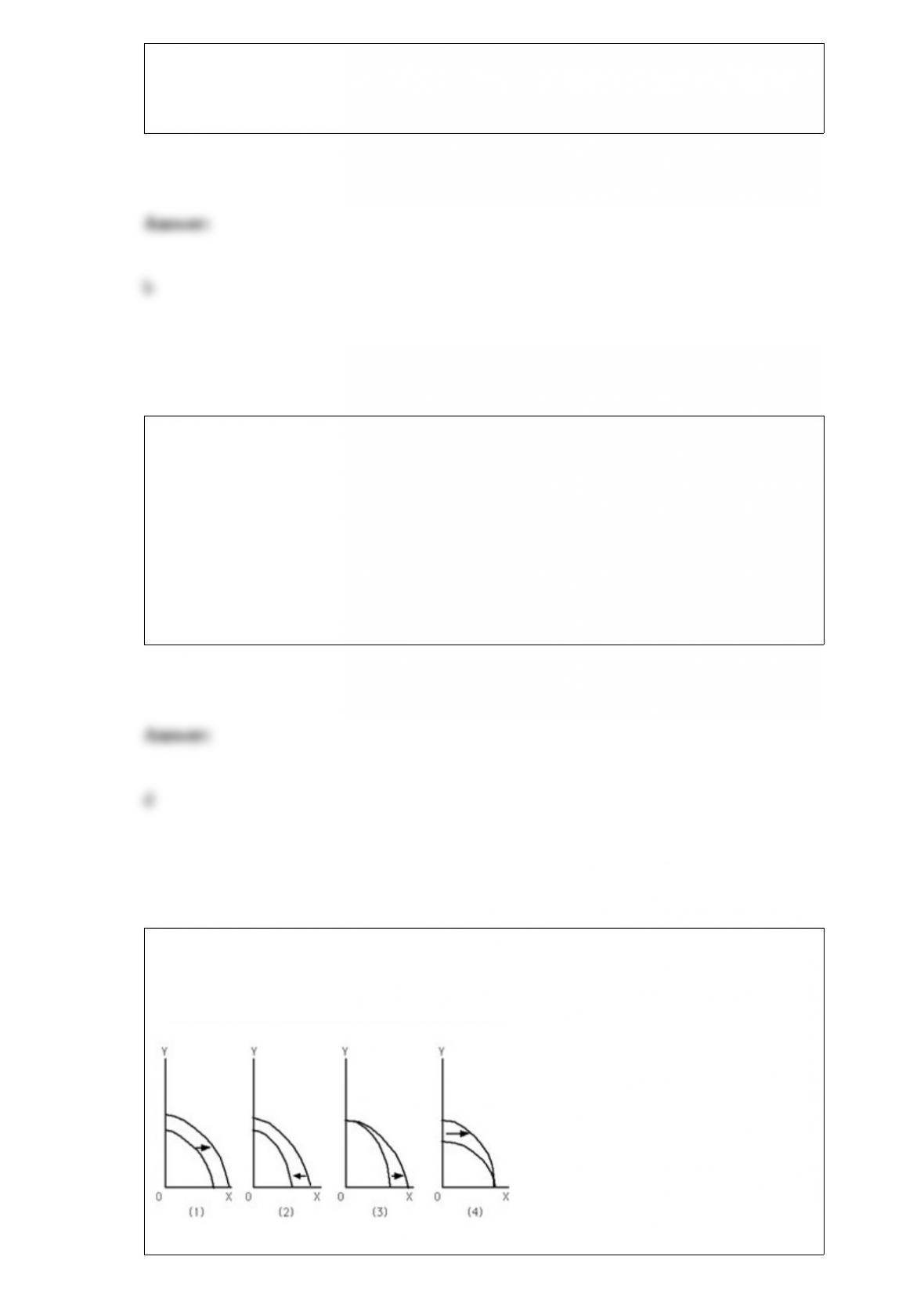
Refer to Exhibit 2-6.Which graph depicts the result of an increase in the number of
illegal immigrants entering the country?
Exhibit 2-6

a. (1)
b. (2)
c. (3)
d. (4)
e. none of the above
Economists usually assume that money has __________ marginal utility.
a. increasing
b. constant
c. decreasing
d. zero
When a firm is experiencing constant returns to scale, it follows that
a. unit costs are rising.
b. average total cost is rising.
c. unit costs are constant.
d. average total cost is constant.
e. c and d
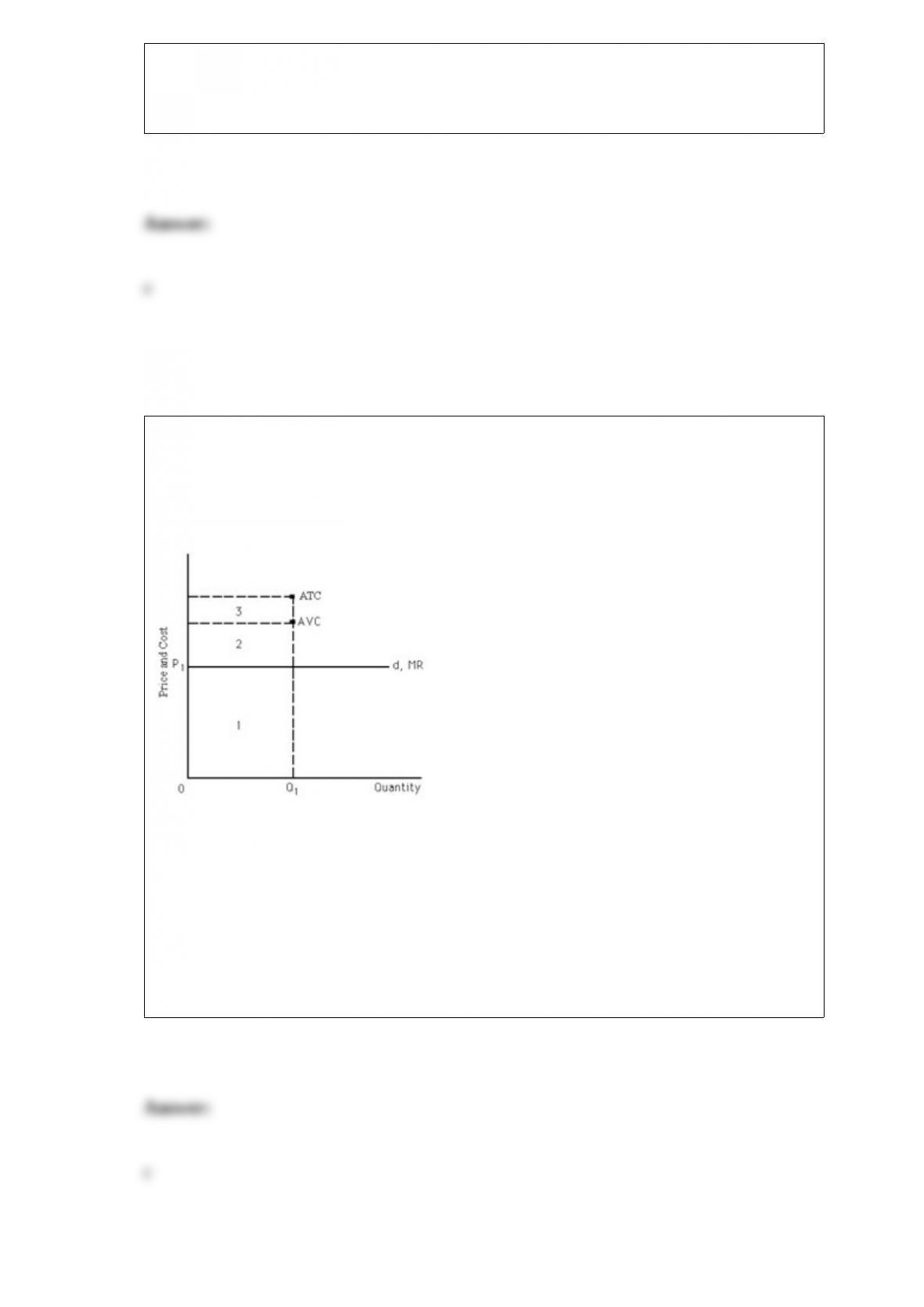
Refer to Exhibit 23-4. The firm sells its product at P1 and produces Q1. Given this
situation,
Exhibit 23-4
a. total variable cost is equal to area 2 + area 3.
b. total revenue is equal to area 1 + area 2.
c. total cost is equal to area 1 + area 2 + area 3.
d. profit equals area 1.
e. none of the above

Which of the following statements is false?
a. If a perfectly competitive firm produces the quantity of output at which MR = MC, it
follows that the firm may or may not be earning a profit.
b. The firm’s supply curve is that portion of its AVC curve that lies above its MC curve.
c. If price is above ATC at the quantity of output at which MR = MC, the firm will be
earning a profit.
d. In long-run competitive equilibrium, price is equal to marginal cost.
Jessica paid $2,300 for a bond with a face value of $2,000. She will be paid $300
annually as long as she holds on to the bond, until the bond’s maturity date. The coupon
rate of the bond is
a. 15.0 percent.
b. 7.5 percent.
c. 13.0 percent.
d. 80.0 percent.
Which of the following statements is false?

a. For a monopolist, the law of diminishing marginal returns does not hold.
b. A monopoly firm will earn profit if it produces the quantity of output at which MR =
MC, and charges a price that is above its average total cost.
c. The monopolist firm searches for the highest per-unit price it can charge for the
quantity of output it produces.
d. The highest per-unit price a monopoly firm can charge is determined by the height of
its demand curve.