
1) Other things being equal, an increase in the default risk of corporate bonds shifts the
demand curve for corporate bonds to the ________ and the demand curve for Treasury
bonds to the ________.
A) right; right
B) right; left
C) left; right
D) left; left
2) The money supply is ________ related to expected deposit outflows, and is
________ related to the market interest rate.
A) negatively; negatively
B) negatively; positively
C) positively; negatively
D) positively; positively
3) A central feature of monetary policy strategies in all countries is the use of a nominal
variable that monetary policymakers use as an intermediate target to achieve an ultimate
goal such as price stability. Such a variable is called a nominal
A) anchor
B) benchmark
C) tether
D) guideline
4) ________ theory relates the quantity of money and monetary policy to changes in
aggregate economic activity and inflation.
A) Monetary
B) Fiscal
C) Financial
D) Systemic
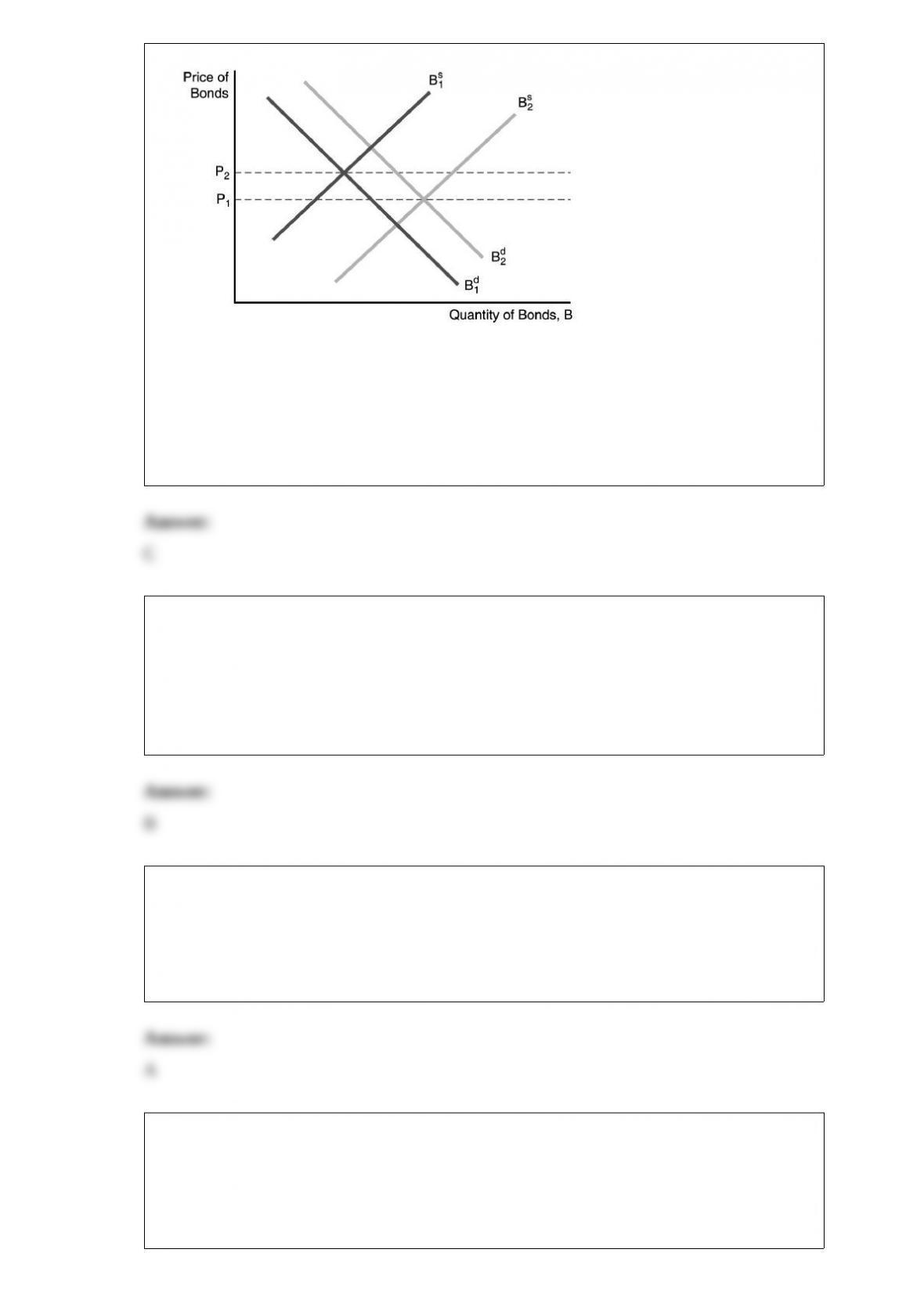
5)
In the figure above, a factor that could cause the supply of bonds to increase (shift to
the right) is:
A) a decrease in government budget deficits
B) a decrease in expected inflation
C) expectations of more profitable investment opportunities
D) a business cycle recession
6) A financial market in which only short-term debt instruments are traded is called the
________ market.
A) bond
B) money
C) capital
D) stock
7) The most comprehensive measure of aggregate output is
A) gross domestic product
B) net national product
C) the stock value of the industrial 500
D) national income
8) An electronic payments system has not completely replaced the paper payments
system because of all of the following reasons except
A) expensive equipment is necessary to set up the system
B) security concerns
C) privacy concerns

D) transportation costs
9) The concept of ________ is based on the common-sense notion that a dollar paid to
you in the future is less valuable to you than a dollar today.
A) present value
B) future value
C) interest
D) deflation
10) The interest rate on secondary credit is set ________ basis points ________ the
primary credit rate.
A) 100; above
B) 100; below
C) 50; above
D) 50; below
11) The interest rate on Treasury Inflation Protected Securities is a direct measure of
A) the real interest rate
B) the nominal interest rate
C) the rate of inflation
D) the rate of deflation
12) Suppose the economy is producing at the natural rate of output. An increase in
consumer and business confidence will cause ________ in real GDP in the long run and
________ in inflation in the long run, everything else held constant.
A) an increase; an increase
B) a decrease; a decrease
C) no change; an increase
D) no change; a decrease

13) The legislative lag represents
A) the time it takes for policy makers to obtain data indicating what is happening in the
economy
B) the time it takes for policy makers to be sure of what the data are signaling about the
future course of the economy
C) the time it takes to pass legislation to implement a particular policy
D) the time it takes for policy makers to change policy instruments once they have
decided on the new policy
E) the time it takes for the policy actually to have an impact on the economy
14) A decrease in the liquidity of corporate bonds will ________ the price of corporate
bonds and ________ the yield of Treasury bonds, everything else held constant.
A) increase; increase
B) decrease; decrease
C) increase; decrease
D) decrease; increase
15) The current international financial system is a managed float exchange rate system
because
A) exchange rates fluctuate in response to, but are not determined solely by, market
forces
B) some countries keep their currencies pegged to the dollar, which is not allowed to
fluctuate
C) all countries allow their exchange rates to fluctuate in response to market forces
D) all countries peg their currencies to the dollar which is allowed to fluctuate in
response to market forces
16) The economic hardship resulting from a financial crises is severe, however, there
are also social consequences such as
A) increased crime
B) difficulty getting a loan
C) currency devaluations
D) loss of output

17) A contract requiring payment of an annual premium in exchange for the payment of
a future stream of payments beginning at a specified age and continuing until death is
A) whole life insurance
B) an annuity
C) term life insurance
D) variable life insurance
E) universal life insurance
18) If the probability of a bond default increases because corporations begin to suffer
large losses, then the default risk on corporate bonds will ________ and the expected
return on these bonds will ________, everything else held constant.
A) decrease; increase
B) decrease; decrease
C) increase; increase
D) increase; decrease
19) If you buy a call option on Treasury futures at 110, and at expiration the market
price is 115, the ________ will ________ exercised.
A) call; be
B) put; be
C) call; not be
D) put; not be
20) Bank capital has both benefits and costs for the bank owners. Higher bank capital
________ the likelihood of bankruptcy, but higher bank capital ________ the return on
equity for a given return on assets.
A) reduces; reduces
B) increases; increases
C) reduces; increases
D) increases; reduces
21) Rules used to predict movements in stock prices based on past patterns are,
according to the efficient markets hypothesis,

A) a waste of time
B) profitably employed by all financial analysts
C) the most efficient rules to employ
D) consistent with the random walk hypothesis
22) Under a fixed exchange rate regime, if a country has an overvalued exchange rate,
then its central bank’s attempt to keep its currency from ________ will result in a
________ of international reserves.
A) depreciating; gain
B) depreciating; loss
C) appreciating; gain
D) appreciating; loss
23) Assume that you borrow $2000 at 10% annual interest to finance a new business
project. For this loan to be profitable, the minimum amount this project must generate
in annual earnings is
A) $400
B) $201
C) $200
D) $199
24) ________ bubble is driven entirely by unrealistic optimistic expectations.
A) An irrational exuberance
B) A credit-driven
C) A stock
D) A debt-driven
25) A sharp depreciation of the domestic currency after a currency crisis leads to
A) higher inflation
B) lower import prices
C) lower interest rates
D) decrease in the value of foreign currency-denominated liabilities