If inventories decline by more than analysts predict they will decline, this implies that
A) actual investment spending was greater than planned investment spending.
B) actual investment spending was less than planned investment spending.
C) actual investment spending was equal to than planned investment spending.
D) there is no relationship between actual investment spending and planned investment
spending.
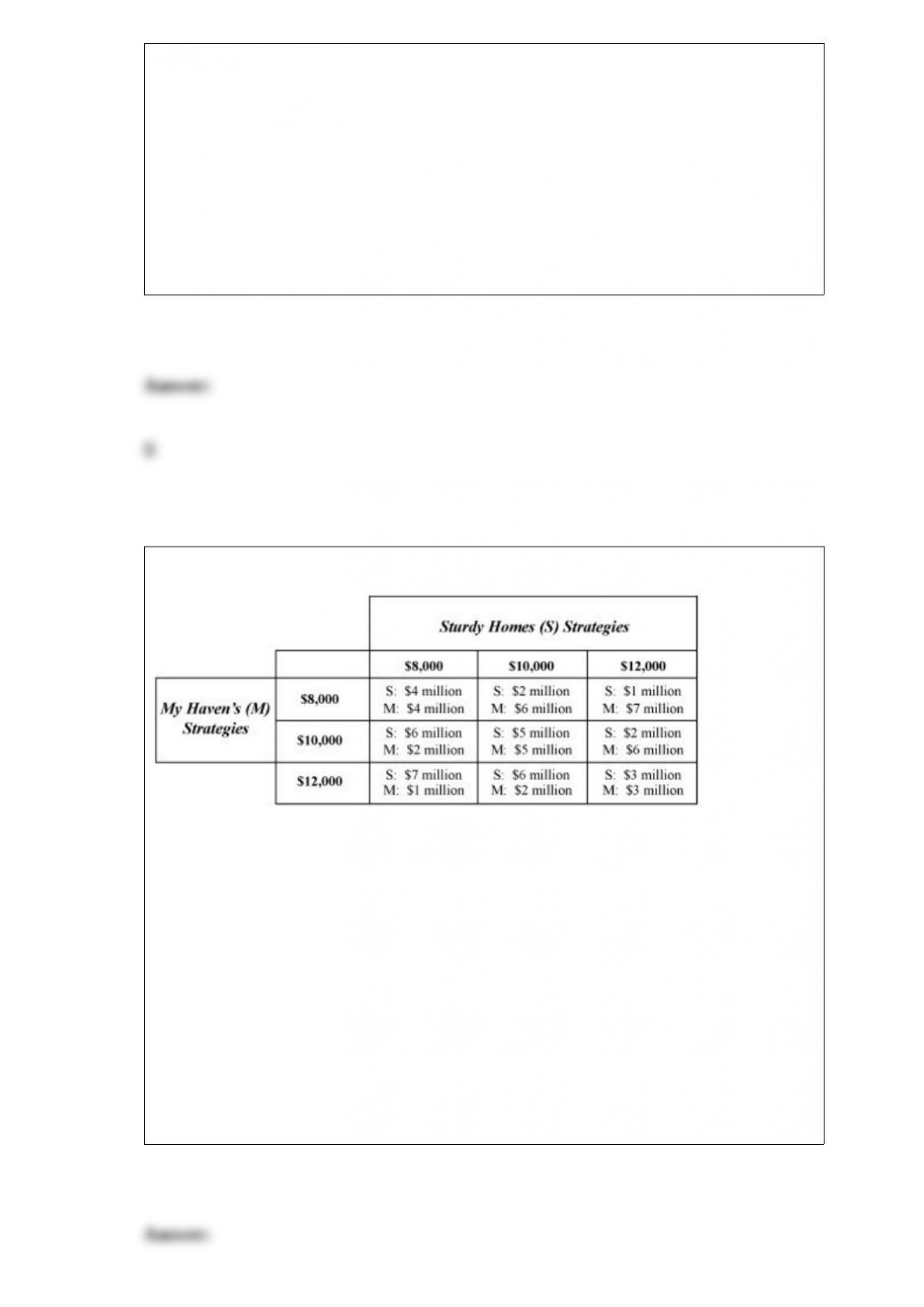
Table 14-6
There are two
mobile home manufacturers in Nevada, Sturdy Homes (S) and My Haven (M). Sturdy
Homes has been in the market for a long time and must now compete with newcomer,
My Haven. Suppose that Sturdy Homes believes that My Haven will match any price it
sets. Use Table 14-6 to answer the following question and assume throughout that
Sturdy Homes believes that My Haven will match any price it sets. What price will
Sturdy Homes charge and what profit does Sturdy Homes expect to make?
A) Price = $8,000; expected profit = $7 million
B) Price = $8,000; expected profit = $4 million
C) Price = $10,000; expected profit = $5 million
D) Price = $12,000; expected profit = $3 million

Suppose the price of gasoline is $3.50 per gallon, the quantity of gasoline demanded is
150 billion gallons per year, the price elasticity of demand for gasoline is -0.06, and the
federal government decides to increase the excise tax on gasoline by $1.00 per gallon,
which increases the price of gasoline by $0.75 per gallon. What is the new equilibrium
quantity of gasoline demanded after the tax is imposed?
A) 109.72 billion gallons per year
B) 127.25 billion gallons per year
C) 148.27 billion gallons per year
D) 161.61 billion gallons per year
Assume you set up a sole proprietorship and your lawyer tells you that as the owner you
will face unlimited liability. What does that mean?
A) You are liable for organizing the business.
B) You could stand to lose your personal wealth if the business goes bankrupt.
C) There is no legal responsibility of the business in case a customer sues, as the
business is legally untouchable.
D) None of these explain what unlimited liability means.

Fiat money has
A) little to no intrinsic value but is backed by the quantity of gold held by the central
bank.
B) little to no intrinsic value and is authorized by the central bank or governmental
body.
C) value, because it can be redeemed for gold by the central bank.
D) a great intrinsic value that is independent of its use as money.
The ________ curve is vertical.
A) short-run aggregate supply
B) short-run aggregate demand
C) long-run aggregate supply
D) long-run aggregate demand
Included on the board of directors of Microsoft are Dina Dublon, former chief financial
officer of JP Morgan Chase, the president of Harvey Mudd college Maria M. Klawe,
and the vice chairman of Bank of America Charles H. Noski. These three board
members do not have a direct management role with Microsoft and are therefore
referred to as
A) inside directors.

B) outside directors.
C) competitive directors.
D) honorary directors.
Forecasts made by White House economists and economists at the Congressional
Budget Office in 2011 projected that real GDP
A) would return to potential GDP by the end of 2011.
B) would not return to potential GDP until the first quarter of 2013.
C) would not return to potential GDP until 2016.
D) would never return to potential GDP.
Figure 12-5
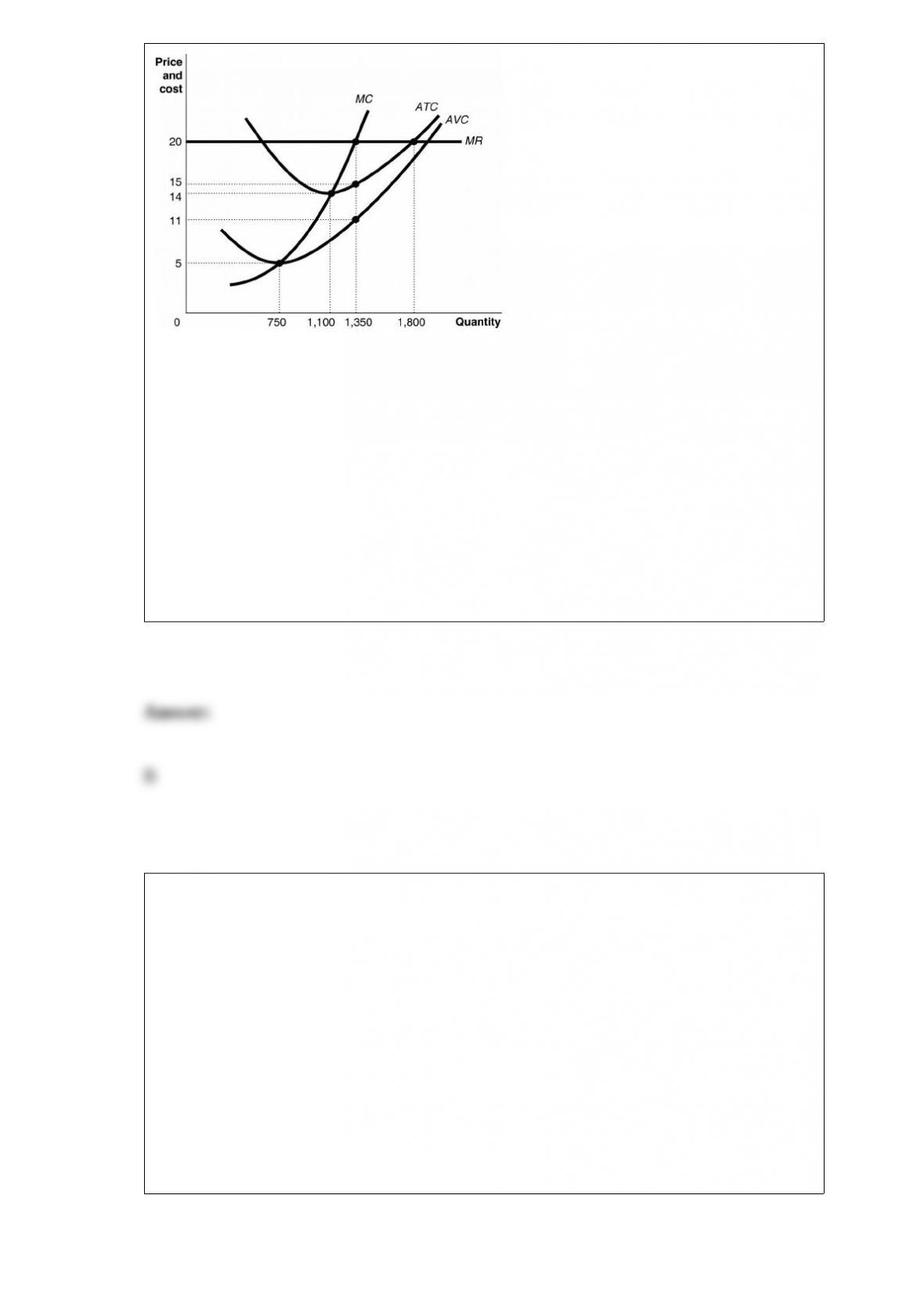
Figure 12-5 shows cost and demand
curves facing a typical firm in a constant-cost, perfectly competitive industry. The firm’s
manager suggests that the firm’s goal should be to maximize average profit. In that case,
what is the output level and what is the average profit that will achieve the manager’s
goal?
A) Q = 1,350 units, average profit =$5
B) Q = 1,100 units, average profit =$6
C) Q = 1,350 units, average profit =$9
D) Q = 1,800 units, average profit =$20
Trade-offs force society to make choices when answering what three fundamental
questions?
A) What will be the prices of goods and services; how will these goods and services be
produced; and who will receive them?
B) What goods and services to produce; how will these goods and services be produced;
and who receives them?
C) Who gets jobs; what wages do workers earn; and who owns what property?
D) How much will be saved; what will be produced; and how can these goods and
services be fairly distributed?

In contrast with perfect competition, excess capacity characterizes monopolistic
competition. Excess capacity is due to which of the following?
A) Monopolistically competitive firms produce at the minimum point on their average
total cost curves.
B) Monopolistically competitive firms face downward-sloping demand curves. In the
long run, firms produce where their demand curves are tangent to their long-run
average total cost curves.
C) Monopolistically competitive firms produce where marginal revenue is equal to
marginal cost.
D) Monopolistically competitive markets have low barriers to entry.
________ exists because unlimited wants exceed the limited resources available to
fulfill those wants.
A) Scarcity
B) Productive efficiency
C) The command economy
D) Economic growth

The “ability-to-pay” principle of taxation is the normative idea that
A) an equitable tax system is one in which high income individuals should bear a
greater burden of taxes than low income individuals.
B) each individual should voluntarily contribute according to her ability to pay taxes.
C) progressive taxes are more equitable than regressive taxes.
D) two individuals earning the same income should have equal ability to pay, all else
constant.
The Business Cycle Dating Committee defines a recession as
A) two consecutive quarters of declining real GDP.
B) two consecutive quarters of declining nominal GDP.
C) a significant decline in activity visible in industrial production, employment, real
income, and wholesale/retail trade lasting more than a few months.
D) a significant decline in inflation and unemployment lasting more than a few months.
An increase in the price level results in a(n) ________ in the quantity of real GDP
demanded because ________.
A) decrease; a higher price level reduces consumption, investment, and net exports.

B) increase; a higher price level reduces consumption, investment, and net exports.
C) decrease; a higher price level increases consumption, investment, and net exports.
D) increase; a higher price level increases consumption, investment, and net exports.
In a study conducted by Marianne Bertrand and Sendhil Mullianthan, identical resumes
were sent in response to help wanted ads in newspapers, with half of the resumes
assigned an African-American-sounding name and half assigned a white-sounding
name. The study found that
A) employers were equally likely to interview workers with white-sounding names and
with African-American-sounding names.
B) employers were 50 percent more likely to interview workers with
African-American-sounding names.
C) employers were 50 percent more likely to interview workers with white-sounding
names.
D) no employers chose to interview workers with African-American-sounding names.
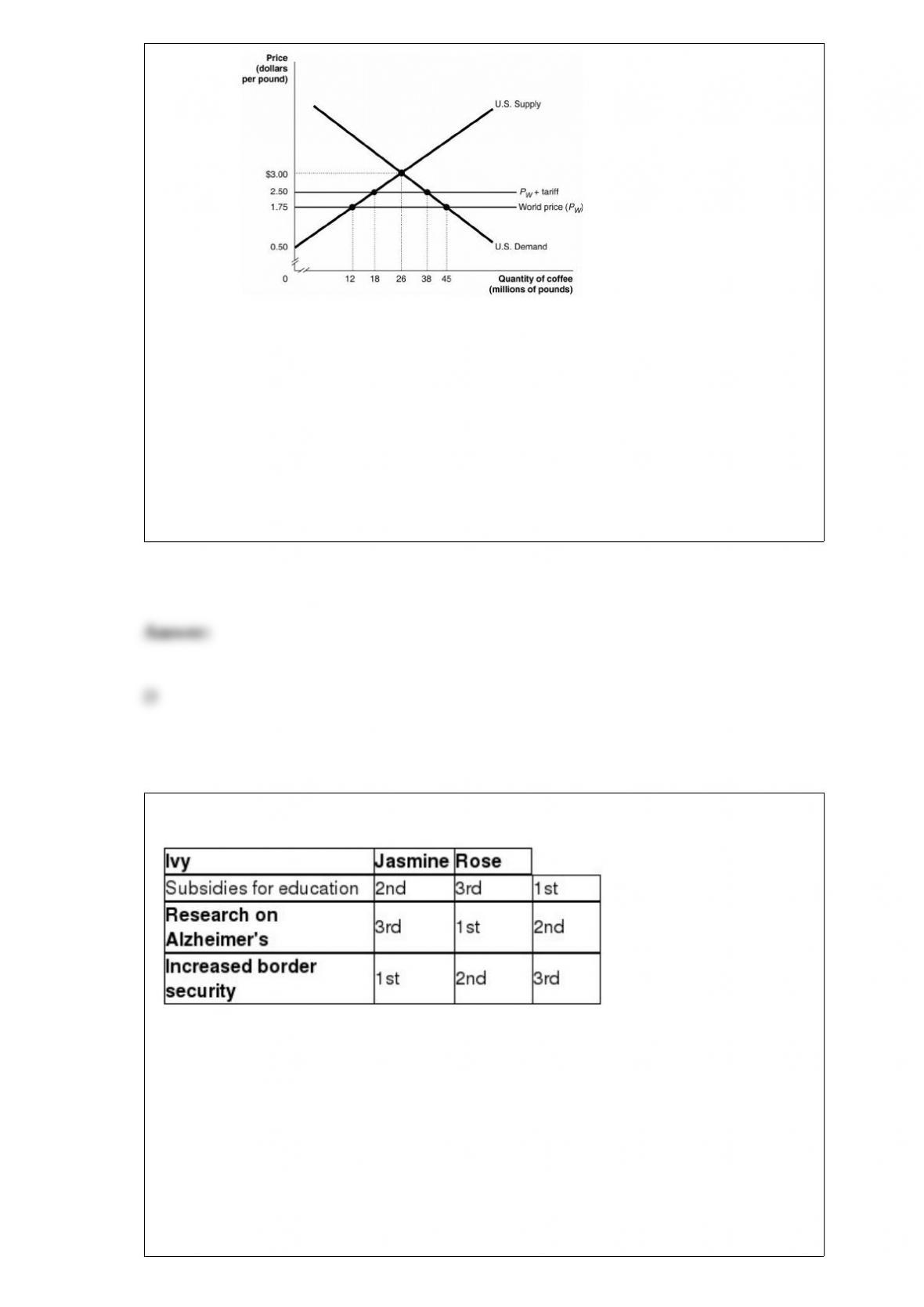
Figure 7-2 Suppose the U.S. government
imposes a $0.75 per pound tariff on coffee imports. Figure 7-2 shows the impact of this
tariff. Without the tariff in place, the United States consumes
A) 12 million pounds of coffee.
B) 26 million pounds of coffee.
C) 33 million pounds of coffee.
D) 45 million pounds of coffee.
Table 18-1
Suppose $1 billion is available in the budget and Congress is considering allocating the
funds to one of the following three alternatives: 1) Subsidies for education, 2) Research
on Alzheimer’s or 3) Increased border security. Table 18-1 shows three voters’ rankings
of the alternatives.
Suppose a series of votes are taken in which each pair of alternatives is considered in
turn. The first pair considered is between subsidies for education and research on
Alzheimer’s. The second pair considered is between Alzheimer’s research and increased
border security. The third pair considered is between education subsidies and increased
border security. In this case, the collective preferences of the voters

A) turn out to be transitive and will yield a consistent outcome.
B) turn out to be transitive but will not result in a consistent outcome.
C) turn out not to be transitive and will not result in a consistent outcome.
D) turn out not to be transitive but will yield a consistent outcome.
The relationship between the inputs employed by a firm and the maximum output that it
can produce with those inputs is the firm’s
A) production function.
B) supply curve, or supply schedule.
C) marginal product of labor.
D) average product of labor.