
1) A merger between an automobile manufacturer and a maker of automobile tires is an
example of a:
A.conglomerate merger.
B.horizontal merger.
C.vertical merger.
D.tying contract.
2) by an increase in demand we mean that :
a.product price has fallen so consumers move down to a new point on the demand
curve.
b.the quantity demanded at each price in a set of prices is greater.
c.the quantity demanded at each price in a set of prices is smaller.
d.a leftward shift of the demand curve has occurred.
3) Which of the following would move the Lorenz curve closer to the diagonal?
A.a 20 percent boost in Social Security retirement benefits
B.an increase in payroll taxes
C.a reduction in the progressiveness of the Federal personal income tax
D.the elimination of the TANF program
4) Which of the following is correct?
A.Both the granting and repaying of bank loans expand the aggregate money supply.
B.Granting and repaying bank loans do not affect the money supply.
C.Granting a bank loan destroys money; repaying a bank loan creates money.
D.Granting a bank loan creates money; repaying a bank loan destroys money.
5) the national income and product accounts (nipa) help economists and policymakers
to:
a.design and implement policies to improve the economy’s health.
b.follow the long-run course of the economy to determine whether it has grown or
stagnated.
c.assess the health of the economy by comparing output levels at regular intervals.
d.accomplish all of the above.
6) The real-balances effect indicates that:
A.an increase in the price level will increase the demand for money, increase interest
rates, and reduce consumption and investment spending.
B.a lower price level will decrease the real value of many financial assets and therefore
reduce spending.
C.a higher price level will increase the real value of many financial assets and therefore
increase spending.
D.a higher price level will decrease the real value of many financial assets and therefore
reduce spending.
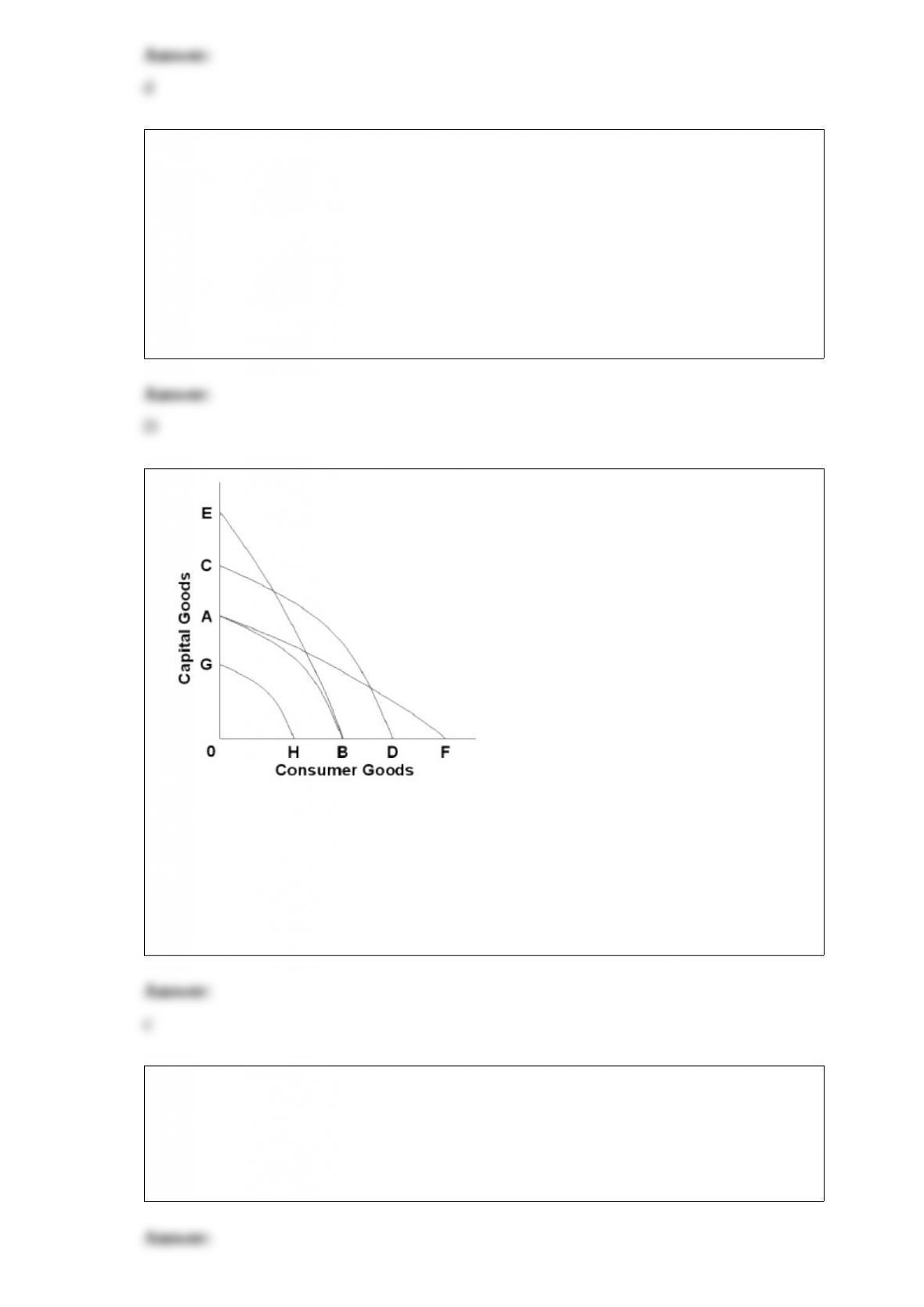
7)
refer to the above diagram. technological advance that is useful in producing consumer
goods but not in producing capital goods is shown by the shift of the production
possibilities curve from ab to:
a.cd.
b.eb.
c.af.
d.gh.
8) When the market for money is in equilibrium:
A.the quantity of money demanded equals the quantity of money supplied.
B.the interest rate is increasing.
C.bond prices are falling.
D.the interest rate is declining.
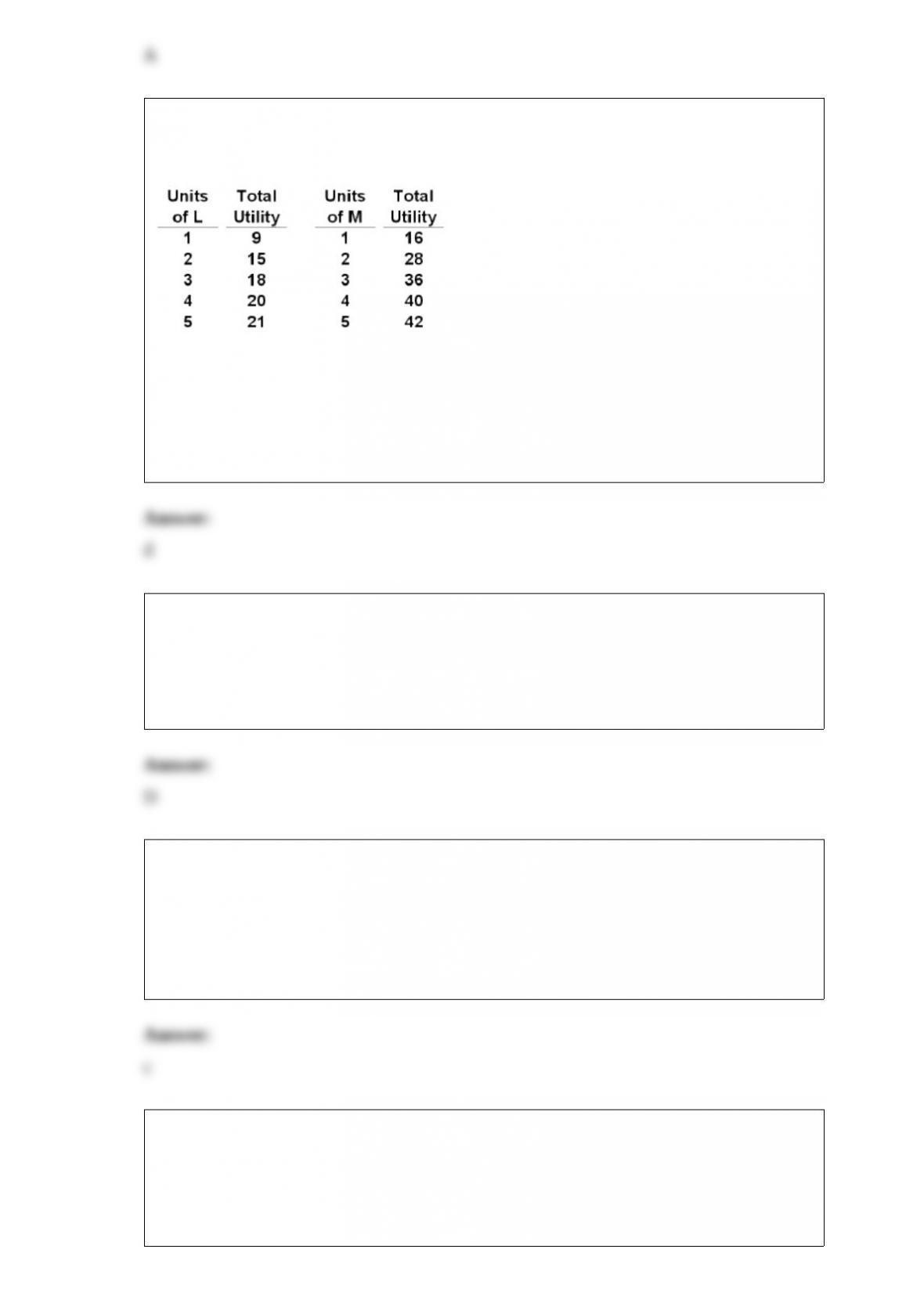
9) the following total utility data for products l and m. assume that the prices of l and m
are $3 and $4 respectively and that the consumer’s income is $18.
refer to the above data. how many units of the two products will the consumer
purchase?
a.3 of l and none of m
b.4 of l and 2 of m
c.3 of l and 5 of m
d.2 of l and 3 of m
10) In 2007, the U.S. Federal debt held by the public was:
A.held largely by foreign governments.
B.about four times as large as the GDP.
C.about twice as large as the GDP.
D.about a third as large as the GDP.
11) because of modern economic growth, the worldwide average lifespan has grown to
about _____ years since the late 1700s.
a.32
b.56
c.67
d.78
12) in drawing a budget line it is assumed that:
a.consumer preferences are fixed.
b.the prices of the two products are variable.
c.money income is fixed.
d.consumer willingness to substitute between the two products is fixed.
13) Total Allowable Catch policies and Individual Transferable Quotas both:
A.limit catch sizes and promote efficiency.
B.limit catch sizes, but TACs promote inefficiency.
C.promote efficiency, but only TACs limit catch sizes.
D.promote efficiency, but only ITQs limit catch sizes.
14) How will the following situations affect the investment demand curve?
(a)A new type of engine is developed that is more fuel efficient.
(b)To lessen the fiscal deficit, Congress increases corporate taxes.
(c)Unplanned inventories rise to new highs.
(d)A firm decides to increase its current inventory levels.
15) According to mainstream economists, a restrictive monetary policy might be
frustrated, wholly or in part, by:
A.Treasury sales of gold bullion.
B.a Treasury surplus.
C.the desire of households and businesses to hold smaller money balances.
D.a decrease in V.
16) which of the following is a short-run adjustment?
a.a local bakery hires two additional bakers.
b.six new firms enter the plastics industry.
c.the number of farms in the united states declines by 5 percent.
d.bmw constructs a new assembly plant in south carolina.
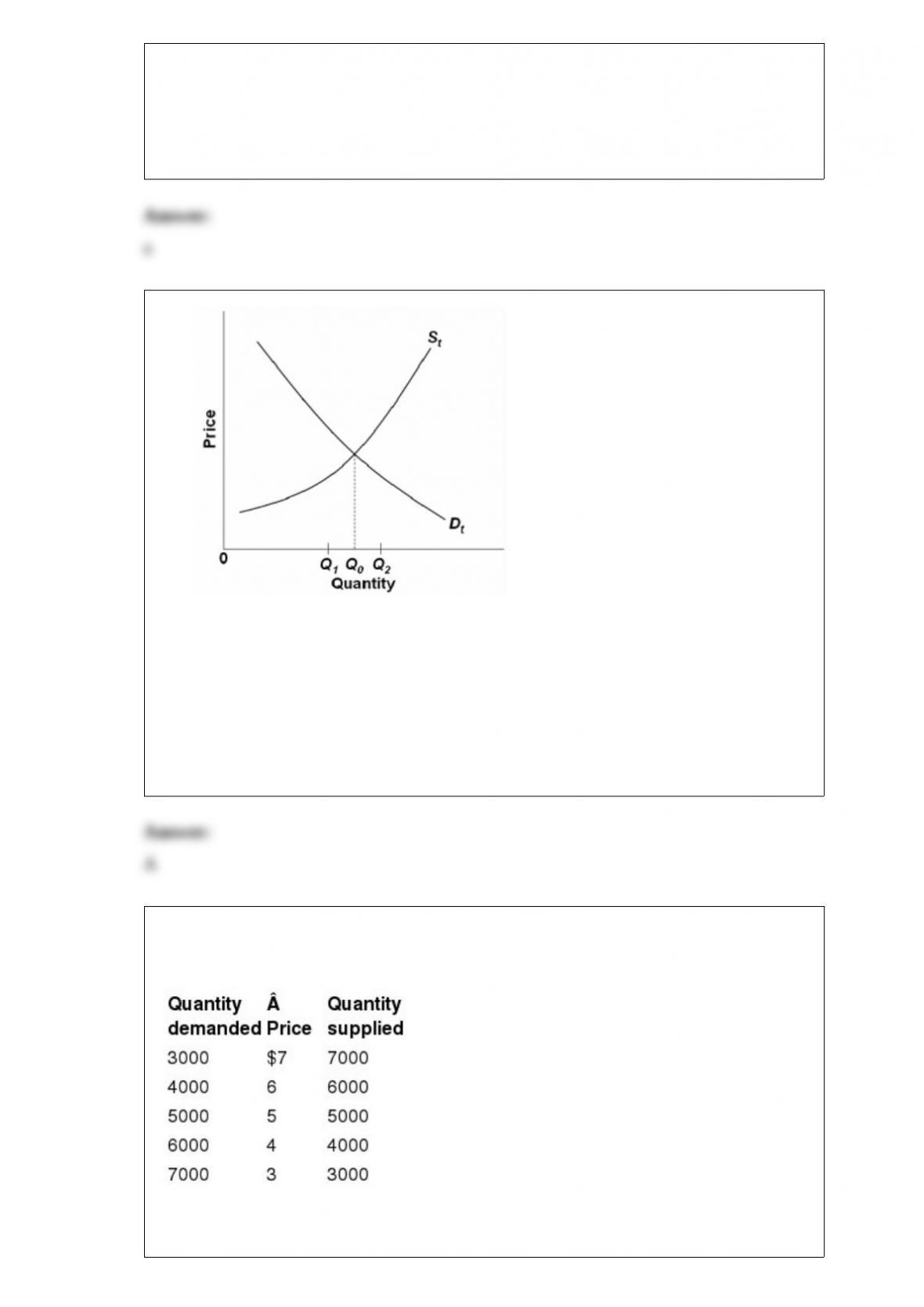
17)
Refer to the above diagram of the market for product X. Curve St embodies all costs
(including externalities) and Dt embodies all benefits (including externalities)
associated with the production and consumption of X. Assuming the equilibrium output
is Q2, we can conclude that the existence of external:
A.costs has resulted in an overallocation of resources to X.
B.benefits has resulted in an overallocation of resources to X.
C.costs has resulted in an underallocation of resources to X.
D.benefits has resulted in an underallocation of resources to X.
18) Answer the next two questions on the basis of the following demand and supply
data for a competitive market:
(a)If government levies a per unit excise tax of $2 on suppliers of this product, what
would the equilibrium price and quantity be? How much tax will be paid?

(b)If government has instead provided a per unit subsidy of $2 to suppliers of this
product, what would the equilibrium price and quantity be?
19) Which of the following is correct?
A.Required reserves minus actual reserves equal excess reserves.
B.Required reserves equal excess reserves minus actual reserves.
C.Required reserves equal actual reserves plus excess reserves.
D.Actual reserves minus required reserves equal excess reserves.