
Suppose the required reserve ratio is 20 percent. If banks are conservative and choose
not to loan all of their excess reserves, the real-world deposit multiplier is
A) less than 5.
B) equal to 5.
C) greater than 5.
D) equal to 20.
Suppose a firm uses labor and capital to produce output. The last unit of labor hired has
a marginal product of 12 units of output, and the last unit of capital employed has a
marginal product of 20 units. Use the optimal combination of inputs rule to calculate
the price of capital if the price of labor is $6 per unit. The price of capital is
A) $2.
B) $10.
C) $20.
D) impossible to determine with the information given.
Vipsana’s Gyros House sells gyros. The cost of ingredients (pita, meat, spices, etc.) to
make a gyro is $2.00. Vipsana pays her employees $60 per day. She also incurs a fixed
cost of $120 per day. What is Vipsana’s total cost per day when she does not produce

any gyros and does not hire any workers?
A) $0
B) $2
C) $60
D) $120
In a typical year, ________ new firms open in the United States.
A) more than 600,000
B) more than 1 million
C) less than 200,000
D) approximately 125,000
Sequential games are used to analyze
A) firms that are subject to the prisoner’s dilemma.
B) cartels.
C) second-price auctions.
D) situations in which one firm acts and other firms respond.
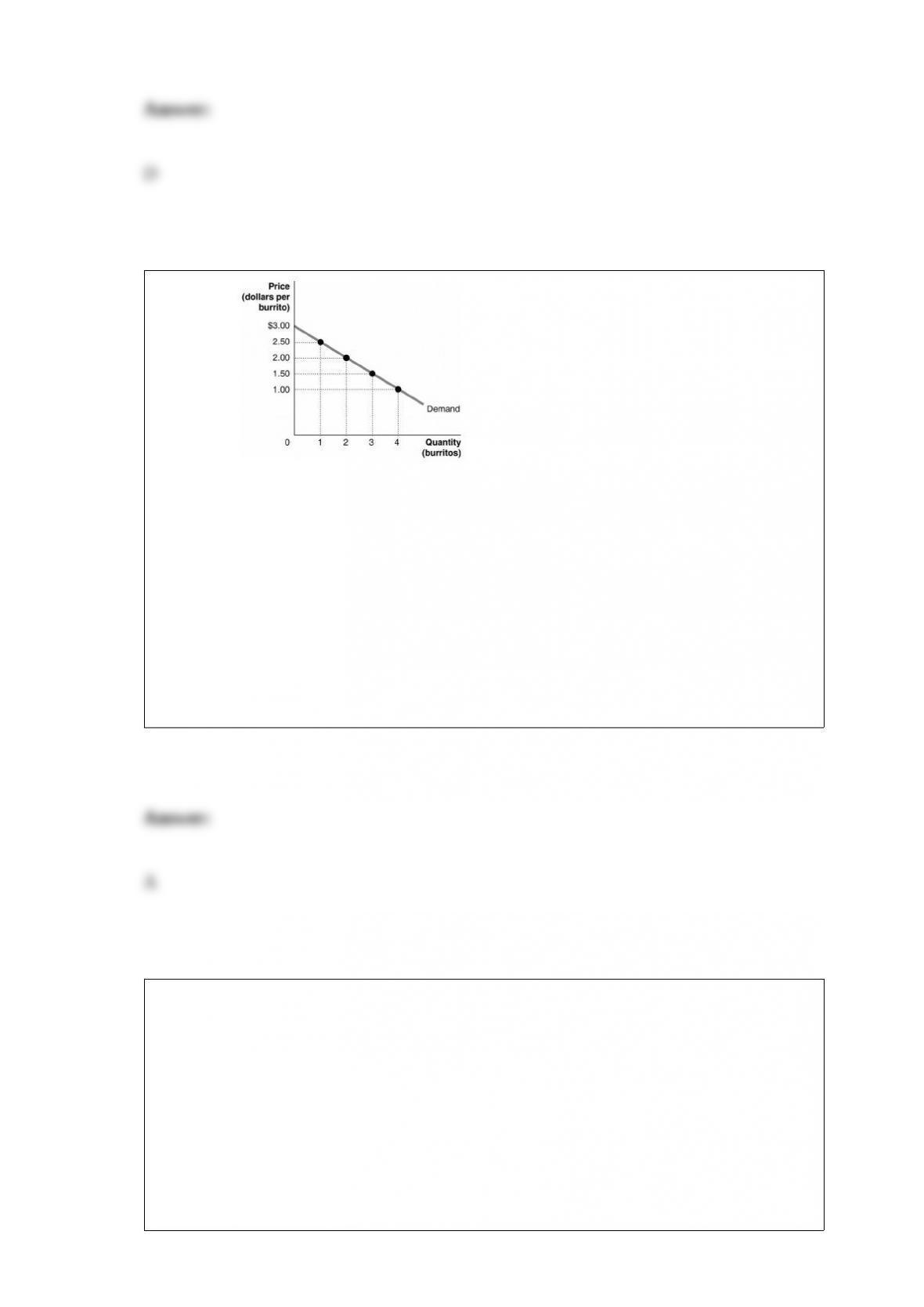
Figure 4-1 Figure 4-1 shows Arnold’s demand curve for
burritos.
If the market price is $1.00, what is the consumer surplus on the third burrito?
A) $0.50
B) $1.00
C) $1.50
D) $7.50
In the long run, what happens to the demand curve facing a monopolistically
competitive firm that is earning short-run profits?
A) The demand curve will shift to the left and became more elastic.
B) The demand curve will shift to the left and became less elastic.
C) The demand curve will shift to the right and became more elastic.
D) The demand curve will shift to the right and became less elastic.
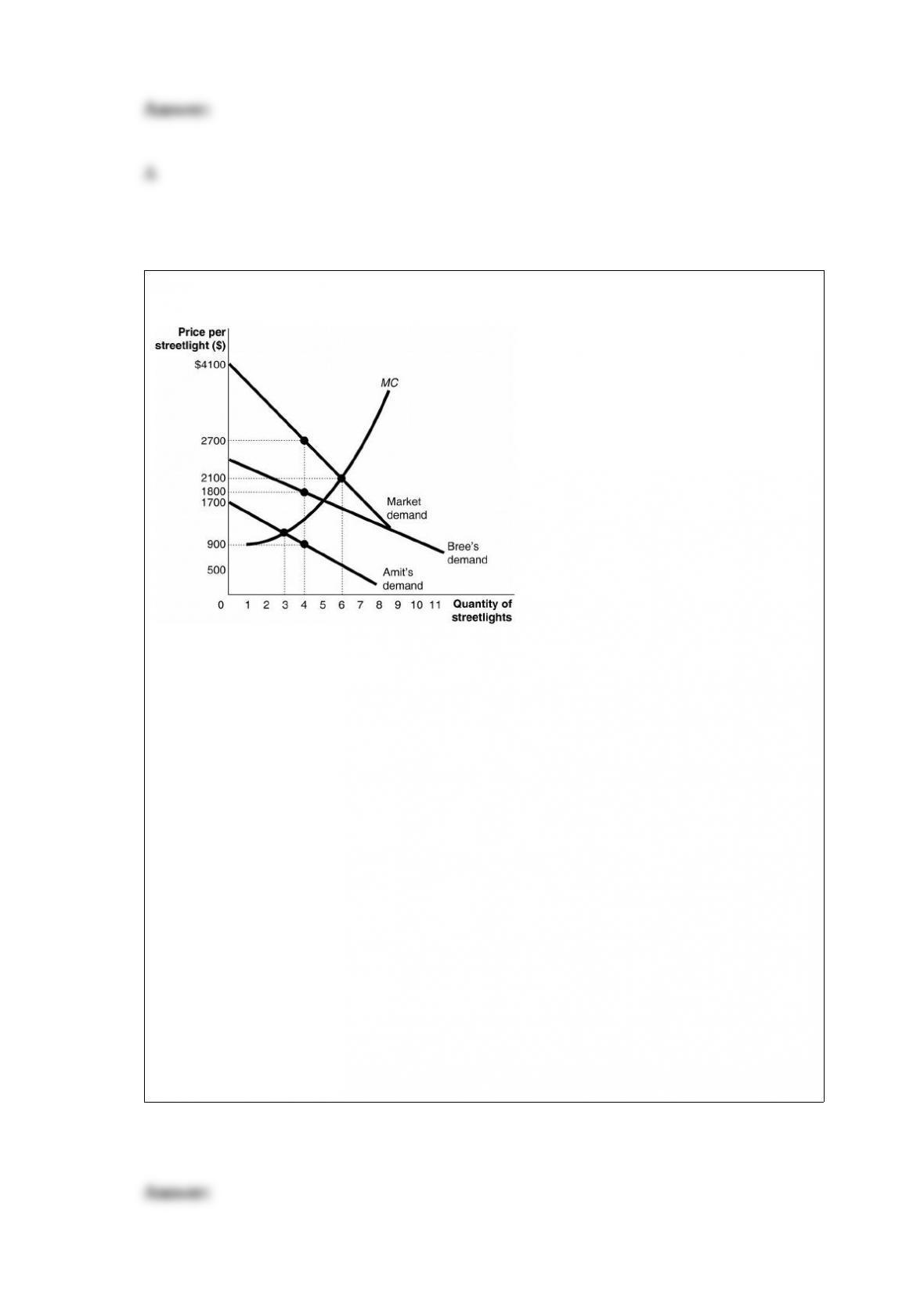
Figure 5-16
Amit and Bree are the only two
homeowners on an isolated private road. Both agree that installing street lights along
the road would be beneficial and want to do so. Figure 5-16 shows their willingness to
pay for different quantities of street lights, the market demand for street lights and the
marginal cost of installing the street lights.
Suppose Amit and Bree know each other’s preferences so that it is not possible for one
to deceive the other. Which of the following statements best describes the
circumstances under which the optimal quantity of street lights could be achieved?
A) The optimal quantity will be installed only if the two parties agree to pay according
to their willingness to pay as indicated by their respective demand curves.
B) Because there are only two consumers, it is likely that private bargaining will result
in the optimal quantity being installed.
C) The optimal quantity will be installed only if the two parties split the cost of
installation equally.
D) The optimal quantity will be installed only if Bree pays for the entire installation
cost.

If the exchange rate between the U.S. dollar and the Indian rupee (rupees per dollar) is
greater than the relative purchasing power between the two countries, which of the
following would be true?
A) There are opportunities for profit by purchasing goods in India and then selling them
in the United States.
B) Purchasing power parity predicts that the value of the dollar will rise as traders take
advantage of arbitrage opportunities.
C) Purchasing power parity predicts that the dollar is undervalued as traders take
advantage of arbitrage opportunities.
D) There are no arbitrage opportunities for which traders can take advantage.
In a small Asian country, it is estimated that changing the level of capital from $8
million to $12 million will increase real GDP from $5 million to $6 million. If the
number of hours worked in the labor force does not change, what does this information
tell you about the slope of the per-worker production function in this range?
A) The slope is -4.
B) The slope is 1/4.
C) The slope is 4.
D) The slope is 8.
Investment spending will increase when
A) the interest rate rises.
B) the corporate income tax increases.
C) business cash flow increases.
D) firms become more pessimistic about earning future profits.
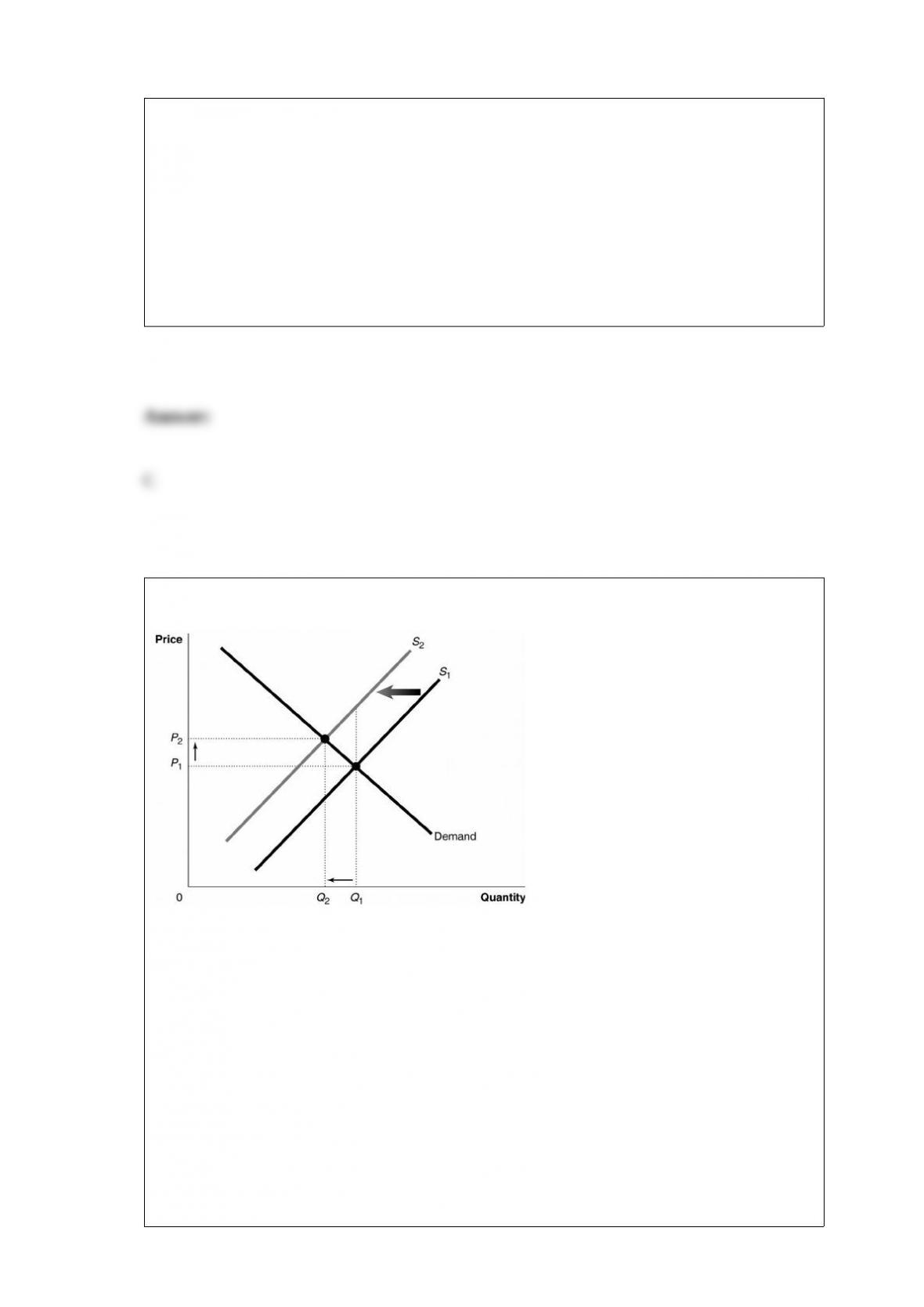
Figure 5-1
Figure 5-1 shows a market with an
externality. The current market equilibrium output of Q1 is not the economically
efficient output. The economically efficient output is Q2. If, because of an externality,
the economically efficient output is Q2 and not the current equilibrium output of Q1,
what does S2 represent?
A) the market supply curve reflecting private cost
B) the market supply curve reflecting social cost
C) the market supply curve reflecting external cost
D) the market supply curve reflecting implicit cost

Voluntary exchange between buyers and sellers generates ________ in a market
economy.
A) scarcity
B) allocative efficiency
C) productive efficiency
D) equity
If a consumer always buys goods rationally, then
A) the total utilities of the different goods consumed will be equal.
B) the average utilities of the different goods consumed will be equal.
C) the marginal utility per dollar spent on all goods will be equal.
D) the marginal utility of the different goods consumed will be equal.

A tax imposed by a government on imports of a good into a country is called
A) an import levy.
B) an import fine.
C) a tariff.
D) an import quota.
Who selects the board of directors of a corporation?
A) the state where the corporation is chartered
B) employees
C) stockholders
D) managers
Which of the following is true?
A) National income = Consumption + Savings – Taxes
B) National income = Consumption – Savings – Taxes
C) National income = Consumption + Savings + Taxes
D) National income = Consumption – Savings + Taxes
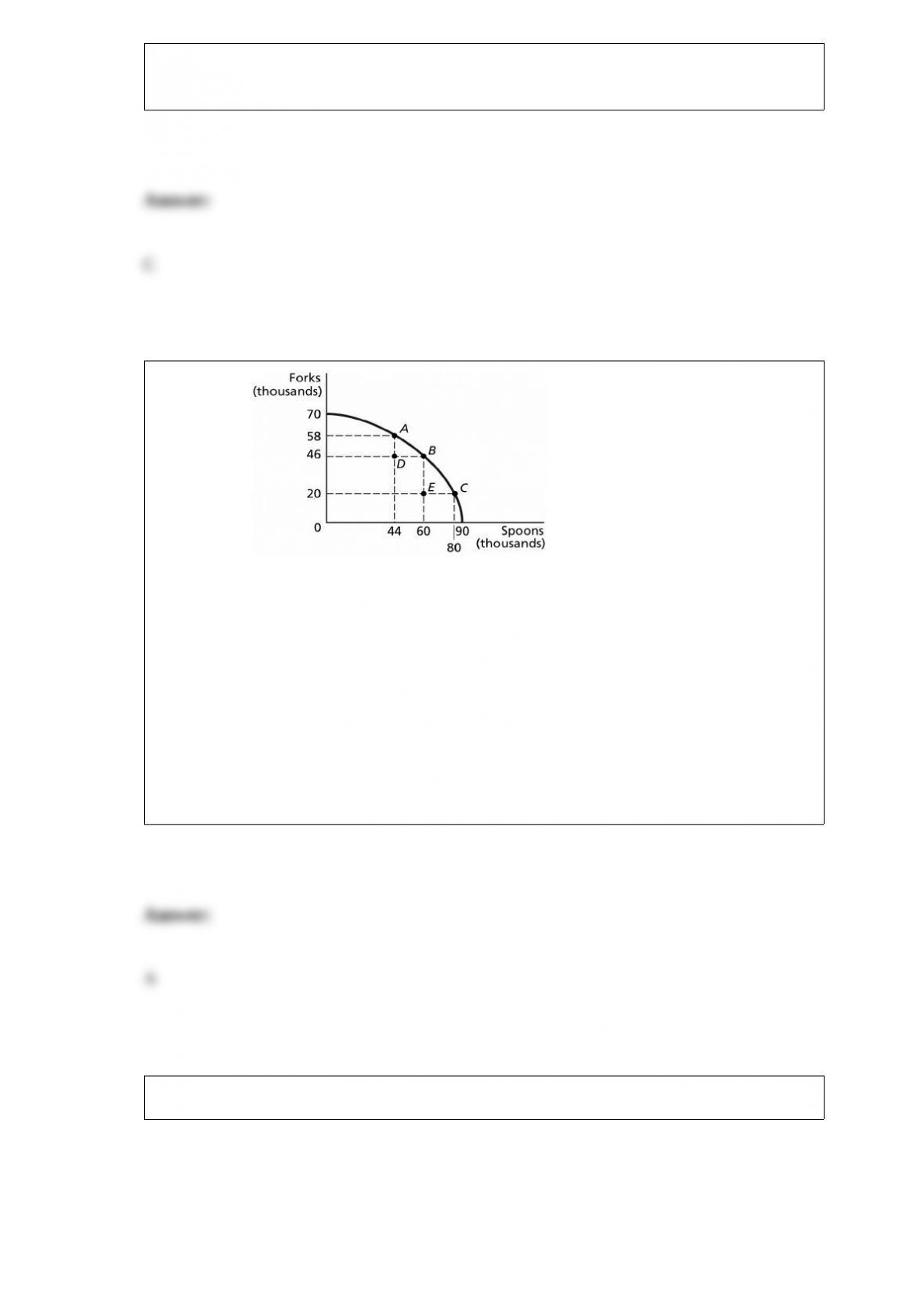
Figure 2-10
If the economy is currently producing at point C, what is the opportunity cost of
moving to point B?
A) 20 thousand spoons
B) 26 thousand forks
C) 40 thousand spoons
D) 46 thousand forks
Figure 13-8
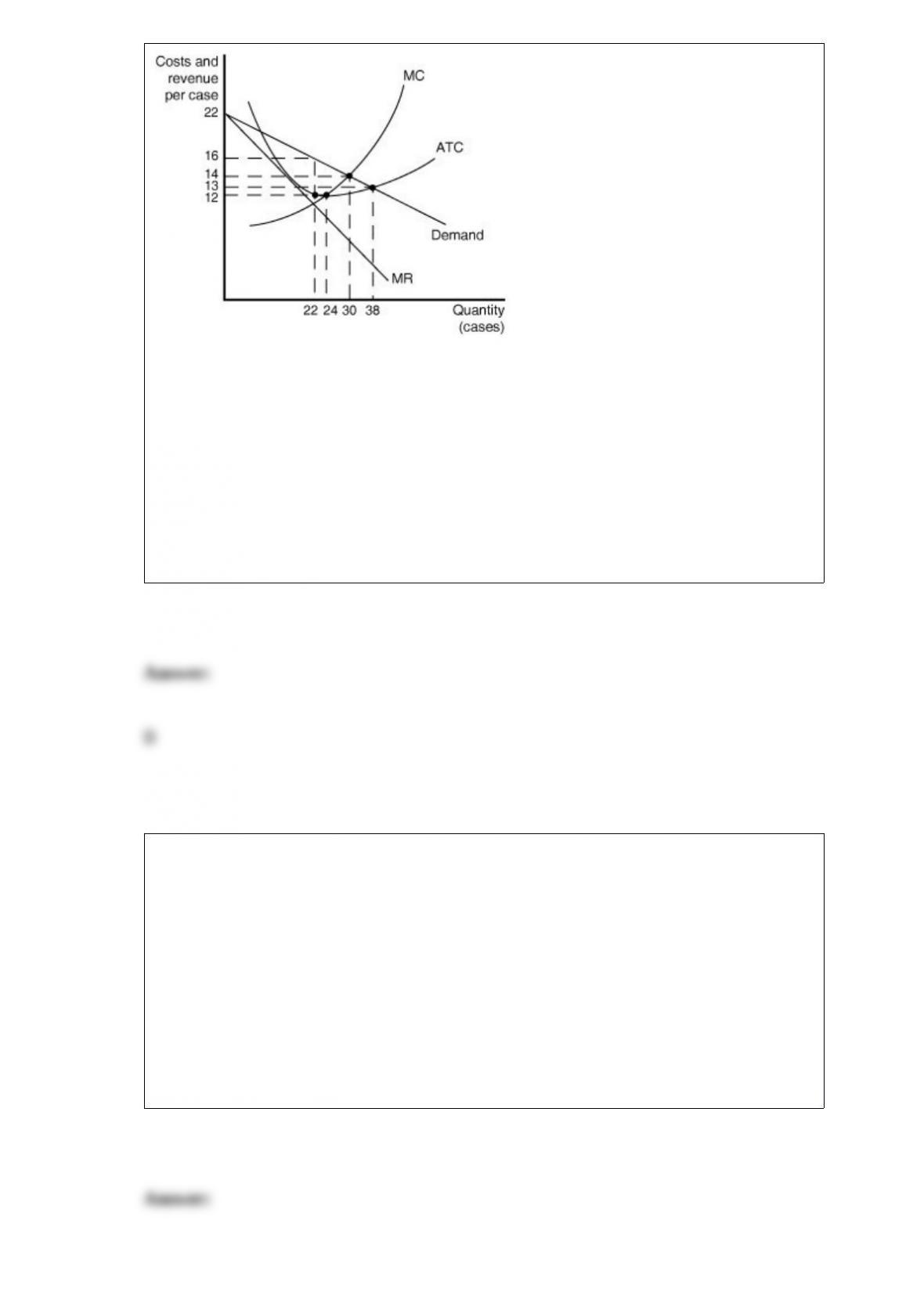
Figure 13-8 shows cost and demand
curves for a monopolistically competitive producer of iced tea. Based on the diagram,
one can conclude that
A) some existing firms will exit the market.
B) new firms will enter the market.
C) the industry is in long-run equilibrium.
D) firms achieve productive efficiency.
That some talented people may not enter an occupation because they have heard that
people with their personal characteristics do not get hired in that occupation is known
as
A) economic discrimination.
B) a compensating difference.
C) a negative feedback loop.
D) worker discrimination.