1) If the for a good is 0.3, then a 20 percent decrease in price results in a
a.0.015 percent increase in the quantity demanded.
b.0.6 percent increase in the quantity demanded.
c.6 percent increase in the quantity demanded.
d.66 percent increase in the quantity demanded.
2) An increase in the price of maple syrup will decrease both the equilibrium price and
quantity in the market for pancakes.
a.True
b.False
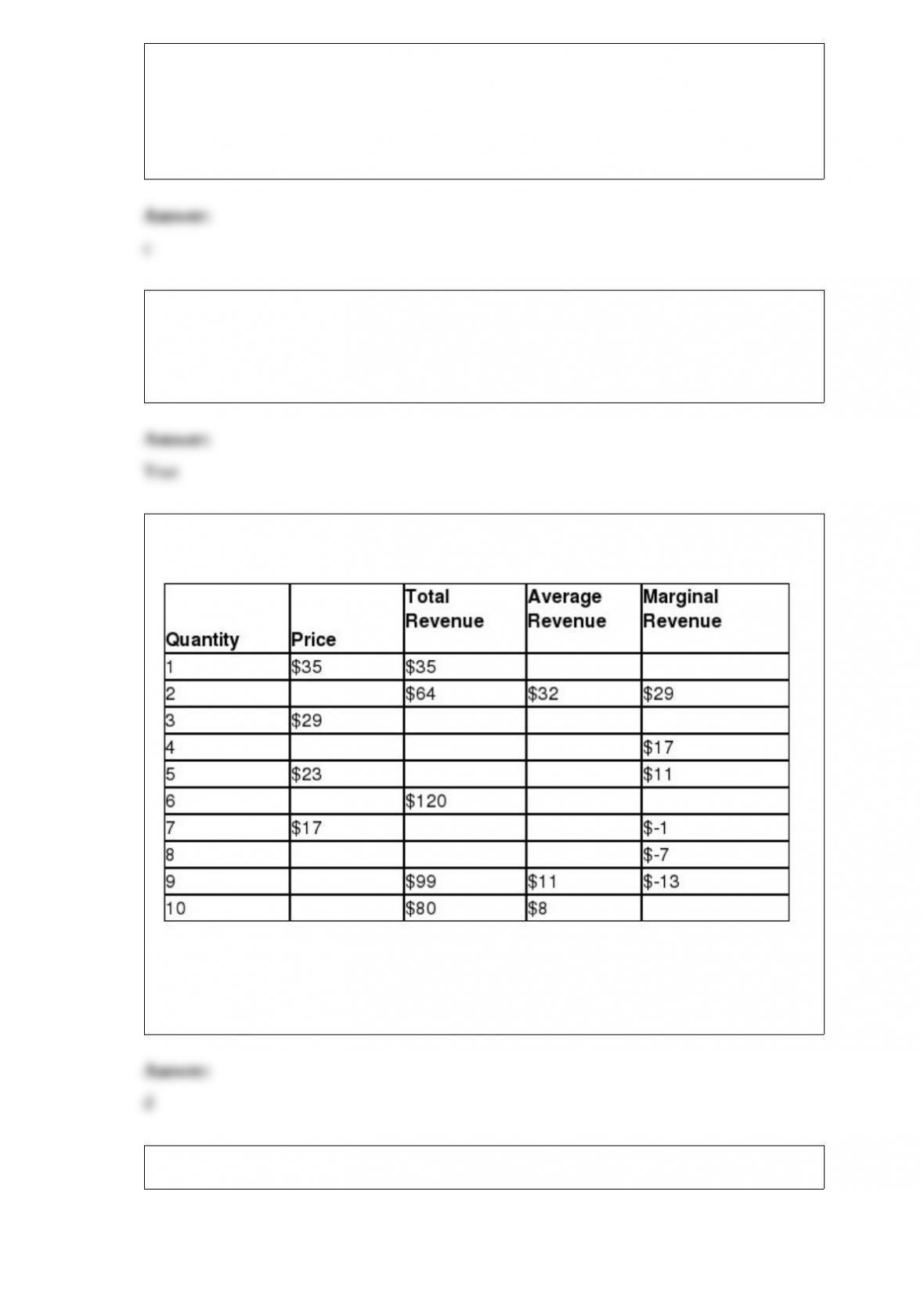
3) Table 15-1
When 4 units of output are produced and sold, what is average revenue? a. $17
b. $21
c. $23
d. $26
4) Figure 10-8

What is the socially-optimal quantity of output in this market?
a.8 units
b.Between 8 and 10 units
c.10 units
d.More than 10 units
5) Which of the following statements captures the meaning of transitivity of
preferences?
a.If A is preferred to B, then B is less preferred than A.
b.If A is preferred to B, and B is preferred to C, then A is preferred to C.
c.If A is preferred to B and B is preferred to C, then the preference for A over B is
stronger than the preference for B over C.
d.If A is preferred to C, then there exists B such that A is preferred to B and C is
preferred to A.
6) Suppose Japan exports cars to Russia and imports wine from France. This situation
suggests
a.Japan has a comparative advantage relative to France in producing wine, and Russia
has a comparative advantage to Japan in producing cars.
b.Japan has a comparative advantage relative to Russia in producing cars, and France
has a comparative advantage relative to Japan in producing wine.
c.Japan has an absolute advantage relative to Russia in producing cars, and France has
an absolute advantage relative to Japan in producing wine.
d.Japan has an absolute advantage relative to France in producing wine, and Russia has
an absolute advantage relative to Japan in producing cars.
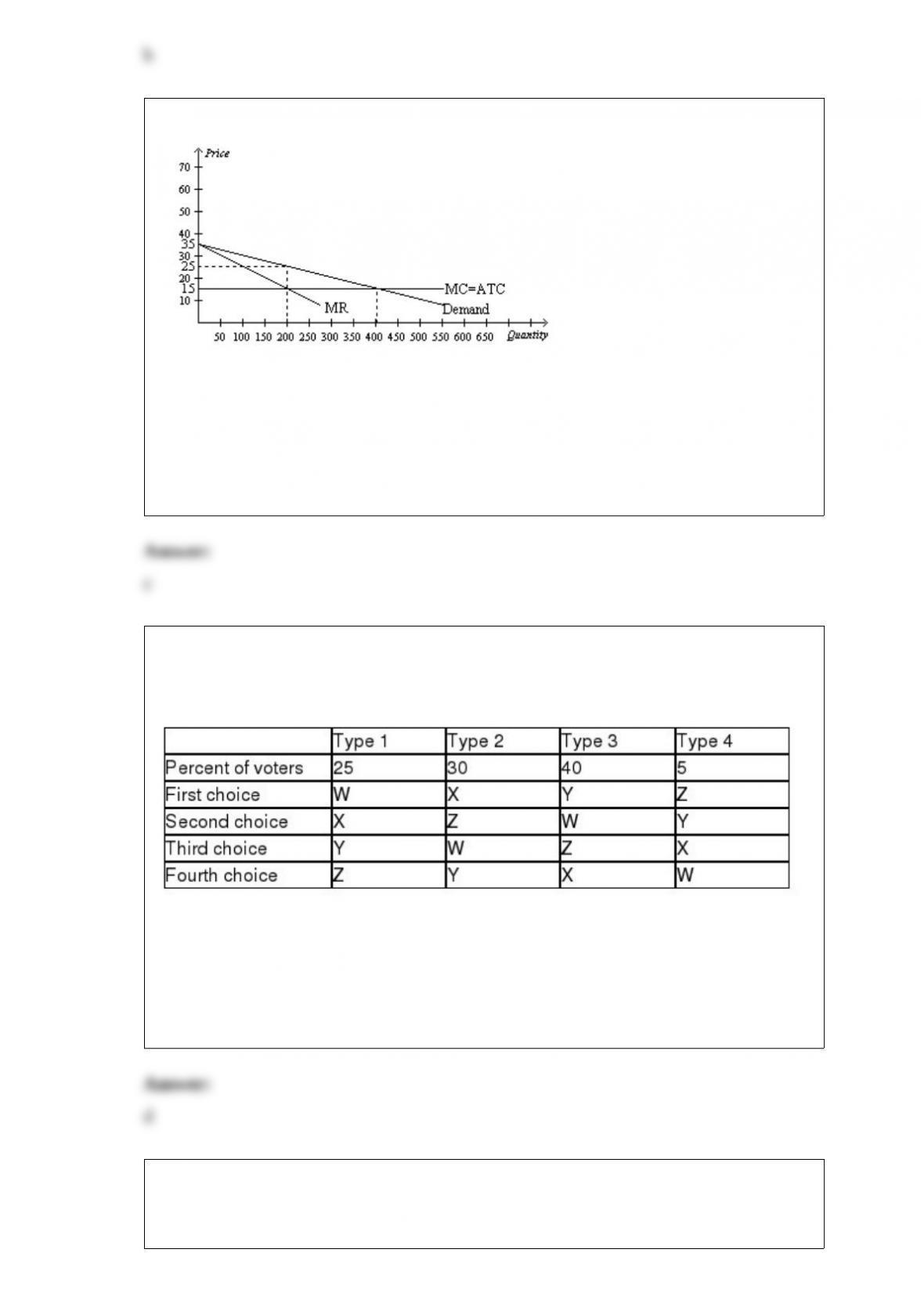
7) Figure 15-18
If there are no fixed costs of production, monopoly profit without price discrimination
equals
a.$0.
b. $1,000.
c. $2,000.
d. $4,000.
8) Table 22-18
The following table shows the preferences of four types of voters over four possible
alternatives as well as the percentage of the electorate with the given preferences.
Refer to Table 22-18. In a majority vote between alternatives W and X, what percentage
of the votes would W receive?
a.35%
b.45%
c.55%
d.65%
9) In the long run,
a.monopolistically competitive firms earn a higher profit than perfectly competitive
firms because monopolistically competitive firms have some monopoly power.

b.monopolistically competitive firms produce a higher output than perfectly
competitive firms because competition drives the perfectly competitive firms’ output
down.
c.both monopolistically competitive and perfectly competitive firms produce where P =
MC.
d.both monopolistically competitive and perfectly competitive firms produce where P =
ATC.
10) Comparing the US to other countries ranked by inequality,
a.the US has a less equal distribution of income than some countries, but a more equal
distribution of income than others.
b.the US has one of the most equal distributions of income.
c.the US has one of the least equal distributions of income.
d.the US has a more equal distribution of income than other economically advanced
countries such as Japan, Germany, and France.
11) A firm cannot price discriminate if
a.its has declining marginal revenue.
b.it operates in a competitive market.
c.buyers only reveal the price they are willing to pay for the product.
d.it has a constant marginal cost.
12) Assume that Zimbabwe and Portugal can switch between producing toothbrushes
and producing hairbrushes at a constant rate.
Suppose Zimbabwe decides to increase its production of toothbrushes by 10. What is
the opportunity cost of this decision?
a.0.3 hairbrush
b.3 hairbrushes
c.30 hairbrushes
d.100 hairbrushes

13) A production possibilities frontier can shift outward if
a.government increases the amount of money in the economy.
b.there is a technological improvement.
c.resources are shifted from the production of one good to the production of the other
good.
d.the economy abandons inefficient production methods in favor of efficient production
methods.
14) The theory of efficiency wages challenges the assumption that
a.workers are efficient.
b.workers have an incentive to shirk their responsibilities to their employers.
c.wages must always adjust to balance labor supply and labor demand.
d.firms sometimes choose to pay their workers above-equilibrium wages.
15) Table 17-6
Imagine a small town in which only two residents, Kunal and Naj, own wells that
produce safe drinking water. Each week Kunal and Naj work together to decide how
many gallons of water to pump, to bring the water to town, and to sell it at whatever
price the market will bear. Assume Kunal and Naj can pump as much water as they
want without cost so that the marginal cost of water equals zero.
The weekly town demand schedule and total revenue schedule for water are shown in
the table below.
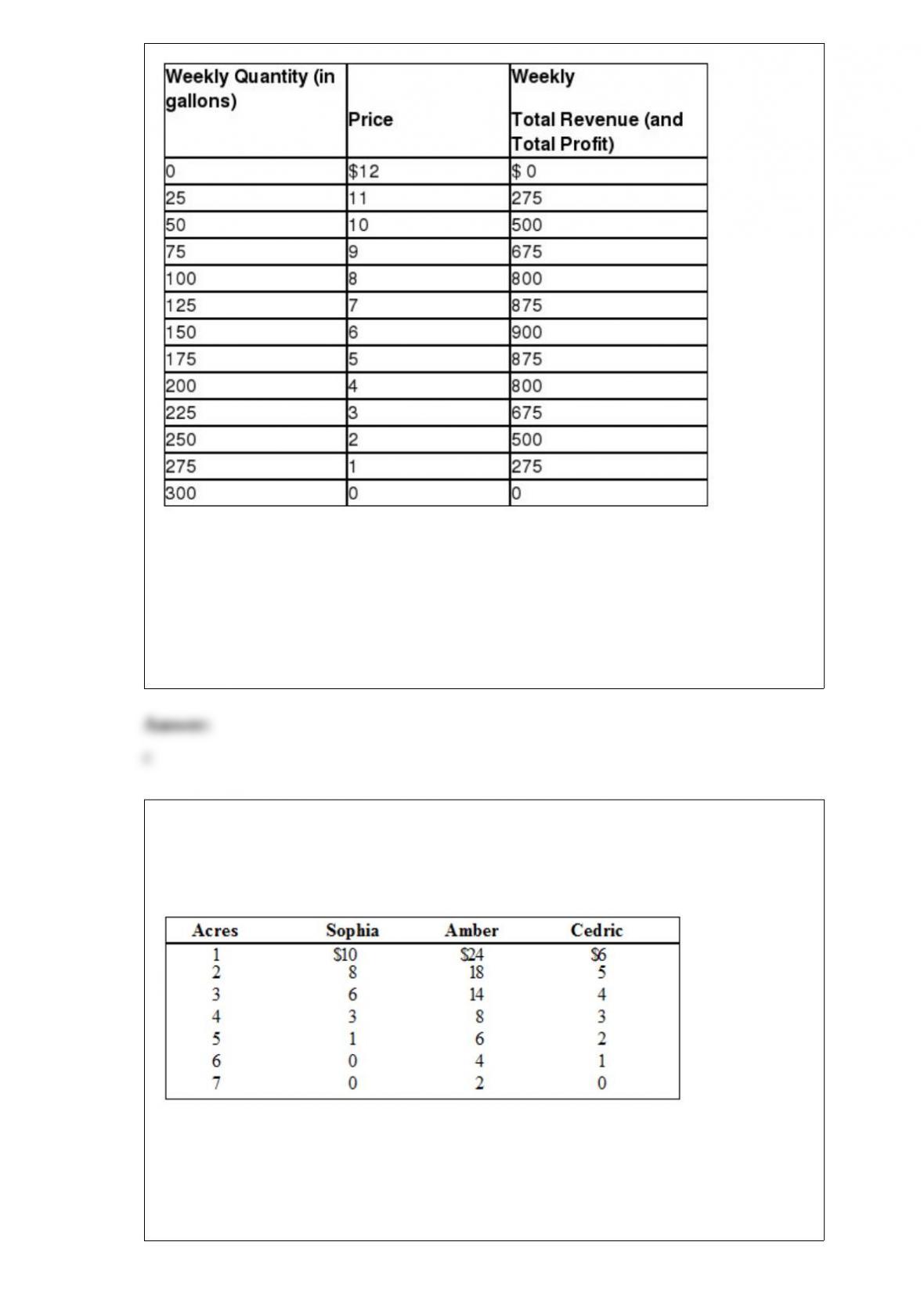
Refer to Table 17-6. Suppose the town enacts new antitrust laws that prohibit Kunal
and Naj from operating as a monopolist. What will quantity of water will each of them
produce once the Nash equilibrium is reached?
a.Each will produce 50 gallons, for a total of 100 gallons.
b.Each will produce 75 gallons, for a total of 150 gallons.
c.Each will produce 100 gallons, for a total of 200 gallons.
d.Each will produce 125 gallons, for a total of 250 gallons.
16) Consider the town of Springfield with only three residents, Sophia, Amber, and
Cedric. The three residents are trying to determine how large, in acres, they should
build the public park. The table below shows each resident’s willingness to pay for each
acre of the park.
Suppose the cost to build the park is $9 per acre and that the residents have agreed to
split the cost of building the park equally. If the residents vote to determine the size of
park to build, basing their decision solely on their own willingness to pay (and trying to
maximize their own surplus), what is the largest park size for which the majority of
residents would vote “yes?”

a.1 acre
b.2 acres
c.3 acres
d.4 acres
17) The ‘superstar” phenomenon can apply to which of these jobs?
a.high-school teacher
b.author
c.heart surgeon
d.carpenter