1) the equilibrium price and quantity in a market usually produces allocative efficiency
because:
a.all consumers who want the good are satisfied.
b.marginal benefit and marginal cost are equal at that point.
c.equilibrium insures an equitable distribution of output.
d.the excess of goods produced at equilibrium guarantees that all will have enough.
2)
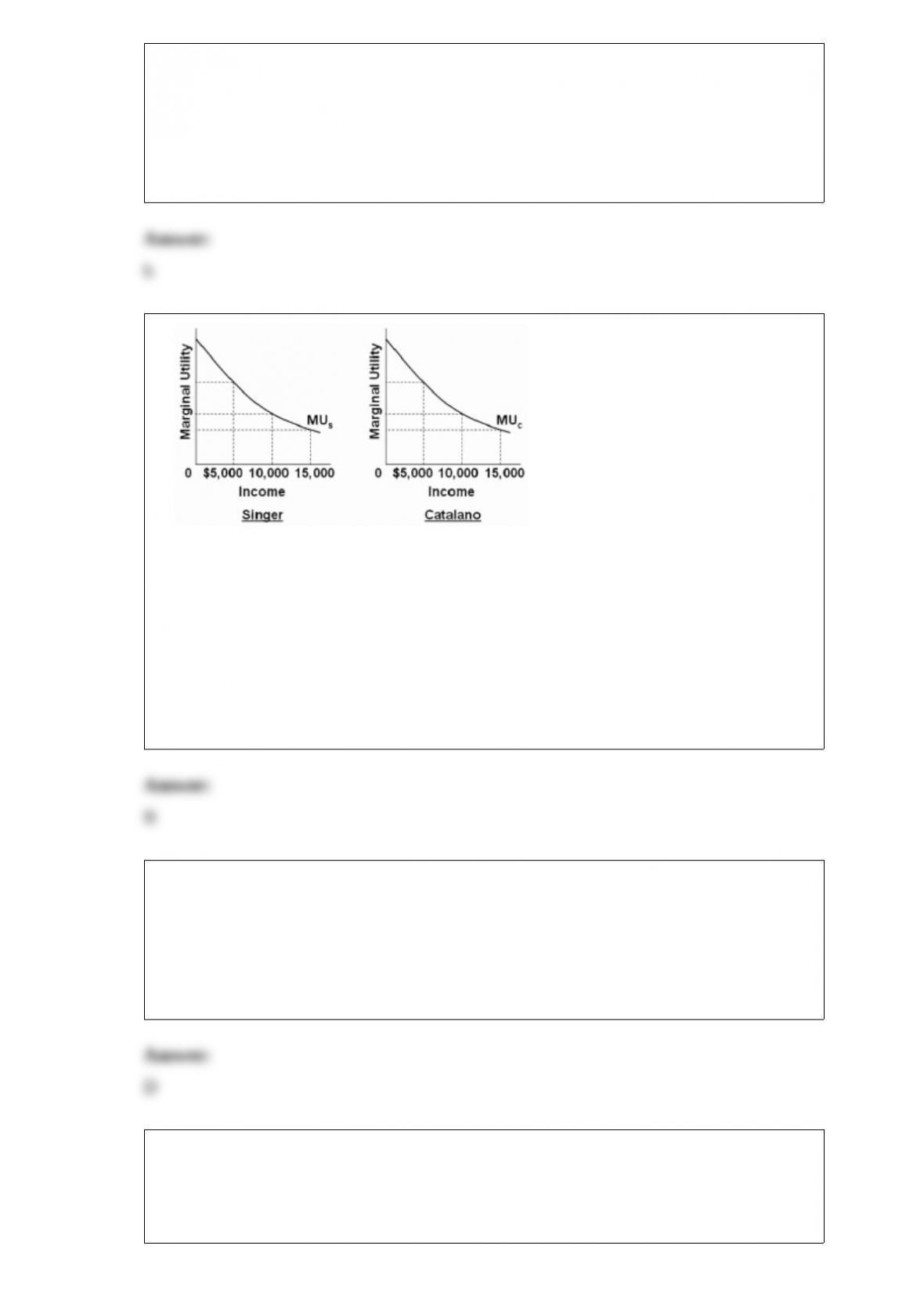
Refer to the above diagrams that show identical marginal utility from income curves for
Singer and Catalano. If this initial distribution of $15,000 to Singer and $5,000 to
Catalano is altered in favor of greater equality, it may be argued that:
A.the combined total utility of the two consumers will decline because Catalano has a
greater capacity to derive utility from income than does Singer.
B.incentives to produce will be weakened and total income will decrease.
C.incentives to produce will be enhanced and total income will increase.
D.the combined total utility of the two consumers will decline because Singer has a
greater capacity to derive utility from income than does Catalano.
3) The price elasticity coefficient of the demand for agricultural products is .2 to .25.
This means that the demand for agricultural products is:
A.price elastic.
B.income elastic.
C.income inelastic.
D.price inelastic.
4) Which of the following statements is correct?
A.Price supports may induce either an underallocation or an overallocation of resources
to farm products.
B.Supported prices have no effect on the allocation of resources to farm products.
C.Supported prices induce an underallocation of resources to farm products.
D.Price supports induce an overallocation of resources to farm products.
5) The group that sets the Federal Reserve Systems policy on buying and selling
government securities (bills, notes, and bonds) is the:
A.Federal Deposit Insurance Corporation (FDIC).
B.Federal Bond Sale Authority.
C.Council of Economic Advisers.
D.Federal Open Market Committee (FOMC).
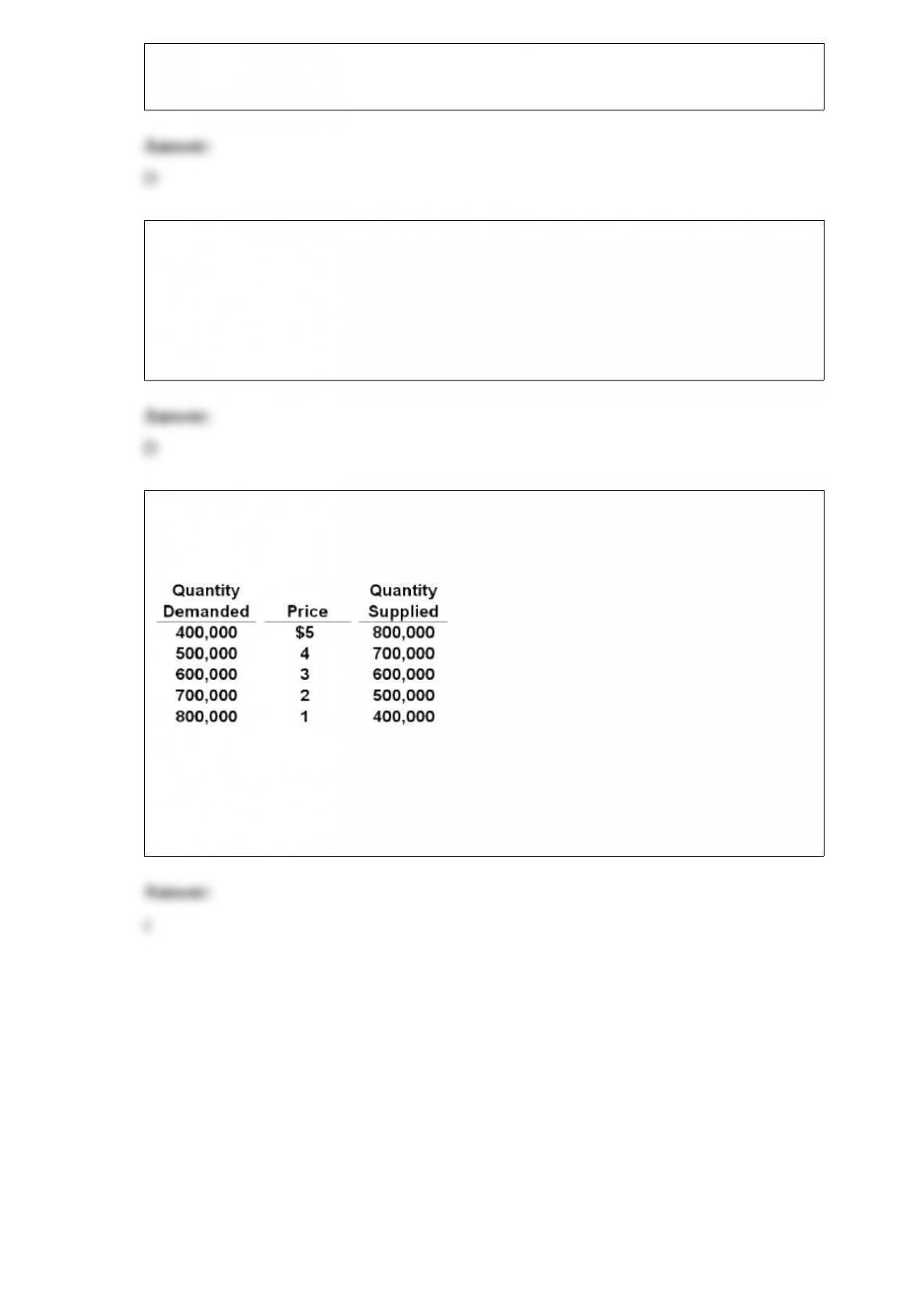
6) the following table applies to a purely competitive industry composed of 100
identical firms.
refer to the above table. the equilibrium price in this purely competitive market is:
a.$5.
b.$4.
c.$3.
d.$2.
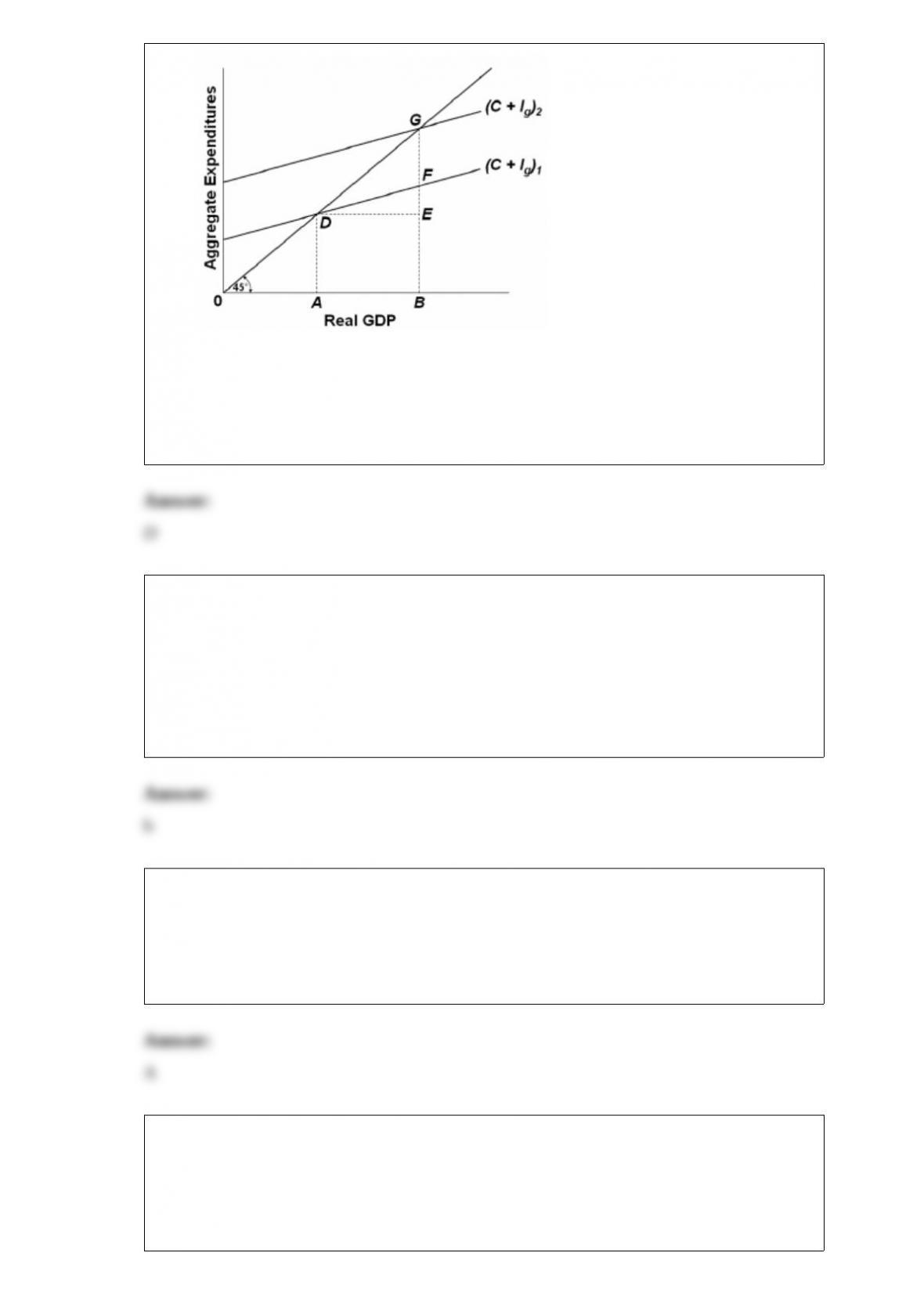
7)
Refer to the above diagram for a private closed economy. The multiplier is:
A.GF/DE.
B.GF/GB.
C.FE/GF.
D.AB/GF.
8) economic theory suggests that the optimal level of immigration in the united states:
a.is zero.
b.occurs where the marginal benefit of the last immigrant equals or just exceeds the
marginal cost of the last immigrant.
c.occurs where the marginal benefit of the last immigrant equals or just exceeds zero.
d.occurs at the level where the difference between the marginal benefit and marginal
cost of the last immigrant is maximized.
9) The largest single share of all income earned by Americans consists of:
A.wages and salaries.
B.interest.
C.rents.
D.corporate profits.
10) (last word) a burst stock market bubble might adversely affect the economy by:
a.causing rapid inflation.
b.greatly reducing net exports.
c.causing a severe negative wealth effect and engendering pessimism about the
economy’s future.
d.raising interest rates.
11) dr. homer simpson, an economics professor, decided to take a year off from teaching
to run a commercial fishing boat in alaska. that year, professor simpson would be
officially counted as:
a.structurally unemployed.
b.frictionally unemployed.
c.not in the labor force.
d.employed.
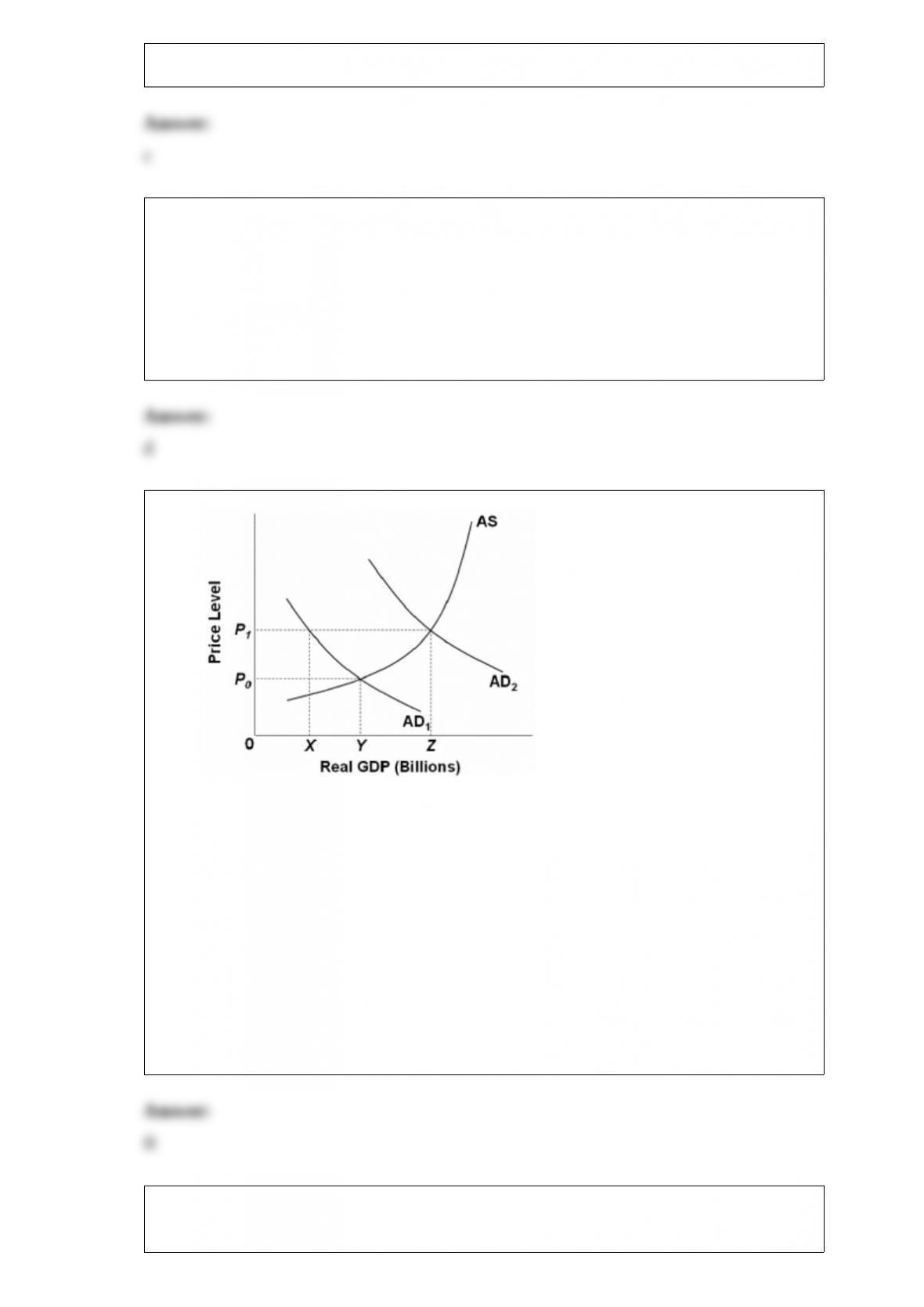
12)
Refer to the above figure. Suppose that the economy is currently operating at the
intersection of AS and AD2, and that the full employment level of output is Y. If
contractionary fiscal policy and accompanying multiplier effects move aggregate
demand from AD2 to AD1, what will be the effect on real GDP and the price level?
A.Real GDP will fall to Y and the price level will fall to P1, assuming a ratchet effect
occurs.
B.Real GDP will fall to X and the price level will remain unchanged, assuming a ratchet
effect occurs.
C.Real GDP will fall to X and the price level will fall to P1, assuming a ratchet effect
occurs
D.Real GDP will fall to Y and the price level will remain unchanged, assuming a ratchet
effect occurs
13) If the prices received by farmers increased and the prices paid by farmers also
increased, the parity ratio:
A.will necessarily be unchanged.
B.may either increase or decrease.
C.will necessarily increase.
D.will necessarily decline.
14) Which of the following is correct?
A.Although land has no production cost from society’s viewpoint, rental payments are
costs to individual producers.
B.Land rent is not a cost to either society or to individual producers.
C.Although land rent is a cost from society’s viewpoint, it is not a cost to individual
producers.
D.Land rent is a cost to both society and individual producers.
15) Planned investment equals saving:
A.at all levels of GDP.
B.at all below-equilibrium levels of GDP.
C.at all above-equilibrium levels of GDP.
D.only at the equilibrium GDP.