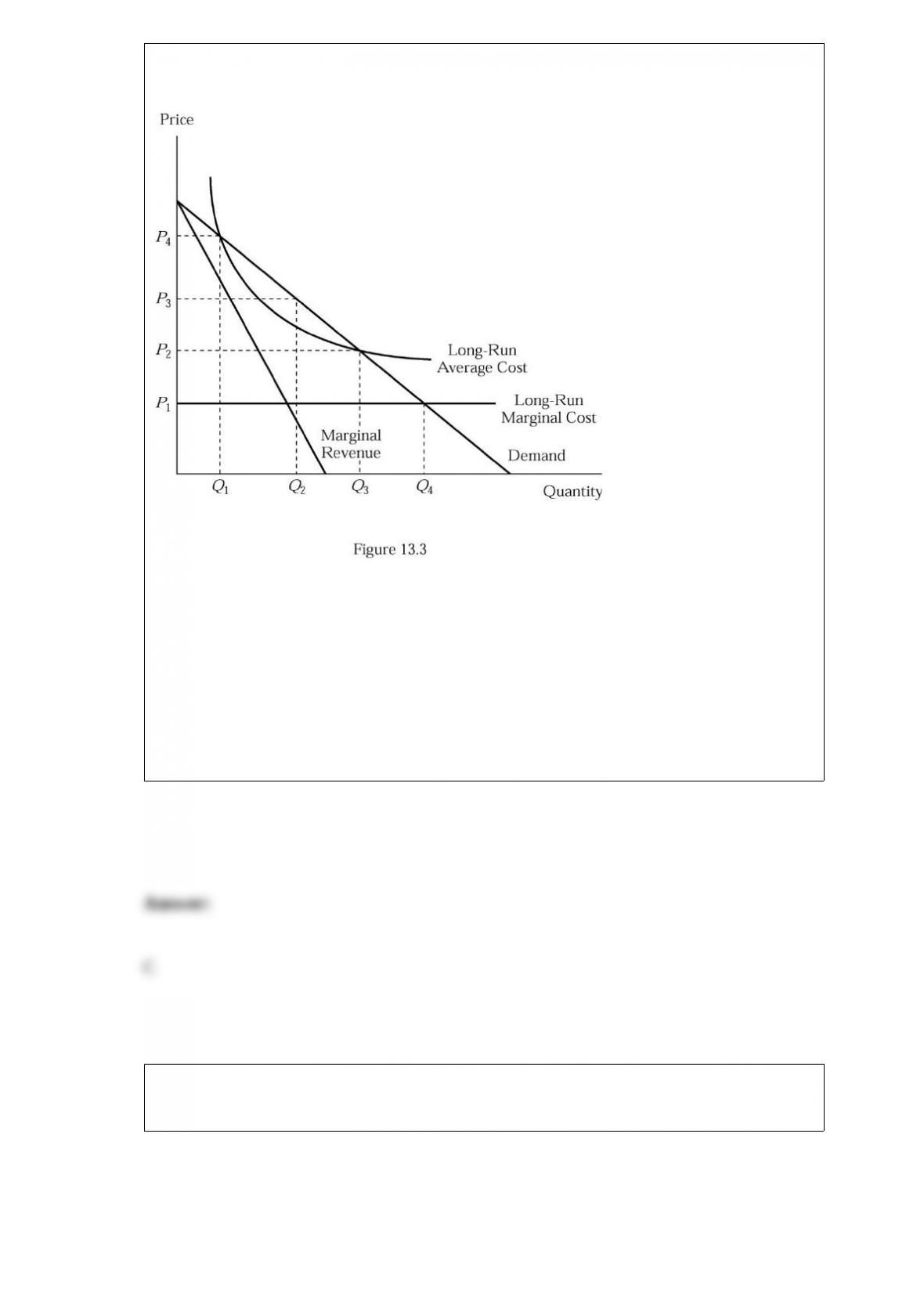
The natural monopoly in Figure 13.3 wants to charge a price of:
A) P1.
B) P2.
C) P3.
D) P4.
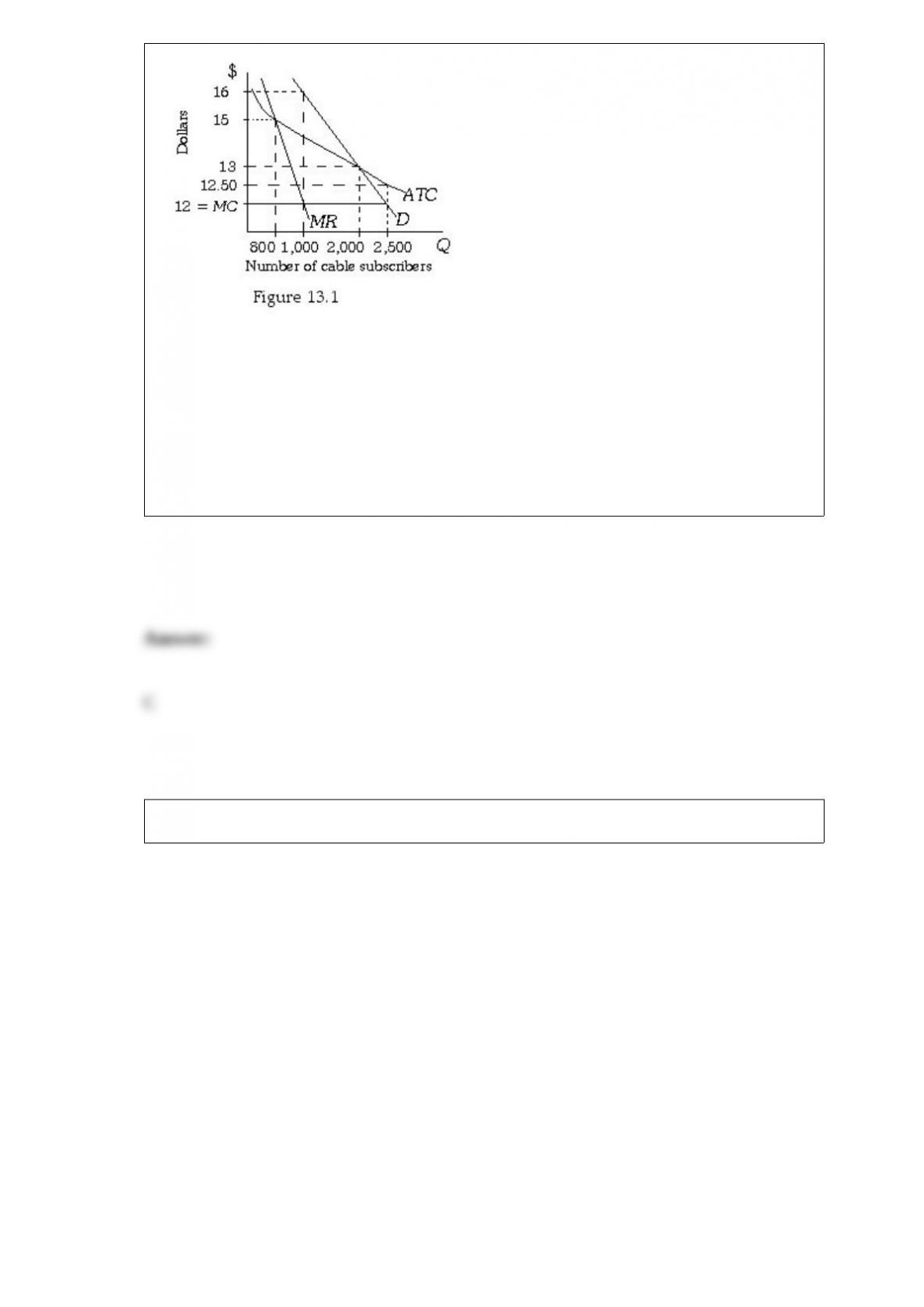
Refer to Figure 13.1. If the government regulates Armstrong Cable so they can earn
only zero economic profit, the price would be set at:
A) $12.00.
B) $12.50.
C) $13.00.
D) $16.00.
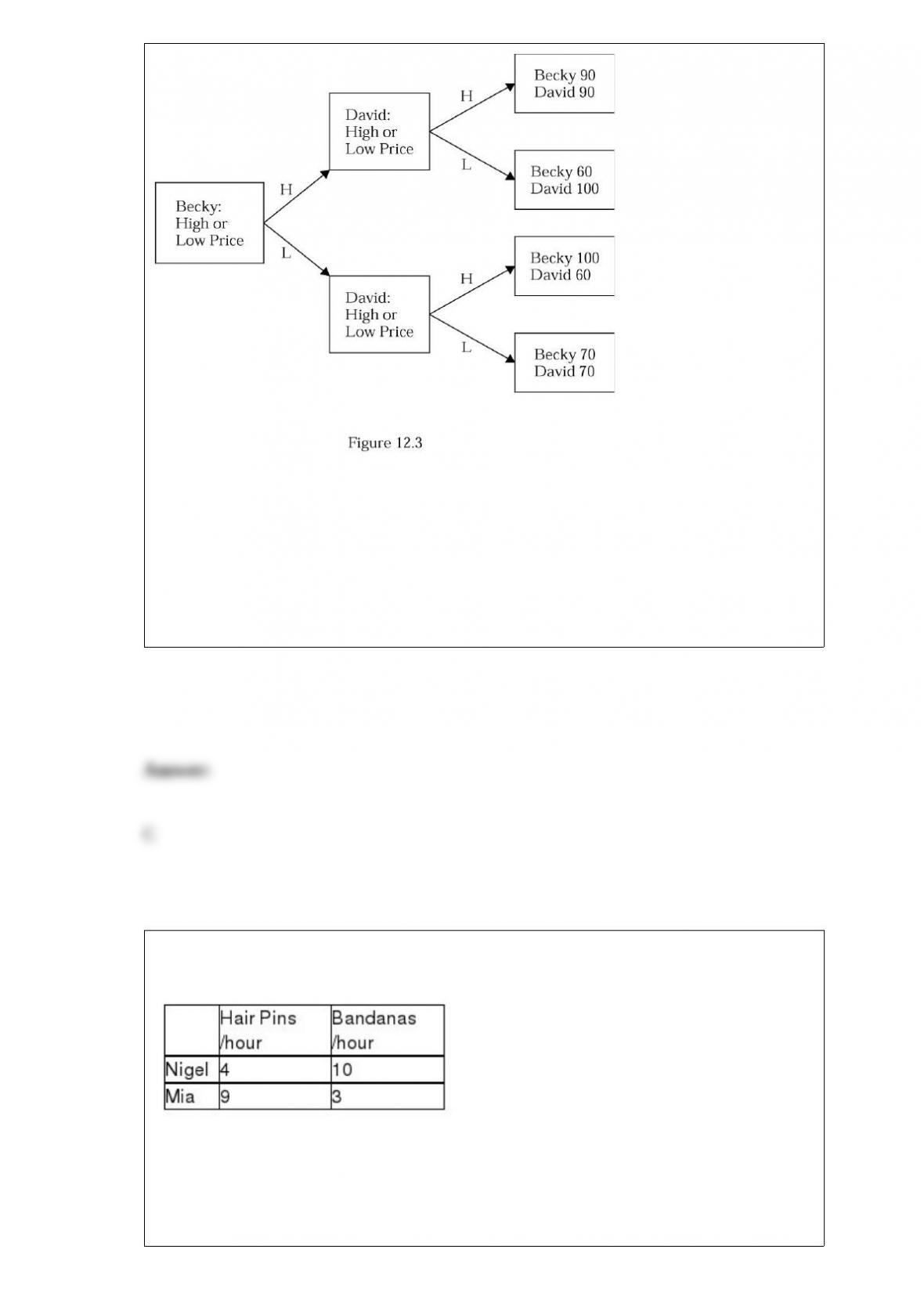
Consider Figure 12.3. Choosing a low price is:
A) a dominant strategy for David but not for Becky.
B) a dominant strategy for Becky but not for David.
C) a dominant strategy for both David and Becky.
D) not a dominant strategy for either David or Becky.
Consider two individuals, Nigel and Mia, who produce hair pins and bandanas. Nigel’s
and Mia’s hourly productivity are shown in Table 3.3.
Table 3.3
Nigel’s opportunity cost of producing one hair pin is:
A) 1/3 of a bandana.

B) 2.5 bandanas.
C) 3 bandanas.
D) 10 bandanas.
Suppose that the elasticity of demand for hamburgers is 2.5 and price decreases by
14%. By what percentage will quantity demanded for hamburgers increase?
A) 2.5%
B) 5.6%
C) 25%
D) 35%
Without the government’s redistribution programs, the income share of the lowest
quintile would ________ and the income share of the highest quintile would ________.
A) decrease; remain the same
B) decrease; increase
C) remain the same; increase
D) increase; decrease
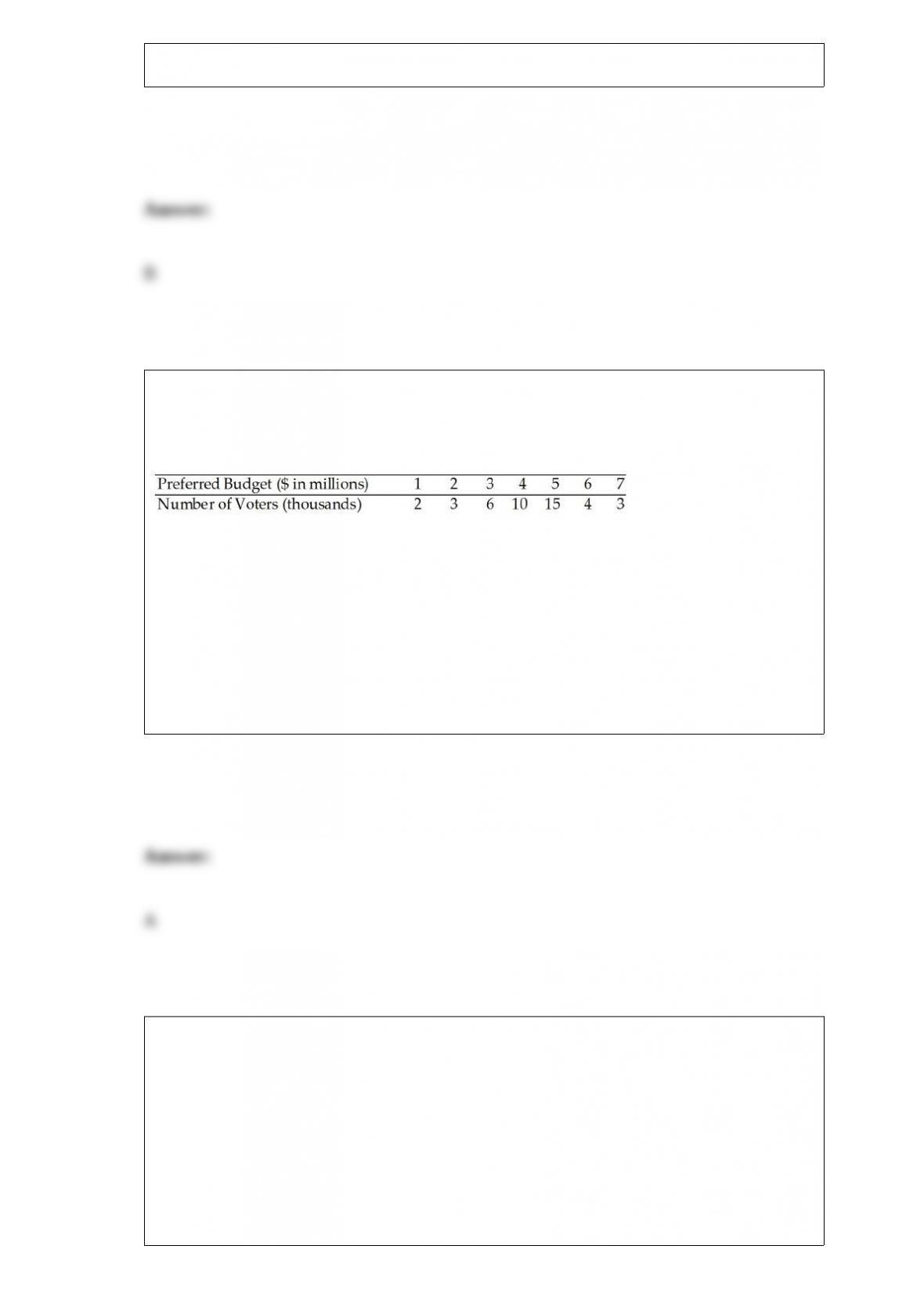
Table 15.1 shows the preferred budget in millions for a new sports facility and the
number of thousands of voters in a community who prefer that budget. Tom proposed a
budget of $6 million while Mary proposed a budget of $3 million. Which of the two
candidates will be elected if everyone votes?
Table 15.1
A) Tom
B) Mary
C) It will be a tie.
D) The outcome of the election cannot be predicted.
The reason that air and water pollution impose external costs is that:
A) providers of goods and services ignore costs that they do not have to pay.
B) they affect the quality of the out-of-doors.
C) environmentalists object to the degradation of the earth.
D) the damage from pollution crosses international boundaries.
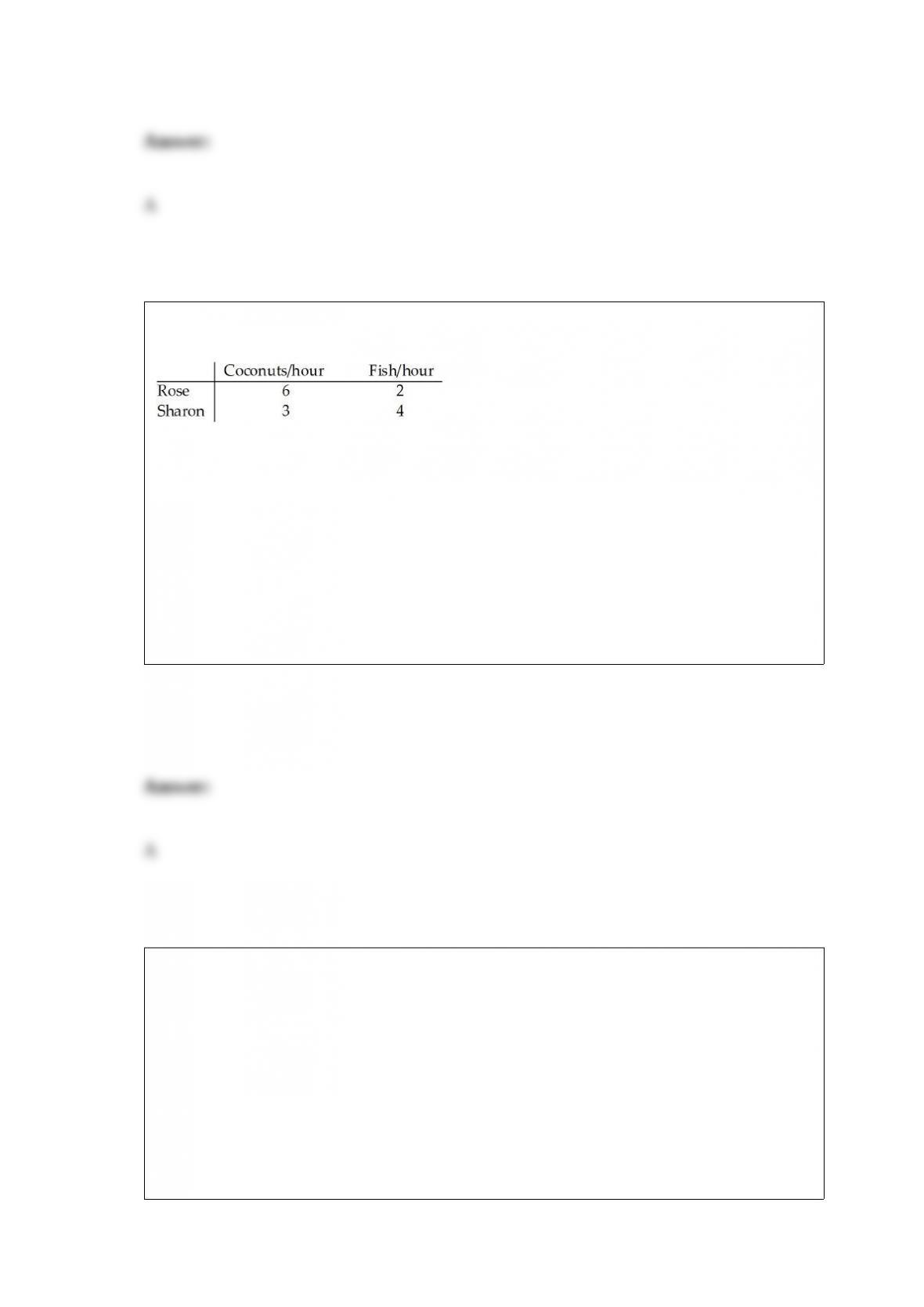
Consider two individuals, Rose and Sharon, who produce fish and coconuts. Rose and
Sharon’s hourly productivity are shown in Table 3.2. Which of the following is true?
Table 3.2
A) Rose has a comparative advantage in producing coconuts but not fish.
B) Rose has a comparative advantage in producing fish but not coconuts.
C) Rose has a comparative advantage in producing both goods.
D) Rose does not have a comparative advantage in producing either good.
If the first copy cost of a music video is $223,000 and the marginal cost is $0, how
much total cost would the firm incur if it produces 1 million copies?
A) zero
B) $223,000
C) $1 million
D) $1 million + $223,000

Which of the following situations will arise in the domestic market following the
imposition of an import quota?
A) imports increase, domestic production decreases, prices decrease
B) imports decrease, domestic production increases, prices decrease
C) imports decrease, domestic production decreases, prices increase
D) imports decrease, domestic production increases, prices increase
Suppose that the price of fertilizer, an input in the production of corn, rises. We would
predict that the equilibrium quantity of corn will ________ and the equilibrium price of
corn will ________.
A) increase; increase
B) increase; decrease
C) decrease; increase
D) decrease; decrease
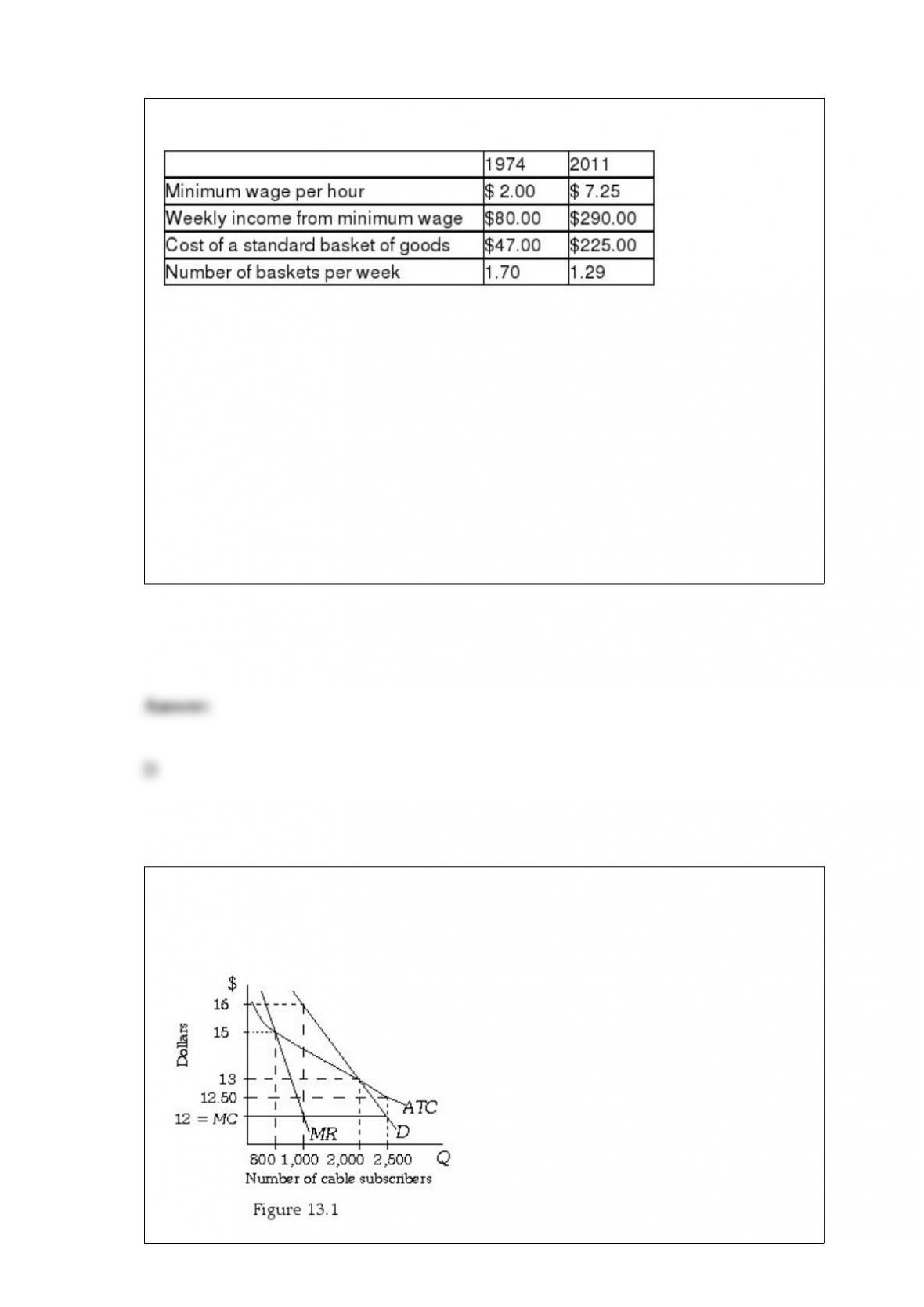
Table 2.5
Comparing the minimum wages between 1974 and 2011 addresses the economic
concept of:
A) the marginal principle.
B) the principle of voluntary exchange.
C) the principle of diminishing returns.
D) the real-nominal principle.
Refer to Figure 13.1. If the cable company depicted was free to sell to any number of
subscribers it desires and set any price, it would sell to ________ subscribers at a price
of ________.

A) 800; $15
B) 1,000; $16
C) 2,200 $13
D) 2,500; $12
Macroeconomics is best described as the study of:
A) very large issues.
B) the choices made by individual households, firms, and governments.
C) the nation’s economy as a whole.
D) the relationship between inflation and wage inequality.
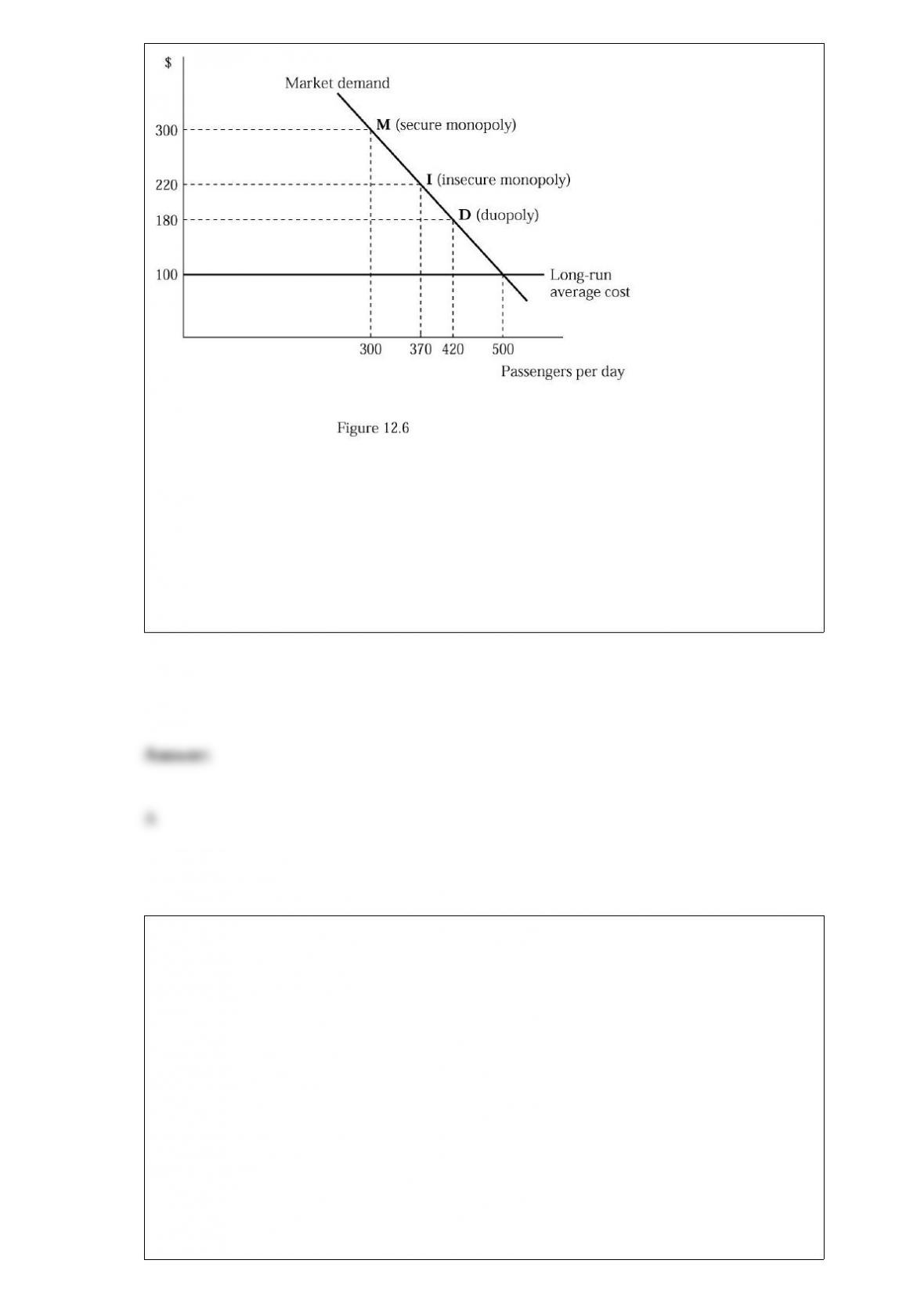
In Figure 12.6, airline Fly Smart is initially a secure monopoly between two cities X
and Y at point M, serving 300 passengers per day at the profit maximizing price of $300
per ticket. What is Fly Smart’s profit per ticket?
A) $200
B) $120
C) $80
D) $0
One factor which was responsible for roughly one-fifth of hybrid vehicles purchased in
2007 was a federal subsidy of up to $3,400 per hybrid vehicle. The average cost of
abating one ton of CO2 emissions through the hybrid subsidy is $177, but a switch from
coal to natural gas in power plants would reduce CO2 emissions at less than one-third
the cost of the hybrid subsidy. The increase in cost associated with the reduction of one
ton of CO2 emissions (assuming that each unit of CO2 emissions is measured in tons)
describes the economic concept of:
A) using assumptions to simplify.
B) ceteris paribus.
C) marginal thinking.
D) rational self-interest.
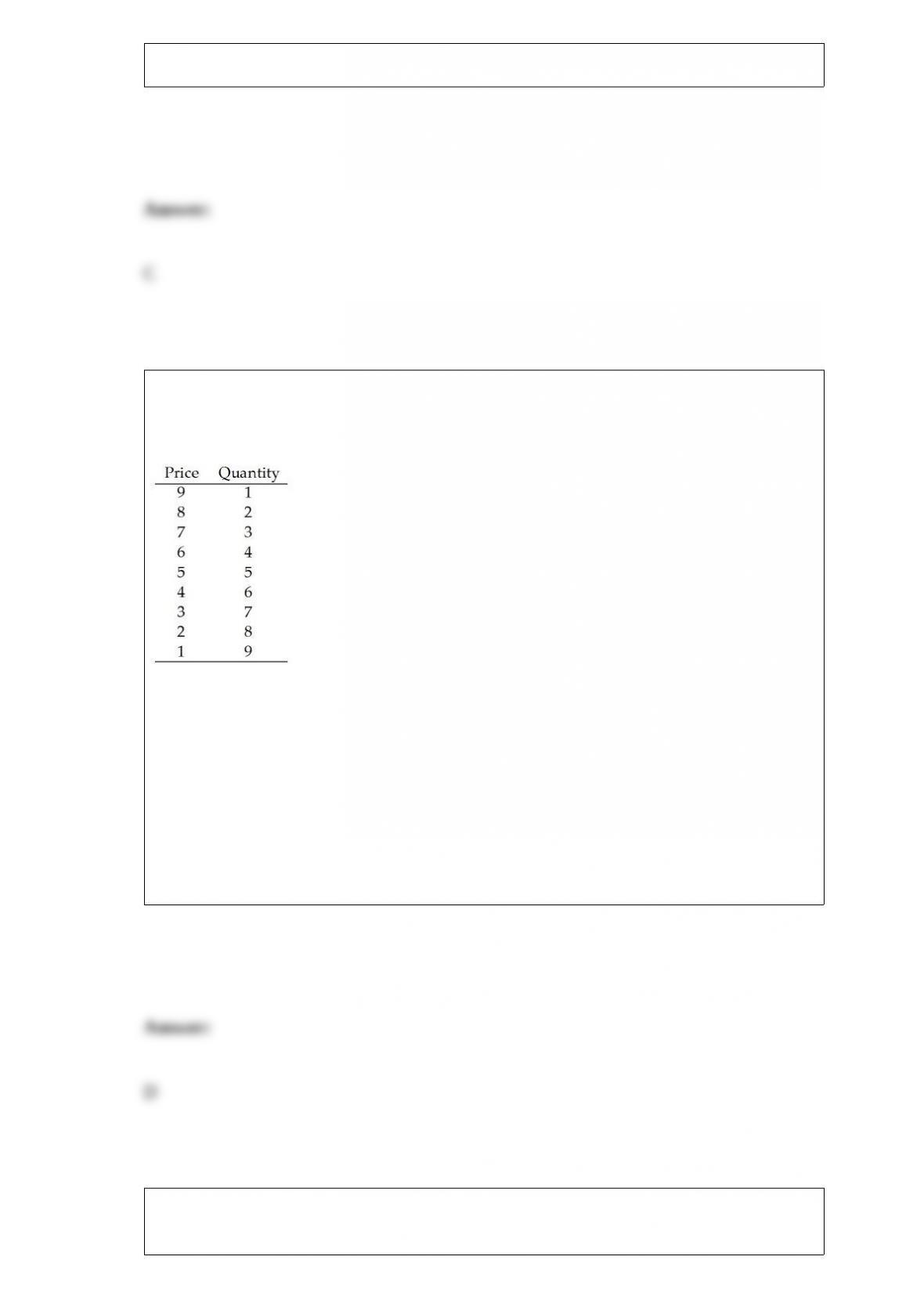
Refer to Table 10.1, which shows the relationship between the price that Gladys charges
for a product and the quantity of that product that Gladys sells. The marginal revenue
that Gladys receives from selling the fifth unit of output is:
Table 10.1
A) $5, because that is the price per unit of output that Gladys receives.
B) $5, because that is the quantity that Gladys sells.
C) $25, because Gladys sells five unit of output at a price of $5.
D) $1, because Gladys earns $1 more in revenues by increasing her output to five units
from four units.
Suppose that the percentage change in demand is 20%, the price elasticity of demand is
3, and the price elasticity of supply is 2. What is the percentage change in the

equilibrium price?
A) 4%
B) 5%
C) 15%
D) 20%
Recall the Application. With the “Got Milk?” advertising campaign, for every dollar
spent on advertising, milk sales have:
A) increased by about $1.00.
B) increased by about $5.00.
C) not noticeably changed.
D) actually decreased by about 6 percent.
Suppose an oil refinery and a paper mill both pollute a river. Under a system of
marketable pollution permits, which of the following must be true in order for both
companies to benefit from trading the right to pollute?
A) They must be able to reduce pollution at exactly the same cost.

B) It must cost the firms different amounts to reduce pollution.
C) They must have a social conscience and must be devoted to pollution abatement.
D) The government must direct them toward beneficial trades.
The additional cost resulting from a small increase in some activity is called the:
A) opportunity cost.
B) marginal benefit.
C) marginal cost.
D) diminishing returns of the activity.
Recall the application about the two main providers of satellite radio, Sirius and XM,
their costs and profitability. Which of the following is a barrier to entry in the satellite
radio industry?
A) high fixed costs
B) too many subscribers
C) high monthly charges to consumers
D) too much competition
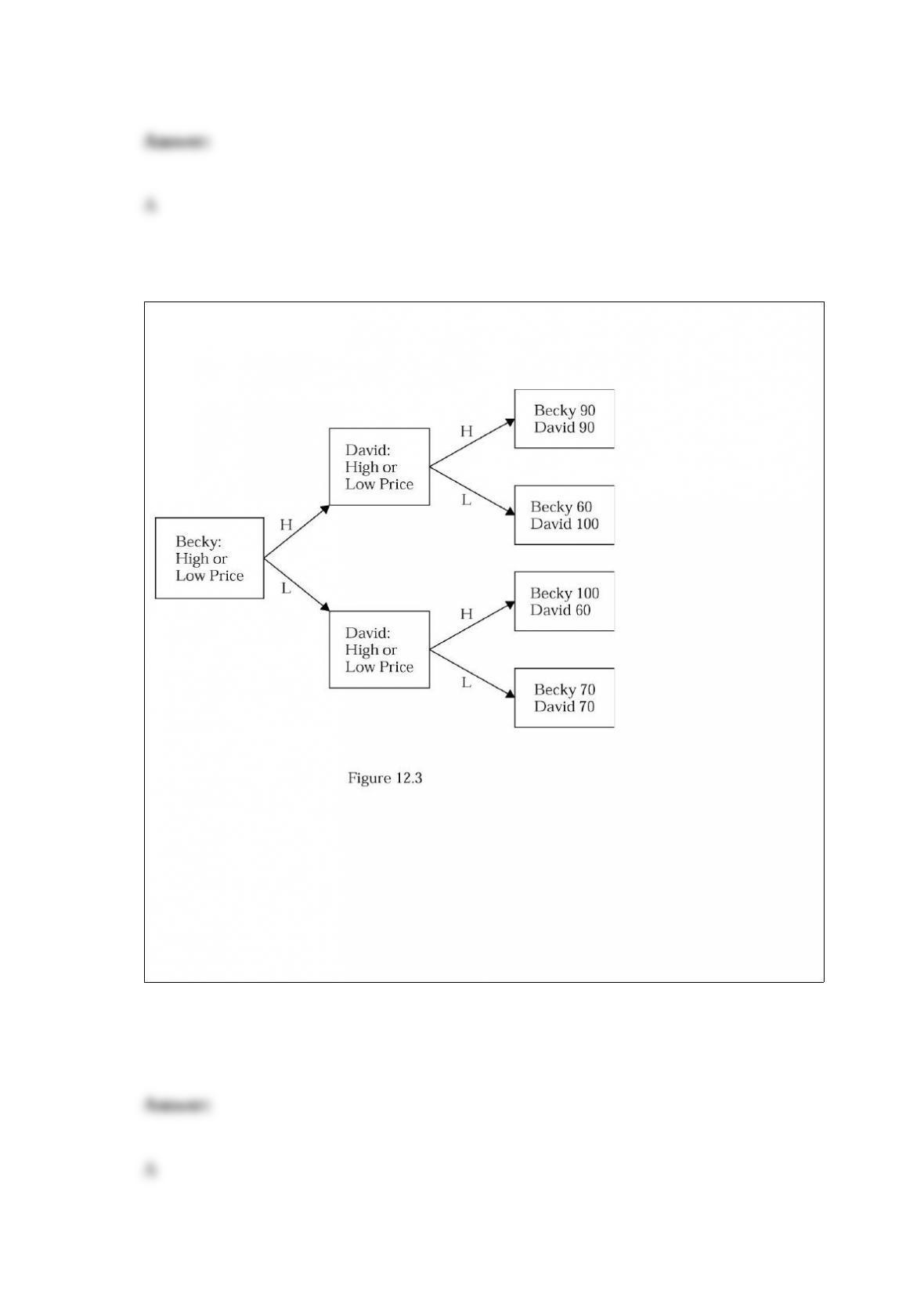
The incentive to charge a low price even though it leads to lower profits in Figure 12.3
is an example of:
A) the duopolists’ dilemma.
B) tying products.
C) scarcity and choice.
D) the economic problem.

Cartels engage in price fixing in order to:
A) drive out competition.
B) retain customers.
C) increase profits.
D) promote entry.
Recall car insurance and risky driving. What does the theory of moral hazard suggest
when it comes to car insurance among insured and uninsured drivers?
A) The insured driver, who bears less than the full cost of a collision, will drive less
carefully than the uninsured driver.
B) The insured driver, who bears more than the full cost of a collision, will drive more
carefully than the uninsured driver.
C) The insured driver, who bears less than the full cost of a collision, will drive more
carefully than the uninsured driver.
D) The uninsured driver, who bears less than the full cost of a collision, will drive less
carefully than the insured driver.
Which of the following is a characteristic of a monopolistically competitive market?

I. Firms sell differentiated products.
II. Each firm’s product is a close substitute for other firms’ products.
III. Firms freely enter and exit the market.
A) I only
B) I and III only
C) II and III only
D) I, II, and III
Suppose the market price for a cup of coffee is $1.25. If Coffee Express’s marginal cost
of making that cup of coffee is $0.75, its producer surplus from that cup of coffee is:
A) $0.50.
B) $0.75.
C) $1.25.
D) $1.50.
The key regions of the brain responsible for cost valuation are the insula and the
amygdala.

At the reservation price, the marginal benefit of continuing to search for a better price
________ the marginal cost of continuing to search for a better price.
A) greater than
B) less than
C) equal to
D) either greater than or less than
If a firm in a perfectly competitive market is currently producing the output where price
= marginal cost = average total cost, the firm is:
A) earning a positive economic profit.
B) earning a zero economic profit.
C) suffering an economic loss.
D) all of the above

One explanation for the development of online music services is:
A) these services will help reduce the incidence of of piracy.
B) consumers do not care about the price they pay for one song.
C) consumers stopped purchasing CDs.
D) the government mandated this market.