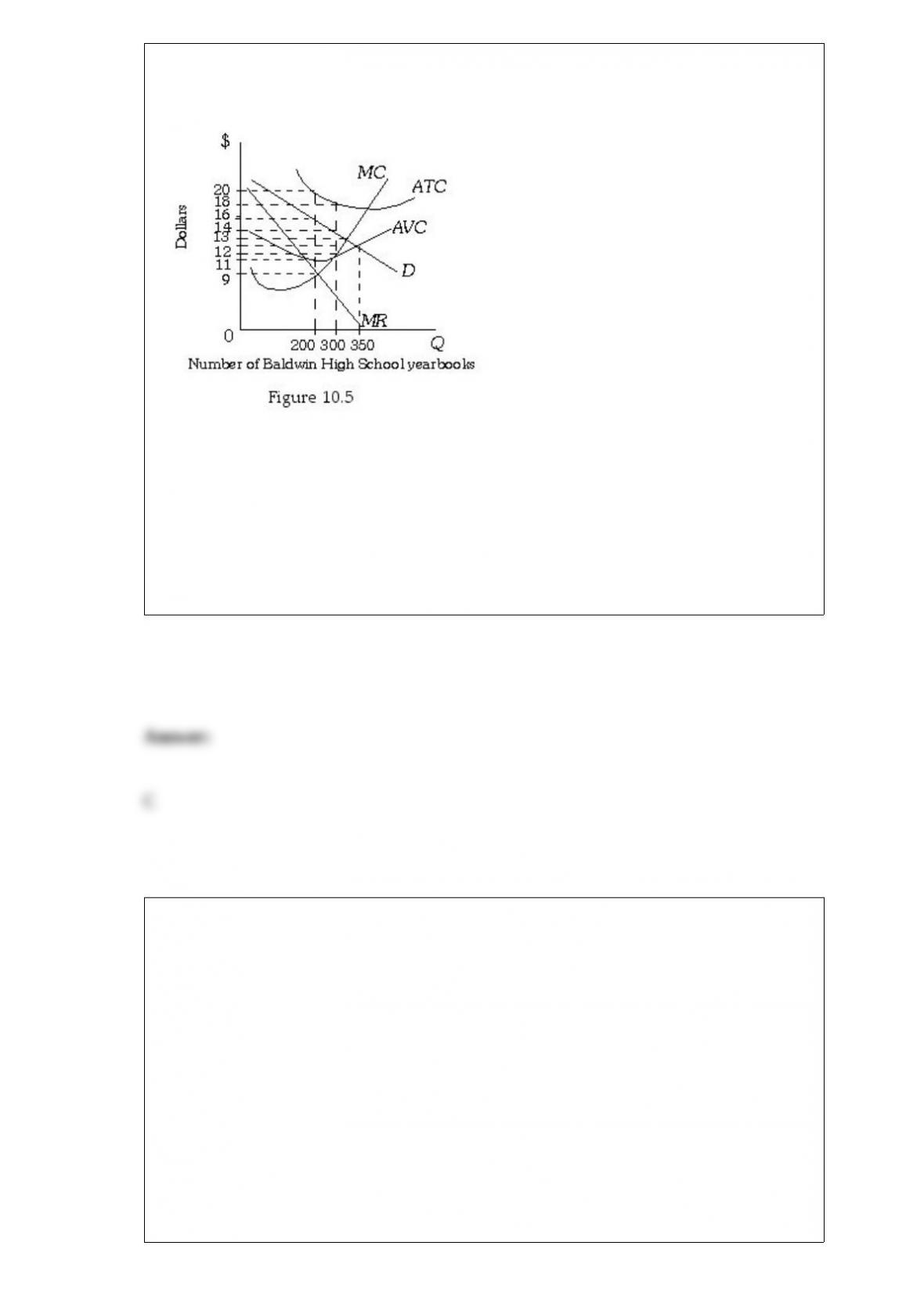
Refer to Figure 10.5. The profit-maximizing level of profit for the Memory Company
is:
A) -$1,800.
B) -$1,200.
C) -$800.
D) $0.
Additional Application
The 2005-2006 Florida citrus harvest has been tallied and is over $1 billion. This is the
highest dollar amount since the 1999-2000 season. This year’s production was 3%
greater than last year, which was dramatically reduced due to three hurricanes that
struck the state last year. While the overall production increase was relatively small, the
prices for all types of citrus increased significantly. On the wholesale level oranges
alone realized a 56% price increase over the previous year after experiencing a 1.3%
decrease from last year. One explanation of this increase was Hurricane Wilma striking
Florida in October 2005 and causing a reduction in this year’s supply of citrus. The
higher citrus prices this year resulted in a 38% increase in revenues to growers over the
previous year.

How can the increased revenues to the citrus producers be explained? The law of
demand states if the price increases, the quantity demanded decreases. The concept of
price elasticity of demand explains that the percentage decrease in quantity demanded
may be greater than or less than the percentage increase in price. Is the demand for
citrus elastic or inelastic?
“States citrus crop tops $1 billion for first time in six years.” September 22, 2006.
palmbeachpost.com. Retrieved October 3, 2006, from http://www.palmbeachpost.com
Using the information in the article the price elasticity of demand for citrus can be
determined to be:
A) relatively inelastic.
B) relatively elastic.
C) perfectly elastic.
D) perfectly inelastic.
Which of the following benefits from a quota or VER?
A) consumers
B) domestic producers
C) the government
D) all of the above

Suppose that in a month the price of tulips increases from $1 to $1.50. At the same
time, the quantity of tulips demanded decreases from 200 to 190. The price elasticity of
demand for tulips (calculated using the initial value formula) is:
A) 0.1.
B) 0.5.
C) 10.
D) 20.
Which type of cost always increases immediately when output increases?
A) fixed costs
B) overhead costs
C) total variable costs
D) sunk costs
Recall the Application about Japanese and American consumers’ willingness to
pay for Internet service to answer the following question(s). In the United States,
the average willingness to pay for Internet service is $85 per month, and the
average monthly price of Internet service is $40 per month.
According to the Application, as a percentage of the price, consumer surplus from
Internet service is:
A) higher in Japan than in the Unites States.
B) higher in the United States than in Japan.
C) about the same in both the United States and Japan.
D) negative in Japan and positive in the United States.
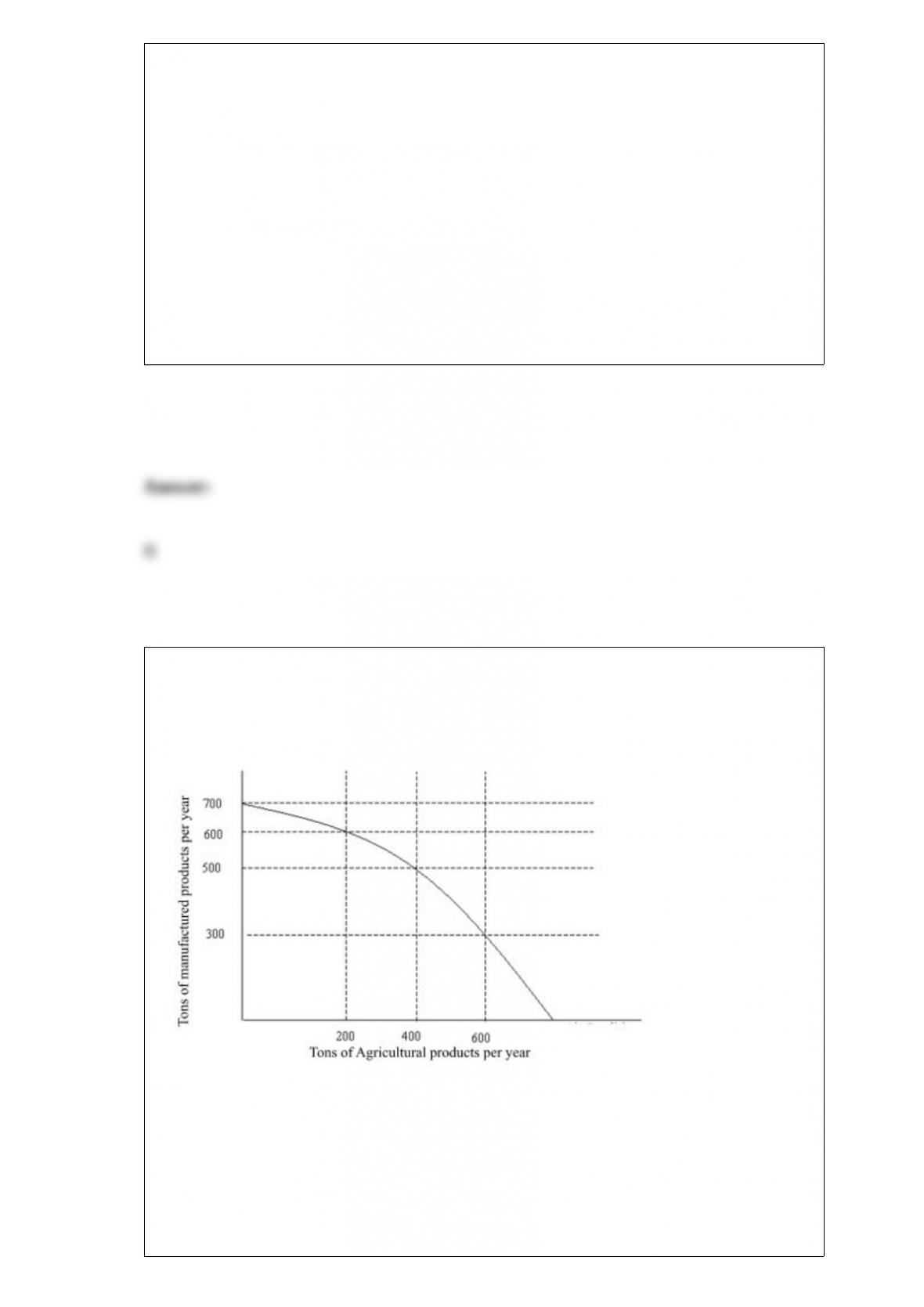
On the production possibilities curve in Figure 2.1 as agricultural production increases
by 200 tons per year from 200 tons to 400 tons and then to 600 tons, the opportunity
cost in terms of tons of manufacturing goods:
Figure 2.1
A) rises.
B) falls.

C) is constant.
D) becomes negative.
The Latin phrase ceteris paribus means that when a relationship between two variables
is being studied:
A) both are treated as unpredictable.
B) neither of those two variables is allowed to change.
C) all other variables are held fixed.
D) we recognize that some factors are unknown.
Which of the following statements is correct with respect to price elasticity of supply?
A) The price elasticity of supply tends to be greater as new firms can easily enter the
market.
B) The price elasticity of supply tends to be greater as expanding existing production
facilities is less costly.
C) The price elasticity of supply tends to be smaller as firms have limited production
facilities.
D) All of the above are correct.

Which of the following is NOT an advantage of a pollution tax?
A) It allows firms to equate its marginal abatement cost and the marginal benefit (tax
savings).
B) It allows a low-cost firm to abate more.
C) It provides firms an incentive to invest in pollution abatement technologies.
D) It allows us to predict the total volume of pollution that will be discharged.
A rich nation will trade with a poor nation because the:
A) rich nation has the absolute advantage in producing all products.
B) poor nation has the absolute advantage in producing all products.
C) poor nation has the comparative advantage in producing a product.
D) rich nation has the comparative advantage in producing all products.
Recall the Application. Suppose a firm that produces trampolines has a linear demand
curve for its product, with a vertical intercept of $1,500. If the firm initially charged a
price of $500 and then raised its price to $750, the firm’s total revenue would ________
and total cost would ________.
A) increase; increase
B) increase; decrease
C) decrease; increase
D) decrease; decease
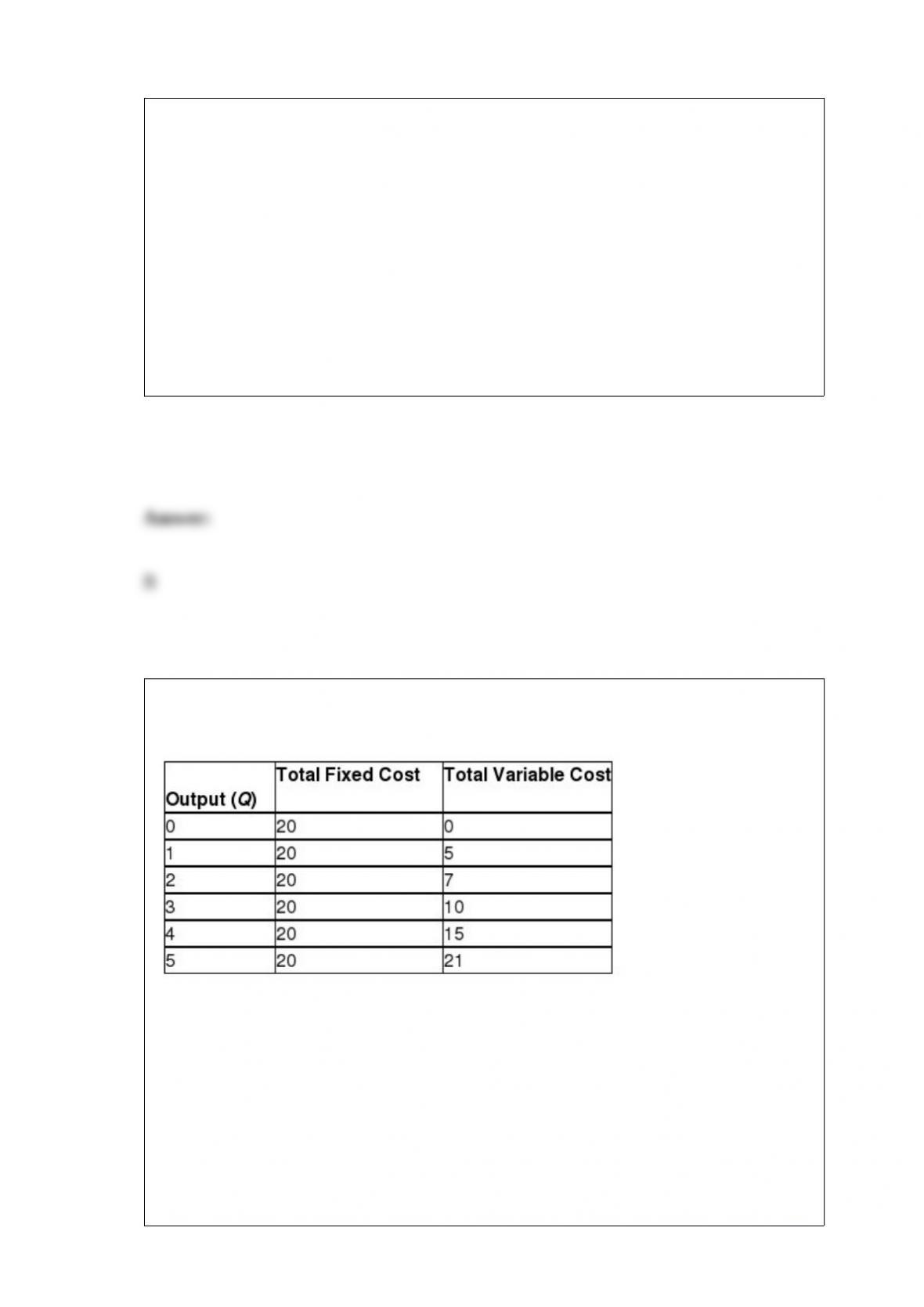
Table 9.1 shows the cost structure of a firm in a perfectly competitive market. If the
market price is $5:
Table 9.1
A) the firm suffers a loss but is better off producing at the output where MR = MC.
B) the firm suffers a loss and is better off shutting down.
C) the market price is lower than its marginal cost at the profit maximizing output level.
D) the market price is lower than the average variable cost at the profit maximizing
output level.

A demand curve is defined as the relationship between:
A) the price of a good and the quantity of that good that consumers are willing to buy.
B) the price of a good and the quantity of that good that producers are willing to sell.
C) the income of consumers and the quantity of a good that consumers are willing to
buy.
D) the income of consumers and the quantity of a good that producers are willing to
sell.
Recall the Application about why international trade may reduce measured
inequality in the United States to answer the following question(s). While it is
conventional wisdom now that inequality in the United States has increased in the
last several decades, until recently no one has taken a careful look at the actual
living standards of different income groups, taking into account the goods they
purchase. Two economists from the University of Chicago, Christian Broda and
John Romalis, investigated the living standards of low-income groups and
high-income groups based on the goods these groups purchase.
According to this Application, the poor consume ________ ratio of nondurable goods to
services ________.
A) a lower; than the rich
B) an equal; as the rich

C) a higher; than the rich
D) a negative; compared to the rich
The economic reason why you voluntarily pay tuition to get into the university/college
that you are in right now is because:
A) you believe the value of education is higher than the tuition costs.
B) the marginal benefit of education is positive.
C) the marginal benefit of money is zero.
D) you believe the value of education is lower than the tuition costs.
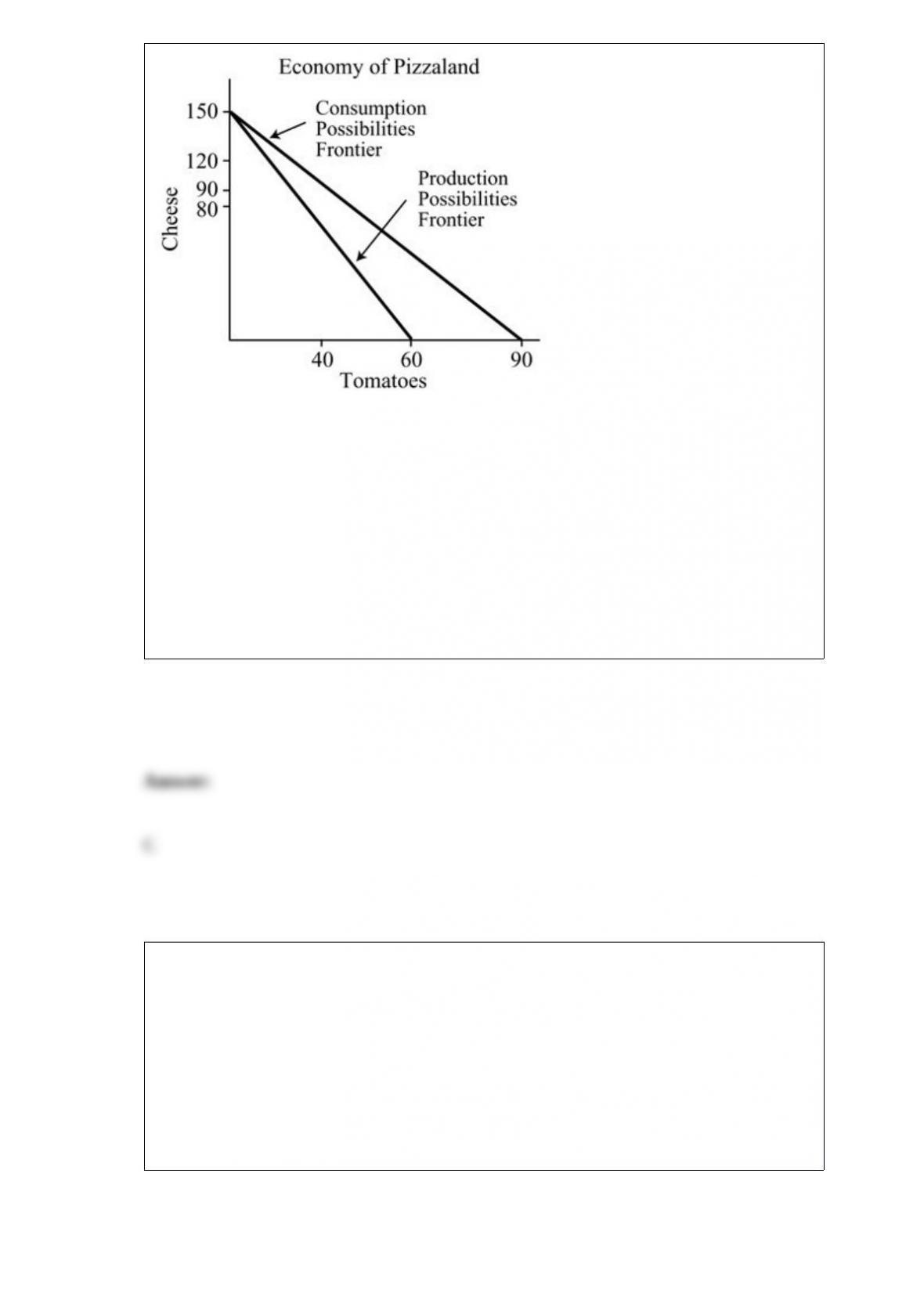
Figure 18.2
Refer to Figure 18.2. The terms of trade for Pizzaland is:
A) 1 tomato for .167 cheeses.
B) 1 tomato for .6 cheese.
C) 1 tomato for .4 cheese.
D) 1 tomato for 2.5 cheeses.
A firm’s short-run demand curve for labor is:
A) upward sloping.
B) the marginal revenue product curve.
C) the downward-sloping portion of the marginal cost curve.
D) the marginal cost divided by price.

A means tested government program is one that:
A) is pilot tested to see if it works.
B) provides assistance to those below a certain income level.
C) is temporary and ends after a short period of time.
D) all of the above
The marginal principle implies that an individual should produce or consume where:
A) marginal benefit exceeds marginal cost.
B) marginal benefit is less than marginal cost.
C) marginal benefit equals marginal cost.
D) total benefit equals total cost.

Recall the Application. If you spend the money to become a Dunkin’ Donuts franchise
and it is in a monopolistically competitive market, you would expect in the long run to:
A) earn positive economic profits.
B) earn zero economic profits.
C) suffer losses because people are eating healthier.
D) earn monopoly profits.
According to this Application, while inequality has increased in the United States in the
last several decades, the study done by Broda and Romalis indicates that:
A) living standards have not become more unequal.
B) living standards have become even more unequal.
C) there is now no noticeable difference in living standards between income groups.
D) living standards have not noticeably changed over the past several decades.
Table 14.1 represents 3 markets for used computers. Which of the markets in Table 14.1
are in equilibrium?
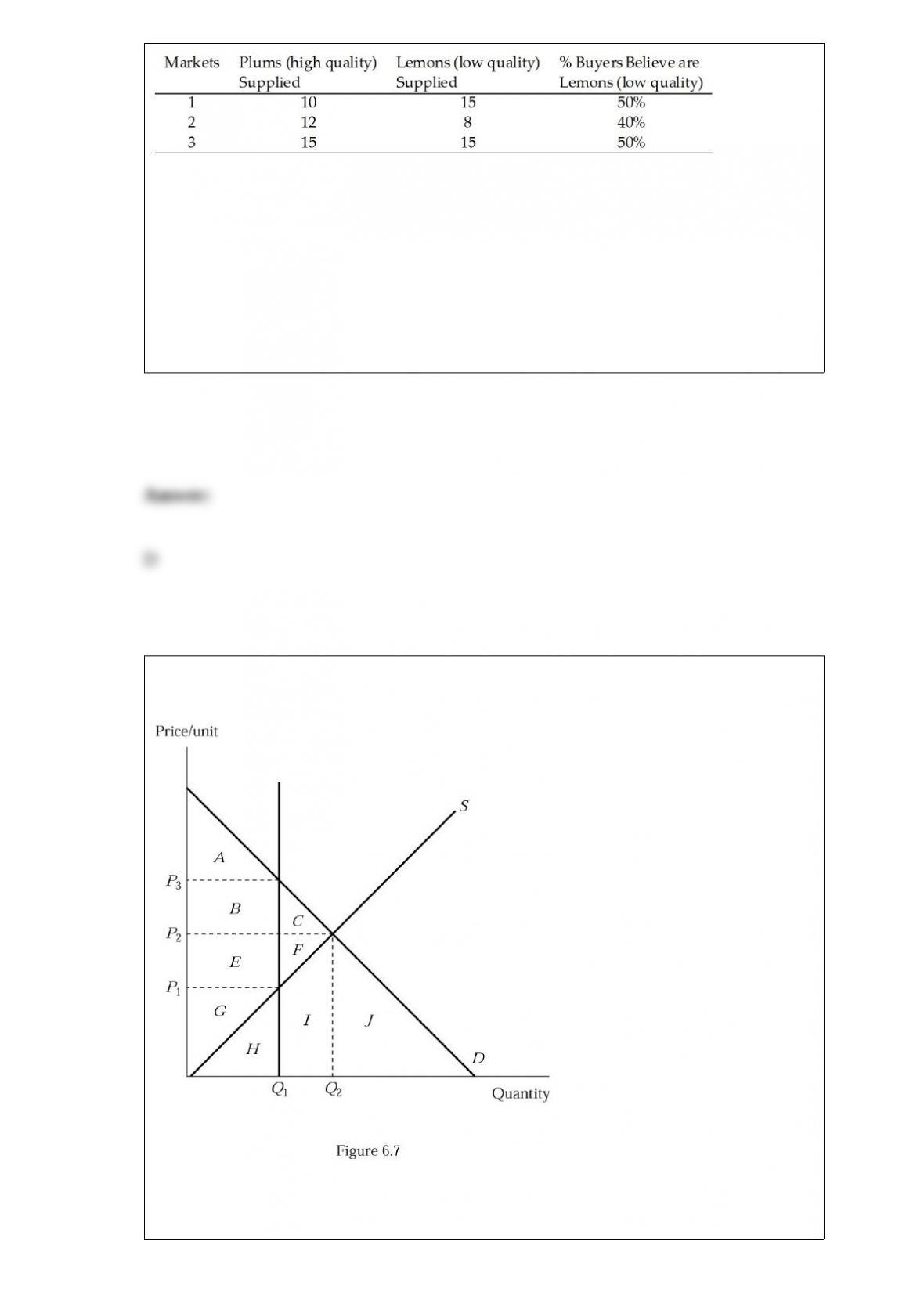
Table 14.1
A) 1 only
B) 2 only
C) 3 only
D) 2 and 3
In Figure 6.7 at equilibrium, producer surplus is area:
A) A.

B) A + B + C.
C) E + F + G.
D) G.
Suppose a tax is imposed on energy drinks that have a price elasticity of demand equal
to 2, and a price elasticity of supply equal to 1. We would expect that:
A) the producers of energy drinks containing sugar would pay a larger portion of the
tax.
B) the consumer would pay a larger portion of the tax.
C) the consumer would pay the entire tax.
D) the producers of energy drinks containing sugar would pay the entire tax.
An unemployed individual decides to spend the day fishing. The opportunity cost of
fishing is equal to:
A) the cost of bait and any other monetary expenses.
B) zero, because the person doesn’t have a job.
C) the value of the individual’s wages while he was working.

D) the cost of bait, any other monetary expenses, and the value of the best alternative
use of the individual’s time.
The argument that calls for the trade protection of only newly developing industries is
known as the ________ argument.
A) learning by doing
B) predatory dumping
C) infant industry
D) developing nation
When compared to the profit maximizing price and quantity supplied, an average-cost
pricing policy for a natural monopoly causes the price the monopolist charges to
________ and the quantity it sells to ________.
A) increase; decrease
B) decrease; decrease
C) decrease; increase
D) increase; increase

If the demand for new cars is elastic, an increase in price will result in:
A) an increase in profits.
B) an increase in total revenue.
C) a decrease in total revenue.
D) an increase in the quantity demanded.
If a firm can maximize its profit by producing the output where price is equal to its
marginal cost, the firm is operating in:
A) a perfectly competitive market.
B) an oligopolistic market.
C) a monopolistic market.
D) a monopolistically competitive market.
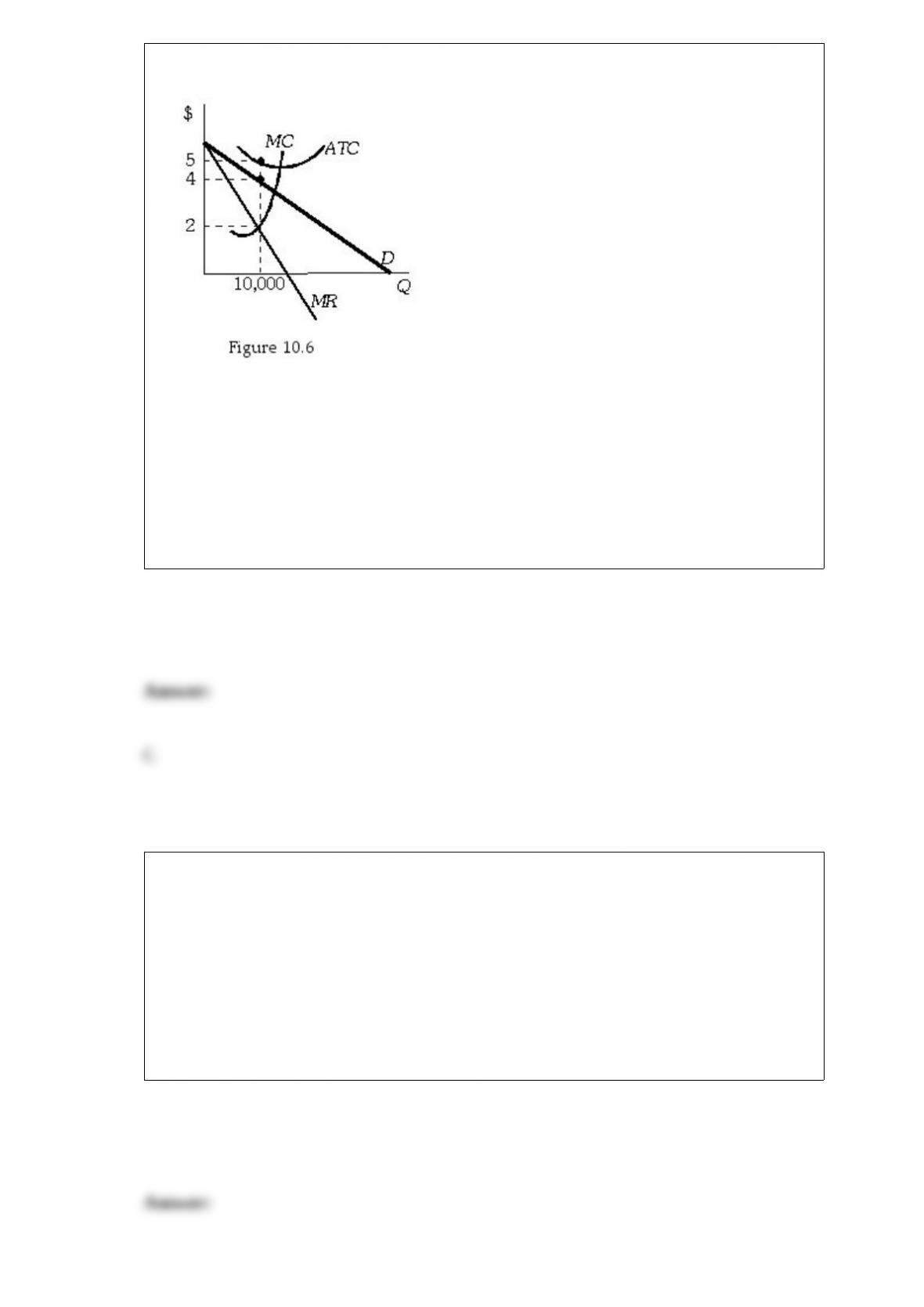
Refer to Figure 10.6. At the profit-maximizing level of output, total revenue:
A) is $10,000.
B) is $20,000.
C) is $40,000.
D) is $50,000.
If demand is perfectly elastic, the price elasticity of demand is equal to:
A) 1.
B) 0.
C) infinity.
D) a positive number between 0 and infinity.

The effect of spreading out the fixed costs outweighing the effect of diminishing returns
is illustrated by the ________ average cost curve ________.
A) long-run; decreasing
B) long-run; increasing
C) short-run; decreasing
D) short-run; increasing
On any given day, Disney World can price discriminate and charge local visitors a
________ price for a ticket than out of state visitors because local visitors have a more
________ demand.
A) lower; inelastic
B) lower; elastic
C) higher; inelastic
D) higher; elastic

Recall the application on rent control and mismatches. Under rent control, the
government sets a maximum price for housing, decreasing the quantity supplied and the
total value of the market. Rent control and other maximum prices cause ________
possibly ________.
A) inefficiency; mismatches.
B) efficiency: mismatches
C) mismatches: equilibrium
D) none of the above