1) Suppose a technological improvement increases the productivity of a firm’s capital
and, simultaneously, its workers’ union negotiates a wage increase. We can predict that:
A.the firm will use relatively more capital and relatively less labor.
B.the firm will use relatively more labor and relatively less capital.
C.inputs of capital and labor will be unchanged.
D.the firm’s equilibrium output will necessarily increase.
2) other things equal, in which of the following instances would the increase in labor
productivity be the greatest?
a.the stock of real capital and inputs of labor increase proportionately
b.the increase in the stock of real capital exceeds the increase in inputs of labor
c.the increase in inputs of labor exceeds the increase in the stock of real capital
d.inputs of labor increase and the stock of real capital remains constant
3)
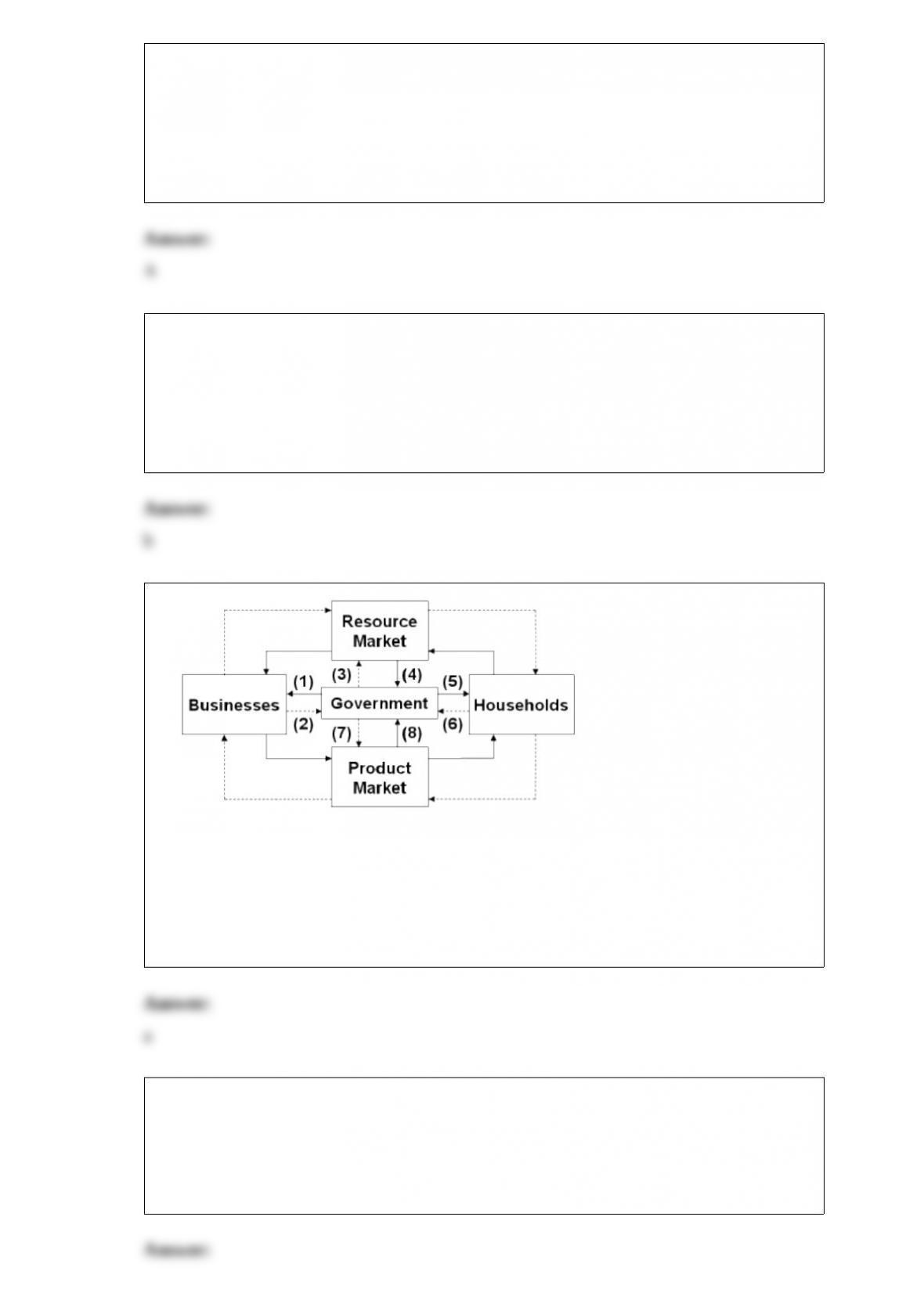
refer to the above diagram, in which solid arrows reflect real flows; broken arrows are
monetary flows. flow (3) might represent:
a.government salaries paid to school teachers.
b.property tax payments.
c.a state university’s purchase of computers.
d.social security payments to retirees.
4) Which of the following would increase GDP by the greatest amount?
A.a $20 billion reduction in taxes
B.$20 billion increases in both government spending and taxes
C.$20 billion decreases in both government spending and taxes
D.a $20 billion increase in government spending
5) Data on education and earnings reveal:
A.negative age-earnings profiles for male workers.
B.no relationship between the two.
C.a positive relationship between the two.
D.a negative relationship between the two.
6)
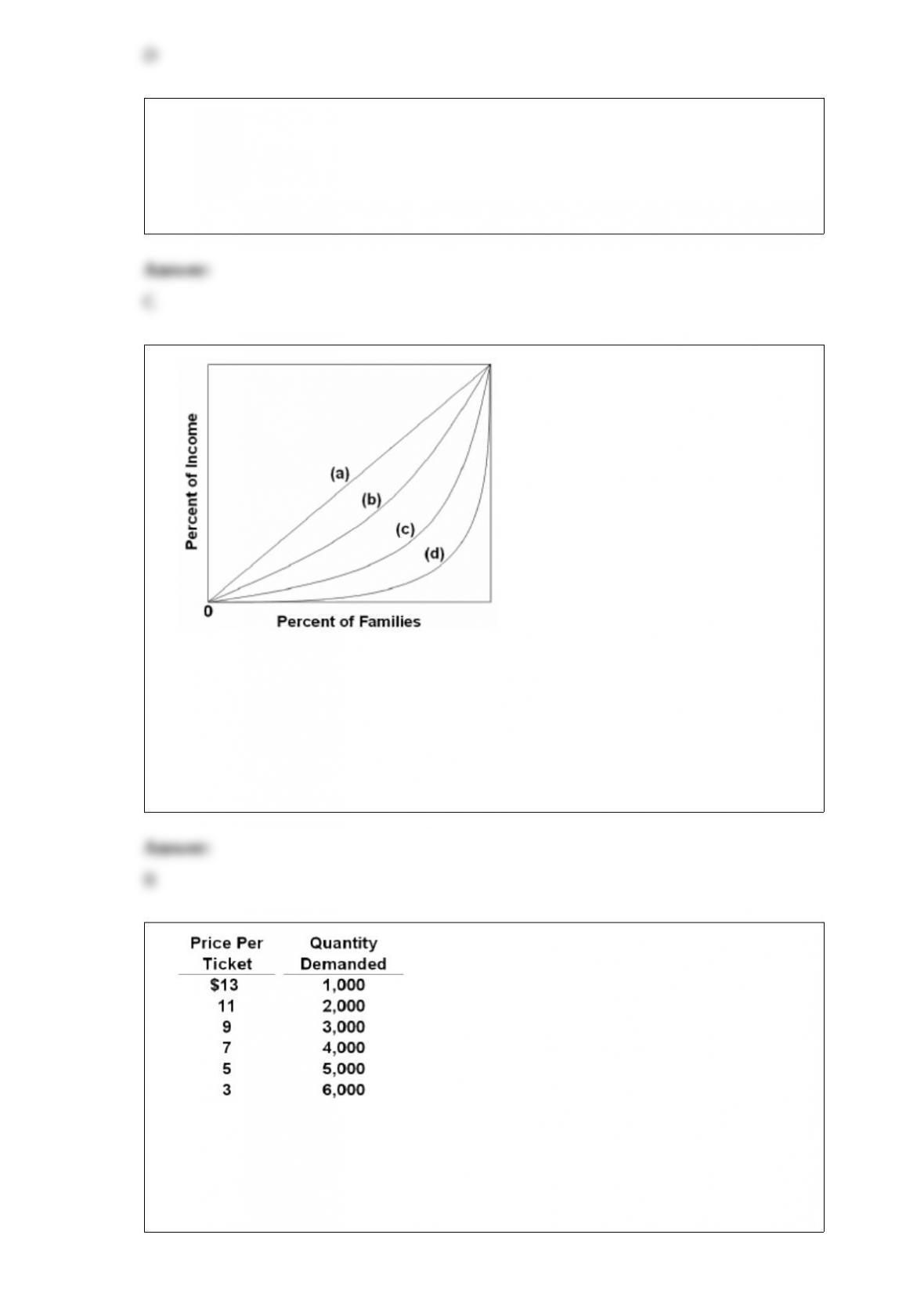
Refer to the above diagram. If line c represents the distribution of income before taxes
and transfers and line b represents the distribution after taxes and transfers, then taxes
and transfers have:
A.added to income inequality.
B.decreased the Gini ratio.
C.increased poverty.
D.reduced real GDP per person.
7)
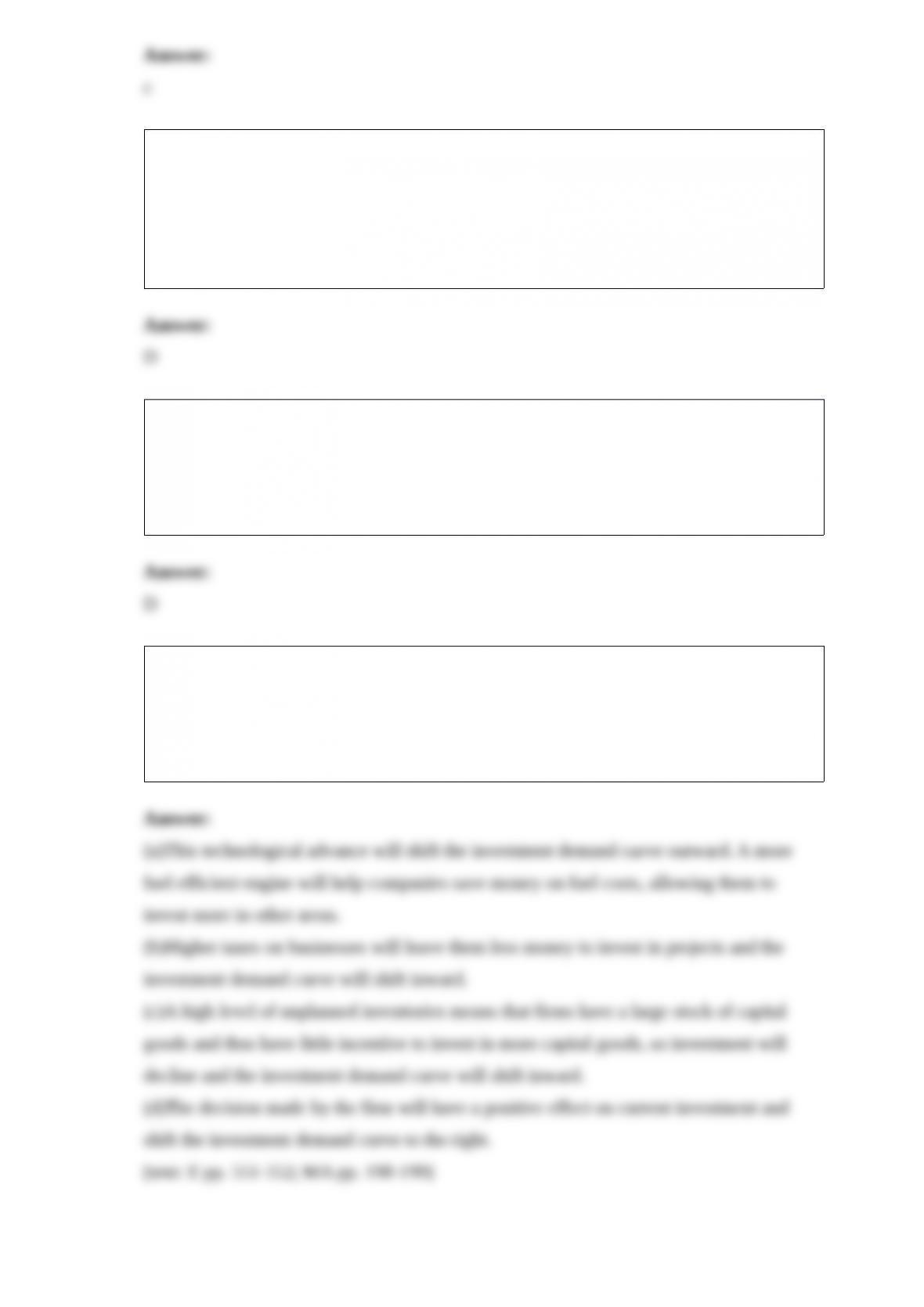
refer to the above information. over the $9-$7 price range, demand is:
a.perfectly elastic.
b.perfectly inelastic.
c.elastic.
d.inelastic.
8) Suppose the MRP of a firm’s twelfth worker is $22 and the worker’s marginal wage
cost is $16. We can say with certainty that the firm:
A.is hiring labor in a competitive labor market at a wage rate of $16.
B.is hiring labor in a monopsonistic labor market.
C.will find it profitable to hire fewer workers.
D.will find it profitable to hire more workers.
9) Free trade based on comparative advantage is economically beneficial because:
A.it promotes an efficient allocation of world resources.
B.it increases competition.
C.it provides consumers with a wider range of products.
D.of all of these reasons.
10) How will the following situations affect the investment demand curve?
(a)A new type of engine is developed that is more fuel efficient.
(b)To lessen the fiscal deficit, Congress increases corporate taxes.
(c)Unplanned inventories rise to new highs.
(d)A firm decides to increase its current inventory levels.
11) If the MPC in an economy is .8, government could shift the aggregate demand
curve rightward by $100 billion by:
A.increasing government spending by $25 billion.
B.increasing government spending by $80 billion.
C.decreasing taxes by $25 billion.
D.decreasing taxes by $100 billion.
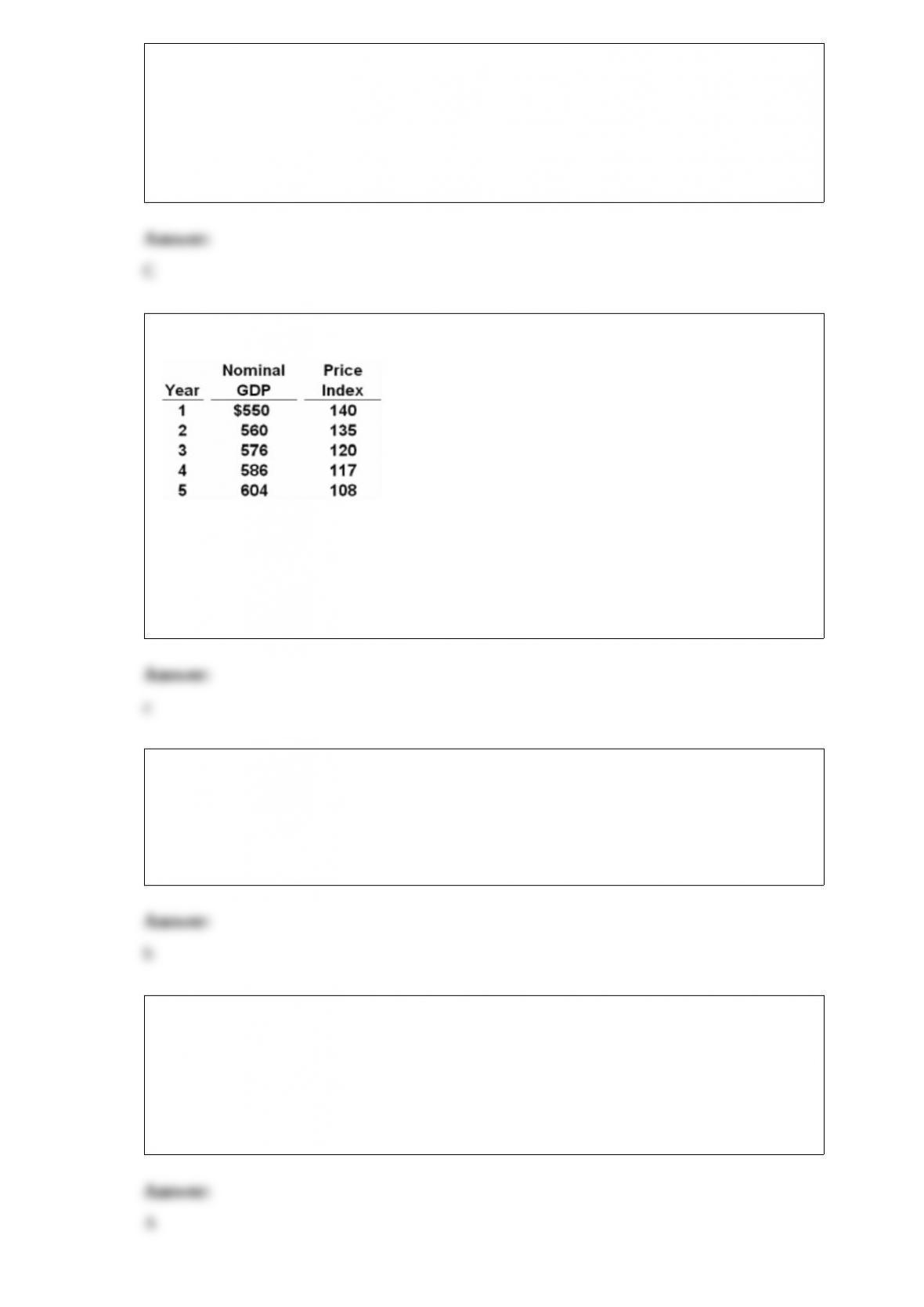
12) answer the next question(s) on the basis of the following information:
in the economy above, real gdp for year 3 is:
a.$512.
b.$428.
c.$480.
d.$691.
13) with respect to the pure monopolist’s demand curve it can be said that:
a.the stronger the barriers to entry, the more elastic is the monopolist’s demand curve.
b.price exceeds marginal revenue at all outputs greater than 1.
c.demand is perfectly inelastic.
d.marginal revenue equals price at all outputs.
14) A company’s extraction cost curve slopes upward to reflect:
A.that marginal extraction costs increase as the company extracts more of the resource.
B.that user costs rise as the company extracts more of the resource.
C.that the price of the non-renewable resource increases as the amount extracted
increases.
D.all of these.
15) if profits are maximized (or losses minimized), which of the following conditions
are common to both unregulated monopoly and to pure competition?
a.mc = p
b.mc = atc
c.mr = mc
d.p = mr
16) a country can achieve some combination of goods outside its production
possibilities curve by:
a.idling some of its resources.
b.specializing and engaging in international trade.
c.buying the debt (bonds and stocks) of foreign nations.
d.producing more capital goods and fewer consumer goods.
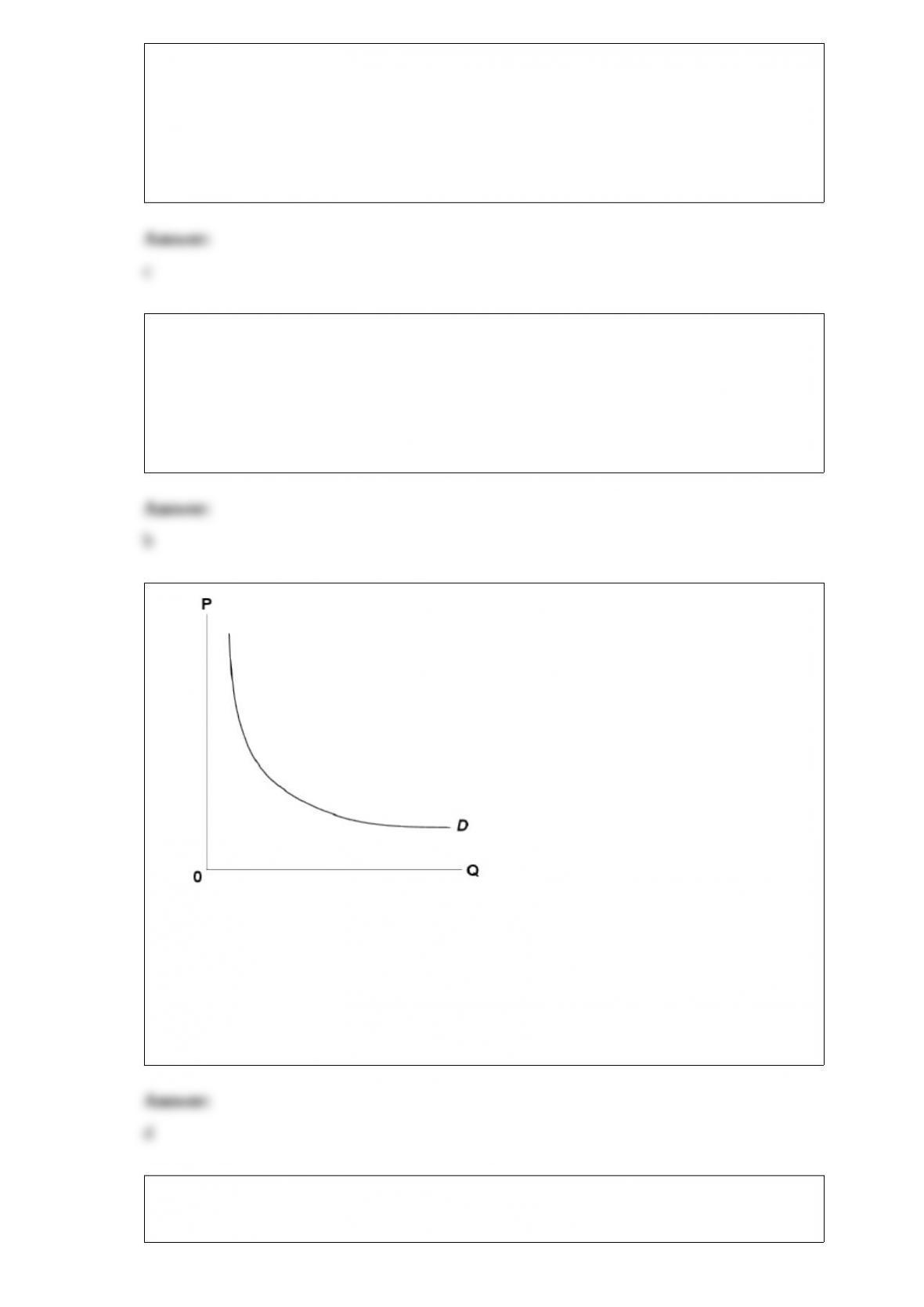
17)
refer to the above diagram which is a rectangular hyperbola, that is, a curve such that
each rectangle drawn from any point on the curve will be of identical area. if this
rectangular hyperbola was a demand curve, we could say that it would be:
a.elastic at high prices and inelastic at low prices.
b.elastic at low prices and inelastic at high prices.
c.impossible to generalize about its elasticity.
d.of unit elasticity throughout.
18) The following data for the hypothetical nations of Alpha and Beta. Qs is domestic
quantity supplied and Qd is domestic quantity demanded.
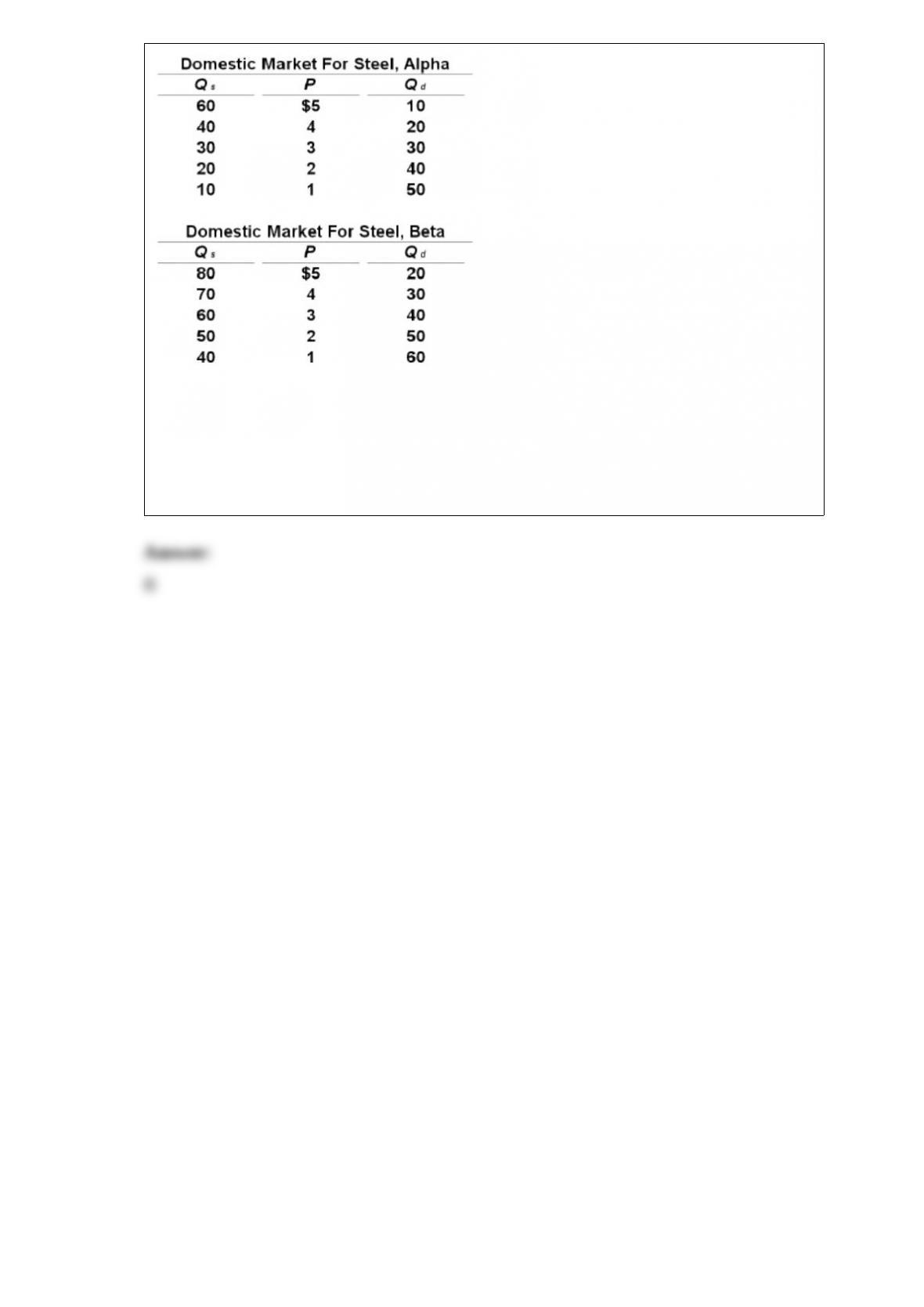
Refer to the above data. The equilibrium world price must be lower than $4 because at
$4:
A.both nations want to import steel.
B.both nations want to export steel.
C.Beta wants to export more than Alpha.
D.Alpha wants to import more than Beta.