A fixed exchange rate
a. is a declared rate that is maintained by central bank intervention in the foreign
exchange market
b. is a rate that is fixed by the forces of supply and demand
c. is a rate that is determined by trilateral arbitrage
d. “fixes” the value of a nation’s price level
e. is a mechanism for eliminating a trade deficit
If a firm produces in a perfectly competitive output market,
A less developed country can increase its capital stock by
a. raising taxes on purchases of capital goods
b. temporarily accepting unusually high unemployment rates
c. reducing government spending
d. shifting resources away from production of consumer goods and toward production
of capital goods
e. providing more opportunities for individuals to spend their accumulated savings
Inflation will generally redistribute purchasing power when
a. it is fully expected
b. it is completely unexpected
c. it is greater than 3 percent
d. it is greater than 5 percent
e. it is greater than 10 percent
An increase in government spending will increase the government budget deficit, which
tends to increase interest rates, increase saving, crowd out private investment, stimulate
capital formation, and slow the level of economic activity.
Figure 5-1 shows the prices of two services offered by Earl’s Barber Shop and the
resulting quantities demanded by customers. Suppose that the current price for a haircut
is $20 and the current price for a manicure is $12, and Earl has a sale of $4 off the price
of either a haircut or a manicure. In this example,
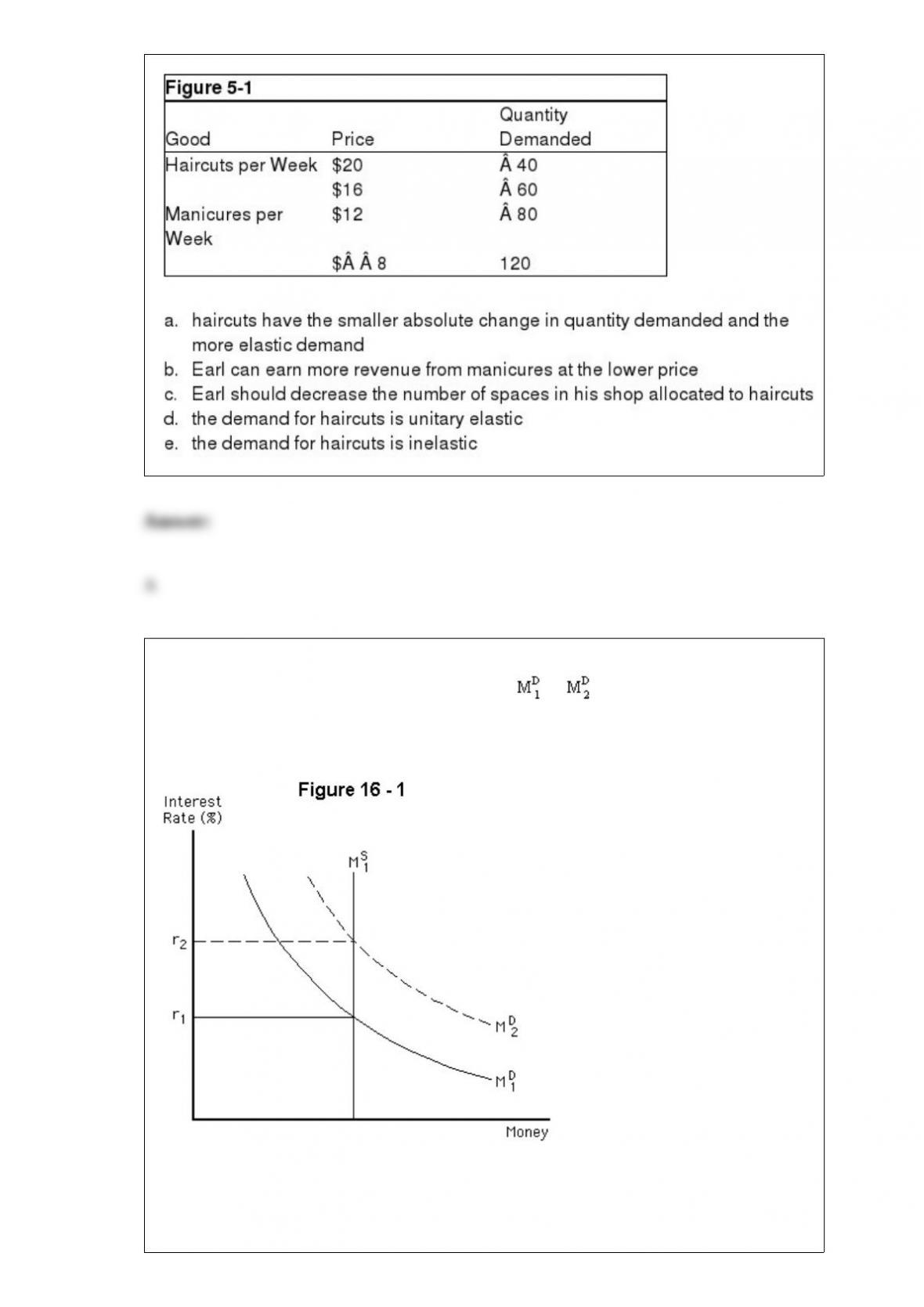
Refer to Figure 16-1. Suppose a demand shock causes output to rise above full
employment and increases money demand from to . If the Fed wants to maintain
the interest rate at r1, it will
a. use a constant monetary supply policy
b. increase the money supply, which will increase aggregate demand and increase
output further in the short run
c. increase the money supply, which will increase the price level, decrease aggregate
demand, and lower output back to full employment
d. decrease money demand, decrease the interest rate, and decrease aggregate demand
until output returns to full employment
e. be unable to meet its interest rate target without causing a recession
U.S. imports of sugar
a. have been illegal since the mid-1980s
b. harm U.S. sugar producers
c. increase the U.S. government’s revenue
d. are restricted by tariffs
e. are restricted by import quotas
Which of the following would be most likely to encourage households to save a greater
proportion of their income?
a. a reduction in the sales tax rate
b. an increase in the capital gains tax rate
c. an elimination of tariffs (taxes on imported goods)
d. changing to a flat income tax (with a single tax rate charged on all income)
e. changing from an income tax to a consumption tax
If firms make agreements that reduce the amount of competition in a market,