
1) refer to above data. marginal utility becomes negative beginning with the:
a.first unit.
b.second unit.
c.third unit.
d.fourth unit.
2) skeptics of the recent productivity acceleration say that:
a.it is too early to predict whether recent boosts in u.s. productivity are permanent or
transitory.
b.global capitalism is a media fiction, not an economic reality.
c.the growth of service productivity is severely understated.
d. many of the factors that slowed productivity in the 1973-1995 period have now
reversed themselves.
3) A firm operating in a purely competitive resource market faces a resource supply
curve that is:
A.perfectly inelastic.
B.perfectly elastic.
C.highly inelastic.
D.highly elastic.
4) The equations for the demand and supply curves for a particular product are P = 10
.4Q and P = 2 + .4Q, where P is price and Q is quantity expressed in units of 100. After
an excise tax is imposed on the product the supply equation is P = 3 + .4Q.
Refer to the above information. Government’s revenue from this tax is:
A.$750.
B.$1,500.
C.$875.
D.$800.
5) Over recent years, economists holding monetarist views have replaced their call for a
monetary rule with a call for:
A.artful Fed management of interest rates.
B.inflation targeting.
C.nominal GDP targeting.
D.inflationary and recessionary gap analysis.
6) The World Bank:
A.is also known as the International Monetary Fund (IMF).
B.lends money to developing nations for basic infrastructure projects such as dams,
irrigation, health and sanitation, communications, and transportation.
C.is an affiliate of the World Trade Organization (WTO).
D.provides subsidies to private firms so they can improve their wages and working
conditions.
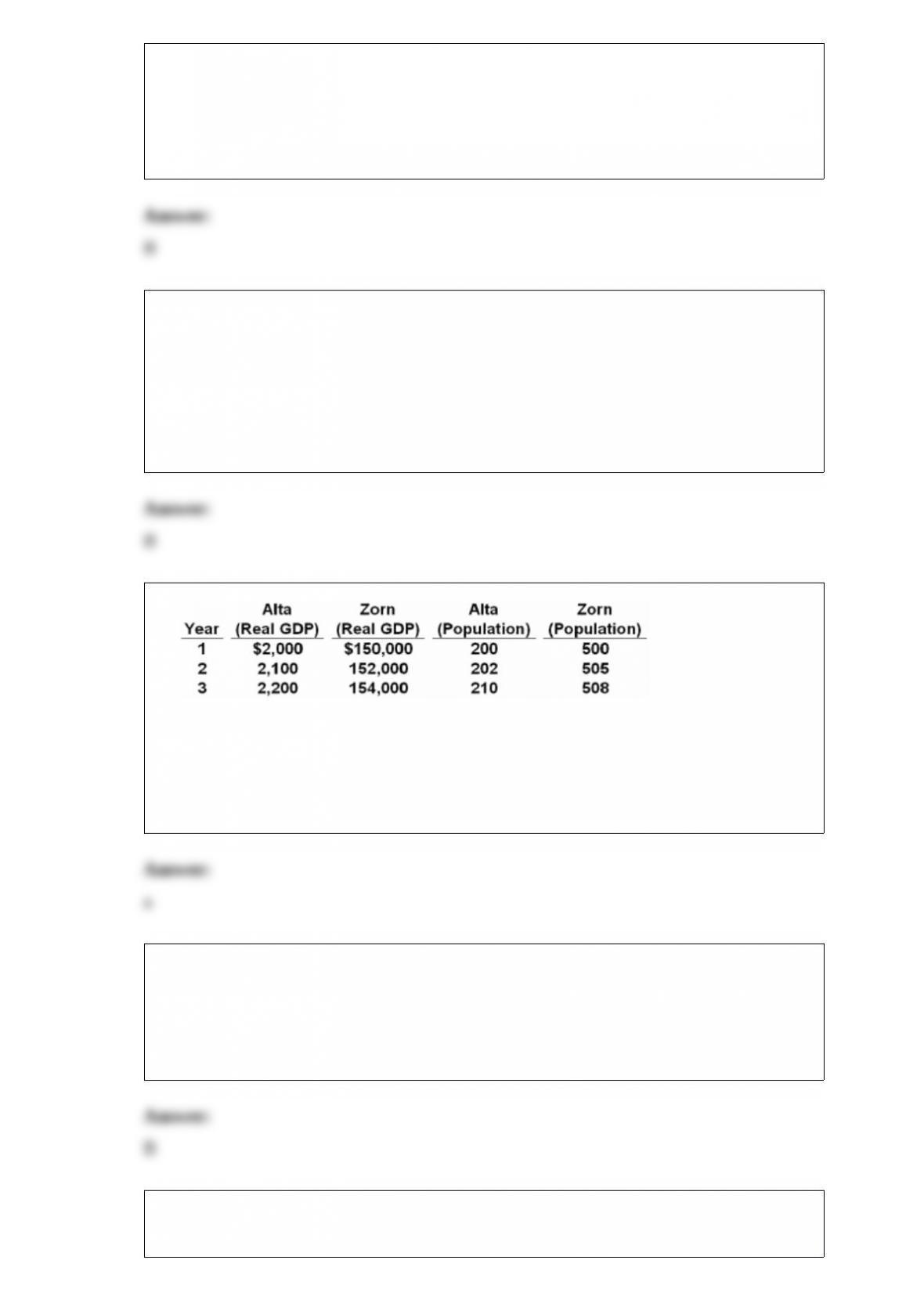
7)
refer to the above table. between years 2 and 3:
a.alta’s real gdp grew more rapidly than zorn’s real gdp.
b.real gdp fell in zorn.
c.population growth reduced alta’s real gdp growth to zero.
d.population fell in alta.
8) A resource’s present value is:
A.greater than its value in the future.
B.less than its value in the future.
C.is the same as its value in the future.
D.should be extracted as slowly as possible.
9) Suppose that a union successfully negotiated a 10 percent wage increase and the
quantity of labor demanded decreased by 10 percent. Given a fixed labor demand curve,
we can conclude that:
A.the labor demand curve is upward sloping.
B.labor demand is elastic.
C.labor demand is unit-elastic.
D.the coefficient of elasticity of labor demand is less than 1.
10) which of the following statements is not correct?
a.if the relative change in price is greater than the relative change in the quantity
demanded associated with it, demand is inelastic.
b.in the range of prices in which demand is elastic, total revenue will diminish as price
decreases.
c.total revenue will not change if price varies within a range where the elasticity
coefficient is unity.
d.demand tends to be elastic at high prices and inelastic at low prices.
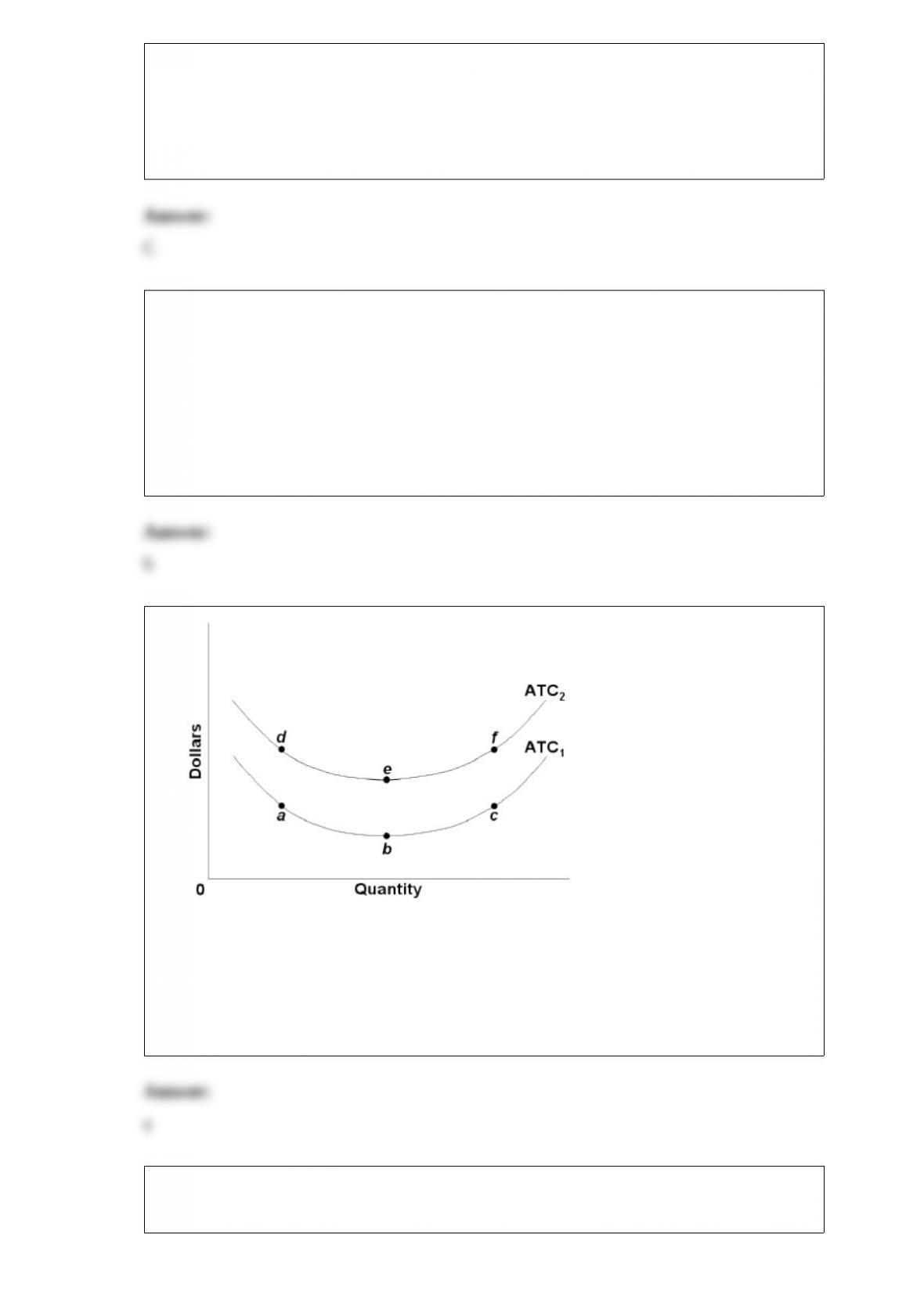
11)
refer to the above graph. which one of the following would cause a move from point b
to point c along short-run average total cost curve atc1?
a.diminishing marginal returns
b.an increase in the wage rate
c.a decrease in the wage rate
d.increasing marginal returns
12) (Consider This) What product did the Roman citizen Erasmo (c. 130 A.D.) produce
and how did he maintain his trade secret?

13) the fundamental problem associated with the u.s. health care system is that:
a.the financing of health care through insurance has resulted in the underallocation of
resources to the health care industry.
b.frivolous malpractice suits have increased malpractice insurance premiums for
doctors.
c.at the margin the value of health care services may be less than the value of
alternative goods and services.
d.there are too many general practitioners and not enough specialists.
14) an increase in demand means that:
a.given supply, the price of the product will decline.
b.the demand curve has shifted to the right.
c.price has declined and consumers therefore want to purchase more of the product.
d.the demand curve has shifted to the left.
15) In deciding on an optimal amount and type of research and development, firms
should adhere to the rule: Expand R&D until:
A.expected rate of return is zero.
B.expected rate of return equals the interest rate.
C.expected rate of return exceeds the interest rate by the greatest amount.
D.the interest rate is constant.