
Suppose the required reserve ratio is 10 percent, but banks choose to hold an additional
15 percent of demand deposits as excess reserves. Under these conditions, the demand
deposit multiplier will be
a. 0
b. 4
c. 5
d. 6.67
e. 10
Inflation has never been a major problem in the U.S.
If the Federal Reserve wishes to increase the money supply by $30,000 and the reserve
requirement ratio is 0.4, how big a purchase of bonds will the Fed need to make?
a. $75,000
b. $12,000
c. $1,000
d. $30,000
e. $3,000
Which of the following is not considered a barrier to entry?
If Country A exports a good to Country B, who is made worse off?
a. The producers in Country A and the consumers in Country B
b. The consumers in Country A and the consumers in Country B
c. The producers in Country A and the producers in Country B
d. The consumers in Country A and the producers in Country B
e. Only the consumers in Country A will be worse off from this trade agreement

The opportunity cost of holding money is
a. the dollar cost necessary to change other assets into money
b. the time cost of accessing funds
c. the value of the goods and services a person is able to obtain with the money
d. the interest a person could have earned by holding other forms of wealth instead
e. zero, because opportunity costs only apply to real assets, goods and services
The federal funds rate is the rate at which
a. banks loan money to the Fed
b. the Fed loans money to banks
c. one regional Federal Reserve bank loans money to another regional Federal Reserve
bank
d. one bank loans money to another.
e. regional Federal Reserve banks loan money to a local bank.
Which of the following could explain a leftward shift of the labor demand curve?
a. Firms are unable to sell all the output they produce.
b. Workers have become less productive.
c. Workers have become more productive.
d. Both (a) and (b) are correct.
e. The demand curve for the product that firms sell shifts to the right.
In the short run,
a. the labor market is always in equilibrium
b. actual output can deviate from potential output
c. crowding out is always complete
d. total output is independent of spending
e. spending is independent of total income
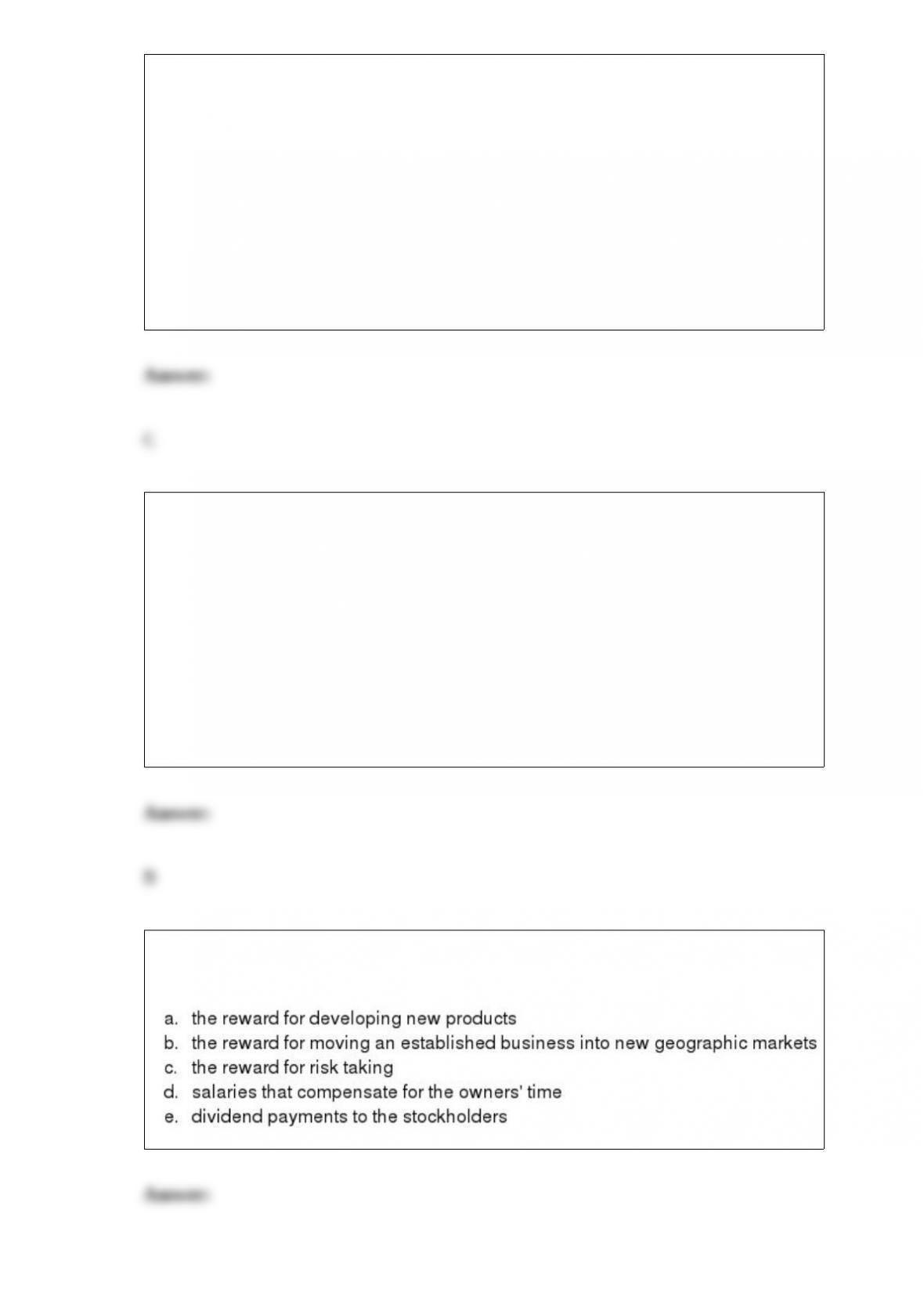
Using the table below, calculate GDP:
a. $2,600
b. $1,800

c. $4,800
d. $2,200
e. $2,500
If consumption expenditures increased by $150 million, while GDP remained the same,
which of the following could have occurred, all else equal?
a. Exports increased by $150 million
b. Imports decreased by $150 million
c. Net exports increased by $150 million
d. Net exports decreased by $150 million
e. Private investment increased by $150 million
A negative demand shock
a. shifts the AD curve to the right
b. decreases real GDP and increases the price level in the short run
c. is the result of an increase in money demand
d. results in a movement down and to the right along the AD curve
e. decreases both real GDP and the price level in the short run
If the expenditure multiplier is 6.5, the tax multiplier is
a. 7.5
b. 5.5
c. -5.5
d. -6.5
e. -7.5
The aggregate demand curve
a. is a horizontal line if the economy is perfectly competitive
b. depicts the economy’s equilibrium output level at each possible price level
c. depicts the economy’s equilibrium output at each possible interest rate
d. shifts whenever the price level changes
e. can slope upward if the Fed changes the money supply
All of the following, except one, are included in the profit earned by a firm’s owners.
Which is the exception?
The Bureau of Economic Analysis estimates the size of the underground economy but
many economists believe that the estimates are too low.
If the inflation rate is higher than expected, real income is redistributed from lenders to
borrowers.
A decrease in government spending would cause all but one of the following to happen.
Which is the exception?
a. The government’s budget deficit would shrink.
b. The interest rate would decrease.
c. Consumption spending would increase.
d. Investment spending would increase.

e. Total output would decrease.
The reason the short-run macro model suggests that the economy can operate either
above or below its potential while in the long-run classical model the economy operates
automatically at full employment is that
a. the short-run macro model is flawed and inaccurate
b. the classical model is flawed and inaccurate
c. the two models measure completely different aspects of the economy
d. in the short run, spending affects output, but not in the long run
e. in the short run the role of government in helping the economy return to equilibrium
is not considered
Why is inflation considered a problem?
a. Firms gain too much economic power.
b. It is always very high when it exists.
c. People prefer falling prices.
d. It is costly for society.
e. Government gains too much economic power..